


I came to Thessaly with a simple plan: see Meteora, eat well, then push on. What happened instead was a string of stops that kept rewriting my itinerary in real time. Thessaly is one of those Greek regions where the distances look small on a map, but the variety is huge once you start driving: sandstone pillars and cliff-top monasteries, port-city food rituals, mountain villages with plane trees and cobbled lanes, and a man-made lake that feels like a Scandinavian postcard dropped into central Greece.
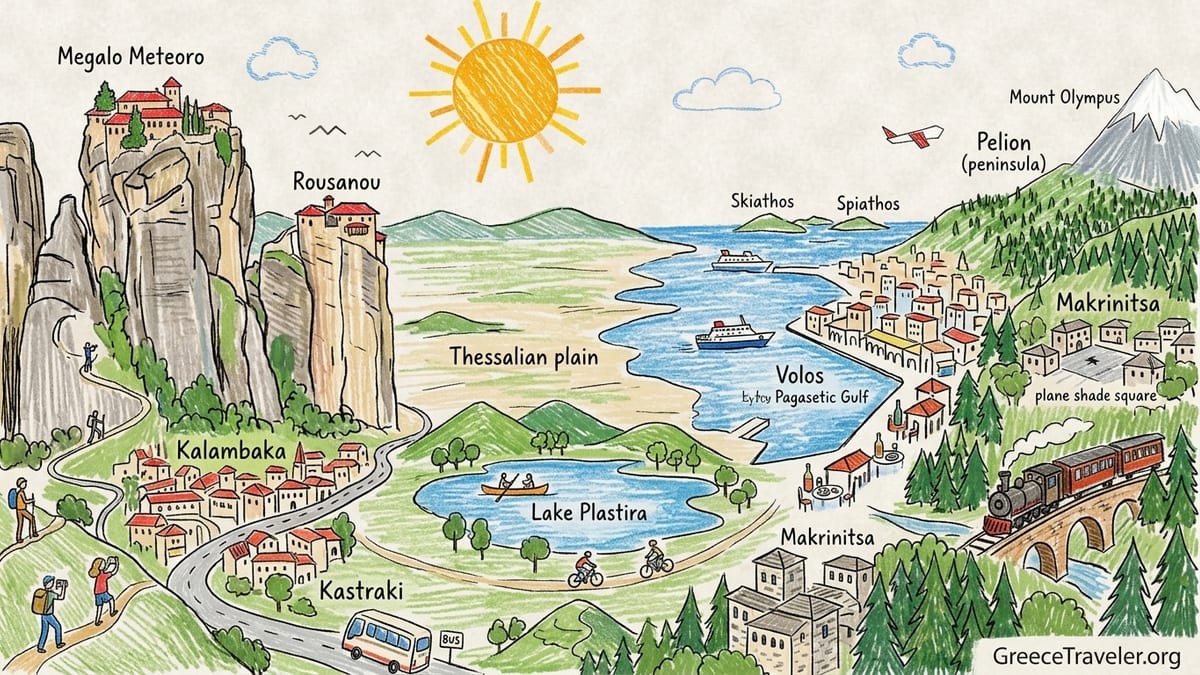
Meteora and Kalambaka: The moment Thessaly stopped being a drive-through
I arrived in Kalambaka by road, with the last stretch flattening into the Thessalian plain before the rock pillars appear almost abruptly, like a set piece. It is hard to describe the first sight of Meteora without sounding dramatic, but the scale is genuinely disorienting. What I remember most is the light: late afternoon sun turning the rock faces warm, and then the shadow lines getting sharper as cars pulled into viewpoints.
If I were choosing accommodation again, I would still base myself either in Kalambaka for convenience or in nearby Kastraki for the feeling of sleeping under the rocks. This is the kind of stop where your hotel location changes your whole day: Kastraki makes early starts easier, while Kalambaka gives you more dinner options and an easier walk to bus stops and shops. Either way, I would book two nights minimum, because trying to do Meteora as a rushed day trip is how you end up seeing only crowds, staircases, and gift shops.
The practical detail that shaped my whole approach: there is no combined ticket, and each monastery charges its own admission at the gate. The going rate is €5 per monastery, and you should plan to pay in cash in euros. Once I accepted that reality, my strategy became simple: pick the monasteries that fit my energy level, then start early. The six active monasteries rotate closing days, so you cannot assume your top choice will be open on the day you arrive. On weekends, the odds improve because all six are typically open, but midweek planning matters.
The experience that changed my opinion was how different Meteora feels at different hours. In the late morning, the road between viewpoints can feel like a slow parade of tour buses and rental cars. But in the first opening hour, it is quieter, cooler, and more contemplative. The landscape itself becomes the main event again. If I had to allocate time now, I would give Meteora one full day for monastery interiors and viewpoints, plus a second half-day for a slower pace: a long walk from Kastraki, a lingering coffee, and a sunset stop without forcing myself to squeeze in “one more monastery.” This stop suits history lovers, couples, photographers, and road trippers. Families can do it too, but I would plan fewer monasteries and more viewpoints, because stairs are non-negotiable at most entrances.
Getting around Meteora right now: driving, walking, and the bus option
My first instinct was to drive everywhere, and yes, the roads up to the monasteries are paved and straightforward. The catch is congestion: when the tour groups arrive, the same narrow stretches that felt effortless at 8:30 a.m. can become a stop-and-go line by midday. Parking can also turn into a game of patience. If I were doing it again in peak season, I would either commit to an early start with a car, or commit to leaving the car parked and using the local bus at least once.
There is a practical bus solution for travelers without a car, and even for travelers with one who want a lower-stress day. A local Meteora bus runs daily from the KTEL station in Kalambaka, commonly with departures around 09:00 and 12:30, and it follows a loop that hits Kastraki and the monasteries. For short hops, there are also KTEL connections between Kalambaka and Kastraki with low-cost fares listed around €1.50 for the quick ride. I like knowing these exist because it changes the pressure of driving and parking, especially if you want to walk one direction and ride back.
Walking is the sleeper highlight here. Kastraki has trail connections into the rock formations, and even a simple walk between viewpoints changes the mood of the whole visit. On foot, you notice the smell of pines, the sound of cicadas, the way the rocks frame small chapels and terraces. The trade-off is heat and elevation. I would not recommend long uphill walks at midday in July or August unless you are used to it and carrying enough water.
My updated “how much time” advice is blunt: if you have only one day total, pick two or three monasteries and do them well, then do viewpoints and a good meal. If you have two days, you can add more walking, an unrushed sunset, and a more thoughtful route based on what is open. This is especially useful for slow travelers: Meteora can be meditative, but only if you give it the time to breathe.
Volos: Where the trip turned delicious (and social)
Volos was not supposed to be a highlight for me. It was a functional stop, a city between places: close to Pelion, with a port and practical roads. Then I sat down at a tsipouradiko and realized Volos is not just a base, it is a ritual. The local culture revolves around tsipouro served in small bottles, with meze arriving in a sequence that you do not fully control. One “round” becomes a conversation, and the table keeps changing as new plates appear.
My most vivid meal memory in Thessaly is from Volos: the rhythm of ordering, the little bottles arriving, and seafood meze following in a rough progression. Some places publish example pricing that helps you understand what you are committing to. At one well-known tsipouradiko in the city center, a 250 ml tsipouro “mostra” paired with five mezedes is listed at €27.50, which is a useful real-world anchor for budgeting. Other spots follow the more traditional style where each small bottle triggers a new plate, and you settle up based on how the night unfolds.
Accommodation in Volos is where I would spend a bit more than I did the first time. The city works best when you can walk: waterfront strolls, late dinners, and that easy hop into the center without negotiating parking. If you are on a road trip, I would still choose a hotel with private parking, because Volos can feel busy depending on the season and day of week.
Time allocation now: I would give Volos at least one full night, ideally two if you want to combine it with Pelion without feeling rushed. Volos is best for food travelers, groups, and couples who like nightlife that is more about conversation than clubs. Families can absolutely enjoy it too, especially if you keep dinner earlier and pick a place with a relaxed pace. For me, Volos changed the trip because it turned Thessaly from “attractions” into lived-in culture. You do not just visit Volos, you participate in it.
Pelion: Villages, sea, and the little train that makes you slow down
Pelion was the part of Thessaly that I thought I would “sample.” Instead, it became the part I most want to return to for a full week. The peninsula has that rare combination of mountain villages with stone houses and plane-shaded squares, plus beaches and coves on the Aegean side. You can do it as day trips from Volos, but the deeper pleasure is staying up in a village and letting mornings unfold slowly.
The experience that reshaped my Pelion plan was riding the historic Pelion train, the “Moutzouris,” on the Ano Lechonia to Milies route. It is short in distance but long in feeling: about 15 kilometers covered in roughly 90 minutes, with slow speed that turns the journey itself into the attraction. The route passes old engineering features, including arched bridges and the famous metal bridge near Milies known as the De Chirico bridge, and then delivers you to a village where the rest is meant to be done on foot.
What matters for planning is that the train is not a daily commuter service, it is a seasonal, experience-driven timetable. Hellenic Train has published specific operating dates for September 2026, including Friday trips on September 18 and September 25, 2026, and weekend itineraries where Ano Lechonia departures are listed at 10:00 with arrival in Milies at 11:35, then a return departure from Milies at 15:00 and arrival back at Ano Lechonia at 16:30. That kind of specificity is exactly why Pelion rewards people who schedule it deliberately rather than squeezing it in last minute.
Time allocation now: I would give Pelion three nights minimum, five if you want both village time and beach time without a daily packing routine. Pelion suits couples, hikers, photographers, and slow travelers. For families, the villages can be magical, but driving on Pelion’s narrow roads can be tiring. My own Pelion lesson was to stop trying to “cover” it and instead pick a micro-region: a couple of villages, one or two beaches, and one special experience like the train.
Lake Plastira: The calm reset that made me stop checking the clock
I did not expect Lake Plastira to hit me emotionally, but it did. After days of driving, stairs, viewpoints, and busy town dinners, the lake felt like someone turned the volume down. The landscape is gentler than Meteora and less performative than the coast. It is a man-made lake, but it does not feel artificial once you are there, especially when the water is still and the surrounding hills hold the light.
Arrival is straightforward by car, and that is how I would recommend doing it if you can, because the magic is in moving between small villages and viewpoints around the shore. What made it work for me was choosing accommodation near the lake rather than treating it as a day trip from a city. Waking up there changes the entire impression: early morning air, quiet roads, and the sense that outdoor time is the point, not something you wedge between meals.
Lake Plastira is also one of those destinations where “things to do” can be genuinely specific, not generic. The local municipality highlights canoe-kayak as a good fit for the lake’s sheltered inlets. They also note organized horseback riding options between Morfovouni and Kalivia of Pezoula, plus cycling infrastructure supported by mountain bike centers operating at Kalivia of Pezoula and in Neochori, with a commonly cited loop around the lake of about 35 kilometers. Those are concrete options that help you build a real itinerary: a morning paddle, an afternoon ride, a lakeside dinner, repeat.
Time allocation now: I would give Lake Plastira two nights, three if you want to add longer rides or hikes without rushing. This stop suits families, couples who want quiet, and anyone building a road trip that needs a reset. It is also excellent for outdoor travelers who are not chasing extreme terrain. The shaping experience for me was simply the pace: I stopped planning the next stop while I was there, which is the clearest sign a place is doing something right.
Trikala: The Thessaly stop I almost skipped (and now recommend)
Trikala was nearly a pass-through city for me, the kind of place you drive by on the way to somewhere “more scenic.” That would have been a mistake. Trikala has a lived-in, modern Greek feel, plus an identity that is surprisingly traveler-friendly if you like walking and cycling. I arrived with low expectations and left thinking of it as a smart, practical anchor between Meteora and the rest of Thessaly.
The specific experience that changed my opinion was how easy it felt to move around. Trikala has long been associated with cycling, and local reporting in June 2026 pointed to ongoing expansion of the city’s bike lane network, including new segments being delivered in the southeastern part of town. Even if you do not rent a bike, that cycling culture tends to correlate with flatter routes, calmer streets in certain areas, and a sense that you can explore without constantly negotiating traffic.
Trikala is also a seasonal powerhouse for families thanks to its signature holiday attraction: the Mill of the Elves, which transforms the Matsopoulos Mill area into a large Christmas theme park. Recent programming has run from late November into early January, with free entrance and long daily hours listed as 10:00 to 22:00. I would not plan an entire Thessaly trip around it, but if you are traveling with kids in winter, it can be the reason your Thessaly itinerary feels like more than monasteries and museums.
Time allocation now: I would give Trikala one night if you are on a road trip, two if you want a slower pace and a base that is less tourist-saturated than the headline destinations. It suits families, budget-minded travelers, and anyone who likes cities that are functional and friendly rather than curated for visitors. For me, Trikala was the reminder that not every stop has to be a spectacle to be worthwhile.
Extra worthwhile Thessaly stops (without stealing the spotlight from Olympus or the Sporades)
Thessaly is at its best when you accept it is polycentric: not one “main city,” but a network of places that complement each other. The official regional tourism messaging emphasizes defining landmarks such as Meteora, Pelion, and Lake Plastira, with Olympus and the Sporades also framed as part of the destination’s identity. That broader map matters because it explains why Thessaly road trips work so well: you can stitch very different landscapes into a single loop.
If you are curious about Olympus from the Thessalian side, I would treat it as a purposeful detour rather than an add-on. The west side is often described as quieter, with Elassona positioned as a “gateway” town and routes leading toward refuges and high-mountain terrain. It is not the same logistics as the more famous Litochoro side, and it is not a casual afternoon unless you are prepared with a vehicle, weather awareness, and realistic expectations. For hikers, it can be rewarding precisely because it feels less crowded, but it deserves its own planning.
The Sporades are tempting from Volos because the port puts islands within reach, but I would only mention them here as a reminder that Thessaly can be a launchpad. Timetables vary by operator and season, yet published 2026 schedules show regular connections from Volos to Skiathos, Skopelos, and Alonissos, with early morning departures such as 07:40 appearing in operator listings for large parts of the year. If you are already in Volos and you have extra days, island-hopping is possible. But if you only have a week for Thessaly, I would keep the islands for their own dedicated trip rather than turning them into a rushed day on a ferry.
Time allocation now, if I were rebuilding my Thessaly itinerary from scratch: two nights Meteora and Kalambaka, two nights Volos, three nights Pelion, two nights Lake Plastira, and one night Trikala. If I had to cut, I would shorten Volos or Trikala, not Pelion or Meteora. The stops that suit slow travel most are Pelion and Lake Plastira, while Meteora is the essential “only in Greece” landmark that anchors everything.
The Takeaway
Thessaly changed my trip because it refused to be a single headline stop. Meteora delivered the awe, but Volos delivered the flavor and the social energy that made the days feel textured. Pelion gave me the kind of mountain-and-sea variety that usually requires multiple regions, and Lake Plastira reset my nervous system in a way I did not know I needed. Trikala, finally, reminded me that a worthwhile stop is not always the one with the most dramatic photos, it is the one that makes travel feel easy and human.
If you are choosing destinations for your own Thessaly route, my strongest advice is to plan fewer bases and stay longer in each. Use early starts in Meteora to dodge the densest crowds. Build at least one evening around Volos tsipouro and meze, because it is not just dinner, it is a local institution. Give Pelion enough days to include the villages and at least one special experience like the little train. And do not skip Lake Plastira if you want a softer, outdoor-driven Greece that still feels unmistakably Thessalian.
Thessaly is not a checklist. It is a set of stops that reveal themselves differently depending on how much time you let them have. That is what changed the trip for me, and it is what will likely change yours too.
FAQ
Q1. How many days do I need for Thessaly if I want the highlights?
Plan 7 to 10 days to do Meteora, Volos, Pelion, Lake Plastira, and Trikala without rushing drives and nights.
Q2. How much does it cost to enter the Meteora monasteries?
Admission is commonly €5 per monastery, paid separately at each gate, and you should plan to have cash in euros.
Q3. Do Meteora monasteries close on certain days?
Yes. Each monastery has its own weekly closing day, so you need to plan your route around what is open on your visit dates.
Q4. Can I visit Meteora without a car?
Yes. Local buses run from Kalambaka toward the monasteries, and there are also short KTEL links between Kalambaka and Kastraki.
Q5. Is Volos worth staying overnight, or is it just a gateway to Pelion?
It is worth staying overnight for the tsipouradika food culture and the ease of combining city evenings with Pelion day trips.
Q6. What is the Volos tsipouradiko “ritual” in plain terms?
You order tsipouro in rounds, and meze arrives alongside it in a sequence chosen by the shop, turning dinner into a paced, social experience.
Q7. Does the Pelion little train run every day?
No. It runs on a published, limited schedule that changes by season, so you need to check dates and plan Pelion around it if it is a priority.
Q8. What are the best activities at Lake Plastira?
Canoe-kayak, cycling routes supported by local bike centers, and horseback riding near villages around the lake are among the most highlighted options.
Q9. Is Trikala a good stop with kids?
Yes, especially in winter when the Mill of the Elves operates as a major holiday attraction with long daily visiting hours.
Q10. Should I add Olympus or the Sporades to a Thessaly road trip?
Only if you have extra days. Both are worthwhile, but they deserve dedicated planning and can easily overwhelm a one-week Thessaly itinerary.