


I didn’t come to Thessaly to “collect” sights. I came because I wanted that rare kind of Greece trip where the driving is part of the story: big motorways that eat distance fast, then sudden switchbacks into fir forests, then a seaside city where you can park, walk, and reset before climbing back into the villages of Pelion.
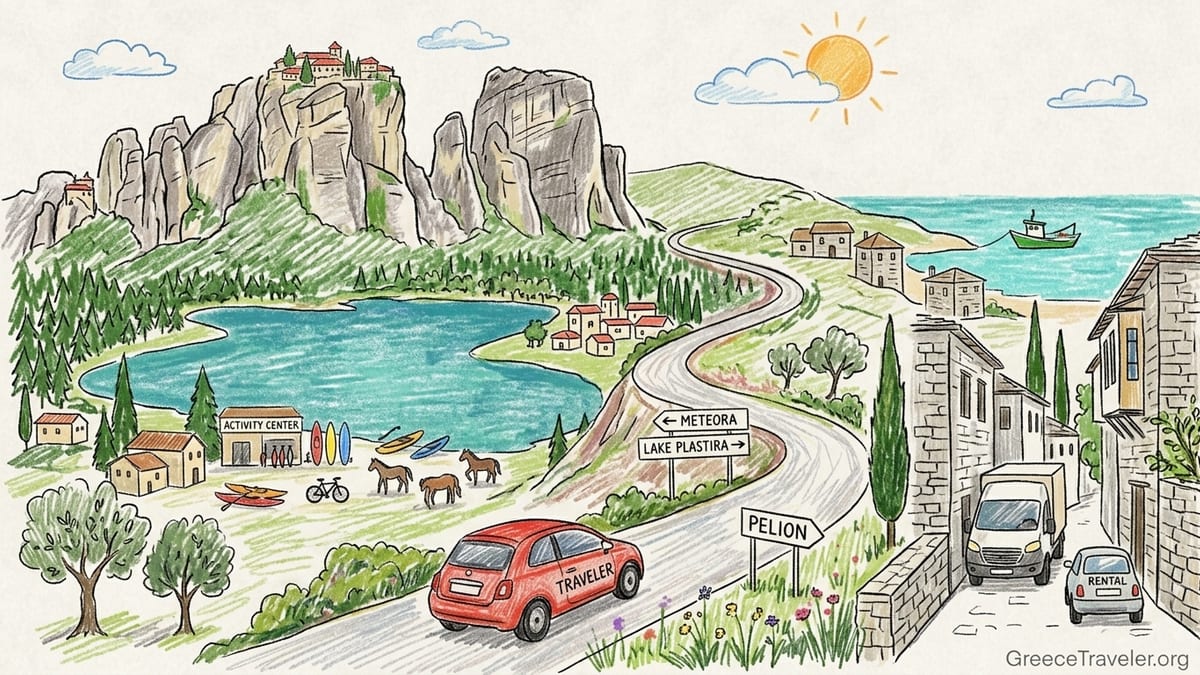
The Route I Actually Drove, and Why the Sequence Worked
I built my Thessaly road trip around a simple truth: Meteora is at its best early and late, Lake Plastira rewards slow mornings, and Pelion is not one destination but many. The most logical sequence on the map also turned out to be the most humane in the car: Meteora (Kalambaka and Kastraki) to Lake Plastira (Neochori and the lakeside villages), then down to Volos to refuel both the tank and my patience, and finally up into Pelion where the roads narrow and the villages scatter.
The drive connective tissue matters more here than most regions. Thessaly has fast links now thanks to the E65 motorway being fully opened to traffic in July 2026, including the northern section between the Kalambaka Interchange and the Egnatia Interchange. That completion doesn’t just shave time, it changes how you plan overnight stops because you can stop trying to “break up” drives that no longer need breaking up.
What I did not do was attempt to turn this into an endless check-in, check-out relay. Thessaly punishes that approach. The tiring sections aren’t the long distances, they’re the last 10 to 20 kilometers into the mountains: tight village lanes, blind bends, delivery vans parked half-on-the-road, and that constant low-grade decision-making that wears you down more than highway driving ever will.
If you only copy one thing from my route, copy the pacing: I used the motorways to move between regions, then slowed down dramatically once I hit the landscapes that actually mattered. Meteora and Pelion are both places where arriving late and rushing through is the easiest way to miss what you came for.
Picking Up the Rental Car, and the “Unsexy” Reality of Tolls
I picked up my rental car with one priority: not being precious about it. Thessaly is safe to drive, but it is not the place for your first-ever experience squeezing past stone walls, reversing on a lane that becomes single-track, or swallowing your pride after a wrong turn sends you into a village square. I wanted something compact enough for Pelion’s village streets, but stable on motorways and mountain descents. In practice, that meant saying yes to a small hatchback and no to anything wide.
On the motorway sections, I paid tolls station-by-station rather than hunting down a transponder. Greece does not use a vignette system on these roads. The price adds up, and the stations come quickly enough that you can feel like you’re feeding a parking meter every 25 minutes. For context, the Athens to Thessaloniki corridor on the A1 is widely cited as roughly €36.70 one way for a passenger car, and if you start on Attiki Odos around Athens there is a separate entry toll. Even if you are not driving that entire length, it’s a useful mental benchmark for budgeting because it tells you how toll-heavy Greece can be.
My practical rule: I kept a card ready and a small cash backup, then stayed out of the electronic-only lanes because I wasn’t carrying an e-pass device. If you miss the signage and drift into an electronic lane, you will feel your stomach drop fast. The signage is usually clear, but at night or when you’re tired, “usually” is not a comfort.
One more detail that mattered: the E65 opening has made certain cross-Thessaly connections feel less like a chore. But even with new motorway, work zones and temporary traffic arrangements still pop up. I treated anything involving Trikala to Kalambaka as a “leave time buffer” segment rather than a precise-to-the-minute promise, especially if I had a monastery slot in mind at Meteora.
Meteora Base: Where I Stayed, Parking Reality, and My First Wrong Turn
I based myself in the Kalambaka and Kastraki area, and if I did it again I would lean toward Kastraki for the feeling of being under the rocks. Kalambaka is practical for groceries and bigger hotel stock, but Kastraki makes early starts easier because you’re already on the right side of the morning traffic flow and closer to the viewpoints.
Parking at Meteora is not one problem, it’s six small problems spread across the monasteries and pull-offs. The roads up to the monasteries are paved and straightforward, but when tour buses stack up, the “easy drive” becomes a slow-motion shuffle for curbside space. I had moments where I parked farther than planned and walked up a steeper approach than I expected, which was fine until the sun was up and I realized I’d brought the wrong shoes on the wrong day.
My first real wrong turn in Thessaly happened here, and it was perfectly predictable: I followed a sign toward a monastery, then second-guessed myself and tried to “correct” mid-flow, which put me into a cramped lane where turning around felt like a three-point turn audition. Nothing bad happened, but it cost me time and energy I would rather have spent inside the monasteries. The lesson is simple: on these roads, commit to the next safe turn-off. Do not improvise a U-turn because your navigation app chirped.
I also learned quickly that Meteora’s schedules are not a single unified timetable. Each monastery has its own opening hours and at least one weekly closing day. Admission is widely stated as €5 per monastery, and travelers should expect cash-only payment at the gate. That sounds like a small detail until you arrive with a card and no euros, staring at a closed ATM screen in the midday heat.
Meteora Driving Day: Scenic Stops, Crowd Timing, and Why One Night Isn’t Enough
I drove the loop road in the morning and again later, and that doubled backtracking was the best “wasted” driving I did. In the early hours, the rocks looked almost matte, like someone had dusted them with chalk. Later, as the light shifted, the same viewpoints turned dramatic and shadowed. If you try to cram Meteora into a tight window, you usually end up seeing it once, in one kind of light, with one kind of crowd.
The most useful scenic stops weren’t secret, they were simply the obvious pull-offs I would have skipped if I felt rushed. A five-minute stop to let tour buses surge ahead can buy you an empty viewpoint. I also found that if I tried to “optimize” by driving directly from one monastery to the next without pauses, I arrived stressed and walked through sacred spaces with the wrong energy.
Weather was the wildcard. Meteora can be bright and hot in the valley, then suddenly windy at a high pull-off. I had a day where I started in short sleeves and ended up wanting a light layer by late afternoon. The wind also changes how safe certain roadside pull-ins feel. If you’re traveling outside the calm summer weeks, respect that shoulder-season gusts can make car doors swing hard, especially if you’re parked close to someone else.
How many nights would I give Meteora now? Two nights, minimum. One night is workable, but it turns the experience into logistics: arrival, check-in, one late day loop, one rushed morning loop, then escape. Two nights gives you a full day with flexibility around opening hours, closures, and the simple need to rest your legs after the stairs.
Meteora to Lake Plastira: The “Quiet Middle” That Deserves Time
Leaving Meteora for Lake Plastira felt like a reset. The scenery shifts from vertical drama to a wide, green rhythm: rolling approaches, then forests, then the lake appearing in fragments through trees. This is where Thessaly’s road trip changes character. You stop thinking about a single headline attraction and start thinking in textures: lake air, fir shade, small villages, and long lunch windows.
The tiring part of this drive wasn’t distance, it was the temptation to treat Lake Plastira as a quick photo stop. That would be a mistake. The lake is famous for activities, and the infrastructure around it is exactly why having a car changes the trip. The “epicenter” of organized activity is commonly described as being around Kalyvia Pezoulas at Plaz Pezoulas, where you can mix lakeside downtime with rentals and guided outings rather than just standing at a viewpoint and leaving.
I drove slowly around sections of the lake, which is when I understood why families and outdoorsy travelers love it. The road isn’t a single scenic highway with one perfect overlook. It’s a series of small, different moods. Some bays feel almost fjord-like, other stretches are open and bright, and then you hit a village where the road tightens and you need to watch for parked cars and sudden turns.
If you’re trying to connect this trip with public transport instead, Thessaly is currently uneven. Rail connections in Central Greece and Thessaly have been subject to substitutions by bus on certain sections, including Larissa to Volos and Palaiopharsalos to Kalampaka as described in Hellenic Train network notices. That’s not a reason not to come, but it is a reason a rental car makes the itinerary dramatically simpler.
Lake Plastira as a Base: Activities I’d Build a Whole Day Around
Lake Plastira surprised me by being practical. Not polished-resort practical, but real-outdoors practical. The area is set up for people who want to do things, not just look. The Municipality of Plastiras Lake explicitly promotes activities like canoe-kayak, cycling, and horse riding, and it points to organized mountain bike centers in Kalyvia Pezoulas and at Neochori near the Botanical Garden. That matters because it means you can arrive without your own gear and still have a full, active day.
I used my car like a gear locker. That’s the advantage you feel immediately at Lake Plastira: you can keep a towel, a dry shirt, a light jacket, and a snack stash in the trunk, then bounce between a short lakeside stop and a higher-elevation village without turning your day into a packing exercise.
On one afternoon, I drove toward the activity area and watched how quickly the lake shifts from quiet to playful. Some operators in the area advertise rentals like SUP, hydrobikes, archery sessions, canoe-kayak, and e-bikes. The point isn’t to endorse one company, it’s to underline the reality: this is not “maybe there’s something to do.” There is a clear, established activity scene, especially around the Kalyvia Pezoulas lakeside zone.
How many nights would I give Lake Plastira now? Two nights if you want the lake to feel like a destination, not a detour. One night is fine if you’re only doing a short loop and a long lunch. But two nights lets you have one “active” day and one “slow” day, which is exactly what the landscape asks for.
Lake Plastira to Volos to Pelion: The Transfer Day That Can Break You if You Overbook It
Driving into Volos after Lake Plastira felt like stepping back into motion: traffic lights, double-parked cars, delivery scooters, people actually in a hurry. Volos is a useful hinge. It’s where you refuel, do errands, and decide whether you’re ready for Pelion’s narrow climbs. It’s also the place where changing hotels can become counterproductive if you let yourself be too “efficient.”
I tried to stack too much on this transfer day: a slow morning at the lake, then a city arrival, then an immediate climb into a Pelion village before dark. I made it, but it was the most fatiguing section of the whole trip because it demanded three different driving mindsets back-to-back. Next time, I would either (a) sleep one night in Volos to break the transition, or (b) leave Lake Plastira earlier and treat the day as travel, not travel-plus-sightseeing.
Volos is also where you notice how public transport workarounds are being used. The Larissa to Volos connection has been described as substituted by bus services in current Hellenic Train network information. KTEL schedules between Larissa and Volos are frequent and published, with journey time often stated around 50 minutes and fares posted in the single digits. That’s a solid backup plan, but it doesn’t replace what a car does once you actually want to spread out across Pelion.
From Volos into Pelion, the road immediately starts to teach you humility. The climbs come quickly, hairpins appear without warning, and village entrances can feel like you’re threading a needle between stone walls. In daylight, it’s thrilling. In darkness, it’s work. I planned my Pelion drives like flights: I wanted to land before evening.
Pelion by Car: Why the Villages Demand More Nights Than You Think
Pelion isn’t a single base-and-day-trip destination unless you’re comfortable spending a lot of time in the car every day. The villages are dispersed, and the coast and the mountain spine don’t “flow” in a simple loop unless you accept slow roads. That’s the whole reason having a car changes the trip substantially: you can do sunrise from a mountain balcony, then still make it to an eastern beach or a quieter cove without relying on limited schedules.
I had a classic Pelion moment on a village lane: I followed navigation confidently, then it guided me into a passage that technically was a road but functionally was an alley. I didn’t hit anything. I did have to fold mirrors and reverse slowly while locals watched with the calm expression of people who have seen this exact movie before. If you drive Pelion, you will have a moment like this. Plan time cushions so it doesn’t ruin your day.
Weather changes faster here than around Volos. Pelion has a reputation for microclimates, and it’s not hard to feel it: mist can sit on the mountain while the city is clear, and the eastern side can feel different again. That variability is part of the charm, but it can derail a schedule if you try to do too much in one day.
How many nights would I give Pelion now? Three nights minimum, and four if you want the trip to feel unhurried. With three, you can pick a base and still do both mountain villages and coast without packing every hour. With four, you can stop driving for half a day and simply exist, which is when Pelion’s magic really shows up.
The Takeaway
This Thessaly road trip worked because I treated it like three different trips stitched together: Meteora for the early starts and sacred spaces, Lake Plastira for outdoors and calm, and Pelion for village-hopping with the patience that narrow roads demand. Volos was the hinge that made it possible to transition from forested lake country to a peninsula of hairpins without losing my mind.
If I did it again, I would plan fewer hotel changes and more full days. Thessaly rewards travelers who give each region at least one day where they don’t have to be anywhere at a certain time. The motorways and the newly completed E65 make the connections easier than they used to be, but the best moments of this itinerary still happen off the fast roads, in the last slow kilometers where you’re finally forced to stop rushing.
My final, practical recommendation is simple: rent the car, budget for tolls, and plan your driving for daylight whenever you can. Meteora and Pelion in particular are places where arriving early and leaving yourself margins turns stress into something closer to joy.
FAQ
Q1. How many nights do you actually need in Meteora?
Two nights is my minimum now. It gives you a full flexible day to work around monastery opening hours, closures, and crowd timing.
Q2. Is it worth sleeping in Volos for one night between Lake Plastira and Pelion?
Yes, if you dislike driving mountain roads in fading light. Volos makes a good reset point for errands, fuel, and an easier arrival day into Pelion.
Q3. Are Meteora monastery tickets cash-only?
Travelers should plan on cash in euros at the gates. Admission is commonly listed as €5 per monastery, and card payment is not something I would rely on.
Q4. What’s the biggest driving mistake people make in Pelion?
Trusting navigation into the smallest lanes. If the road starts feeling like an alley, stop and reassess before you commit downhill or into a tight turn.
Q5. Why is Lake Plastira better with a car?
The activities and viewpoints are spread out, and the organized activity zone around Kalyvia Pezoulas is easier when you can carry extra layers, towels, and gear in the trunk.
Q6. What kinds of activities are realistically available at Lake Plastira?
Expect organized options such as canoe-kayak, mountain biking support, horse riding, and in some areas rentals and sessions like SUP, hydrobikes, and archery.
Q7. Are there any current rail replacement services relevant to this itinerary?
Yes. Hellenic Train has described some Thessaly and Central Greece sections as substituted by bus services, including Larissa to Volos and Palaiopharsalos to Kalambaka.
Q8. What’s the best way to avoid Meteora parking stress?
Arrive early, pause at scenic pull-offs to let tour buses surge ahead, and accept that you may park a little farther away and walk stairs.
Q9. How many nights should you plan for Lake Plastira?
Two nights if you want both an active day and a slow day. One night works only if you treat it as a brief stop rather than a full destination.
Q10. How many nights should you plan for Pelion?
Three nights minimum, four if you want to explore dispersed villages without spending every day in the car.