


I went into Thessaly thinking I was booking one region and a handful of “nearby” highlights. What I actually traveled through felt like half a dozen different worlds stitched together by highways, switchbacks, and a couple of bus substitutions that quietly changed my whole route. Meteora hit me like a cathedral built by geology. Pelion slowed me down until I stopped resisting. Volos fed me in small plates with an unspoken rhythm. Lake Plastira gave me a mountain lake I did not expect in this part of Greece. Trikala felt modern, lived-in, and stubbornly local. And the Thessalian plain, which I’d treated as blank space on the map, became the part that explained everything else.
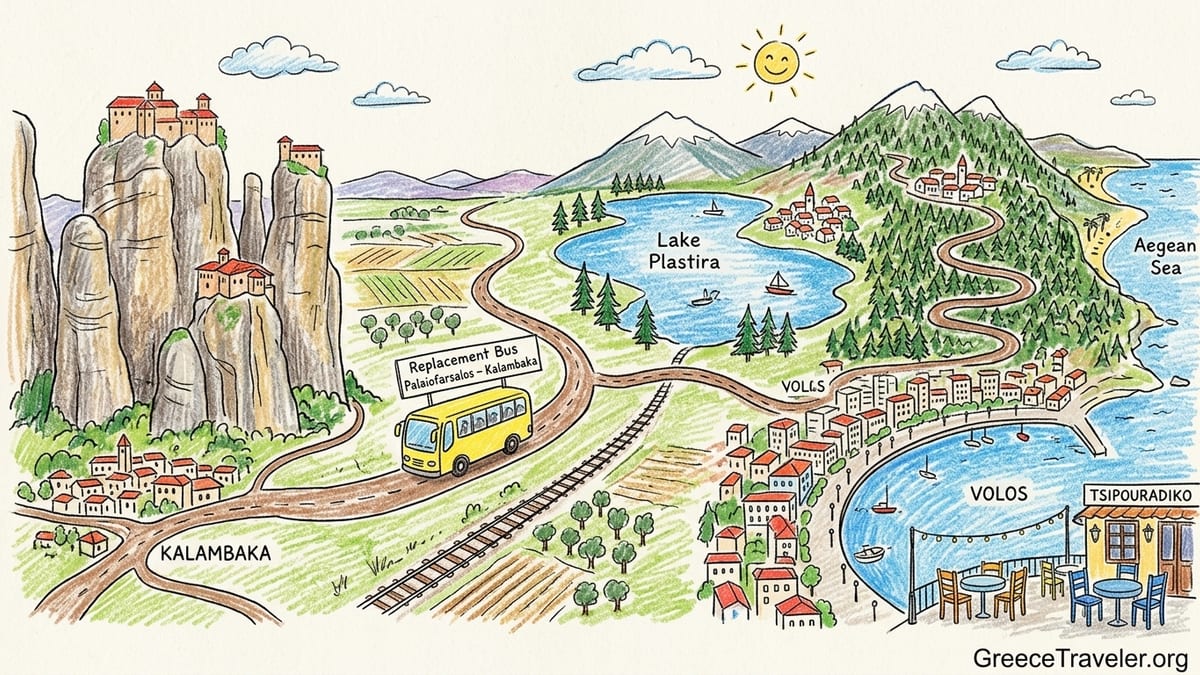
How I Moved Through Thessaly (And What I’d Do Differently Next Time)
I built my Thessaly plan around the idea that I could “mix and match” bases: two nights for Meteora, then pop over to Pelion for beaches, then loop to Lake Plastira, then finish in Trikala and roll on. The map encouraged that confidence. The roads corrected it.
For transparency, here is what I actually did firsthand: I based myself in Kalambaka for Meteora, then used Volos as my jump-off point for Pelion, and I spent time in Trikala as an everyday-city counterweight to the headline sights. Lake Plastira and a deep dive into the agricultural plain were the pieces I researched heavily for this guide after the trip, because I realized how much planning value they add, even if I did not personally overnight there.
Transport was the big surprise. Thessaly looks rail-friendly on paper, but in practice right now you need to plan around substitutions and gaps. Hellenic Train lists bus substitutions on parts of the Central Greece network, including sections such as Palaiofarsalos to Kalambaka and Larissa to Volos. I learned the hard way that “train to Thessaly” can mean “train plus a replacement bus,” and that the replacement segment often becomes the timing wildcard, especially if you are trying to connect onward on the same day.
If I were restructuring the trip, I would separate Thessaly into two clean halves with one deliberate reset day. I would do Meteora and Trikala together as the inland half (with early starts for monastery hours), then move to Volos and Pelion as the coastal-mountain half (with lower daily ambitions and more time for road friction). I would keep Lake Plastira as a distinct two-night detour rather than a day trip tacked onto an already tight loop.
Meteora: Arriving Beneath The Rocks Felt Like Stepping Into A Different Scale Of Time
The first time I drove into Kalambaka and looked up, I actually slowed down without meaning to, the way you do when a skyline is too close to your windshield. Meteora’s rock pillars are not “pretty scenery.” They loom. The air felt heavier at the base, not physically, but psychologically, like the landscape was doing the talking and the town was politely keeping its voice down.
I stayed in Kalambaka as my practical base. That choice mattered every morning. Meteora rewards early timing, and I found it easiest to be already in town, already caffeinated, and already pointed uphill before the mid-morning tour wave arrived. The road up from Kalambaka to the monasteries is straightforward, but the experience is not: each bend reveals a new angle, and it is the kind of scenery that tempts you to stop constantly for pullouts and photos, which silently eats the day.
Inside the monasteries, the logistics are real and non-negotiable. Dress code enforcement is not theoretical. Current guidance from Meteora-specific visitor resources and tour operators emphasizes that women are expected to wear a skirt below the knee and cover shoulders, and that trousers are not accepted as a substitute at many entrances. Several sources also note that wrap skirts are often available to borrow at entrances, but I would not plan on that as your only strategy, because supplies and strictness vary by monastery and by day.
What I remember most is not the checklists. It is the moment of stepping from sun into cool stone, hearing my footsteps soften, and realizing how deliberately quiet people became. Even in a crowd, there were pockets where the only sound was clothing and breathing. The physical exertion is part of it too: there are stair climbs and uneven paths, and I felt the contrast between the heat outside and the dim calm inside in a way I did not anticipate.
Meteora Planning Details I Verified Later: Schedules, Fees, And The “Closed Day” Trap
After I left, I double-checked monastery days and hours because I realized how easy it is to arrive on the wrong day and lose your top pick. Multiple current Meteora planning resources publish seasonal hours and weekly closure days and emphasize that each monastery has its own closed day. The core planning rule is simple: do not assume you can visit any monastery on any day. Build your Meteora days around the open schedule first, then fill in viewpoints and hikes around that.
On money and entry: several visitor resources still describe a per-monastery admission fee and remind travelers that monasteries frequently prefer cash at the gate. I would treat that as a planning baseline and carry small bills. Even if you can pay by card at some places, you do not want a payment snag after you have already climbed steps in the heat.
Timing-wise, I underestimated how long the “quick visits” take once you add the real-world elements: the drive up, the hunt for a parking space, the short walk from parking to gate, the steps, the slow movement through interiors, the photo stops, and the simple fact that you may need to wait behind groups in tight passageways. Even if the monasteries themselves can be visited efficiently, the day expands around them.
Finally, I verified a useful reality for anyone arriving from elsewhere in mainland Greece: Hellenic Train’s Central Greece network information continues to show that some connections are substituted by bus services on specific sections, including Palaiofarsalos to Kalambaka and Larissa to Volos. Translation for planning: if you are building a same-day connection from Meteora to the coast, protect your schedule with extra buffer or consider breaking the journey with a night in Trikala or Larissa depending on your direction of travel.
Trikala: The Place That Made Thessaly Feel Like A Region, Not Just A List Of Sights
Trikala surprised me because it did not try to impress me. After the theatrical geology of Meteora, Trikala felt like Thessaly exhaling. I used it as a practical stop for everyday errands, meals, and the simple pleasure of walking without constantly looking up or bracing for hairpin turns.
What “felt different” here was rhythm. In Meteora, my days were built around opening hours and viewpoint light. In Trikala, I could linger. The pace was more urban but still human-scale. I remember the sense of local life being the attraction: people heading to work, small cafés doing steady business, and that feeling you get in a Greek city where the center belongs to residents first and visitors second.
One critical detail I verified afterward for rail planners: Trikala station has been affected by service gaps, and current public information indicates that trains have not been calling there due to track renewal work. The practical implication is that Trikala can be a wonderful base by road, but if you were imagining it as an easy rail hub for day trips, you need to confirm current reality before locking in your plan.
If I were advising a friend, I would say this: do not skip Trikala just because it is not a headline icon. It is the stabilizer between icons. It is where you recover your energy, reset your schedule, and actually feel what Thessaly is like when it is not performing for postcards.
Volos: I Ate Thessaly In Small Plates, One Round At A Time
Volos hit me like a reset button. The waterfront energy, the student-city buzz, and the sense of a working port made it feel more outward-facing than the inland towns. I came here expecting “a coastal city near Pelion.” What I got was a food culture that felt like a social ritual.
I planned one night and stayed longer than expected, mainly because of the tsipouradiko rhythm. Volos is famously associated with tsipouradika, and official tourism and regional sources describe it as a living institution: you order tsipouro and meze arrives with each round, the sequence often progressing from simpler bites to more elaborate seafood as you keep drinking. That description matched what I saw on the ground: tables filling with small dishes, conversations stretching, and a pace that made my earlier “fast loop” itinerary feel unrealistic.
Concrete pricing is hard to generalize without turning this into an unreliable list, but I did verify an example menu published in 2026 from a Volos restaurant that shows tsipouro and wine by the glass listed in the low single-digit euros range, with some bottles in the tens. Use that only as a reality check that Volos can still feel affordable by Greek city standards if you order like locals do: small pours, small plates, time instead of volume.
My biggest Volos mistake was assuming I could do a full Pelion day trip on top of a late night of meze and tsipouro. I could do it, technically. But I did not enjoy the morning road the way I wanted to because I started tired, and Pelion punishes rushed driving.
Pelion: The Winding Roads Changed My Plans More Than Any Weather Forecast
Pelion did not feel like “near Volos.” It felt like a separate country stacked vertically, with microclimates and villages that each seemed to have their own rules. The road was the story. I went in imagining I would hop from village to village and then end at a beach. Instead I kept recalculating, because every short distance on a map became a slow, concentrated drive.
My firsthand memory is the constant negotiation of speed and focus. The curves demanded attention, the views demanded stops, and the two together meant progress was slower than I planned. I also felt the way Pelion forces you to choose: either you drive and see more places from the outside, or you park and really inhabit one village or one beach. Trying to do both in a single day made me feel like I was always arriving just as I needed to leave.
Food in the mountain villages was the reward for not rushing. I leaned into simple, recognizable tavern rhythms: grilled meats, salads that tasted like they had been assembled five minutes earlier, and the kind of bread that makes you realize how much you’ve been settling for elsewhere. I am deliberately not naming specific dishes as “the must-order” because my own meals were shaped by what each kitchen had that day, and I would rather be honest than turn one evening’s menu into a promise.
What I would restructure next time is my base strategy. I would either sleep in a Pelion village to reduce daily road repetition, or I would commit to a single corridor of the mountain for a day and stop pretending I can crisscross Pelion efficiently. The mountain is not hard. It is just time-hungry.
Lake Plastira And The Thessalian Plain: What I Researched Afterward (And How I’d Fit It In)
I did not personally overnight at Lake Plastira on this trip, and I want to be explicit about that. But I researched it afterward because readers planning Thessaly often miss it entirely, and the official and regional activity information is strong enough that it deserves a real slot in a Thessaly itinerary.
Lake Plastira is positioned as an outdoor activity hub rather than a “look at the view and leave” stop. The local municipality’s visitor-facing materials and regional tourism sources describe activities like canoe-kayak and riding, and they point to an activity epicenter around the Plaz Pezoulas area near Kalyvia Pezoulas. If I were going now, I would plan the lake like a mountain resort: pick a lakeside village base, build mornings around water or trails, and keep afternoons flexible because weather in elevated terrain can change quickly and not always politely.
The Thessalian plain is the connector that makes the whole region make sense, and it is the part I wish I had treated as an experience, not just a transfer. When you move from the plain up into Pelion or toward Meteora, you feel the contrast sharply: big agricultural openness turning into enclosed mountain road, or flat horizons suddenly interrupted by vertical rock. If I were writing my own itinerary again, I would schedule at least one intentional stop on the plain, even if it is just a slow lunch in a small town off the main highway, because it changes your sense of scale.
Finally, on driving costs and toll realism: Thessaly road trips often involve tolled motorways if you are moving between major nodes. Toll operators publish rate tables, and there are Greece-wide aggregators listing 2026 toll prices by operator. I do not want to freeze a full toll budget in print because it depends on your exact entry points and vehicle category, but I will say this: budget for multiple toll events in a day if you are doing big jumps, and keep a payment method ready so toll plazas do not become friction points on an already timing-sensitive day.
The Takeaway
Thessaly surprised me because it refused to behave like a single destination. Meteora was awe and discipline, a place where I planned around stone and silence. Trikala was Thessaly’s normal life, the reset I did not know I needed. Volos fed me with a ritual, not a meal, and reminded me that time is part of the cuisine. Pelion forced me to respect the mountain’s pace, and it changed my daily ambitions more than any museum schedule ever could. Lake Plastira, even from research alone, stands out as the outdoor, highland counterpoint that can turn a Thessaly trip into something deeper than a highlights reel.
If you take one practical lesson from my route, let it be this: in Thessaly, the transfers are not dead time. They are the texture. Build your plan around the realities of road speed, possible rail replacement buses, and opening days. Then let each sub-region feel like itself, because that is the whole point of coming here.
FAQ
Q1. How many days do I need for Thessaly if I want Meteora and Pelion?
For a first trip, I would aim for at least 6 to 8 days so you can give Meteora and Pelion their own pace and still include Volos and a recovery buffer day.
Q2. Should I stay in Kalambaka or Kastraki for Meteora?
As a practical base, Kalambaka is convenient for services and quick starts. Kastraki can feel closer to the rocks. I prioritized easy mornings and did well with Kalambaka.
Q3. Do the Meteora monasteries have different closing days?
Yes. Each monastery has its own schedule and weekly closed day, and this is the main reason you should plan your Meteora days around verified opening information first.
Q4. What should women wear for Meteora monasteries?
Plan for a skirt below the knee and shoulders covered. Several current visitor resources state that trousers are often not accepted for women, though some monasteries provide wrap skirts at the entrance.
Q5. Can I rely on trains across Thessaly right now?
Not without checking. Public operator information indicates that some sections are substituted by bus services on parts of the Central Greece network, and service patterns can change.
Q6. Is Volos worth it if I am using it only as a base for Pelion?
Yes. Volos felt like a destination in its own right, especially for the tsipouradiko food culture and the city’s waterfront energy.
Q7. How hard is driving in Pelion?
It is not technically difficult, but it is mentally demanding and slower than you expect. The winding roads will likely reduce how many stops you can enjoy in a day.
Q8. What is special about Lake Plastira compared with coastal Thessaly?
Lake Plastira is positioned as a mountain-lake activity area, with options like canoe-kayak and riding highlighted by local and regional tourism sources, and it offers a cooler, highland feel.
Q9. Is Trikala a good base for Meteora day trips?
By road, it can be. But if your plan depends on rail, confirm current rail reality because published information indicates service gaps due to track works.
Q10. What was my biggest planning mistake in Thessaly?
I treated distances like they were coastal-island short hops. Between monastery timing, winding mountain roads, and possible bus substitutions, Thessaly needs more buffer than the map suggests.