


Thessaloniki is the easiest base for sampling Central Macedonia in bite-sized day trips, but it is also a city where you can accidentally overpay for “guided” logistics you could have arranged in 10 minutes. On my most recent Macedonia, Greece journey, I mixed a few bookable excursions with a handful of independent days using a rental car and intercity buses. The difference was not just cost. The best tours solved real friction points: the long, non-intuitive routes between headline sites, the lack of same-day public transport connections, and the fact that some experiences (wildlife watching on Lake Kerkini, a Naoussa winery visit with tastings, an Olympus trail walk with a safety-minded leader) are simply better with a local who does this every week.
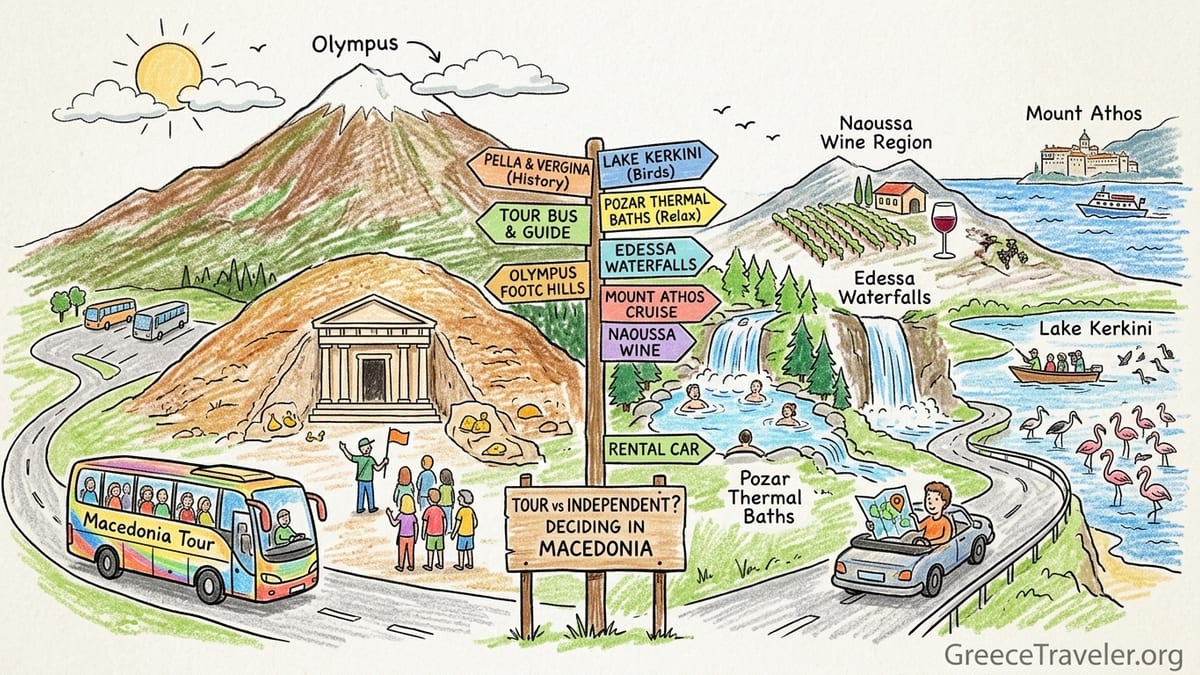
How I Decided When to Book a Tour vs Go Independently
My rule was simple: if a day trip involved two or more stops with tight timing, or if it required local know-how (wildlife timing, winery appointments, trail choices), I leaned toward a tour. If it was a single, high-impact site with easy road access and predictable ticketing, I leaned toward a rental car. Macedonia’s highlights are spread across distinct pockets: the ancient capitals around Pella and Vergina, the Pieria plain and Olympus foothills around Dion and Litochoro, the wetlands north toward Lake Kerkini, and the spa-and-waterfall combo of Pozar and Edessa.
What changed the math in 2026 is how clearly Thessaloniki’s day-trip market is now shaped around a handful of “bookable” routes. If you open any major tour marketplace for Thessaloniki, you will see the same five categories surfaced again and again: Pella and Vergina, Olympus and Dion, Lake Kerkini nature trips, Pozar baths with Edessa, and Naoussa wine experiences. Mount Athos cruises show up as a sixth pillar, typically starting from Ouranoupoli on Halkidiki’s third peninsula rather than from Thessaloniki itself.
I also learned to separate two kinds of guiding. Some trips are essentially escorted transport, where the value is a clean pickup, a reliable driver, and a pre-set schedule. Others are truly guided: a licensed guide (or a specialist nature guide or wine host) who adds context you would not reasonably get from a few phone notes and a museum label. The price is only justified when the second kind of guiding is present, or when the day would be a logistical headache on your own.
Firsthand: Pella and Vergina in One Day (When the Guide Actually Earns Their Fee)
I booked my Pella and Vergina day as a guided group excursion because I wanted both sites on the same day without driving, and because I did not want to gamble on museum timing. My pickup was in central Thessaloniki near a main square, and the vehicle was a modern coach sized for day tours. Group size on my day felt mid-range rather than packed, the kind of bus where you can switch seats and still spread out a bit. The guide was an English-speaking escort for the transport and schedule, and at Vergina there was an emphasis on how to move through the museum efficiently rather than a long lecture at every stop.
Driving time is the hidden cost of this route. Thessaloniki to Pella is not hard, but it is long enough that you notice it in a day with two major sites. On a tour, that drive becomes “dead time” you can use for a quick nap, a coffee, or listening to the guide’s orientation. On my trip, the guide’s best contribution was sequencing: arriving before the heaviest crowds, explaining where the toilets are, where the ticket line forms, and how much time you truly need for the museum sections that matter most.
Queues were manageable, but you should plan for a bottleneck at Vergina’s Royal Tombs museum entrance during peak hours. This is exactly where a tour can help. Even when tours do not skip the line, they often time arrivals better than a casual independent plan. Lunch on my day was a simple taverna stop that suited the schedule. It was not “destination dining,” but it prevented the classic trap of losing an hour and a half hunting for food between sites. Actual sightseeing time felt balanced: enough at Pella to appreciate the site and museum without lingering, and enough at Vergina to let the tombs and gold finds land emotionally rather than rushing through for photos.
Was the price justified? For this specific combination, yes, but only if the itinerary includes both Pella and Vergina and you value having someone manage the clock. If you are a confident driver, renting a car can work better here, especially if you prefer lingering at Pella’s museum or detouring for a quieter lunch. The guide’s value was strongest in logistics, not deep interpretation. If you want detailed historical narration, look specifically for a tour that includes a licensed guide for Vergina and Pella, because some private day trips list the licensed guide as an add-on rather than included.
Pella and Vergina: The Most Useful Bookable Formats (Group, Private, Cruise Excursion)
This is the flagship history day trip from Thessaloniki for good reason: you are pairing the birthplace of Alexander the Great at Pella with the royal tombs at Aigai (Vergina), which are among the most affecting museum experiences in Greece. In 2026, you will commonly see this sold in three formats: shared group day tours, private driver-and-vehicle days, and cruise-style shore excursions when ships call at Thessaloniki.
Group tours tend to be the best value if you simply want a clean, no-stress day: fixed pickup points, a predictable timetable, and a guide who keeps the group moving. Private tours can be excellent if you want hotel pickup, a quieter pace, or a customized stop, but you should check exactly what “guide” means. Many private listings include a professional driver and vehicle and offer a licensed guide as a paid upgrade, which can meaningfully change the experience.
If you are arriving on a cruise, the Pella and Vergina pairing is also a classic shore excursion format. These packages often include lunch and are tuned to ship schedules, which can make them attractive even to non-cruise travelers who want a straightforward all-in day. The downside is the cruise style pace can feel brisk, with less time to read museum labels or linger in the most compelling rooms.
Firsthand: Mount Olympus Foothills and Dion (Where a Tour Helps Less Than You Think)
I did the Olympus and Dion day as a guided excursion from Thessaloniki, expecting the “mythology factor” to come alive through narration. Pickup was again central, and transport was a tour coach or minibus style vehicle depending on the operator’s group size. My day ran smoothly, but it also clarified a truth: for Olympus and Dion, you can often do just as well independently if you are comfortable renting a car or using a mix of train and taxi for a simplified version.
Driving time to the Pieria region is long enough to matter, but not so long that it feels unbearable. The tour’s core stops typically include the archaeological site and museum at Dion, then a village stop in Litochoro or a short nature walk near the mountain. On my day, attraction queues at Dion were not the problem. The challenge was time management: how much of the day goes to “Olympus” itself versus a quick lookout or short walk that does not feel like a true mountain experience.
Lunch was usually scheduled in a village, and it was practical rather than memorable. Actual sightseeing time at Dion felt adequate, and this is where I most appreciated having a guide who could quickly point out what you are seeing among foundations and sanctuaries. Still, I found that much of the interpretation at Dion can be self-led if you arrive prepared, because the site is structured and the museum is designed for independent visitors. The guide’s strongest contribution was again logistics: where to park, which loop to walk, and how to avoid doubling back.
Where renting a car would have worked better: if your goal is a longer, satisfying Olympus walk rather than a quick taste. With a car you can choose a trailhead suited to your fitness and season, stop for coffee in Litochoro without watching the clock, and spend as long as you want inside the Dion museum. If you want a true hike, however, the calculus flips: a dedicated hiking guide around Olympus is worth paying for, because weather, trail choice, and turnaround timing are safety issues, not just convenience.
Olympus and Dion in 2026: What to Look For Before You Book
In 2026, “Olympus and Dion” is marketed as a single Thessaloniki day trip, but not all versions feel equally substantial. Some are primarily a Dion archaeology day with a brief Olympus viewpoint stop. Others include a short guided nature walk. And a third category, usually marketed separately, is a more focused hike such as a canyon or river walk with a smaller group and more walking time.
The most important thing to confirm is what the “Olympus” portion actually is. If the listing emphasizes villages and viewpoints more than walking, treat it as an easy cultural day. If it includes a named trail and walking duration, treat it as a light hike. If you want the feeling of being on the mountain, not just seeing it, prioritize the tours that clearly state how long you will be on foot, what footwear is required, and what happens in bad weather.
If your main goal is Dion, renting a car can be very competitive on cost and pacing. But if you want to pair Dion with a walk where someone else takes responsibility for route choice and timing, book a guided experience that is explicit about trail and walking time rather than vague “Olympus exploration” language.
Lake Kerkini: The Nature Day Trip Where a Guide Adds the Most Value
Lake Kerkini is where I most strongly recommend booking a tour, especially if you are visiting for birdlife and seasonal scenery rather than simply “seeing a lake.” I visited Kerkini independently on a separate day with a rental car, and the biggest challenge was not the drive. It was knowing where to go once you arrive. The lake’s experience depends on timing, light, water levels, and whether you are doing a boat ride, a lakeside walk, or a visit to a specific wildlife-viewing area. Without local knowledge, you can spend an hour driving to viewpoints that look fine but not spectacular.
On the day I went, having my own car gave me flexibility, but I also realized why guided day trips are so popular here. A good nature operator coordinates a small-group boat ride, chooses the right part of the lake for conditions that day, and brings binoculars or at least tells you what you are looking at. If you have ever stood on a wetlands platform wondering whether that dark speck is a bird worth photographing, you understand the value immediately. Kerkini’s appeal is subtle compared with a famous temple or tomb. A guide turns “nice landscape” into “I understand what I am seeing.”
In 2026 Thessaloniki coverage, Lake Kerkini is consistently highlighted as a major bookable excursion, usually framed around wildlife watching, buffalo sightings, and nature photography. If you are short on time, this is one of the clearest cases where paying for a guided day is not just paying for transport. You are paying for expertise, access, and a plan that is built around nature’s rhythms rather than clockwork sightseeing.
Pozar Thermal Baths and Edessa: The Easy Win for Relaxation (But Read the Fine Print)
Pozar and Edessa is one of the most commonly booked “break from the city” days from Thessaloniki, and it is easy to see why. You get a hot springs soak, a mountain village feel, and a waterfall park, all in a single day that feels different from museums and ruins. I visited independently with a rental car on a quieter weekday, which worked well because I wanted to control how long I soaked and when I ate. But I compared that independent day with 2026 tour listings closely, because this route is now strongly standardized.
The key detail most travelers miss until they are already booking: many Pozar and Edessa day trips do not include the bath entry cost, towel rental, or lunch. Some ticket packages spell out small pool versus big pool entry pricing and even towel rental pricing, while others roll the day into a single “tour price” and leave you guessing. In 2026, you can find day tours marketed around the 10-hour range, and you may see listings that advertise a low headline price but charge extras on the day. The best operators state clearly what is and is not included.
Driving time from Thessaloniki to the Pozar area is significant for a day trip. A tour removes the stress of mountain roads and parking, and it also helps if you want to relax in the water without worrying about driving back afterward. The tradeoff is flexibility. At Pozar, some travelers want 60 to 90 minutes in the pools. Others want three hours and would happily skip Edessa. Tours have to split the difference, so independent travel can be better if soaking is your priority.
If you book this as a tour, choose it for logistics and ease. Expect an escort more than deep guiding, and treat it as a comfort day: transport, timing, and a simple plan. If you do it by car, it can be an excellent DIY day too, particularly if you start early, bring your own towel, and build in a proper lunch stop in a village rather than a rushed meal between attractions.
Naoussa Wine Experiences: The Best Upgrade Day Trip (Even for Non-Experts)
Naoussa is the day trip that made my Macedonia journey feel like it had layers. I visited Naoussa independently with a rental car and pre-booked tastings directly with wineries, which is feasible if you are comfortable coordinating appointments and not overindulging before driving. That said, wine experiences are one of those categories where a private tour can be worth it for travelers who do not want to drive after tastings or who want a host to translate styles and explain what makes the region distinctive.
In 2026, Thessaloniki-based wine experiences are marketed heavily around Naoussa and its flagship red grape, Xinomavro. The practical advantage of a bookable wine tour is not just transport. It is access and sequencing: wineries that accept visitors at specific hours, a tasting lineup that is balanced rather than random, and a lunch plan that fits the day. When a tour includes a knowledgeable wine host, the value jumps. Instead of “three pours and a sales pitch,” you leave with a sense of how barrel aging, altitude, and producer style changes what is in your glass.
Where renting a car works better: if you are traveling as a couple or group that can split driving responsibly, and you want the freedom to linger at one estate or add a scenic village stop. Where a tour works better: if you want to taste without thinking about the drive back to Thessaloniki, or if you are short on time and want someone else to curate a high-probability-good day.
Mount Athos Sightseeing Cruises: A Smart Add-On, Not a Thessaloniki Day Trip Shortcut
Mount Athos is one of the most intriguing places in Northern Greece because it is both close and inaccessible. For most travelers, the realistic way to see it is from the water on a sightseeing cruise that skirts the monastic peninsula. I did not take a Mount Athos sightseeing cruise on this trip, but I researched it carefully because it is frequently marketed to Thessaloniki visitors, and because it can be misunderstood as an “easy Athos visit.” It is not. It is a sea-view experience, usually departing from the Ouranoupoli area, not a monastery entry experience.
The value proposition is clear: you get a view of monasteries from the boat, plus a day that feels very different from inland ruins. In 2026, you will find multiple cruise operators and ticket types, including standard sightseeing cruises and versions pitched as pilgrimage-style outings. What matters for travelers is the departure logistics. If your base is Thessaloniki, you are adding a transfer to the Halkidiki area and back. Some bookable experiences solve that with transport included, while others assume you will reach the port on your own.
If your itinerary already includes Halkidiki beaches, adding a Mount Athos cruise can be a natural fit. If you are purely city-based in Thessaloniki with only one free day, Athos cruises can feel like a lot of transit for a sea-view experience, unless you are specifically drawn to Athos for religious, cultural, or photographic reasons.
The Takeaway
If you can only book one history day trip, Pella and Vergina is the most satisfying combination and the easiest to justify paying for, because it packs two heavyweight sites into one day and removes timing stress. If you want a day that feels restorative, Pozar and Edessa is the most accessible “switch-off” option, but read exactly what is included and be honest about whether you want more soaking time than a tour can allow.
For nature and photography, Lake Kerkini is the strongest argument for hiring a guide, because knowing where and when to look is the difference between a pleasant drive and a truly memorable wildlife day. For food and drink, Naoussa wine experiences are the best upgrade if you want local culture in a way that is relaxing rather than educational-heavy. Olympus and Dion can be excellent, but it is the category where I most often think a rental car competes well, unless your tour clearly includes meaningful walking time or a specialist hiking guide.
Finally, treat Mount Athos sightseeing cruises as their own experience. They can be powerful and beautiful, but they are not a shortcut into Athos itself. Book them when the sea-view story is what you want, and when your wider plan makes the Ouranoupoli departure logistics sensible.
FAQ
Q1. Which Thessaloniki day trip is best for ancient Macedonian history?
Pella and Vergina is the most concentrated ancient Macedonian history day, combining a major archaeological site with the royal tombs museum experience.
Q2. Is a tour necessary for Pella and Vergina, or can I do it by rental car?
A rental car works well if you want full flexibility, but a tour can be worth it for stress-free timing across two sites and for crowd-aware scheduling.
Q3. What does an “Olympus and Dion” day trip usually include?
Most versions include Dion’s archaeological park and museum plus a village stop or short walk near Mount Olympus, often around Litochoro.
Q4. Will I actually hike Mount Olympus on a day trip from Thessaloniki?
Not always. Many tours offer a short nature walk or viewpoint rather than a true hike, so confirm walking time and trail details before booking.
Q5. Why do travelers book Lake Kerkini tours instead of self-driving?
Kerkini’s best experiences depend on timing and local knowledge, and guided trips often coordinate small-group boat rides and wildlife viewing more effectively.
Q6. Do Pozar Thermal Baths and Edessa tours include the bath entrance fee?
Some do, many do not. Always check the inclusions for bath entry, towel rental, and lunch so the on-the-day costs are not a surprise.
Q7. Is Pozar and Edessa better independently or on a tour?
Independent travel is great if you want to soak longer and control your pace. A tour is great if you want to relax and not drive back to Thessaloniki.
Q8. What makes Naoussa a standout day trip from Thessaloniki?
Naoussa adds a different side of Macedonia through wine culture, tastings, and a slower-paced countryside day that complements ruins and museums.
Q9. Can you visit Mount Athos monasteries on a sightseeing cruise?
No. Sightseeing cruises typically view the monasteries from the water and do not provide entry into the monastic community.
Q10. Which day trip category is most likely to feel overpriced?
Escorted transport tours with minimal guiding can feel overpriced if you could easily rent a car, so prioritize tours with clear guiding value or complicated logistics.