

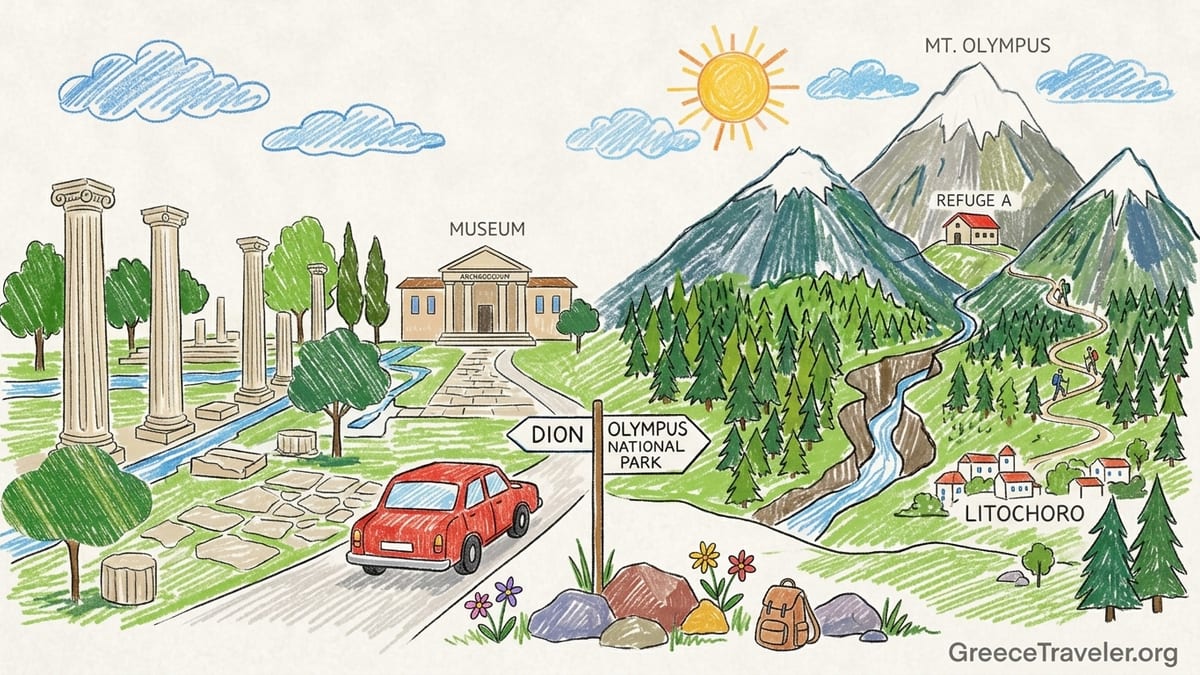
I left Thessaloniki before the cafés had properly switched on their espresso machines, chasing a classic Pieria double feature that sounds almost too neat on paper: morning archaeology at Dion, afternoon mountain air on Mount Olympus, and a sunset drift through Litochoro. It is absolutely doable in one long day if you drive yourself and keep your expectations grounded. You will not summit Mytikas on a sightseeing itinerary, and you will not linger for hours in every sanctuary and museum gallery without feeling the clock nudge you forward. But if your goal is to understand how Dion and Olympus belong to the same story, sacred city and sacred mountain, this route delivers something that feels more complete than ticking off either one alone.
Before You Go: What’s Realistic In One Day
The biggest misconception is thinking “Mount Olympus” automatically means “the summit.” On a day trip from Thessaloniki that also includes Dion, the honest Olympus goal is a satisfying, safe taste of the National Park: a gorge-side walk, a monastery-side viewpoint, or a short climb from Prionia into the forest toward Refuge A before turning back. The mountain’s scale is the point. You are not there to conquer it between lunch and dinner.
The second misconception is treating Dion as a quick stop. Dion is not a single monument. It is a spread-out archaeological park with waterways, trees, and multiple sanctuaries, plus the Archaeological Museum in the modern settlement. Even moving briskly, the park and museum together deserve a meaningful block of time, not a “walk-through.”
Because of that, I planned the day so the cultural portion came first while my legs and focus were fresh, and the mountain portion came second, when the shade and temperature changes of the Olympus foothills feel like a reset. That order also helped psychologically: after stepping through temples and theaters, the drive toward the mountain made the landscape feel like it was continuing the same narrative, not starting a separate excursion.
Early Departure From Thessaloniki: The Drive South Into Pieria
I set off from Thessaloniki around 7:00 a.m., aiming to reach Dion soon after the day’s first wave of visitors. The most straightforward way is the A1/E75 motorway heading south, which is the backbone route toward Pieria. Leaving early mattered more than any micro-optimization of roads; the biggest time-saver is simply avoiding the heavier late-morning flow out of the city.
Once you are on the motorway, the day immediately feels like a “real” road trip rather than a local hop. The urban edges give way to long, fast stretches and a horizon that starts hinting at Olympus. Even before you reach the foothills, the mountain reads as a presence rather than a postcard: broad, high, and often capped with its own changing weather.
I exited toward Dion and followed signs for the archaeological site. The final approach is calmer, with more local road texture: fields, low buildings, and then suddenly the sense of being under the mountain’s shadow. In practical terms, it is an easy drive for anyone comfortable on Greek motorways, and it is the kind of day where having your own car dramatically improves the rhythm. You can keep the archaeology-to-mountain sequence tight without waiting on timetables.
Dion First: The Archaeological Park, In Real Time
I started at the Archaeological Park of Dion, and I treated it like a walk through a living landscape rather than a set of isolated ruins. The site is known for its vegetation and water, and that feeling is immediate: shaded paths, damp air in places, and the kind of quiet you do not expect so close to a major motorway corridor.
For planning purposes, the park’s posted schedule is specific: Tuesday operates 8:30 a.m. to 3:30 p.m., while Wednesday through Monday runs 8:00 a.m. to 8:00 p.m. The listed ticket price is 10€ full and 5€ reduced. The site also notes that an electronic ticket service is “coming soon,” so I approached it expecting on-site purchase rather than relying on an online checkout. The ticket information also states that entry includes a visit to the Archaeothiki of Dion, which is valuable if you want the famous mosaics context without guessing what you are missing.
I spent about two and a half hours inside the park itself. That time estimate includes walking between the main points, pausing for photos, reading a few signs rather than all of them, and letting the overall atmosphere land. Dion is at its best when you notice the relationship between sacred spaces and the natural setting: it feels like a place chosen, not randomly occupied. If you try to sprint it, you miss what makes it different from a more “dry-stone-and-sun” archaeological experience elsewhere in Greece.
The Museum And Archaeothiki: The Pieces That Make Dion Click
After the park, I drove the short distance to the Archaeological Museum area in the modern settlement. This is the moment where the day can either become rushed or become coherent. The park gives you space and mood. The museum gives you the objects and the why.
Here is the key practical detail I used for timing: the Dion site’s own published hours for the Archaeological Museum are Monday through Sunday, 11:00 a.m. to 7:00 p.m., with the same 10€ full and 5€ reduced pricing listed. Because the museum opens later than the park, doing the park first made the schedule feel natural rather than forced. I arrived close to opening and didn’t have to kill time in a parking lot.
I spent roughly 60 to 75 minutes inside the museum, focusing on the pieces that connect directly to what you just walked through. If you have a deep interest in sculpture and inscriptions, you could happily stay longer. If you are doing Olympus the same day, you will feel the tradeoff: every extra half-hour inside is a half-hour you lose in the gorge later.
By the time I left the museum area, it was early afternoon and I was ready for a change of pace. Dion had given me the sacred city. Now I wanted the sacred mountain.
Lunch Between Worlds: A Practical Food Stop Before Olympus
I kept lunch simple on purpose, because a heavy sit-down meal can slow the rest of the day and make a hike feel like a chore. The sweet spot for this itinerary is something familiar and fast: a grilled souvlaki pita, a horiatiki salad to share, or a plate of chicken with fries that doesn’t require a long wait.
What mattered most was not culinary ambition but timing and hydration. I topped up water and made sure I had something easy in the car for later, because once you start moving up toward Prionia and into the National Park, you do not want to be negotiating hunger with a limited snack selection.
If you prefer to build the lunch stop into the Olympus portion, there is an important on-mountain alternative: Prionia has a café-restaurant operating throughout the year, and it is explicitly described as a natural starting point and gathering place for hikers. That makes it a reliable “late lunch” option if your museum time runs longer than expected.
Litochoro And The Olympus Approach: Why This Town Anchors The Day
I drove next to Litochoro, the classic access town for Olympus routes. Even if you do not spend hours there, arriving in Litochoro changes the day’s mood. After the flatlands around Dion, the town feels like a threshold: you are no longer touring the “idea” of Olympus, you are entering its everyday logistics, with trailhead signs, outdoor shops, and people dressed for the mountain.
I treated Litochoro as a short, grounding pause rather than a long sightseeing stop. I walked a few minutes through the center, grabbed a coffee, and used the break to check my plan honestly. How much time was left before late afternoon? Did I have enough daylight and energy for a real trail attempt, or should I settle for a viewpoint and call it a win?
This is also where the one-day concept can start to feel tight. If your Dion portion runs late, Litochoro becomes a “drive-through.” If your Dion portion is disciplined, Litochoro becomes a genuine third chapter of the day, not just a signpost. In my case, it was somewhere in between: enough time to enjoy the town’s atmosphere, but not enough to add a long sit-down meal without sacrificing Olympus.
Olympus Without Pretending: Prionia And A Realistic Trail Attempt
From Litochoro, I continued up to Prionia, which is described as the highest point on Olympus that can be reached by car, about 18 kilometers from Litochoro, with designated parking areas. The road climb is part of the experience: every switchback makes the air feel cooler and the vegetation denser. By the time you park, the mountain feels close enough to touch, even though the serious heights are still far above you.
At Prionia, I did what most honest day-trippers should do: I started the classic E4 ascent toward Refuge A (Spilios Agapitos) but treated it as an out-and-back sampler, not a mission. The official route description for Prionia to Refuge A frames it as the most frequently used access path to the higher sections of the mountain, part of the European long-distance E4. The same description gives a clear sense of what it involves: about 6 km, roughly 1,000 meters of elevation gain, and around three hours one way, with moderate difficulty. On a day that began in Thessaloniki and included Dion, that is not a casual “stroll.” It is a genuine hike.
I walked into the forest far enough to feel the character of the trail: steady climbing, shade, and the sense of moving through a protected landscape rather than a manicured park. I did not push to reach Refuge A because doing so would have forced a late return down the mountain and turned the drive back toward Thessaloniki into a tired, rushed endgame. Instead, I treated the hike as a viewpoint-and-feel exercise, then returned to Prionia while I still had daylight, energy, and enough margin to enjoy Litochoro again if I wanted.
If you do reach Refuge A on a separate, longer itinerary, its own published details show why it is a destination in itself: it typically operates from mid-May to late October, and it is large, with around 110 to 120 beds. Even the menu reads like a small mountain canteen with real prices: bean soup around 7.50€, spaghetti options around 7.50€, meatballs around 12€, and a Greek salad around 10€. That is exactly the kind of concrete, reassuring infrastructure that turns Olympus from a myth into a manageable hiking plan. But it is also the reason not to pretend it is a “quick stop” from Thessaloniki in the same day as Dion.
The Takeaway: Balanced, But Only If You Accept The Limits
Did archaeology and mountain scenery feel balanced? Yes, with one condition: I accepted that “Olympus” would mean foothills and a real trail taste, not a summit. With that mindset, the day felt surprisingly coherent. Dion gave me the sacred city in the morning. Litochoro and Prionia gave me the sacred mountain in the afternoon. The two experiences stitched together into a single story rather than competing checkboxes.
Did it feel rushed? It flirted with rushed, especially in the early afternoon when I could feel the schedule tightening: museum time versus mountain time, coffee pause versus trailhead. The way to keep it from tipping into stress is to leave Thessaloniki early, be disciplined about how long you linger at Dion, and choose an Olympus plan that matches the remaining daylight and your fitness.
Would staying overnight in Litochoro improve the trip? Absolutely. If I could rewrite the day for anyone who can spare it, I would keep the same order but stretch it across an overnight. Day one becomes Dion plus an unrushed Litochoro evening. Day two becomes a proper Olympus hike, potentially reaching Refuge A without worrying about driving back to Thessaloniki the same night. That change does not just add comfort. It changes what you can genuinely attempt on Olympus, safely and enjoyably, without turning the day into a test of stamina.
As a one-day road trip, Thessaloniki to Dion to Litochoro to Prionia is one of the most satisfying “myth made real” loops in northern Greece. The trick is telling the truth about what you can do, and letting that truth guide your timing. When you do, the day feels less like a rush between attractions and more like a journey from ancient worship to living landscape, all under the same mountain.
FAQ
Q1. Can I really do Dion and Mount Olympus in one day from Thessaloniki?
Yes, if you self-drive and keep Olympus to a foothills hike or viewpoint. Plan an early departure and avoid trying to reach the summit.
Q2. Should I visit Dion or Olympus first?
Dion first works well because the archaeological park opens earlier than the museum and it keeps the mountain portion for later when temperatures are often cooler in the forest.
Q3. What are the current ticket prices for Dion?
The Dion site lists 10€ full and 5€ reduced for the Archaeological Park and also 10€ full and 5€ reduced for the Archaeological Museum.
Q4. What are the current opening hours for Dion’s Archaeological Park?
The Dion site lists Tuesday 8:30 a.m. to 3:30 p.m., and Wednesday through Monday 8:00 a.m. to 8:00 p.m.
Q5. What are the current opening hours for the Archaeological Museum of Dion?
The Dion site lists Monday through Sunday 11:00 a.m. to 7:00 p.m.
Q6. How much time should I budget for Dion Park and Museum together?
A realistic minimum is about 3.5 to 4 hours combined if you want the park to feel meaningful and still have time for Olympus afterward.
Q7. What is the most realistic Olympus stop on a combined day trip?
Drive to Litochoro, continue up to Prionia, and do an out-and-back hike into the E4 trail rather than committing to Refuge A if you are short on time.
Q8. How long is the hike from Prionia to Refuge A (Spilios Agapitos)?
The route is commonly described as about 6 km with roughly 1,000 m elevation gain and around 3 hours one way, which is substantial on a day trip.
Q9. Is Refuge A open year-round?
It typically operates from mid-May to late October. Outside that window it is generally closed or only available for emergency shelter.
Q10. Would an overnight in Litochoro make the experience better?
Yes. It turns Olympus from a quick taste into a proper hike day and removes the pressure of a late drive back to Thessaloniki.