


I used to treat “Macedonia, Greece” as a quick add-on between islands: a night in Thessaloniki, a rushed day trip to an archaeological site, then back south. The first time I stayed longer, Northern Greece quietly rearranged my travel instincts. This is not the kind of region that wins you over with one headline attraction. It changes your mind stop by stop, usually in the in-between moments: a late dinner in Thessaloniki when the city is still humming at midnight, a museum visit that resets what you thought you knew about ancient Macedon, a mountain day where the air smells like pine and cold stone, and a lake town where the “evening activity” is simply walking the promenade until the lights come on.
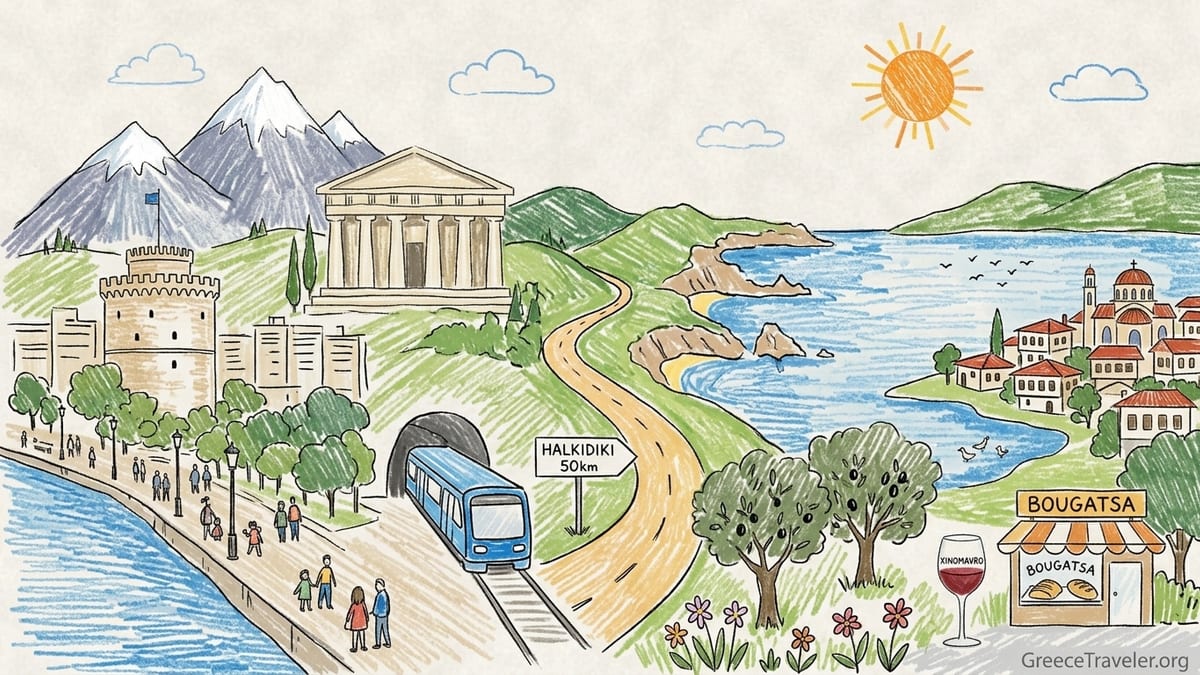
Thessaloniki: The city that made Northern Greece feel contemporary
I arrived through Thessaloniki the way many travelers do: by air, landing at “Makedonia” airport and taking the airport express bus into town. The important detail now is that Thessaloniki’s public transport landscape is no longer just buses. The metro has been operating since late 2024, and it changes how quickly you can move between neighborhoods without the usual traffic and parking chess. I based myself in the city center, close enough to walk to the waterfront in minutes and still reach metro stations easily when I wanted to escape the heat or hop toward the east side for dinner.
What made the city click for me was how quickly “practical” became “pleasant.” Instead of treating Thessaloniki as a transit hub, I started using it as my base for the whole region, coming back between road trips. A fare detail that genuinely helps visitors: the Transport Authority (OSETH/TheTA) keeps the metro and bus fare products aligned in ways that are easy to use, including a 10+1 ticket bundle priced at €5.80 that works across metro and buses, and a €2.00 special fare for airport bus routes such as X1 and X2. When you realize you can run your day on one system, Thessaloniki stops feeling like “the city you pass through” and becomes the place you return to.
My most repeatable Thessaloniki dinner was classic and unfussy: grilled fish or soutzoukakia in Ladadika, or meze and a glass of xinomavro in the center, followed by bougatsa the next morning from a busy bakery where locals are clearly not in a hurry. Crowds are real in summer, especially on weekend nights along the promenade and in nightlife zones, but the city carries them well. After dark, Thessaloniki feels lived-in rather than staged. The moment that changed my impression of Northern Greece happened on a late walk from Aristotelous Square down to the waterfront: the city was loud, bright, and young, but also deeply historic, and it felt like the “north” wasn’t a quieter alternative to Athens at all. It was its own cultural engine.
How many nights would I give Thessaloniki now? At least 3, and ideally 4 to 5 if you want day trips without feeling fragmented. It suits city-break travelers, food travelers, night owls, and anyone building a road trip loop. Families can do it too, especially if you stay near the waterfront for easy stroller walks, but I’d add a day trip (Kerkini, Edessa, or Halkidiki) to break up museum time.
Halkidiki: Learning the difference between “beach day” and “beach life”
I drove to Halkidiki because I wanted to understand what locals mean when they say “we’re going to the sea.” From Thessaloniki, it’s close enough to feel casual, not like a full-blown relocation. I chose to base myself on the middle peninsula, Sithonia, because it tends to feel more road-trip friendly: smaller coves, fewer “package” vibes, more evenings that end quietly. If you don’t have a car, you can still make Halkidiki work using regional buses, including routes that connect Thessaloniki with gateway towns, and there are verified intercity schedules published for key points like Ouranoupoli (the Mount Athos gateway) that can help you plan the Athos side without guessing.
The first night was the turning point. I had expected beach towns to go sleepy once the sun dropped. Instead, the atmosphere after dark in the right village is exactly what many travelers say they want in Greece but rarely find near major airports: families strolling, couples sharing a late drink, children still playing, the smell of grilled octopus and fried zucchini drifting out of tavernas. I ate simply and repeatedly: horiatiki salad, saganaki, grilled sardines, and whatever the kitchen listed as “today’s fish.” In peak season, the busiest beaches can feel tight by midday, but if you treat Halkidiki like a coastline to explore rather than one beach to conquer, you can always find breathing room by shifting timing and choosing smaller bays.
What changed my impression of Northern Greece was how “Greek summer” here feels both accessible and unperformed. People aren’t acting like they are on vacation for your benefit. They are just at the sea because that’s what you do. If you want something more specific than sunbathing, use Halkidiki as a choose-your-own adventure: Kassandra for easier resort logistics, Sithonia for road-tripping coves and quieter nights, and the Athos side around Ouranoupoli when you want that edge-of-the-map feeling.
How many nights would I give Halkidiki today? Minimum 3, ideally 4 to 6 if beaches are the reason you’re coming to Greece. It suits beach travelers, families (especially for sandy, shallow water), couples, and slow-travelers who want days built around swimming, long lunches, and sunset drives. It also fits a road trip loop because it’s an easy “blue” counterbalance to museum-heavy inland stops.
Aigai (Vergina): The UNESCO stop that made “ancient Macedon” feel real
I went to Aigai (Vergina) on a day when I felt “museumed out,” which turned out to be the perfect time. From Thessaloniki, it’s roughly an hour by road, and the whole experience works best with a car so you can arrive early and leave on your own schedule. The site matters even more than most guidebook blurbs suggest. UNESCO identifies Aigai as the first capital of the ancient Kingdom of Macedonia, and the inscription emphasizes what is preserved here: the royal necropolis with hundreds of tumuli and the monumental palace, among other remains. That framing is not academic throat-clearing. It tells you exactly why this stop can reset your map of Greek history.
I centered my visit on the Polycentric Museum of Aigai, especially the Royal Tombs display that incorporates the tombs into the museum itself, creating an atmosphere that is part archaeology and part reverence. It’s the kind of place where you naturally lower your voice. The practical note that mattered to my planning: the museum listing is actively maintained by the Ministry of Culture’s museum directorate, with recent updates, and the ticket covers multiple components of the Aigai complex, including the central museum building and key site elements. If you are visiting around major holidays, you have to double-check opening hours because schedules can differ on Good Friday and Holy Saturday, and similar exceptions can happen at other sites across Greece.
The experience that changed how I saw Northern Greece was standing in the low light of the Royal Tombs and realizing the region isn’t a “second tier” classical add-on. It is a core narrative. Aigai made the word “Macedon” stop being a vague label and become an anchored place with royal burials, monumental architecture, and a distinct cultural history. On the way back, I stopped in a small town for a plate of grilled meat and potatoes, the kind of lunch you don’t photograph because you’re too hungry, and it felt like the best possible contrast: world-class heritage in the morning, ordinary northern Greek comfort food in the afternoon.
How many nights would I give this area today? I’d treat Vergina as a day trip from Thessaloniki if time is tight, but if you’re building a deeper archaeology route, 1 night nearby can be rewarding so you can visit early or combine it with Pella without rushing. It suits archaeology lovers, history-first road trippers, and families with older kids who can handle museum pacing. If you could only do one ancient Macedonian “statement” stop, this would be it.
Pella, Naoussa, and the taste of the interior: mosaics, xinomavro, and a slower tempo
Pella and Naoussa work best as a pair because they tell two different stories about the region: one ancient, one agricultural, both deeply Macedonian. I drove from Thessaloniki and kept my base flexible: one night in the Naoussa area if I wanted wineries and quiet evenings, or back to Thessaloniki if I wanted more restaurant choice and nightlife. For Pella, I planned around the Archaeological Museum of Pella, which is also on the Ministry of Culture’s maintained museum list with current updates. Again, seasonal or holiday hour changes are a real factor in Northern Greece trip planning, so I treat museum schedules as “verify close to the day” rather than fixed truths.
Pella gave me my favorite kind of archaeological satisfaction: clear storytelling. The mosaics are the obvious headliners, but what stayed with me was how the museum visit made the landscape outside the building feel legible. You drive through modern fields and suddenly you can imagine political power and daily life in the same flat geography. It was also one of the stops where crowds felt manageable even in summer. People cluster at the signature exhibits, but the overall pace is calmer than the most famous southern sites.
Naoussa, by contrast, is where Northern Greece became personal through taste. The region is closely tied to xinomavro, and Greece’s official tourism channels frame Naoussa as the heartland where the grape shows real depth and character. I booked a visit at a winery designed for guests rather than just production, the kind of place where a guided tasting comes with a view over sloping vineyards and someone explains why altitude and exposure matter. Ktima Kir-Yianni is one recognizable example of an estate welcoming visitors for tours and tastings in the Naoussa area, and it is exactly the kind of stop that turns a day of driving into an experience you remember by flavor.
How many nights would I give Pella and Naoussa today? I’d allocate 1 day for Pella (as a day trip from Thessaloniki) and 1 to 2 nights in or near Naoussa if wine is a priority, especially if you want a relaxed evening with food that’s meant to match reds. This combination suits archaeology travelers who also want something sensory, wine travelers, couples, and road trippers looking for inland variety between coastal days.
Mount Olympus and Dion: Where myth meets an unexpectedly grounded day out
I used to think of Mount Olympus as a “nice photo,” not a place I would genuinely spend time. Then I paired it with Dion and understood the rhythm: hike or walk in the foothills, then cool down with a history stop that is tied to the mountain’s mythic gravity. I drove down from Thessaloniki and based myself either in the Olympus area (if hiking was the goal) or back in Thessaloniki (if I wanted city evenings). Even if you are not attempting a summit route, you can build a full day around fresh air, short walks, and a strong cultural visit.
Dion’s museum is also formally listed by the Ministry of Culture’s museum directorate with recent updates, and it is the kind of stop that works for travelers who want substance without a huge time commitment. The archaeological park and museum combination is what made the day feel complete: you are in a landscape where water, greenery, and sanctuaries make the ancient world feel less like stone fragments and more like a lived environment. If you are traveling in high summer, the best practical strategy is to go early or late for softer light and fewer groups, then take your long lunch afterwards.
The after-dark atmosphere here depends on where you sleep. If you base yourself in a small Olympus-area town, evenings can be quiet in the best way: grilled meats, local pies, a carafe of house wine, and an early night because you’ve been outside all day. That quiet was the impression-shifter for me. Northern Greece isn’t only urban energy and beach nightlife. It also offers a “mountain reset” that feels like a different country two hours away.
How many nights would I give Olympus and Dion today? Two nights if hiking is central, one night if it’s a pause between bigger stops. It suits hikers, nature travelers, families with active kids, and road-trippers who want to balance coastline and cities. It’s also a strong shoulder-season choice because cooler weather makes walking more comfortable.
Kastoria and Prespa: The lake country that finally slowed me down
Kastoria was the point in my loop where I stopped planning my hours. I drove in via the main roads and felt the shift immediately: water, trees, and a promenade that invites you to do nothing but walk. Greece’s official tourism channels describe Kastoria as a city mirrored in Lake Orestiada, with the lakeside promenade lined by plane and beech trees, and they highlight the old Doltso quarter with its mansion houses. That description is accurate in the way that matters to travelers: this is a place built for slow afternoons and long evenings.
I based myself near the lake so I could step outside and be on the promenade in minutes. The best meal I had was the kind of northern Greek comfort cooking that feels designed for crisp air: beans, grilled sausages, seasonal salads, and local cheese on bread that tastes like it was baked for people who walk a lot. Crowds were present but never oppressive, and even when the promenade had life, it didn’t feel frantic. After dark, Kastoria’s atmosphere is gentle. Lights reflect on the lake. Couples loop the waterline. You hear conversation more than music.
Prespa, further out, felt even more like the edge of the map: a place defined by space rather than attractions. The concrete detail that stayed with me is the approach to Agios Achilleios on Small Prespa, where you cross a long pedestrian bridge to reach the inhabited island village. It’s simple, but it creates a threshold effect. You arrive differently. Prespa is for travelers who want nature, birds, quiet roads, and a sense of borderland geography, not shopping streets or nightlife.
How many nights would I give Kastoria and Prespa today? Two nights in Kastoria is the sweet spot, with a day trip into Prespa if you have a car and want the region’s most spacious landscapes. Add a third night if you are traveling in winter or shoulder season, when the lake atmosphere feels even more dramatic and you’ll want time for warm meals and unhurried mornings. This area suits nature lovers, photographers, road-trippers, and winter travelers. Families can enjoy it too, especially if your kids like walking trails and caves more than beaches.
Lake Kerkini and Edessa to Loutra Pozar: The detours that made the region feel bigger
Once you’ve done Thessaloniki and a couple of the “headline” stops, it’s tempting to lock your plan and ignore detours. Northern Greece rewards the opposite instinct. Lake Kerkini is one of those places that looks like a niche nature stop until you get there and realize how close you can be to birdlife. The lake is known as one of Greece’s premier birdwatching sites, and on the ground the experience is often built around boat trips departing from areas near the lake. This is the kind of half-day that changes the texture of a trip: instead of another museum label, you remember wings, water, and the sound of reeds in wind.
Edessa is a different kind of detour: immediate and physical. You go for the waterfalls and stay because the town gives you a reason to stretch your legs and reset your eyes from “road horizon” to “water movement.” From there, Loutra Pozar is an easy temptation, especially if you’re traveling in colder months or you want a recovery day between longer drives. What matters for planning is that the thermal baths have clear, published pricing structures. One example: an all-day pass has been promoted at €7.00 for access to three outdoor pools (with certain exclusions), and there are separate posted fees for the large outdoor pool and child pricing. Those numbers are exactly why a Pozar day can be a high-value addition when you don’t want to spend another day inside a car or inside a museum.
Crowds at Pozar can vary sharply by season and weather. In winter, the atmosphere can feel almost cinematic: steam rising, people bundled up, the mountain air cold on your shoulders. In summer, it can feel more like a busy aquatic break. Either way, the experience that shifted my view was the realization that Northern Greece is not only about what you see. It’s also about how you recover: a lake morning, a waterfall walk, then a soak that makes you sleep hard.
How many nights would I allocate for these detours today? If you’re based in Thessaloniki, Kerkini can be a day trip. Edessa and Pozar can be a long day trip, but I prefer 1 night nearby if I’m doing Pozar so I can soak late and not drive tired. These stops suit nature travelers, families, road trippers, and shoulder-season and winter travel. They also work for anyone who wants one day in the itinerary to feel restorative rather than ambitious.
The Takeaway
If you plan Macedonia, Greece as a checklist, you will get a good trip. If you plan it as a route that alternates energies, you’ll get a region that changes how you see Northern Greece. Thessaloniki gives you modern momentum and late-night life. Halkidiki supplies the sea in multiple moods. Aigai (Vergina) is the essential UNESCO anchor that reframes ancient Macedon as a primary story, not a footnote. Pella and Naoussa add the deeper interior: mosaics and xinomavro, history and taste. Olympus and Dion bring myth back to ground level through landscape. Kastoria and Prespa slow everything down, turning travel into a rhythm. And the so-called detours, Kerkini, Edessa, Pozar, are what make the north feel spacious rather than point-to-point.
If I were doing the loop again, I’d build it around bases rather than constant hotel changes: Thessaloniki as the hub, plus one coastal base in Halkidiki, one mountain or inland base for Olympus or Naoussa, and one lake base in Kastoria. That structure lets you experience Northern Greece the way it reveals itself best: not as a sprint through attractions, but as a set of places that each change the lens slightly, until you realize your idea of “Greek travel” has expanded.
FAQ
Q1. How many days do I need for a first trip to Macedonia, Greece?
Plan 7 to 10 days to combine Thessaloniki, Halkidiki, Aigai (Vergina), and at least one inland loop (Olympus, Naoussa, or the lakes).
Q2. What is the single most important archaeology stop in Greek Macedonia?
Aigai (Vergina). UNESCO identifies it as the first capital of ancient Macedon, and the Royal Tombs museum experience is unmatched in the region.
Q3. Can I do these places without a car?
Thessaloniki is easy without a car, and parts of Halkidiki and key gateways can be reached by intercity buses. For Aigai, Prespa, and flexible lake and mountain days, a car makes the trip dramatically simpler.
Q4. What are the best bases if I want to avoid changing hotels constantly?
Use Thessaloniki as your main base, then add one base in Halkidiki for beaches and one base in either Naoussa (wine) or Kastoria (lakes).
Q5. What is the easiest way to save on transport inside Thessaloniki?
Consider the integrated metro and bus ticket products, such as the 10+1 ticket bundle, and reserve the special airport fare ticket for airport express routes.
Q6. Is Naoussa worth it if I am not a wine expert?
Yes. Winery visits in Naoussa are often approachable and scenic, and the town is a pleasant inland contrast to coastal travel even if you only do one tasting.
Q7. When is the best season for Olympus and Dion?
Spring and fall are the most comfortable for walking and hiking. Summer is still doable if you start early and plan shade and water.
Q8. Is Kastoria more of a summer or winter destination?
Both. Summer gives you long lakeside evenings; winter adds a cozier atmosphere and is ideal if you want a slower pace and seasonal food.
Q9. What is the vibe at Loutra Pozar, and is it family-friendly?
It’s a paid thermal baths complex with outdoor pools and a nature setting. It can be family-friendly, especially earlier in the day and outside peak crowd times.
Q10. If I only have time for one beach area near Thessaloniki, which should I pick?
Halkidiki is the default choice. Decide by mood: Kassandra for convenience and amenities, Sithonia for coves and a road trip feel, and Ouranoupoli area if you want the Mount Athos gateway atmosphere.