

I thought I knew Greek Macedonia because I’d “done” Thessaloniki. A long weekend of bougatsa, waterfront walks, and museum-hopping felt like enough. Then I pushed past the city limits and everything changed, fast: resort-strip Chalkidiki that felt louder than the postcards, royal Macedonian archaeology that felt almost private once the day-trippers vanished, mountain roads that looked short on the map but took real time, and lake country in the west where the air turned cooler and the light turned silvery. This is the guide I wish I’d had, written from my own loop through Thessaloniki, Halkidiki (Kassandra and Sithonia), Pella, Vergina, Naoussa, Dion, Kastoria, and Prespa, with current planning details checked separately so you can actually replicate the trip.
Landing In Thessaloniki: The Airport Bus I Actually Used, And Why I Didn’t Rent A Car On Day One
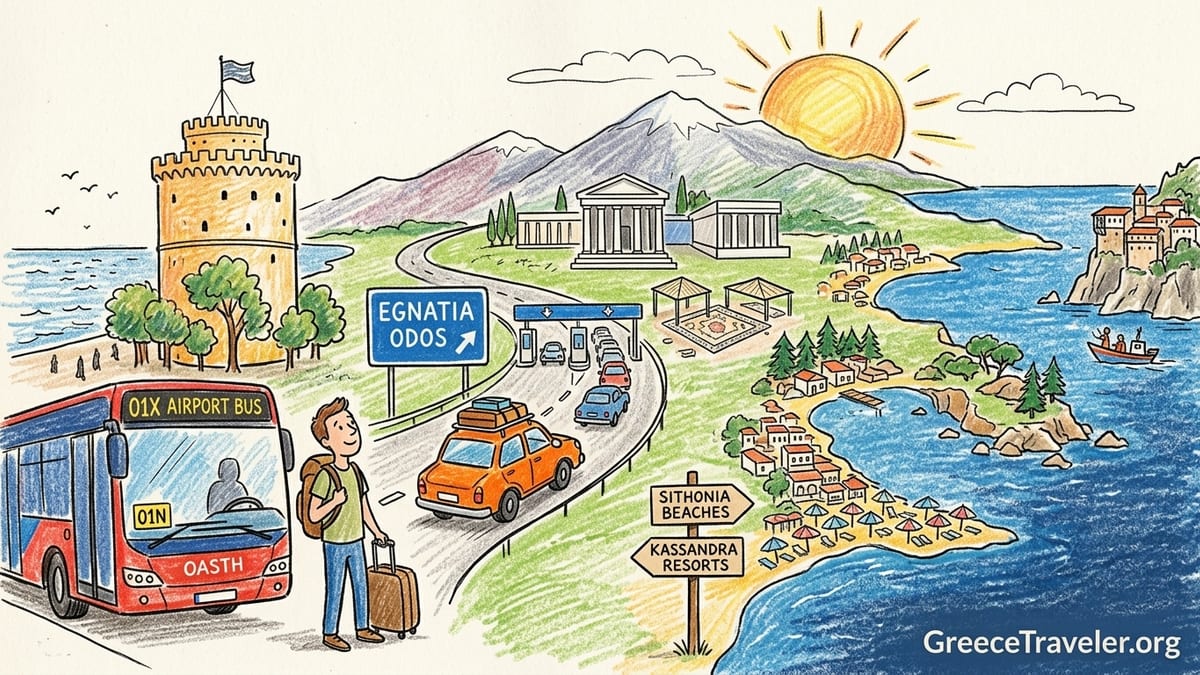
I flew into Thessaloniki’s Macedonia International Airport (SKG) and used the OASTH airport bus connection that runs all day and night. The line is marketed as 01X by day and 01N overnight, and it links the airport with the city and the intercity bus and rail areas. Practically, it let me get to my hotel without paying taxi prices and without immediately dealing with driving in a new city.
What surprised me was how much time Thessaloniki rewarded on foot. I spent my first full day walking between the seafront, the White Tower area, and the museum district, then retreating into backstreets for meze. The Archaeological Museum of Thessaloniki became my “primer” for everything I would see later in the region, and it’s one of the few places where I slowed down enough to connect names and places before I started chasing them on the highway. Its published visiting hours are seasonal, with longer evenings on the first Thursday of certain summer months for specific exhibitions, and winter closures on Tuesdays. It’s the kind of detail that matters when you land on a shoulder-season Tuesday and assume “museums are always open.”
I deliberately did not rent a car in Thessaloniki proper. Between one-way streets, tight parking, and the way the city pulls you along on foot, I found it easier to get my bearings first. Instead, I saved my car rental for the moment Thessaloniki stopped being the destination and became the gateway.
Thessaloniki As A Base: What Felt Easy, What Felt Crowded, And Where I Underestimated Time
Thessaloniki surprised me by being both compact and time-consuming. Distances look small, but you keep stopping: for a coffee standing at a counter, for a view over the water, for a bakery window that suddenly becomes your lunch plan. I also underestimated how long it takes to do a museum day properly, especially if you want to connect it to the later archaeology at Pella and Vergina. If I had to reorganize, I would put my museum visit early, then keep my evenings for food and neighborhoods, not “one more sight.”
Food-wise, I ate like I was in a city that cooks for locals first. Bougatsa was my morning anchor, and I kept chasing the version that was creamy without being heavy. In the evenings I leaned into mezze culture: small plates, a table that kept changing, and the feeling that I didn’t have to “book a concept” to eat well. The wine surprise was how often Xinomavro appeared even in casual spots, which quietly set up my later day in Naoussa.
Thessaloniki also taught me my first Macedonia lesson: this region changes temperament quickly. In the city, everything is layered, busy, and social. Once I left, the scale widened, the air dried out, and the roads started dictating the rhythm of my days.
Halkidiki Reality Check: Kassandra And Sithonia, Resort Seasons, And The Beaches That Didn’t Match The Hype
From Thessaloniki, I pivoted to Halkidiki using the intercity bus system that locals actually rely on. The KTEL Chalkidikis terminal is separate from the main Macedonia intercity station, and I remember how easy it would be to go to the wrong one if you’re sleepwalking through travel day. I did this portion by bus first, then later returned for my car, because I wanted at least one coastal day without the pressure of “finding parking near a beach at noon.”
Kassandra hit me like a splash of cold reality: it can be beautiful, but it is also unapologetically developed. In peak season, the main roads and beach towns feel built for volume. I had moments where I genuinely enjoyed the water and the ease of services, then moments where I caught myself thinking, “This could be any Mediterranean resort strip if you removed the Greek language from the signs.” If your dream is a quiet peninsula, Kassandra can feel like too much.
Sithonia felt like the mood shift I’d been hoping for, even though it still has busy nodes. The coastline changes fast and the experience becomes more about driving to a cove, checking the wind, then deciding if you’re staying or moving on. What surprised me most was how distances looked trivial on the map, yet the reality of curving roads, beach turn-offs, and summer traffic made it feel like I was always 20 minutes farther than I thought. I learned to stop planning “three beaches in a day” and instead pick one anchor beach and let the rest happen organically.
I also kept Mount Athos in view as a powerful presence without turning my trip into an Athos pilgrimage. One practical reminder for planning: Mount Athos has strict entry rules, including the centuries-old ban on women (the avaton), and men need a diamonitirion permit arranged in advance through the official pilgrims’ office system, with collection procedures tied to the entry day. Even if you’re only doing an Athos boat cruise from outside the border, it’s worth knowing the restrictions so you don’t accidentally plan something that is simply not possible.
Driving The Egnatia Odos: The Highway That Made This Trip Possible, Plus Tolls, Parking, And The “Short” Distances That Weren’t
I picked up a rental car for the inland loop, and it was the single decision that made Greek Macedonia feel like a region rather than a set of disconnected day tours. Once I joined the Egnatia Odos corridor, the trip snapped into place. The surprise wasn’t just speed. It was how quickly the scenery toggled from plains to foothills to harsher, more dramatic western landscapes.
Tolls are part of the Egnatia reality. I budgeted for frequent toll stops and kept my wallet accessible, because the rhythm of driving changes when you’re pulling in and out of toll lanes repeatedly. The last thing I wanted was to be rummaging for coins with a line behind me. My other practical lesson was parking: Thessaloniki parking felt like a puzzle, but outside the city the challenge changed to “where is the obvious place everyone else parks?” At popular archaeology sites, the lots can fill in the midday wave, while smaller towns are calmer but still have tight historic centers.
The biggest surprise was psychological distance. On a map, Thessaloniki to Vergina looks like a simple westward hop, and Vergina to Naoussa looks like a minor detour. In reality, when you factor in arriving, buying tickets, actually walking the sites, and the fact that you’ll want to sit down and eat, a “quick day trip” becomes a full day without you noticing. If I could reorganize my trip, I would stop pretending I could stack multiple major archaeology stops into a single afternoon and still have energy left for a long drive.
Archaeological Macedonia Up Close: Pella, Vergina, And The Way The Story Finally Clicked
Pella was the point where Macedonia stopped being an abstract term and became a physical place under my feet. I built my visit around the Archaeological Museum of Pella and the adjacent site experience, treating the museum as the key and the ruins as the proof. Because opening hours and ticket rules can change seasonally, I checked current official details before I went rather than trusting whatever a map app happened to display.
Vergina (Aigai) delivered the biggest emotional hit of the trip. I arrived expecting “important museum, important tombs,” and left feeling like I’d been allowed into something unusually intimate for a major UNESCO-level story. The Polycentric Museum of Aigai structure matters in practice because you are not visiting a single room. You are moving through a broader complex of components that together make the Aigai experience. I timed it so I wasn’t racing. Inside, I remember the lighting, the hush, and the way I slowed down in spite of myself.
Planning details at Vergina are not trivial. Seasonal hours differ, and even within the same month there can be adjusted schedules on specific days. The museum’s official channels emphasize confirming visiting hours for your date, and I treated that as non-negotiable. Ticketing can also be confusing if you search casually, because you might see outdated numbers repeated in travel forums. I verified what I could through official museum and culture channels before committing.
If you’re trying to choose between Pella and Vergina with limited time, I’d say this: Pella helps you understand daily life and city planning in the Macedonian world, while Vergina feels like the ceremonial heart. What I did wrong was under-allocate time to just sit with the material. I moved too quickly at first, then realized I wanted to re-read panels and linger. If I could redo the day, I would give Vergina a longer, quieter block and avoid squeezing it between other obligations.
Naoussa Wine Country: Xinomavro, Reservations That Matter, And The Afternoon I Wish I’d Protected
Naoussa changed the tone again, from stones and museum labels to vineyards and long lunches. By the time I arrived, I’d been seeing Xinomavro on menus for days, and I wanted to understand it in its home landscape rather than as a random by-the-glass order. The countryside around Naoussa felt greener and more textured than I expected, and it reminded me how quickly Greek Macedonia moves from coastal glare to inland softness.
Wine tasting here is not something I would leave to chance, especially in high season weekends. Some estates make it explicit that certain experiences, like food-and-wine pairings, are strictly by reservation only. I treated that as my cue to plan ahead rather than showing up hoping to be squeezed in. The reward was a more relaxed visit where I didn’t feel like I was interrupting someone’s workday.
What surprised me most was how Naoussa made my whole route make sense. Thessaloniki had given me the big picture, Pella and Vergina had given me the deep past, and Naoussa gave me a living agricultural identity that still feels distinctly Macedonian. If I could reorganize my itinerary, I would place Naoussa after Vergina on purpose, because the shift from royal history to everyday terroir felt like a clean narrative arc.
Olympus Foothills At Dion: Water, Shade, And A Completely Different Kind Of Ancient Site
Dion was my palate cleanser after the intensity of royal tombs and museum interiors. The archaeological park sits in the foothills of Mount Olympus, and the experience is as much about landscape as it is about ruins. The first thing I noticed was water: channels, damp ground in places, and the sense that this is not a dry, sun-blasted set of stones. It felt alive.
Before I arrived, I checked Dion’s official visitor information because I didn’t want to show up on the wrong day or assume the same hours as a city museum. The practical point is simple: Greece’s archaeological sites can run on seasonal schedules and can include additional components, like archives, that are part of the ticketed visit. I found that having the current facts in hand lowered my stress and let me enjoy the site rather than doing mental math at the gate.
Logistically, Dion also reminded me why a car helped. Public transport can get you to some major points, but the freedom to arrive early, avoid the midday heat, and then continue toward Western Macedonia without backtracking was the difference between a smooth loop and a tangled one. If I had tried to stitch this day together by buses alone, I would have lost the flexibility that made Dion feel peaceful.
Western Macedonia Surprise: Kastoria And Prespa, Lake Weather, Mountain Roads, And The Silence I Didn’t Expect
Western Macedonia was where I stopped thinking like a city-break traveler and started thinking like someone crossing a region. Kastoria arrived like a revelation: a town wrapped around a lake, with light that kept shifting as clouds moved. After coastal Halkidiki and busy Thessaloniki, Kastoria felt quieter, more self-contained, and less performative. The lakefront atmosphere invited slower mornings and longer walks, and I realized I had been underestimating how restorative “lake weather” can feel after days of sun and salt.
I built time for a specific attraction in Kastoria rather than treating it as a generic stop, and I checked current entry details in advance. For example, the Dragon’s Cave is a known highlight, and published information includes a standard ticket price. That kind of concrete detail matters because it shapes how much cash you keep on you and whether you plan the stop as a quick visit or a longer one. In Kastoria, I also became more careful about where I parked, because the lakefront zones can be deceptively tight once you leave the wide roads.
Then I drove to Prespa, and this is where my map illusions peaked. The distances did not look intimidating, but the mountain roads and the rhythm of villages stretched time. I remember arriving and feeling the temperature drop. Prespa is not a “quick photo stop” if you want to feel it. The landscape has a fragile, protected quality, and the area’s official tourism information emphasizes its ecological significance as a wetland of European value, which matched what I felt standing there watching birds over the water.
The most specific moment I carried away from Prespa was crossing the pedestrian bridge to the islet of Agios Achilleios on Small Prespa. It’s the kind of experience that sounds like a small add-on until you do it and realize it’s the anchor memory. Practical note: even the bridge length is described differently across local sources, which is a good reminder that you should plan with buffer time rather than obsessing over an exact number. What I do know is that it’s long enough to feel like you’ve left the mainland behind, and the payoff is a quiet sense of stepping into another pace of Greece.
The Takeaway
Greek Macedonia surprised me because it refuses to be one thing. Thessaloniki is layered and social, Halkidiki can be dazzling but sometimes overbuilt, archaeological Macedonia feels like a private doorway into the ancient world once the crowds thin, Dion is green and watery in the Olympus foothills, and Western Macedonia is cooler, slower, and emotionally spacious. The radical shift isn’t just scenery. It’s how you plan: buses make Thessaloniki and parts of Chalkidiki straightforward, while the inland loop rewarded me every time I chose the car and gave myself longer blocks at fewer places.
If I could redo my trip with what I know now, I would spend less time trying to “collect” beaches, more time in the archaeology with a calmer pace, and at least one extra night in the west. I would also protect my Naoussa afternoon with a reservation and a buffer, because wine country works best when you’re not watching the clock. Above all, I would stop trusting the map’s scale and start trusting the region’s variety. In Greek Macedonia, the real distance is not kilometers, it’s the difference in atmosphere from one sub-region to the next.
FAQ
Q1. What airport did you use to start this Greek Macedonia trip?
I flew into Thessaloniki Macedonia International Airport (SKG), which is the most practical entry point for Central Macedonia and Chalkidiki.
Q2. How did you get from the airport into Thessaloniki without a taxi?
I used the OASTH airport bus connection (marketed as 01X by day and 01N overnight), which links the airport with the city and major transport hubs.
Q3. Is Thessaloniki a good base for day trips, or should I move hotels?
It’s a strong base for the first part of the trip, but once I started doing Pella, Vergina, Dion, and the west, I preferred having a rental car and not trying to return to the city every night.
Q4. Do I need a car for Halkidiki (Kassandra and Sithonia)?
You can reach Halkidiki by intercity bus, which I did, but having a car makes Sithonia in particular much easier because the experience depends on hopping between coves and beaches.
Q5. What felt overdeveloped to you in this region?
Kassandra in Halkidiki was the place that most often felt resort-heavy in peak season, even though the sea can still be beautiful.
Q6. Which archaeological sites did you personally visit, and which one hit hardest?
I visited Pella, Vergina (Aigai), and Dion. Vergina was the strongest emotional experience for me because of the atmosphere and the way the story is presented on site.
Q7. How do I verify archaeological opening hours and ticket prices for my exact dates?
I check official museum and Ministry of Culture channels right before I go, because hours can change seasonally and can be adjusted on specific days.
Q8. Do I need reservations for wine tasting in Naoussa?
For structured tastings and especially food-and-wine pairings, I recommend reserving in advance because some experiences are explicitly reservation-only.
Q9. Can women visit Mount Athos?
No. Mount Athos has a long-standing entry restriction known as the avaton, which bans women from entering the monastic territory.
Q10. What was the biggest “looks-short-on-the-map” mistake you made?
I underestimated how long the Western Macedonia drives feel in practice. Mountain roads and slower sections meant I needed more buffer time, especially between Kastoria and Prespa.