


Choosing where to stay in Crete is often the single most important decision of a Greece itinerary. Distances are longer than many visitors expect, the island has two main airports plus several resort belts, and each region offers a very different mix of beaches, atmosphere, nightlife and day trips. This guide focuses on the big decision most travelers face: whether to base themselves in Chania, Rethymno, Heraklion, the Hersonissos and Gouves strip, stylish Agios Nikolaos and Elounda, or the quieter south coast hubs of Paleochora and Plakias.
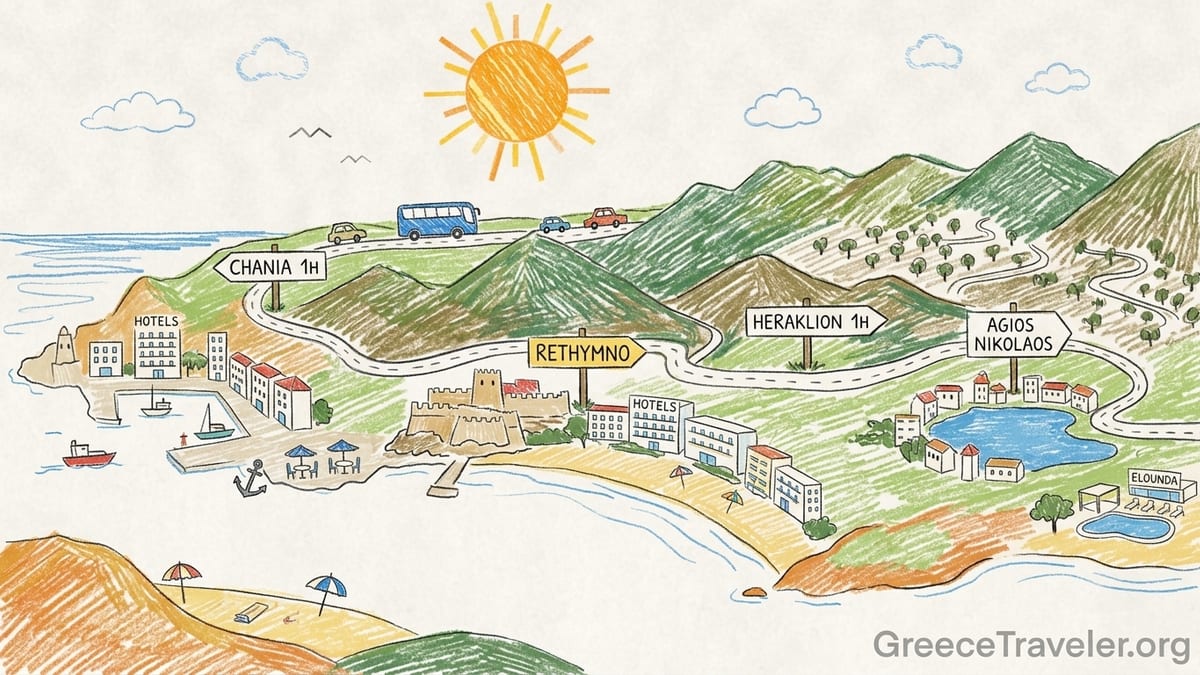
How Crete is Laid Out and Why Your Base Matters
Crete stretches roughly 260 kilometers from west to east, with mountains running down the middle. That means driving from Chania in the northwest to Agios Nikolaos in the east can easily take three hours or more, especially in summer traffic. Many visitors underestimate these distances and end up spending more time in the car than on the beach. Picking the right base for your priorities can turn a rushed island dash into a relaxed holiday with realistic day trips.
The two main airports are in Chania and Heraklion. Charter and low cost flights often serve both, while many long haul connections route through Athens. In practical terms, if your flight arrives late at night into Chania, it is smarter to sleep in or near Chania rather than transfer straight away to Rethymno or Heraklion. Likewise, families landing in Heraklion in the evening often choose nearby Hersonissos or Gouves for a short 20 to 25 minute transfer, rather than driving directly to the far west.
Public transport on Crete is better than many expect, with KTEL buses running along the north coast between Chania, Rethymno, Heraklion and Agios Nikolaos. However, once you leave that main axis, service becomes sparse and seasonal. If you plan to hike gorges, hunt out small coves or visit multiple ancient sites, renting a car for at least part of your stay will make life easier. If you mainly want a beach, restaurants and a few organized excursions, you can manage in most of the areas below without driving.
Hotel prices vary widely across the island and through the season. As a broad example, in June you might find a small double in Chania Old Town from around a modest nightly rate, while a sea view room in a five star Elounda resort can easily be several times that. Shoulder seasons in May and October bring noticeably better value across all regions, and car rentals are usually cheaper and easier to arrange at these times too.
Chania: Atmosphere, Old Town Charm and Western Beaches
Chania is many travelers’ favorite base in Crete, thanks to its Venetian harbor, atmospheric old town and easy access to the island’s most famous western beaches. The historic center packs in dozens of boutique hotels, restored townhouses and small apartments along narrow lanes such as Theotokopoulou and Zambeliou, just behind the harbor. Staying a street or two back from the waterfront usually means quieter nights and slightly lower prices, while still being within a three minute walk of the lighthouse or the old shipyards.
If you want a city and a beach in one place, consider staying in Nea Chora, the urban beach just west of the old harbor. Here you step out of modest family run hotels or modern apartments directly onto a sandy curve lined with fish tavernas and cafes, and it is still only a 10 to 15 minute flat walk into the heart of the old town. For softer sand and more resort infrastructure, the strip west of Chania toward Agia Marina and Platanias offers long beaches with sunbeds, beach bars and larger hotels with pools. This area has some of the liveliest nightlife outside the city, with music bars and clubs that run late in high summer.
Chania is the best base if your wish list includes Balos Lagoon, Falassarna or Elafonissi. These beaches lie to the northwest and southwest, and even from Chania you should allow roughly 60 to 90 minutes by car for Falassarna or Elafonissi, and a combination of driving and a boat or hike for Balos. Organized day tours depart from the harbor and from larger resort areas west of town, which is handy if you prefer not to drive the mountain and coastal roads yourself. For hikers, early morning buses to the Samaria Gorge depart from near the center in peak season, returning in the evening after the ferry ride from Agia Roumeli.
Within Chania, you do not need a car. The old town is compact, taxis are readily available, and local buses run out to nearby beaches such as Agioi Apostoloi and Golden Beach in 10 to 20 minutes. A car becomes more important once you start planning multiple long range day trips into western Crete, or if you are staying in a beach suburb and want flexibility in the evenings. Drivers should be aware that parking inside the old town is difficult in July and August; many visitors opt for a hotel with private parking just outside the medieval core and walk in after dark for dinner.
Rethymno: Central Balance of Beach, Old Town and Day Trips
Rethymno sits roughly halfway between Chania and Heraklion, which makes it an ideal base for travelers who want variety without changing hotels every few nights. The old town is smaller than Chania’s but still full of Venetian and Ottoman architecture, including a hilltop fortress and a waterfront lined with tavernas. Many streets are pedestrian, and plenty of small hotels and guesthouses occupy old merchant houses with inner courtyards and wooden balconies.
One advantage Rethymno has over Chania is the way the beach blends into town. A long sandy strand begins just east of the harbor and runs for several kilometers, fronted by medium sized hotels and serviced apartments. Staying near the harbor gives you a short stroll into the old lanes for dinner, while staying a little further along the beach road brings more resort style pools and kids’ facilities. Couples often choose boutique hotels in the old town and wander to the beach during the day, while families might prefer a property right on the sand with a playground and shallow water for children.
From Rethymno, you can day trip both west and east along the north coast and also reach the south fairly easily. The drive to Chania usually takes around one hour on the national road, and Heraklion is a similar distance in the opposite direction. Buses run frequently to both cities in season. To the south, a scenic road crosses the mountains via the Kourtaliotiko or Arkadi routes to reach Plakias and the Libyan Sea in approximately an hour, making it realistic to visit for a day and still be back for dinner in the old town.
For visitors who do not want to rent a car, Rethymno still works well. You can walk from most central hotels to the beach, harbor and major sights. Excursion agencies in town sell day trips to Samaria Gorge, Knossos near Heraklion, and various south coast beaches, including Preveli with its river palm forest. If you plan to mostly stay within town and take one or two organized outings, you can comfortably rely on buses and tours. A car mainly becomes useful if you want to string together multiple small villages, monasteries and hidden coves on your own schedule.
Heraklion: Knossos, Museums and Island Transport Hub
Heraklion is not a classic resort town but it is the main transport hub of Crete, hosting the island’s largest airport and busiest ferry port. For travelers who care most about history, archaeology and onward connections, it can be an excellent base for a night or two or even a short city break. The star attraction is the archaeological site of Knossos, usually reached in about 20 to 30 minutes by local bus or taxi from the city center, depending on traffic.
The city itself has a revitalized waterfront, pedestrianized streets around Lion Square and a major archaeological museum that holds many of the finest artifacts from Knossos and other Minoan sites. Accommodation in central Heraklion ranges from simple pensions and family run hotels near the port to contemporary business style properties with rooftop pools and harbor views. These are ideal for travelers with early morning ferries to the Cyclades or late flights, as you can walk or take a short taxi to the terminal.
Heraklion does not have a beach inside the center, but several options lie within a short drive or bus ride along the coast. Amnisos to the east and small city beaches to the west offer quick dips, though most beach focused visitors prefer to base themselves elsewhere. If you do stay in Heraklion for several days, you can use the excellent bus connections to reach Rethymno, Agios Nikolaos and resort belts like Hersonissos without renting a car, especially in high season when services are frequent.
For those planning a larger Crete itinerary, a common pattern is to spend the first or last night in Heraklion to visit Knossos and the museum, then move on to a more relaxed base. For example, you might land in Heraklion, sleep downtown, tour Knossos early the next morning before the tour buses, then pick up a rental car and drive to Rethymno or Chania for the rest of the week. This balances convenience and culture without committing to a full holiday in a busy urban environment.
Hersonissos and Gouves: Family Resorts near Heraklion Airport
East of Heraklion, the coastal strip from Kokkini Hani through Gouves to Hersonissos is one of the island’s classic family resort zones. The main appeal here is convenience and facilities: transfer times from Heraklion airport can be as short as 20 minutes, many hotels operate on an all inclusive basis, and you find waterparks, mini golf, beach clubs and kids’ entertainment lined up along the seafront. This makes the area popular with package holidays and multi generational family groups who value short transfers and predictable amenities over old town atmosphere.
Hersonissos is the livelier hub, with a busy waterfront of bars, cafes and souvenir shops, plus a small harbor and numerous beaches and bathing platforms. A few kilometers inland, the traditional villages of Piskopiano and Koutouloufari offer stone houses, tavernas with views and quieter small hotels for those who want to be near the action without sleeping right above a bar. Gouves, slightly closer to Heraklion, has a lower key feel, with long sandy stretches broken by rocky coves and a mix of medium sized hotels and apartment complexes set back from the water.
For children, the big draws include nearby waterparks and aquariums. Families often combine lazy days by the hotel pool with outings to these attractions, plus short drives or tours to Knossos or the Lassithi Plateau. Most large resorts have their own bus or taxi partners that can arrange straightforward transfers, and excursion desks that sell day trips without needing to visit agencies in town. If you plan a classic resort week of sun, swimming and a couple of organized excursions, you may not need a car at all.
If you do want more flexibility, renting a car for a day or two opens up quieter beaches east of Hersonissos and small inland villages that see fewer package visitors. Parking near the resorts is generally easier than in the old towns, though in August the coastal road can still get busy. Couples and groups looking for nightlife will also find that Hersonissos has one of the more energetic bar scenes in Crete, particularly in July and August, with music and cocktails late into the night along the main strip.
Agios Nikolaos and Elounda: Eastern Crete and Discreet Luxury
Agios Nikolaos sits on a picturesque bay in eastern Crete, built around a small inner lake and a waterfront promenade lined with cafes and restaurants. It feels like a large town rather than a pure resort, making it appealing for travelers who like to stroll, shop and eat out in different places every night. Beaches are tucked into the coastline in and around town, with small sandy coves and organized swimming areas within walking distance of many hotels.
About 10 kilometers north, Elounda has developed into one of the Mediterranean’s better known pockets of discreet luxury. Along its coastline and the nearby village of Plaka are several five star resorts, some with private beaches, helipads and spa complexes. These sit alongside smaller family run hotels and apartments in Elounda village itself, where fishing boats still bob in the harbor and local cafes serve simple grills and meze plates. A common pattern is to stay in an upscale resort with sea views and then wander into Elounda or Plaka by taxi or on foot for a more low key dinner.
The major local excursion is to Spinalonga, the small island fortress guarding the bay. Boats run regularly from Elounda and Plaka in season, making it easy to visit for a few hours to walk the ramparts and swim from nearby coves. From Agios Nikolaos and Elounda you can also drive east along quieter coils of coastline, explore small villages, or head inland to plateaus and monasteries that see far fewer tour buses than Knossos. Distances to central Crete are longer: driving to Heraklion usually takes around one hour from Agios Nikolaos and longer from Elounda, while Chania is not realistic as a day trip.
Agios Nikolaos and Elounda suit travelers who want a self contained base in the east, with a mix of beach relaxation, gentle nightlife and quality dining. In Agios Nikolaos, most visitors do not need a car for daily life, as the center is walkable and boats run to nearby beaches and islets in season. A rental car for a couple of days is still useful if you want to tour remote eastern beaches or small archaeological sites. In Elounda, a car or at least a willingness to use taxis makes it easier to move between resorts, village tavernas and departure points for boat trips, especially if your hotel is set on a private bay outside the main village.
Paleochora and Plakias: Quieter South Coast Stays
For a very different side of Crete, look to the south coast towns of Paleochora and Plakias. Both face the Libyan Sea and are separated from the busy north coast by high mountain ranges, which help keep development lower and temperatures a little higher. Reaching either town from the northern airports usually takes around two to three hours by car, depending on traffic and the exact route, and buses are less frequent, particularly outside July and August.
Paleochora, on the southwest coast, sits on a small peninsula between two main beaches: a long sandy arc to the west and a mix of pebbly coves and smaller bays to the east. The village has a laid back, slightly bohemian atmosphere, with family run guesthouses, small hotels and open air cafes lining its streets. Many visitors come back year after year to the same pension or apartment, attracted by the relaxed pace, excellent hiking routes and regular small ferries that connect Paleochora with Sougia, Agia Roumeli and Loutro along the dramatic south coast.
Plakias lies further east, in a wide bay backed by cliffs and hills. Its main beach is a long strip of sand and shingle with views along the coast, flanked by tavernas, dive schools and small hotels. Just beyond the headlands on either side you find smaller coves and naturist friendly strands, which hikers reach by coastal paths or short drives. Inland, the Kourtaliotiko and Kotsifou gorges offer impressive scenery on the winding road up to the plateau and onward to Rethymno.
Both Paleochora and Plakias are ideal for travelers who value quiet evenings, nature and local tavernas over nightlife. There are bars and a few late opening spots, but nothing like the strips in Hersonissos or the harbor area of Chania. A car is strongly recommended in both bases unless you are content to spend most of your time in the immediate village and on its main beach. With a vehicle, you can explore olive growing valleys, hilltop chapels, small archaeological ruins and secluded coves where you may share the water with only a handful of people even in peak season.
The Takeaway
Choosing the best place to stay in Crete starts with deciding what kind of holiday you want and how much time you are willing to spend on the road. Chania is the clear winner for old town atmosphere and access to the island’s famous western beaches, especially if you dream of evening walks around a Venetian harbor and day trips to Balos or Elafonissi. Rethymno offers a balanced, central base with a long town beach and easy access both west and east, ideal for visitors who want variety without moving hotels too often.
Heraklion works best as a transport hub and cultural stop for Knossos and the archaeological museum, either for a night at the start or end of a trip or for a short city break. Hersonissos and Gouves appeal to families and resort focused travelers keen on short airport transfers, pools, kids’ clubs and organized excursions, while Agios Nikolaos and Elounda suit those seeking eastern Crete, discreet luxury and stylish yet relaxed evenings by the water.
For a quieter, more nature oriented stay, Paleochora and Plakias on the south coast deliver smaller scale tourism, gorges and remote coves in exchange for longer drives and fewer nightlife options. In all areas, renting a car for at least a couple of days dramatically expands your options, but it is entirely possible to enjoy a beach and town focused week relying on buses and organized excursions.
With realistic expectations of driving times and a clear sense of your priorities, Crete rewards you with exactly the version of the island you are hoping to find, whether that is a lantern lit harbor, a family resort with a waterslide, a chic eastern bay or a quiet pebble cove under steep limestone cliffs.
FAQ
Q1. Is Chania or Rethymno better for a first time visit to Crete?
For a first trip focused on atmosphere and western beaches, Chania usually wins, thanks to its larger old town and easier access to Balos, Elafonissi and Falassarna. Rethymno is better if you want a central base with a long town beach and easier access in both directions along the north coast.
Q2. Do I need a car if I stay in Chania Old Town?
You can comfortably spend several days in Chania without a car, walking between the old town, harbor and nearby beaches, and joining organized trips to Samaria Gorge or Balos. A rental car becomes useful if you plan multiple independent day trips or are staying in beach suburbs where bus times might limit your evenings.
Q3. Is Heraklion a good place to stay for beaches?
Heraklion itself is more of a working city and transport hub than a beach resort. There are beaches within a short bus or taxi ride, but travelers who prioritize swimming and sunbathing tend to stay in nearby resort areas such as Hersonissos, Gouves or further along the coast and visit Heraklion for a day to see Knossos and the museum.
Q4. Which area in Crete is best for families with young children?
Hersonissos and Gouves are very popular with families because of short transfer times from Heraklion airport, plenty of all inclusive hotels, shallow sandy beaches and attractions like waterparks. Nea Chora and the beaches west of Chania also work well for families who prefer a blend of local town life and accessible sand.
Q5. Where should I stay in Crete for luxury resorts and quiet relaxation?
Elounda and the nearby village of Plaka are the main luxury hotspots, with several high end resorts offering private beaches, spas and sea views across to Spinalonga. Many travelers pair a stay here with time in Agios Nikolaos or Heraklion to balance resort life with a bit of city and culture.
Q6. Is it realistic to see the whole island of Crete from one base?
Trying to cover the entire island from a single base usually leads to long driving days and frustration. For trips of a week or less, it is better to pick one main region such as Chania or Rethymno and explore that in depth. For stays of 10 to 14 days, consider two bases, for example Chania plus Agios Nikolaos or Rethymno plus a south coast town like Plakias.
Q7. How long does it take to drive between Chania and Heraklion?
The drive between Chania and Heraklion typically takes around two to two and a half hours on the main north coast road, depending on traffic and exact starting point. In peak summer, allow extra time for slower traffic near resort areas and brief stops at service stations or viewpoints.
Q8. Are Paleochora and Plakias suitable without a rental car?
You can reach both Paleochora and Plakias by bus from the north coast and enjoy a quiet village and main beach without a car. However, a rental vehicle greatly expands your options for exploring nearby gorges, coves and villages, and makes arrival and departure more flexible, especially outside the busiest summer months when bus schedules are reduced.
Q9. Which base is best if I want nightlife but not a full party resort?
Chania offers a good compromise, with lively bars around the harbor and late opening spots in Koum Kapi and the beach suburbs west of town, without feeling like a dedicated party strip. Agios Nikolaos also has a relaxed but active evening scene around its lake and waterfront, with plenty of bars and cafes that stay open late.
Q10. When is the best time of year to visit Crete for this kind of trip?
Late May, June, September and early October are ideal for combining sightseeing, beaches and driving without extreme heat or the heaviest crowds. Sea temperatures are usually pleasant from June through October, and hotel prices and car rental rates in shoulder season are often noticeably lower than in late July and August.