


Planning a Greek island holiday and stuck between Crete and Rhodes? You are not alone. These are two of Greece’s biggest and most popular islands, and they suit slightly different kinds of trips. Crete usually wins on sheer scale, variety, mountain landscapes and long road trips, while Rhodes is more compact, easier to navigate and ideal for a shorter, beach-and-history break built around Rhodes Old Town and Lindos. This guide walks through the key differences with real-world examples so you can match the right island to your style, budget and time frame.
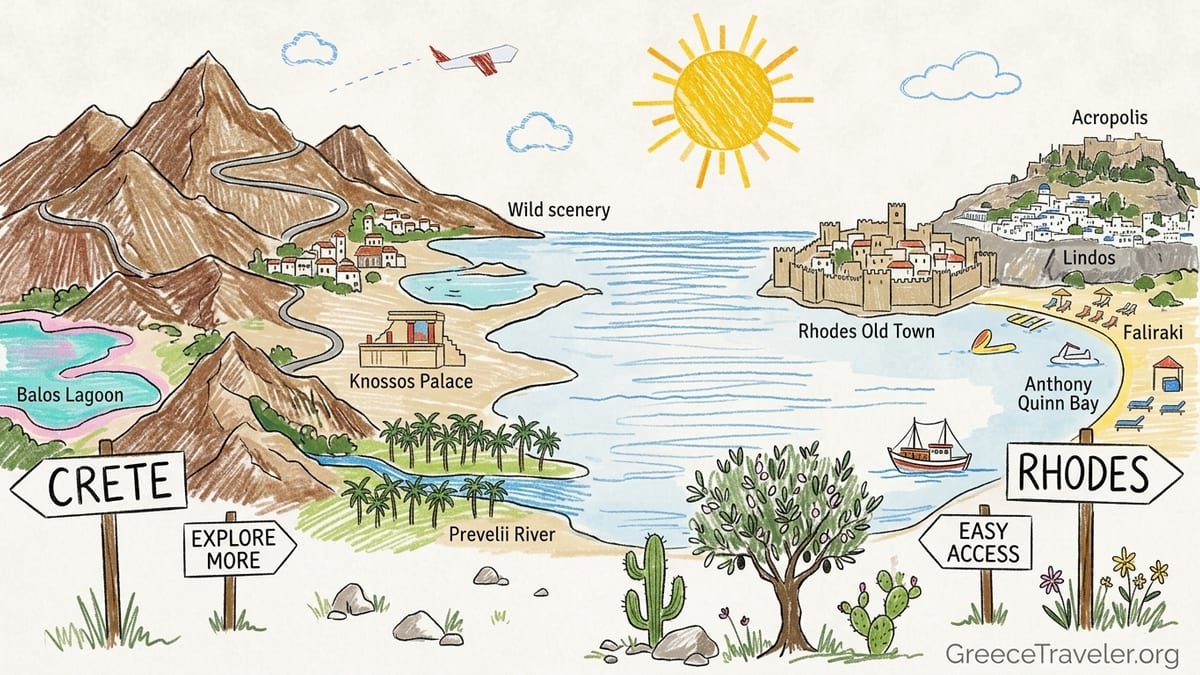
Overall vibe: Big-country Crete vs compact Rhodes
Crete is Greece’s largest island and feels almost like a country within a country. Distances are significant: driving from Chania in the northwest to Agios Nikolaos in the east takes around 3 hours without stops, and crossing from north to south over the mountains can easily add another 60 to 90 minutes. That scale is part of the appeal. You can spend a week just exploring the west around Chania and Balos, or two weeks crossing from the Venetian harbor of Rethymno to the palm forest of Vai, and still feel you have only scratched the surface.
Rhodes, by contrast, is manageable in a single stay. Rhodes Town to Lindos is roughly a 1-hour drive along the east coast, and most major resort strips and beaches sit off this same spine of road. For many travelers that means less decision fatigue and easier logistics. You can stay in a beach resort at Faliraki or Kolymbia, rent a car for just a couple of days, and still see Rhodes Old Town, Lindos and several coves without feeling rushed.
In practical terms, choose Crete if you enjoy the feeling of a large, varied island with distinct regions and you are happy to spend time on the road. Choose Rhodes if you want something you can understand and “do” more fully in 4 to 7 days, with far shorter driving days and a simple mental map.
The atmosphere also differs. Crete’s villages in the interior, such as Aradena or Anogia, still feel deeply traditional, with older men drinking raki in kafeneia and minimal resort development. Rhodes has quieter corners in the south, but its tourism is more concentrated along the east coast, where beach resorts, bars and water sports are never far away.
Beaches and sea: Iconic variety vs easy access
Both islands are strong on beaches, but they deliver different experiences. Crete is famous for variety and drama. On the west coast, Balos Lagoon mixes white sand, shallow turquoise water and a wild setting backed by a Venetian fort, while Elafonisi has pale pink sand in places and a shallow lagoon that is ideal for paddling. Further south, Preveli beach sits where a palm-lined river meets the Libyan Sea, while the east coast’s Vai beach is backed by one of Europe’s largest natural palm groves. Many of these spots require effort: Balos might mean a 1-hour bumpy drive plus a steep walk down, or a boat excursion; Elafonisi can involve 2.5 to 3 hours of driving each way from Chania depending on traffic.
Rhodes’ beaches are more about convenience and classic holiday comfort. Along the east coast you find long stretches such as Faliraki and Afandou with sunbeds, showers, water sports and beach bars, and more scenic coves such as Tsambika and Anthony Quinn Bay. Around Lindos, St Paul’s Bay is a postcard-perfect horseshoe of clear water with tavernas and sunloungers just steps from the sand. From Rhodes Town, popular beaches like Faliraki and Tsambika are roughly 30 to 40 minutes by car, so you can easily mix city sightseeing with beach time without committing to full-day road trips.
For travelers who love hunting down wild and unusual coasts, Crete is ahead. You can spend several days just doing beach excursions in the Chania region alone, from the pink lagoon of Elafonisi to more low-key family options like Marathi or Stavros. If your priority is waking up directly on a beach with restaurant and bar options on the sand, Rhodes makes life simpler, since many of its major resorts front directly onto organized beaches and you never need to drive far for a swim.
It is also worth considering time of year. In midsummer, headliners such as Balos, Elafonisi, Lindos and St Paul’s Bay get very busy from late morning onwards. On Crete, that often means long walks from overflow parking and some congestion on narrow access roads. On Rhodes, the trade-off is crowded sunbed lines in compact bays. In both cases, early starts or late-afternoon visits significantly improve the experience.
History, culture and day-to-day sightseeing
Crete’s historical appeal rests heavily on its ancient Minoan heritage and layered Venetian and Ottoman history. The Palace of Knossos near Heraklion is the star, with its reconstructed sections hinting at a Bronze Age civilization that flourished long before classical Athens. In practice, a visit to Knossos is often combined with the Heraklion Archaeological Museum, where many of the original frescoes and artifacts are displayed. Alongside that, Venetian harbors in Chania and Rethymno, scattered monasteries such as Arkadi, and mountain villages provide plenty of non-beach days.
Rhodes is dominated by its medieval period. Rhodes Old Town is a UNESCO-listed walled city, with cobbled streets, inns of the Knights and the Palace of the Grand Master forming a compact historic district that is easy to explore in a single day. Many visitors stay in or just outside the walls and spend their evenings wandering between the old city’s restaurants and bars. To the south, the whitewashed village of Lindos, with its acropolis on a rocky headland above twin bays, offers another major historical sight that can be tackled during a day trip or as a base for a few nights.
If archaeology and very ancient history are central to your trip, Crete’s Minoan sites and museums give it the edge. You can plan a loop that takes in Knossos, the lesser-visited Minoan palace at Phaistos and smaller sites like Malia, interspersed with wine tasting in the Heraklion hinterland or walks in gorges such as Samaria or Imbros. If your mental image of a “historic Greek island” is more about knights, castles and fortified harbors, Rhodes’ Old Town and Lindos will deliver that mood with far less time in transit.
Both islands have plenty of living culture as well. On Crete, it is easy to find traditional music nights in village tavernas, particularly in the Rethymno and Chania regions, and summer festivals in towns like Heraklion. Rhodes has a more resort-oriented nightlife in Faliraki and Ixia, plus cultural events in the moody courtyards and squares of the Old Town during peak season.
Road trips, car dependence and how long to stay
Crete rewards slow travel and almost demands a car for anyone wanting to see more than a single resort area. The main north-coast highway connects the biggest towns, but many of the island’s highlights sit off smaller, winding roads. For example, driving from Chania to Elafonisi involves crossing the mountains on narrow, twisty routes, and reaching the gorge and beach at Preveli means tackling hairpins and village lanes. A typical first-time itinerary might be 10 to 14 days, split between two or three bases such as Chania, Rethymno and the south coast near Plakias or Loutro. With that approach you can mix long scenic drives with lazy days, without spending every second day packing and unpacking.
Rhodes is far more compact and forgiving. You can base yourself in Rhodes Town or a beach resort like Faliraki or Kolymbia and rent a car for just a couple of days to see Lindos, Tsambika and a few viewpoints on the west coast. The drive from the port or airport to most major resorts rarely exceeds an hour. For many travelers, 5 to 7 days is enough to feel they have done the island justice: one or two days for Rhodes Old Town, one day for Lindos, two or three days for beaches and boat trips, and perhaps a drive into the interior.
In terms of car dependence, ask yourself how much you enjoy driving on holiday. On Crete, even if you rely on organized excursions, you will still face longer journey times. A boat trip to Balos or a bus-led day to Elafonisi can mean 10 to 11 hours door to door from Chania hotels, including pick-ups and returns. Rhodes’ shorter distances make group excursions and taxis more viable if you prefer not to drive: a taxi from Rhodes Town to Faliraki, for instance, is a common and relatively short hop, and many resorts are on public bus routes that run along the east coast.
If you only have 4 or 5 days and want to feel like you have properly “done” an island, Rhodes is generally a more satisfying fit. If you have 10 days or longer and like stringing together scenic drives, mountain passes and different coasts, Crete will keep you exploring happily for the full duration.
Where each island shines for different travelers
For families, both islands work, but in slightly different ways. Large, all-inclusive resorts with pools and kids’ clubs are easy to find on Rhodes’ east coast around Faliraki, Kallithea and Kolymbia, and many sit directly on gently shelving beaches. That setup is ideal if you want minimal planning and short transfer times with younger children. Crete has big resorts too, especially around Hersonissos and Elounda, but its main strengths for families are space and choice. You can pair a few nights at a resort hotel with several days in a smaller coastal town like Agios Nikolaos or Plakias, where older children can try snorkeling, paddleboarding or simple hiking in nearby gorges.
Couples and honeymooners often find Rhodes appealing for shorter, more focused trips. A week split between a boutique guesthouse in Rhodes Old Town and a stylish adults-oriented hotel near Lindos allows for lazy beach days, sunset dinners under medieval walls and a boat trip or two without ever facing a long drive. On Crete, romantic trips tend to be longer and more road-trip based: for example, five nights in Chania’s old town followed by five nights in a south-coast village like Loutro or Sougia, with drives to Balos, Elafonisi or mountain viewpoints in between.
For hikers and outdoor travelers, Crete takes a clear lead. The Samaria Gorge, often done as a full-day excursion from Chania, is one of Greece’s most famous hikes, and secondary gorges like Imbros or Kourtaliotiko add options at different difficulty levels. Combining these with highland drives through the White Mountains or Psiloritis region gives Crete a more rugged, adventure-travel flavor. Rhodes has a handful of rewarding walks, such as the trail up to Tsambika Monastery above the beach or hikes around Profitis Ilias, but its landscapes feel softer and more compact.
Finally, if you like to combine islands, Rhodes often slots more easily into multi-stop itineraries because of its location within the Dodecanese. Travelers sometimes pair Rhodes with Symi or Kos via ferries, while Crete is often the main event at the southern end of a trip that otherwise focuses on Athens and the mainland.
Nightlife, food and accommodation
Nightlife on both Crete and Rhodes tends to concentrate in specific zones. On Rhodes, Faliraki is the long-standing party hub with clubs, late-opening bars and beach nightlife that appeals to younger crowds. Rhodes Town and Lindos offer a more mixed scene, with rooftop bars, cocktail terraces and open-air venues that stay lively well past midnight in July and August. On Crete, Hersonissos and Malia on the north coast draw the party-focused set, while Chania and Rethymno have a broader selection of cocktail bars, wine bars and waterfront spots where the mood is lively but less club-driven.
Food is a major reason many repeat visitors choose Crete. The island is known for its rustic, vegetable-forward cuisine and locally produced olive oil, cheeses and wines. In practice that means simple but memorable meals in village tavernas: slow-baked lamb with potatoes in the mountains near Anogeia, or fresh seafood and dakos salad in a harbor taverna in Chania. Rhodes has plenty of excellent tavernas too, including atmospheric spots inside the medieval walls and on Lindos’ roof terraces, but overall Crete’s size and agricultural hinterland give it a slight edge for travelers who build their itineraries around eating.
Accommodation options are wide ranging on both islands. Crete spans everything from family-run pensions in seaside towns like Agia Galini or Paleochora to high-end resorts in Elounda with private pools and spa facilities. Because the island is large, prices and styles vary a lot between regions: coastal villages on the south coast, for instance, often feel more low-key and good value than the more polished north-coast resorts. Rhodes’ lodging scene is more tightly clustered along its main resort areas. You find many big, modern hotels with half-board or all-inclusive packages in Faliraki, Kallithea, Kolymbia and further south around Kiotari and Gennadi, along with smaller boutique options in Rhodes Old Town and Lindos.
For budget-conscious travelers, both islands offer simple rooms in smaller towns where a double room outside peak August can often cost less than a large resort’s daily all-inclusive supplement. In practical terms, the bigger range of non-resort towns on Crete makes it slightly easier to construct an affordable, multi-stop trip that still feels rich in experiences.
Trip length, budgeting and seasonal timing
When deciding between Crete and Rhodes, start with how much time you have. With only 4 to 6 days, Rhodes is generally more rewarding. You can fly into Rhodes, transfer 20 to 60 minutes to your hotel, and spend most of your time relaxing and sightseeing rather than crossing the island. A balanced one-week Rhodes itinerary could include three days based around Rhodes Town and nearby beaches, two days further down the east coast around Lindos, and a day exploring the inland villages or the quieter south.
With 10 days or longer, Crete’s extra size becomes a positive rather than a challenge. A realistic 12-day Crete route might look like four nights in Chania, four near Rethymno or Heraklion for Knossos and central Crete, and four on the south coast or east, perhaps near Agios Nikolaos or Makry Gialos. This gives time for headline beaches such as Balos and Elafonisi, plus village exploring, hiking and winery visits, without needing to change hotels every other day.
Budgeting is similar across both islands, though specifics depend on your accommodation choices and travel month. In peak season from late June to late August, expect higher hotel and sunbed prices, plus more pressure on car rentals. Travelers visiting in May, early June, September or early October often find a sweet spot: the sea is usually warm enough for swimming, many tavernas and beach clubs are open, but crowds are thinner and driving is less stressful, particularly on Crete’s mountain roads and on the access routes to Rhodes’ most popular bays.
If you are particularly sensitive to summer heat, note that Rhodes’ southeast coast around Lindos is among the warmer parts of Greece, which works well if you love hot, dry beach days but can feel intense for city sightseeing in July and August. Crete’s mountains and varied coasts give you a bit more scope to escape the hottest spots by heading inland or to breezier south-coast villages.
The Takeaway
In the end, the choice between Crete and Rhodes is less about which island is “better” and more about what kind of trip you want. Crete is larger, more varied and more demanding. It stands out for rugged mountains, long road trips, Minoan archaeology and a food culture that rewards those who wander into the hills and small harbors. It suits travelers with at least 10 days, a willingness to drive and a desire to combine iconic beaches like Balos and Elafonisi with quieter coves, gorges and mountain villages.
Rhodes is the easier island to grasp. Its medieval Old Town, the white village of Lindos and a chain of east-coast beaches form a compact, highly accessible triangle that works beautifully for a 5 to 7 day holiday. You can stay in one or two bases, make short day trips and return to the same beach bar or taverna in the evening without feeling you are missing large swathes of the island.
Put simply, choose Crete if you want scale, variety, road-trip freedom and deep dives into landscapes and food. Choose Rhodes if you prefer a shorter, more straightforward break that still balances history, beaches and resort comfort. Either way, planning with realistic drive times, an eye on summer crowds at star beaches and a willingness to explore slightly beyond the obvious will pay off in a richer, more relaxed Greek island experience.
FAQ
Q1. Is Crete or Rhodes better if I only have one week?
For a week or less, Rhodes usually works better because it is compact. You can see Rhodes Old Town, Lindos and several beaches without spending long days driving.
Q2. Which island has better beaches overall?
Crete offers more variety and dramatic landscapes, from pink-sand lagoons to palm-backed coves, while Rhodes focuses on easy-access, well-equipped resort beaches along the east coast.
Q3. Do I need to rent a car on Crete and Rhodes?
On Crete, a car is strongly recommended if you want to reach headline beaches and mountain villages. On Rhodes, you can rely more on short car rentals, taxis and buses, especially if you stay along the east coast.
Q4. Which island is better for families with young children?
Both work well. Rhodes is simpler for resort-based family trips with short transfers and organized beaches, while Crete suits families who like mixing a few resort days with exploring villages and quieter coasts.
Q5. Where will I find livelier nightlife, Crete or Rhodes?
Rhodes has concentrated nightlife in Faliraki, Rhodes Town and Lindos, with plenty of bars and clubs. Crete’s nightlife is more spread out, with party hubs like Malia alongside atmospheric late-night bars in Chania and Rethymno.
Q6. Is Crete really too big for a short trip?
You can visit Crete for 4 or 5 days, but you will need to focus on just one region, such as the Chania area. To appreciate the island’s variety, 10 days or more is ideal.
Q7. Which island is better for hiking and outdoor adventures?
Crete is stronger for hiking and rugged scenery, with famous gorges, mountain ranges and long coastal trails. Rhodes has some good walks but overall feels more low-key for hiking.
Q8. Are food and restaurants better on Crete or Rhodes?
Both islands have excellent tavernas, but Crete has a slight edge thanks to its strong local food culture, mountain produce and wide choice of village and harbor eateries.
Q9. Can I combine both islands in one trip?
It is possible but usually involves a domestic flight or a long ferry and extra logistics. Most travelers get more out of choosing one island and exploring it in depth, especially on a shorter holiday.
Q10. Which island is easier to explore without leaving my resort much?
Rhodes is easier for a mostly resort-based stay, as many hotels sit directly on good beaches and key sights like Rhodes Old Town and Lindos are reachable on short day trips.