


The Sporades are some of the easiest Greek islands to fall in love with and some of the hardest to choose between. Skiathos, Skopelos, Alonissos and Skyros all offer pine backed hills, clear water and old stone towns, yet the experience on each can feel completely different once you factor in flights, ferries, buses, beaches and nightlife. With around eighteen hundred stays listed across the archipelago and particularly dense clusters around Skiathos and Skopelos, the real art is not finding accommodation but deciding where to base yourself.
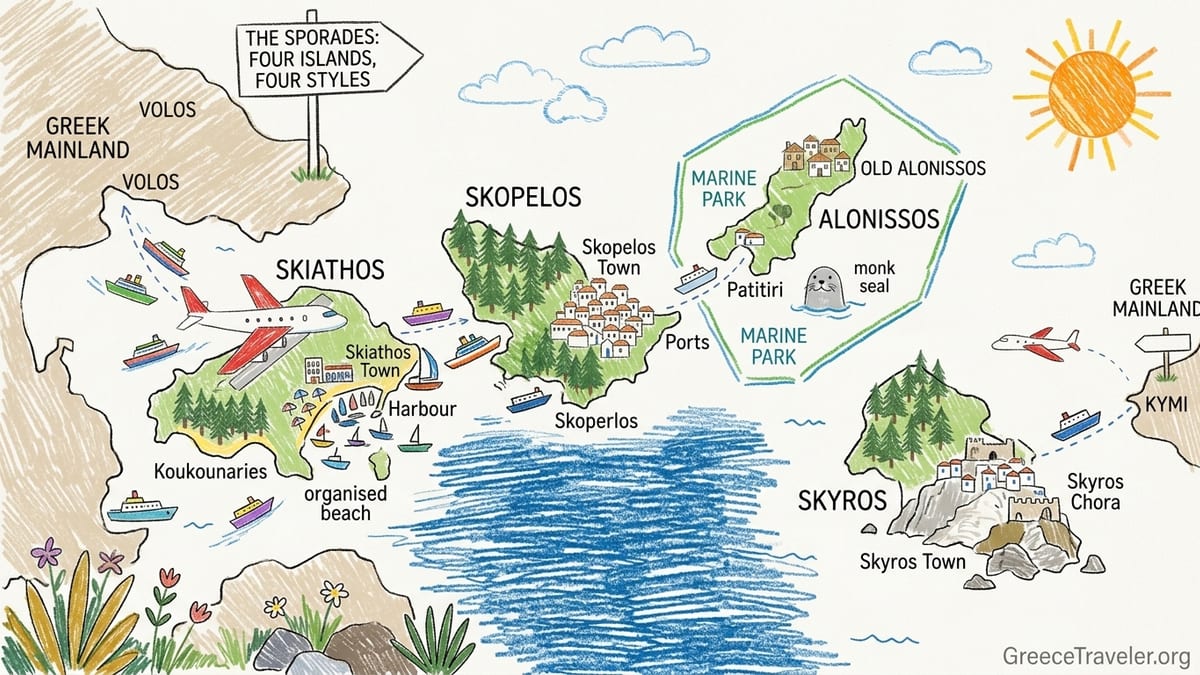
Understanding the Sporades: Four Islands, Four Travel Styles
Skiathos is the most accessible and developed of the Sporades. It has the only international airport in the group, regular summer flights from many European cities, and frequent ferries to Volos and the other northern islands. That makes it the default first stop for most visitors. The island itself is compact, about 12 kilometres from Skiathos Town to Koukounaries along the south coast road, with more than 60 beaches ranging from organised strips like Megali Ammos to boat access only coves in the north. In practice, this means you can combine a town stay with easy day trips to beaches or base directly on the sand and still ride the bus into town for dinner.
Skopelos sits just east of Skiathos and feels immediately greener and more traditional. It has no airport, so arrivals come by ferry or hydrofoil, usually via Skiathos or the mainland ports of Volos and Agios Konstantinos. Skopelos Town climbs steeply from the harbour in whitewashed tiers, with tiled roofs and small churches that give it more of a Cycladic look, while the hinterland is dense pine forest. The island’s scale, plus a bus network that radiates from Skopelos Town to beaches such as Stafylos and Panormos, makes it good for visitors who want scenery, hiking and local life rather than late night bars.
Alonissos is quieter again. It lies one ferry hop beyond Skopelos and shares its waters with the National Marine Park of Alonissos and Northern Sporades, where the Mediterranean monk seal has one of its last refuges. Most visitors stay in Patitiri, the main port, or in the restored hilltop settlement often called Old Alonissos. There is no airport, nightlife is low key, and much of the island’s appeal lies in walks along old stone paths, kayaking in coves and boat trips into the marine park. It suits travellers who are happy with a handful of tavernas instead of dozens and are more interested in quiet evenings than clubbing.
Skyros is the outlier. Geographically it sits further south, reached by domestic flights from Athens or ferries from the small Evia port of Kymi rather than via Skiathos. The landscape shifts from pine forest in the north to rockier, almost Cycladic scenery in the south around Skyros Town. Tourism is significantly less developed than on Skiathos, and you feel this in the smaller choice of accommodation and more independent, do it yourself style. It is rewarding if you prefer local cafes to cocktail bars, are comfortable driving to explore beaches and are not relying on dense ferry timetables to hop between islands.
Skiathos vs Skopelos vs Alonissos vs Skyros: How to Choose
If your priority is minimising transit and maximising swim time, Skiathos is the simplest choice. In high season you can step off a direct flight from cities like London or Munich and be at your hotel in Skiathos Town within 10 minutes by taxi, or at a beach resort such as Megali Ammos or Troulos in under 20. Buses run along the south coast roughly every 15 to 20 minutes in peak months, with tickets in the 2 to 3 euro range from town to Koukounaries, so a car is optional rather than essential if you stay on that axis. Nightlife in Skiathos Town, especially around the old port and bar street, keeps going well past midnight, with everything from cocktail terraces to loud clubs.
Skopelos makes more sense if you prefer evenings in an old town over late nights in a bar strip. The ferry from Skiathos to Skopelos Town can take as little as 35 to 50 minutes on a high speed catamaran, so it is realistic to land on Skiathos in the afternoon and be checking into a pension in Skopelos Town in time for dinner. Once there, you can walk from an old town guesthouse to the harbour promenade, choose between traditional fish tavernas and more contemporary wine bars, and then retreat back into quiet lanes. The beaches tend to be pebble or coarse sand, backed by pine forest, and the nightlife is centred on waterfront bars that close far earlier than their Skiathos equivalents.
Alonissos is ideal if you imagine your evenings ending on a terrace with only cicadas and the distant sound of the harbour for company. Ferries from Skiathos or Skopelos to Patitiri are not as frequent as intra island buses, but in summer there are usually at least one or two daily connections. Once on Alonissos, buses link Patitiri with Old Alonissos and a few beach areas, but frequencies are limited enough that many visitors either walk the old stone kalderimi routes or rent a small car for a few days. Instead of clubs, you get simple harbourfront tavernas where a dinner of grilled fish, Greek salad and house wine might come to 20 to 30 euros per person.
Skyros works best for people who treat the island as its own trip rather than as part of a northern Sporades hop. You are unlikely to combine it with Skiathos and Skopelos without backtracking via the mainland or changing ferries in less obvious ports. The payoff is an island where you can still find uncrowded beaches in August, where the main town’s kafeneia fill with a mostly Greek crowd, and where festivals and local traditions such as carnival are more influential than package tourism. With public transport limited to a few bus routes, hiring a car or scooter is far more important than on Skiathos or Skopelos.
Within Skiathos: Skiathos Town vs Koukounaries and Troulos
The core decision on Skiathos is whether to stay in Skiathos Town or along the south coast beaches around Troulos and Koukounaries. Skiathos Town suits travellers who want to walk to dinner, bars and shops, and who do not mind using the beach bus or boat services by day. Hotels such as modest harbourfront studios or small boutique properties in the old lanes give you immediate access to the ferry port, making onward trips to Skopelos or Alonissos almost effortless. You can be on a morning catamaran with a coffee from a café across the street, then back in town that evening dining in a courtyard restaurant without once needing a taxi.
Koukounaries, at the far end of the paved south coast road, is often described as one of the best beaches in Greece, with fine sand, shallow water and a dense pine forest and lagoon behind the dunes. The trade off is that it is essentially a hotel and beach zone rather than a traditional village. Resorts and apartments line the access roads, beach bars and tavernas sit behind the sand, but for a real evening stroll with shops and multiple bars you are likely to take the bus back into Skiathos Town. For a family that wants children to be able to walk from room to sunbed in minutes and does not need nightlife, this can be perfect.
Troulos sits roughly halfway between town and Koukounaries and offers more of a village feel. The bay is shallow and sheltered enough that small children can stand far out, and in summer there are lifeguards and a scattering of tavernas, minimarkets and cafés behind the sand. Many of the accommodation options are low rise studios with kitchenettes, and prices can be noticeably lower than in Skiathos Town at the height of August. You can still ride the same bus line to town at night, usually in under 20 minutes, which makes Troulos a good compromise if you value quieter evenings and a walkable beach but want the option of a late night in town once or twice.
In terms of car dependence, Skiathos is the most forgiving of the islands discussed here. If you stay in Skiathos Town, Megali Ammos, Troulos or Koukounaries, the bus will cover most of your everyday needs, although hiring a small car or taking a boat excursion remains the easiest way to reach the more remote northern beaches such as Lalaria. If you plan to explore inland monasteries or do a lot of beach hopping in shoulder season, when bus timetables thin out, budget for at least a couple of days of car hire.
Within Skopelos: Skopelos Town vs Panormos and Neo Klima
Skopelos Town is the main ferry port and the heart of the island’s transport network, which makes it a natural base if you are arriving without a car. Buses radiate from the harbour to Stafylos, Agnontas, Panormos, Milia, Kastani and on to Glossa, with more frequent services in July and August. Staying in or just above the old town means you can walk from your guesthouse down cobbled steps to the harbourfront in a few minutes, then choose between a dozen or more tavernas and cafés. The nearest beaches by bus, such as Stafylos, are roughly a 10 to 15 minute ride away, and many visitors end up alternating between beach days and town wandering days.
Panormos, midway up the west coast, is a good choice if you want to be based directly on a beach. The bay here is pebbly with clear, deep water, ideal for confident swimmers and snorkellers rather than toddlers. A line of small hotels, studios and tavernas follows the curve of the beach, and in high season sunbeds and umbrellas fill much of the shore. Evenings tend to revolve around a simple pattern of beach, shower, then dinner at a table almost on the water. The island buses between Skopelos Town and Glossa stop in Panormos, so you can still dip into town for variety, but departures tail off in the late evening and a taxi back after the last bus will add to your budget.
Neo Klima, also known as Elios, was rebuilt after an earthquake and feels more modern and purpose built than Panormos. It has a marina, a pebble and sand beach edged by pine forest, and a handful of tavernas and rooms to let. It is quieter than Panormos, which can make it attractive in peak season if you want space on the beach, but the trade off is a smaller choice of places to eat and drink. With the bus route passing through, you can commute to other beaches or to Skopelos Town, yet many visitors who choose Neo Klima do so precisely because they are planning to rent a car and explore independently.
Compared with Skiathos, Skopelos rewards having at least a few days of car hire more strongly. Public buses are reliable in high summer but operate on a fixed spine route, and some of the prettiest coves or viewpoints are down side roads. If you base in Skopelos Town without a vehicle you can still see plenty, but if you stay in Panormos or Neo Klima and want to visit multiple villages and remote chapels, you will likely end up arranging wheels.
Within Alonissos: Patitiri vs Old Alonissos
Patitiri is the main port and practical hub of Alonissos. Most ferries and hydrofoils arrive here, and the harbourfront concentrates the island’s small supermarket, bank services, car rental offices and a clutch of cafés and tavernas. Accommodation ranges from simple rooms above restaurants to small hotels built into the hillside behind the harbour, many with sea views. If your priority is easy arrivals and departures, minimal hills and straightforward access to boat trips into the marine park, Patitiri is the obvious base. You can finish breakfast and be boarding a day cruise boat within five minutes’ walk.
Old Alonissos, often referred to simply as the Chora, perches on a hilltop above Patitiri and has a very different feel. After an earthquake in the 1960s, many residents moved down to the port, and the old town fell quiet until it was slowly restored. Today its lanes are a mix of traditional stone houses and tasteful holiday homes, with a handful of boutique guesthouses and small tavernas. Evenings here are calmer than in Patitiri, with lantern lit courtyards and a few bars offering views across the island chain. There is a local bus between Patitiri and the Chora in season, and the ride takes roughly 10 to 15 minutes, but services are not hourly all day, so visitors often time their returns around the timetable or use taxis.
Beach access is where the two bases diverge most clearly. From Patitiri you can walk to a couple of small swimming spots in less than 15 minutes and are closer to the road that heads north to popular beaches like Roussoum Gialos and Leftos Gialos. Chasing the bus to do every swim becomes tiring, so many people based here rent a car for at least half their stay. From Old Alonissos, you are committing to either using the bus, arranging transfers, or hiring a car from the outset, as the walk down is long and steep in summer heat and the walk back even more so.
In terms of atmosphere, Patitiri feels more like a small working port that happens to host holidaymakers, while Old Alonissos feels like a restored traditional village with holidaymakers woven into its fabric. If you enjoy a small choice of low key bars and tavernas and being able to look down at the harbour lights from above, the Chora is worth the extra logistics. If you prefer popping into a bakery at 7 a.m., picking up supplies from the island’s main supermarket and walking along the quay to dinner, Patitiri is better aligned with your habits.
Skyros: A More Independent, Less Touristed Choice
Skyros receives far fewer visitors than Skiathos or Skopelos and caters to them in a different way. Skyros Town, also called Chora, rises dramatically above the east coast and looks almost Cycladic, with white cube houses climbing up toward a castle. The island’s main resort-style area, Magazia or Molos, stretches along the sandy bay below. Many visitors choose to stay in simple seafront hotels or studios here, crossing a small road to reach the beach and driving or taking a short taxi up to town in the evenings. There is some nightlife in the form of bars and music cafés, but nothing like the density or volume of Skiathos Town.
Getting to Skyros often involves either a domestic flight from Athens with a small regional airline or a ferry from Kymi on Evia, which itself requires a bus or car journey from Athens. This additional step tends to filter visitors who are comfortable piecing together their own itinerary rather than relying on package transfers. Once on the island, there are local buses, but they are limited enough that anyone wanting to explore the wilder north, visit multiple remote beaches or head out in the evenings from a rural base is well advised to rent a car or scooter for most of their stay.
Accommodation options on Skyros range from family run pensions in Skyros Town to contemporary seafront hotels in Magazia and a few inland guesthouses geared to walkers and retreat groups. Because the island has fewer large developments, you are more likely to find places with a personal feel: owners who remember your breakfast preferences by the second morning or who can recommend their cousin’s taverna on the other side of the island. Prices vary, but in peak season you can often find a basic double in a small pension for less than the equivalent in Skiathos, while more stylish boutique options remain lower profile than on better known islands.
For travellers who value local culture and independence over infrastructure, Skyros is rewarding. You might spend a morning swimming at a nearly empty cove, an afternoon visiting workshops where artisans carve the island’s distinctive wooden furniture, and a night in Skyros Town at a café where most of the conversation is in Greek. It is not the place to rely on buses or expect beach clubs with international DJs, but it is a good candidate if you have already done more popular islands and want something less touristed that still feels very Greek.
Nightlife, Ferries, Buses and Car Hire: Practical Comparisons
Nightlife across the Sporades peaks in July and August, with Skiathos Town at the top of the scale. Here you find cocktail bars along the old port, late night clubs off Papadiamantis Street and loud music that runs into the early hours. Skopelos Town sits in the middle, with a pleasant evening buzz, harbourfront bars and occasional live music but far fewer venues open after 1 or 2 a.m. Patitiri and Old Alonissos are quiet, with nights tending to end when the last diners leave the tavernas, while Skyros offers a small number of late opening bars in its main town and seaside strip without any dedicated club scene.
Ferry convenience is another major factor in where you stay. Skiathos Town is the main gateway, with ferries and hydrofoils linking the island to Volos, Agios Konstantinos and the other northern Sporades. Staying within walking distance of the quay makes it easy to slot in a day trip to Skopelos or Alonissos or to plan a multi island itinerary. Skopelos Town is the principal port on Skopelos and the best base if you are arriving or leaving by ferry, though Glossa and its port Loutraki in the north also see services. Patitiri is the ferry hub for Alonissos, while Skyros has its own separate ferry line from Kymi, meaning it rarely fits neatly into the same hop as the three northern islands.
Bus networks are best on Skiathos and Skopelos and more limited on Alonissos and Skyros. On Skiathos, the single south coast route between Skiathos Town and Koukounaries has stops near most major beaches and runs regularly in high season, making it entirely feasible to stay without a car if you choose your base on this spine. On Skopelos, buses radiate from Skopelos Town across the southern and western coasts, but services thin out in shoulder season, and travel to more remote areas is slower. Alonissos has a simpler network linking Patitiri, Old Alonissos and a few beaches, while Skyros generally expects visitors to rely more on private vehicles.
Car hire costs vary but, as a rough guide, in high season you might expect to pay from around 40 to 60 euros per day for a small manual car booked on island, with discounts for multi day rentals. In practice, many travellers on Skiathos and Skopelos combine buses for everyday beach trips with a day or two of car hire to reach remoter spots. On Alonissos and Skyros, especially if you stay in hilltop villages or rural accommodation, it is prudent to budget for more days of car hire or to plan your itinerary explicitly around bus timetables and walking routes.
The Takeaway
Choosing where to stay in the Sporades is less about finding availability and more about aligning the island and base with the trip you want. Skiathos works best if you want straightforward flights, plenty of beaches on one bus line and nightlife you can walk to from your hotel. Within the island, Skiathos Town is the obvious choice for ferry convenience, restaurants and bars, while Troulos and Koukounaries suit people who prefer to step straight from their room to the sand and are happy to bus into town when they want more atmosphere.
Skopelos is ideal if you value scenery and traditional atmosphere over clubs. Skopelos Town, with its steep lanes and harbour, gives you access to buses and tavernas and acts as a classic Greek island base. Panormos and Neo Klima bring you closer to the water and pine backed bays, with a quieter, more resort like feel and a stronger case for renting a car. Alonissos adds another step of calm, with Patitiri convenient for ferries and boat trips and Old Alonissos offering slow evenings in a beautifully restored hilltop village.
Skyros stands apart as a more independent, less touristed option, better reached directly from Athens than via a northern island hop. It suits travellers who are comfortable hiring a car, piecing together connections and trading nightlife and choice of restaurants for authentic local colour. Across all four islands, it pays to match your base to how you imagine your evenings: wandering old town lanes, sitting on a quiet balcony or walking home from a bar street at 2 a.m.
With around eighteen hundred places to stay spread across the Sporades, from harbourfront rooms in Skiathos Town to hillside suites above Old Alonissos, the right choice is out there. Start by deciding whether flights and nightlife, scenery and tradition, nature and quiet, or independence and low key tourism matter most. Then choose the specific town or beach that fits that priority, and let the islands’ pine scented hills and clear water do the rest.
FAQ
Q1. Which Sporades island is best for a first time visitor?
For most first timers Skiathos is the easiest choice, thanks to its international airport, frequent buses, wide beach selection and lively but compact Skiathos Town.
Q2. Can I get around Skiathos, Skopelos or Alonissos without a car?
On Skiathos and Skopelos you can rely on buses in high season if you stay near the main routes, but on Alonissos and Skyros a car quickly becomes useful for exploring.
Q3. Is Skiathos Town or Koukounaries better for families?
Troulos and Koukounaries often suit families better, with shallow, sheltered beaches and accommodation close to the sand, while Skiathos Town works if older children want nightlife nearby.
Q4. Where should I stay for the best scenery and traditional atmosphere?
Skopelos Town and Old Alonissos are strong choices if you want whitewashed lanes, sea views and a more traditional feeling, backed by pine forest and quiet bays.
Q5. Which base is best if I want a quiet trip close to nature?
Alonissos, especially stays in or above Patitiri or in Old Alonissos, is ideal for a quiet, nature focused trip with access to walking trails and marine park boat excursions.
Q6. How easy is it to visit multiple Sporades islands in one trip?
Island hopping between Skiathos, Skopelos and Alonissos is straightforward in summer with regular ferries; combining these with Skyros usually requires extra mainland connections.
Q7. Is Skyros a good idea without a rental car?
You can manage short stays in Skyros Town or Magazia using local buses and taxis, but to reach more remote beaches and villages a rental car or scooter is strongly recommended.
Q8. Where should I stay if nightlife is a priority?
If nightlife matters most, base yourself in Skiathos Town, where bars, clubs and late opening cafés cluster around the old port and central streets.
Q9. Which areas are best for travellers on a tighter budget?
Studios in Troulos on Skiathos, rooms in Panormos or Neo Klima on Skopelos, and simple pensions in Patitiri on Alonissos often offer better value than the most central town spots.
Q10. When should I book accommodation in the Sporades?
For stays in July and August, especially in popular areas like Skiathos Town, Koukounaries or Skopelos Town, it is wise to book several months in advance for the best choice.