


The Sporades are a rare combination in the Aegean: emerald pine forests, clear turquoise coves and easy connections from the mainland, yet a feel that is still more Greek summer than mass package resort. For first-time visitors, the key to planning a smooth trip is understanding that there are really two different Sporades experiences. Skiathos, Skopelos and Alonissos form one connected island chain, linked by regular ferries. Skyros, by contrast, stands alone to the southeast, with its own ferry and flight routes. Treat them as two separate trips and you will avoid unrealistic itineraries and stressful last-minute changes.
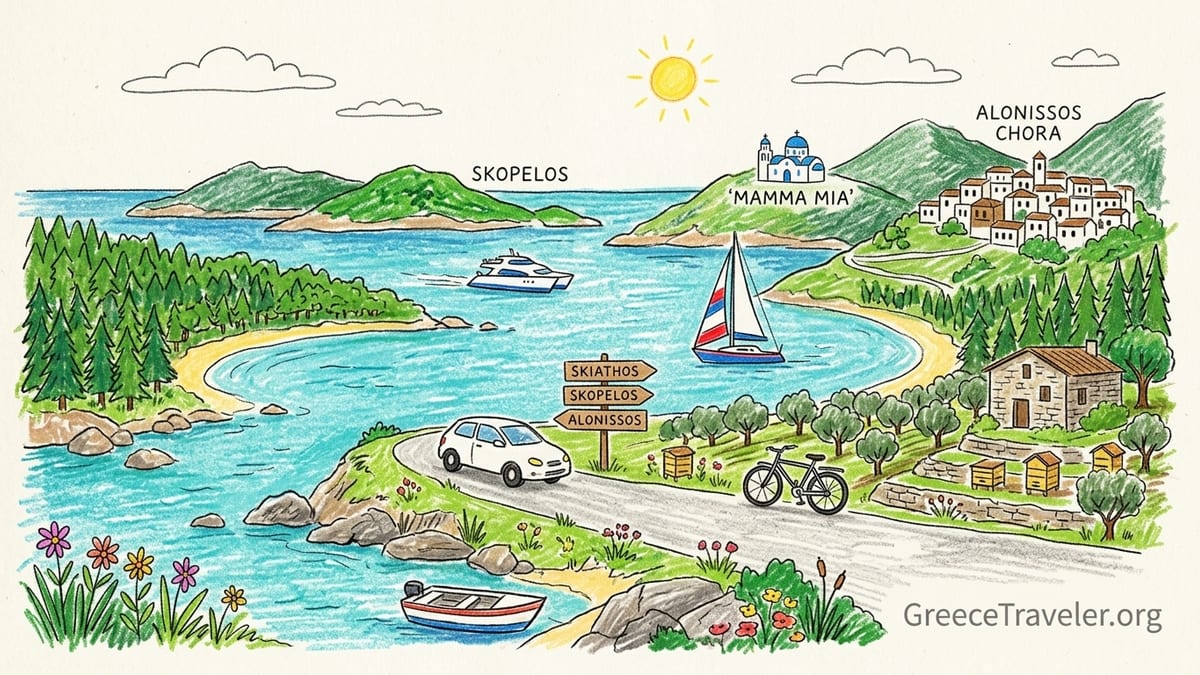
Understanding the Sporades and Why They Are So Green
Look at a map and you will see the three main Northern Sporades islands lined up from west to east: Skiathos closest to the mainland, then larger Skopelos, then quieter Alonissos, with uninhabited islets and the National Marine Park stretching beyond. Skyros sits well to the south and slightly east, surrounded by open water and connected to the mainland by its own routes from Kymi in Evia and by domestic flights. In practical terms, you can hop easily between Skiathos, Skopelos and Alonissos in a single trip, but reaching Skyros usually means a separate journey via Kymi or a flight from Athens.
The first impression on arrival is how green these islands are compared with many parts of the Cyclades or Dodecanese. Slopes are covered with Aleppo and black pine, olive groves and cypress, running almost down to sandy bays. This greenery is partly thanks to the Sporades’ position in the northwest Aegean, where winter and spring bring more rainfall than the sunbaked central Aegean. The islands are also relatively compact and mountainous, which helps collect moisture and feed the aquifers that keep forests alive into summer.
On Skiathos you can see this contrast on a simple bus ride from Skiathos Town along the south coast road past Megali Ammos and Agia Paraskevi: pine-covered hills frame each beach in deep green. Skopelos is even more densely forested, with its north coast plunging straight from wooded ridges into cliffs and pebble coves. Alonissos feels wilder again, with terraced hills and pine groves giving way to maquis and low shrubs as you head toward the marine park. Even Skyros, which has a rocky, almost lunar southern half, keeps a surprisingly green north with pine woods around areas like Atsitsa and Agios Fokas.
For travelers this lushness has several practical effects. Summer temperatures are still hot, but shaded walking paths make light hikes possible in the mornings and late afternoons. It also means a rich rural culture: family olive presses, small vineyards and beekeeping, especially on Skopelos and Skyros, where you will see local honey on most taverna menus. When you read about the “green Sporades” in brochures, it is not just a slogan; the difference is obvious as soon as your ferry noses into a pine-fringed bay.
Getting In and Around: Ferries, Airports and Island Hopping
The main gateway to the chain is Skiathos Island National Airport, which has frequent summer flights from Athens and other Greek cities, plus seasonal international services from parts of northern and western Europe. Many visitors fly directly to Skiathos from their home country, then move on by ferry to Skopelos or Alonissos. Even if you land in Athens or Thessaloniki, Skiathos often works as the first island stop, since there are multiple daily boats linking it to the rest of the chain in high season.
Ferries between Skiathos, Skopelos and Alonissos are straightforward in summer. Conventional ferries and high-speed catamarans run routes like Volos to Skiathos to Skopelos to Alonissos, as well as services from Mantoudi in northern Evia. Travel times vary from around 1 hour from Skiathos to Skopelos on a high-speed vessel to roughly 2 hours on a slower ferry to Alonissos. It is common to arrive on Skiathos in the morning, spend a few hours in town, then catch an afternoon boat on to Skopelos. Prices fluctuate, but as a rough guide you can expect a one-way high-speed ticket between islands to cost similar to a mid-range restaurant meal in Greece.
Skyros operates on a different network. Regular ferries link Skyros to Kymi, a small port on the island of Evia that is about a 2.5 hour drive from Athens. There is no practical, regular ferry that connects Skyros with Skiathos, Skopelos or Alonissos, despite what a quick glance at the map might suggest. Some visitors spend hours trying to find a “hidden” Skyros to Skopelos route that simply does not exist. To include Skyros in the same trip, you would typically return to the mainland first, then continue separately, or fly from Athens to Skyros and treat it as its own mini-holiday.
For island hopping within the main chain, a simple loop works well: start in Skiathos for easy access and busy beaches, move to Skopelos for a larger, greener island and traditional villages, then finish in Alonissos for a quieter, nature-focused stay and marine park boat trips. Many travelers choose 3 to 4 nights per island on a 10-day itinerary. Try to keep your last night on Skiathos or Volos if you have an early flight home; connections usually run smoothly but summer meltemi winds can cause delays, and being on the departure island the night before removes a lot of stress.
Skiathos: Beaches, Nightlife and Easy Logistics
Skiathos is the smallest of the three connected islands, but it has the busiest airport and the most developed tourist infrastructure. Skiathos Town curves around a natural harbor with a waterfront lined by tavernas, cafe-bars and small hotels. Cobbled lanes climb the hill behind, with whitewashed houses and views out to the Bourtzi peninsula. For first-time visitors who want a soft landing in Greece, Skiathos offers an easy start: English is widely spoken, buses run frequently along the south coast, and there is a wide range of accommodation from simple rooms near Megali Ammos to higher-end hotels around Vasilias and Kanapitsa.
The island’s biggest draw is its beaches. Along the south coast, sandy bays like Megali Ammos, Agia Paraskevi and Achladies offer shallow water, sunbeds and beach bars, making them ideal for families or relaxed days. Further west, Koukounaries is one of the most famous beaches in the Sporades, backed by thick pine forest and a protected lagoon. It can get busy in July and August, especially near the main access points, but walking a few minutes along the sand usually finds a quieter patch. On the north coast, Lalaria is the postcard-perfect cove, with white stones and cliffs accessed only by boat from Skiathos Town when the sea is calm.
Public transport makes getting around straightforward. A main bus line runs from Skiathos Town to Koukounaries, with numbered stops at the major beaches and resort areas. In summer, buses can be standing-room only mid-morning, so leaving before 10 am or after 4 pm is more comfortable. Taxis are available but not plentiful, and prices reflect that; many visitors rent a small car for a few days to explore inland monasteries or less accessible coves like Mandraki or Elias. Typical daily car rental rates in peak season often fall in the range of a moderate hotel room in town, with lower prices in May, June and September.
Skiathos also works as a base for day trips. Dozens of small agencies in town advertise boat excursions around the island, visits to Lalaria and stops at nearby islets. If you are heading on to Skopelos or Alonissos, it can still be worth taking one of these early in your stay as an orientation before moving on. The combination of short flight from the mainland, frequent ferries and plenty of services makes Skiathos the most practical entry point for first-timers who may be nervous about Greek island logistics.
Skopelos: Pine Forests, Traditional Towns and Film Locations
Skopelos is larger, greener and quieter than Skiathos, with two main settlements: Skopelos Town on the east coast, where most ferries arrive, and Glossa in the northwest, perched above the port of Loutraki. Skopelos Town climbs steeply from the harbor, its maze of steps, churches and stone houses giving a strong sense of a lived-in Greek town rather than a resort. Evenings here are about strolling the waterfront, picking a taverna under the bougainvillea and perhaps listening to live rebetiko music in a small bar up the hill.
Beaches on Skopelos are mostly shingle or pebbly with clear water. Popular choices near town include Stafilos and Velanio, reached by local bus or a short drive, with pine trees sloping down toward the sea. Further west, Panormos is a broad bay with good sunset views and a row of tavernas and small hotels behind the beach. Kastani and Milia gained fame as filming locations for the musical Mamma Mia!, and visitors still come to see the headland and wooden jetty that appeared in the movie, though some structures are temporary and change over the years.
Skopelos really rewards those who explore into the hills. Driving inland from Skopelos Town toward the monasteries of Evangelistria or Prodromos takes you into dense pine forests and olive groves, with views back to the harbor and across to Alonissos on clear days. Road surfaces are generally good but narrow and winding. Hiring a small car or scooter is common; many rental agencies are clustered around the port and main road into town. First-timers who are nervous about hairpin bends may find an automatic car easier on the steep approaches to Glossa and some monasteries.
Connections to the other islands are frequent in high season. Ferries and high-speed vessels call at Skopelos Town and often at Glossa as well, creating flexibility in how you arrive and depart. For example, you might land on Skiathos, take an afternoon high-speed catamaran to Glossa, spend your first nights in that quieter corner of the island, then continue by ferry to Alonissos a few days later. Local companies also run boat trips from Skopelos to Alonissos and the marine park on calm-weather days, which can be a good way to sample Alonissos if you do not have time to stay there.
Alonissos: Marine Park, Quiet Villages and Clear Waters
Alonissos is the easternmost of the main chain and feels noticeably slower and more low-key than Skiathos or Skopelos. The main port, Patitiri, sits in a small amphitheater of cliffs, with a promenade of tavernas, cafes and a few understated bars. Above it, the restored old village of Alonissos Chora, sometimes called Old Village, crowns a hill with narrow alleys, traditional stone houses and sweeping views over the archipelago. Many travelers stay near Patitiri for convenience, then visit the old village in the evenings for dinner and sunset.
The island is a gateway to the National Marine Park of Alonissos and Northern Sporades, the first large marine protected area in Greece, created to safeguard species like the Mediterranean monk seal along with dolphins and seabirds. Numerous small boats and day-cruise companies based in Patitiri and neighboring ports on Skopelos offer full-day trips that combine swimming stops at uninhabited islets with short walking tours and the possibility, never guaranteed, of spotting wildlife. Typical itineraries leave mid-morning, include several swim stops at places like Peristera or remote coves on nearby islets, and return by late afternoon.
On land, Alonissos is ideal for low-intensity hiking and beach-hopping. A simple day might involve following one of the waymarked paths from Patitiri or the old village through pine and olive groves to beaches like Megalos Mourtias, Votsi or Leftos Gialos. These coves range from small shingle bays with a single taverna to slightly larger beaches with a couple of options for lunch and sunbeds. Water clarity is excellent; snorkel gear is useful even in shallow areas, and many visitors comment that fish life is more visible here than at busier beaches in other island groups.
Prices on Alonissos can feel slightly lower than on Skiathos and similar to Skopelos, especially for accommodation and meals in family-run tavernas. There are no large resorts, and nightlife is limited to relaxed bars and waterfront cafes. This makes Alonissos especially suitable for couples, nature lovers and families who are happy with quiet evenings. It also means that visiting in shoulder months like June or September can be very peaceful, but services such as boat trips may be reduced, so checking schedules a few days in advance is important.
Skyros: Separate, Quieter and Characterful
Skyros belongs politically and geographically to the Sporades, but for the traveler it functions as its own island world. It is smaller in population than Skiathos or Skopelos, with a distinctive landscape: a greener, forested north and a rocky, rugged south dominated by hills and the imposing profile of Kochylas mountain. The main town, Skyros Chora, climbs dramatically up a steep hill above the sea, crowned by a fortress and monasteries. Its white cubic houses look more like a Cycladic settlement than the tiled roofs of Skiathos or Skopelos, giving Skyros a hybrid personality.
Access to Skyros is via domestic flights from Athens or seasonal flights from other Greek airports, along with ferries from Kymi in Evia. In practice this means that combining Skyros with Skiathos, Skopelos and Alonissos in a single short holiday is complicated. You would usually need to travel back to the mainland, change ports and perhaps stay overnight before continuing to Skyros. For a one or two week trip, it is often more realistic to treat Skyros as a separate destination, perhaps pairing it with a few days in Athens or on Evia rather than with the northern Sporades chain.
For those who make the journey, Skyros offers a more traditional and less touristed atmosphere. Beaches like Molos, Magazia and Gyrismata near the main town provide long stretches of sand with scattered tavernas, while smaller coves such as Atsitsa and Agios Petros in the north feel remote and low-key. Inland, visitors come to see the small, semi-wild Skyrian horses, a rare local breed, and to walk old paths between stone farmhouses, chapels and viewpoints. Accommodation is mostly in small guesthouses and family hotels, with only a handful of higher-end options.
Because Skyros has its own ferry network and flight schedule, planning ahead is crucial. Retail ferry agencies in Athens or online booking platforms will show current timetables, but services can be less frequent than in the Skiathos–Skopelos–Alonissos triangle. When building an itinerary, imagine two separate trips: one to the connected northern islands, one to Skyros. Trying to bounce directly from Alonissos to Skyros will almost always mean long, backtracking travel days, and there is rarely a direct boat, even in peak summer.
Beaches, Sailing, Boat Trips and Driving Practicalities
The Sporades are above all a beach and sea destination, whether you prefer umbrella-lined sands with full services or small coves reached on foot or by boat. On Skiathos, the south coast from Megali Ammos to Koukounaries is the main strip for organized beaches with sunbeds, cafes and water sports. On Skopelos, Panormos, Stafilos and Kastani blend clear water with pine-backed scenery. Alonissos favors smaller pebble coves like Leftos Gialos and Agios Dimitrios, where the emphasis is on clean water and a couple of friendly tavernas rather than large-scale facilities. On Skyros, wide sandy beaches near Chora suit families, while the north coast has more secluded swimming spots.
Sailing and small-boat trips are a highlight of any Sporades visit. Experienced sailors often charter yachts from Volos or Skiathos and follow a loop through Skiathos, Skopelos and Alonissos, using well-protected anchorages such as Panormos Bay or the coves of Peristera islet. For non-sailors, day cruises from Skiathos Town, Skopelos Town, Loutraki or Patitiri are plentiful in summer. A typical full-day trip might cost the same as a decent dinner for two in a mid-range taverna and include swims, a simple on-board lunch and time ashore in a small harbor village.
Renting a car or scooter opens up forest roads and quieter beaches, but the terrain demands attention. Roads are mostly paved but can be narrow and winding, with steep drops in places and occasional goats or sheep on bends. On Skopelos in particular, roads linking Skopelos Town to Glossa or mountain monasteries require confident driving. Many rental companies offer small hatchbacks with manual gearboxes as the default, which are economical but can be challenging for drivers not used to manual shifting on hills. Booking an automatic in advance is wise if you prefer it, especially in July and August when fleets are stretched.
Parking can be tight in harbor areas in peak season. On Skiathos, the lanes of Skiathos Town are mostly pedestrian, with cars left in designated parking areas at the edge of town. On Skopelos and Alonissos, harbors like Skopelos Town and Patitiri have limited quay-front spaces that fill up on busy ferry days. A practical tip is to plan your first driving day on each island around understanding where locals park for the beach and evening; spending ten minutes observing can save you repeated stressful searches later in the trip.
The Takeaway
For a first visit to the Sporades, think in terms of two distinct experiences. One is the connected trio of Skiathos, Skopelos and Alonissos: easily linked by regular ferries, each with its own character, and all wrapped in the deep greens and blues that define this part of the Aegean. Skiathos offers straightforward arrivals, sandy south-coast beaches and lively nights. Skopelos adds bigger landscapes, film-famous coves and traditional villages. Alonissos provides space, quiet and a gateway to Greece’s first large marine park.
The other experience is Skyros, which shares the Sporades name but sits apart both geographically and logistically. Reaching it usually means a separate leg via Kymi or a domestic flight, rewarded with a distinctive town, a mix of green north and rocky south, and a slower, more traditional rhythm. Combining Skyros with the northern chain in a single short itinerary is technically possible but often results in long transfers and reduced time actually on the islands.
Whichever combination you choose, understanding the basic geography and transport patterns will make planning far smoother. Use Skiathos as your main gateway, allow generous margins for ferry connections in case of wind or delays, and balance busy gateways with quieter stays on Skopelos, Alonissos or Skyros. With a bit of forethought, the Sporades repay you with pine-fringed bays, clear, swimmable seas, and a version of Greek island life that still feels refreshingly unhurried.
FAQ
Q1. Can I travel directly by ferry between Skyros and Skiathos, Skopelos or Alonissos?
Direct ferries between Skyros and the other Sporades islands do not generally operate. Most travelers reach Skyros via the ferry from Kymi in Evia or via domestic flights, and treat it as a separate trip from the Skiathos–Skopelos–Alonissos chain.
Q2. How many days do I need to visit Skiathos, Skopelos and Alonissos on one trip?
A comfortable first-time itinerary allows around 9 to 12 days, with 3 to 4 nights on each island. This gives enough time for beach days, boat trips and short hikes without rushing between ferries.
Q3. Is it better to fly into Athens or directly to Skiathos?
If your dates match a direct flight to Skiathos, it usually makes logistics easiest because you arrive in the island chain immediately. If not, flying into Athens or Thessaloniki and then connecting by domestic flight or by bus and ferry works well, but adds extra travel time.
Q4. Do I need a car on the Sporades islands?
You can manage without a car on Skiathos thanks to its good bus network and taxis, especially if you stay near the main south-coast beaches. On Skopelos, Alonissos and Skyros, renting a small car or scooter for at least a few days is very helpful for reaching quieter beaches, villages and viewpoints beyond the main ports.
Q5. When is the best time to visit the Sporades for beach weather and fewer crowds?
Late May to late June and September to early October usually offer warm sea temperatures, swimming-friendly weather and thinner crowds compared with the peak of July and August. Ferries and flights still run regularly, but accommodation prices and beach density are often more comfortable.
Q6. Are the Sporades suitable for families with small children?
Yes. Skiathos in particular has many shallow, sandy beaches like Megali Ammos and Koukounaries, plus easy public transport and plenty of family-friendly accommodation. Skopelos and Skyros have more pebbly beaches in places but are generally calm and low-key, while Alonissos suits families who enjoy quieter evenings and nature-focused activities.
Q7. Can I visit the Alonissos marine park and see monk seals?
Day trips from Alonissos and sometimes from Skopelos visit parts of the marine park with swimming stops and coastal views. Monk seals are wild animals and sightings are never guaranteed, so think of these trips as a chance to experience a protected seascape with the bonus of possible wildlife encounters rather than a zoo-style visit.
Q8. How expensive are the Sporades compared with other Greek islands?
Overall costs are moderate by Greek island standards. Skiathos can feel pricier in high season, especially for waterfront stays and nightlife, while Skopelos and Alonissos are often slightly more affordable for accommodation and meals. Skyros sits somewhere in between, with limited but fairly priced options in family-run hotels and tavernas.
Q9. Is it realistic to visit the Sporades without booking ferries in advance?
In shoulder seasons it is sometimes possible to buy tickets shortly before travel, but in July and August it is safer to book main inter-island crossings and any car spaces in advance. High-speed vessels and popular routes can fill up, particularly on weekends or around public holidays.
Q10. Are there good options for hiking in the Sporades?
Yes. Skopelos and Alonissos in particular have signed trails through pine forests, olive groves and small valleys, often linking villages with beaches. Routes around Skopelos’ monasteries and the paths between Alonissos’ old village and coastal coves are popular half-day walks, best enjoyed in the cooler mornings or outside the hottest summer weeks.