


The Northern Sporades are one of Greece’s easiest areas for classic island hopping, with Skiathos, Skopelos and Alonissos linked by frequent ferries in 2026. The details, though, matter: which port you start from, whether you aim for Glossa or Skopelos Town, how to book at sensible prices, and how many islands actually fit into a one or two week trip. This guide walks through the practical ferry logistics so you can focus on beaches, pine forests and harbor tavernas instead of timetables and ticket queues.
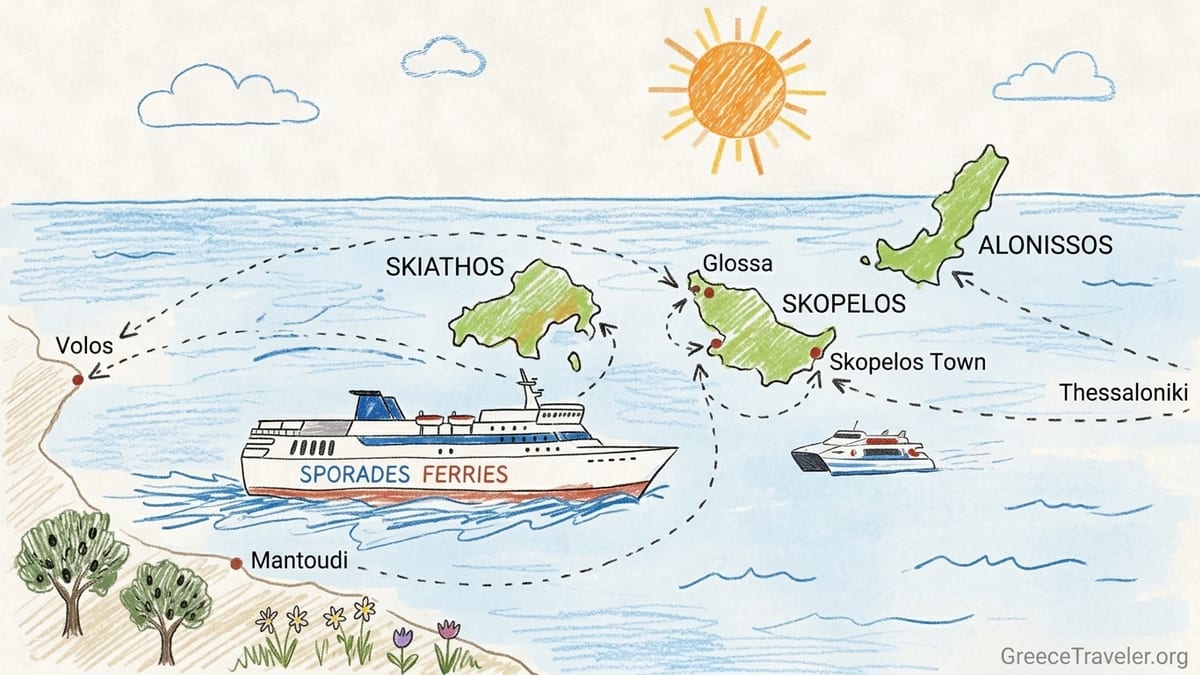
Understanding the Northern Sporades Ferry Network in 2026
In 2026, Skiathos, Skopelos and Alonissos are tightly connected by a mix of conventional ferries and high-speed vessels, primarily operated by Seajets, Aegean Flying Dolphins, Hellenic Seaways services under the Attica Group umbrella, and newer operators such as Mantoudi Lines (rebranded as M Lines on some routes). On a typical July day you can expect multiple sailings linking Volos with all three islands, plus additional crossings on the short hops between Skiathos, the two ports of Skopelos and Alonissos. This makes a linear route Skiathos → Skopelos → Alonissos straightforward to plan for most of the season.
Most travelers use Volos on the mainland as their entry or exit point, but in 2026 there are also seasonal high-speed connections from Thessaloniki, and increasingly popular routes from Mantoudi on Evia. A standard routing on many conventional ferries is Volos → Skiathos → Glossa (northern Skopelos) → Skopelos Town → Alonissos, which means that on one ticket you can ride the whole chain. The main choice to make is how far along that chain you go, and whether you are happy to connect via Skiathos or prefer to board directly at Volos, Mantoudi or Thessaloniki.
Fares fluctuate based on the vessel type and season, but as a ballpark in high summer you might pay around 20 to 30 euros per person for a longer leg such as Volos to Skiathos on a conventional ferry, and 25 to 40 euros on high-speed catamarans. Short inter-island hops can be considerably cheaper, sometimes in the 15 to 25 euro range, especially if you travel as a foot passenger and avoid booking a cabin. Prices for vehicles and larger luggage are additional but transparent at booking stage, which is why it pays to use a proper booking engine or the ferry company sites rather than generic ticket resellers.
A key feature for 2026 is improved connectivity between Skopelos and Alonissos. On some high-speed runs, the crossing time can be as little as about 10 to 15 minutes port to port, turning what used to feel like a separate leg into a quick hop. By contrast, the longer Skiathos to Alonissos stretch has a daily connection in season but usually takes closer to 1.5 to 2 hours depending on intermediate stops. This difference shapes how you structure your island hopping: once you reach Skopelos, Alonissos is now very close indeed.
Starting Points: Volos, Mantoudi and Thessaloniki Compared
For most visitors arriving from Athens, mainland Europe or other parts of Greece, the starting question is not “Skiathos or Skopelos first?” but “Which mainland port makes most sense?” In practice for 2026 the three realistic options are Volos, Mantoudi and Thessaloniki, each with its own pros and cons in terms of travel time, cost and convenience.
Volos is the classic gateway. The port city sits roughly midway between Athens and Thessaloniki and is well connected by intercity buses and, to a lesser extent, trains. Several ferry companies run from Volos to Skiathos, Skopelos and Alonissos, including Seajets and Aegean Flying Dolphins. In summer 2026, timetables show numerous daily crossings, ranging from conventional ferries that take around 4 hours to Alonissos to high-speed vessels shaving that down considerably. For example, a conventional ship following Volos → Skiathos → Glossa → Skopelos Town → Alonissos might depart mid-morning and reach Alonissos mid-afternoon, letting you watch the full island chain slide by from the deck.
Mantoudi on the island of Evia is a more recent and more “local” gateway that has grown in popularity. Reached by bus or car from Athens in roughly 2 to 3 hours, it offers relatively fast crossings to Skiathos, Skopelos and Alonissos with operators such as Mantoudi Lines / M Lines and Seajets. In high season you might find an afternoon route Mantoudi → Skiathos → Glossa → Skopelos → Alonissos, putting you on Skiathos in around 1.5 to 2 hours and on Alonissos a bit later the same day. Mantoudi itself is quiet, with far fewer accommodation and transport options than Volos, so it suits confident travelers who are happy to move straight from bus to ferry without needing big-city backup services.
Thessaloniki, Greece’s second city, now fields seasonal catamaran services linking it to the Sporades several times a week in peak season. In a typical summer 2026 pattern, a high-speed vessel may run Thessaloniki → Skiathos → Skopelos → Alonissos and back on multiple days, such as four or five times weekly. The crossing is longer and usually pricier than from Volos or Mantoudi, but this route makes sense if you are already in northern Greece or flying into Thessaloniki Airport. A traveler spending a few days exploring Thessaloniki’s waterfront district and Byzantine monuments, for example, can then board an early-morning catamaran and be in Skiathos by lunchtime without having to detour south to Volos.
For most first-time island hoppers, Volos is the safest and most flexible bet, thanks to its wide choice of sailings, backup buses and taxis, and straightforward logistics if something is delayed. Mantoudi can trim overall journey time if you are confident with Greek regional buses or are driving a rental car from Athens. Thessaloniki is ideal as part of a wider northern Greece itinerary, pairing city sightseeing with an island escape.
Core Route: Skiathos → Skopelos → Alonissos
The primary transactional route through the Sporades in 2026 is the simple chain Skiathos → Skopelos → Alonissos. Most travelers either fly into Skiathos Airport or arrive by ferry from Volos, Mantoudi or Thessaloniki, then move eastwards to Skopelos and finally to Alonissos before looping back to the mainland. Structuring your trip this way keeps connections logical and reduces backtracking, especially if you are traveling with children, luggage or a vehicle.
Skiathos is the most accessible island with an international airport and a busy port. High-speed and conventional ferries from Volos and Mantoudi call here daily in summer, often several times a day. From Skiathos to Skopelos you will find multiple crossings a week, with a crossing time usually in the range of 1 hour on a conventional ferry, sometimes less on smaller, faster vessels. In addition there are local services such as the Petroula Seabus connecting Skiathos with Glossa on Skopelos, useful if you plan to base yourself in the north of Skopelos around Loutraki, Elios or Klima.
From Skopelos to Alonissos, the picture in 2026 is particularly favorable. On the main summer schedules, fast ferries and smaller high-speed craft can complete the leg from Skopelos Town to Alonissos in roughly 10 to 15 minutes in calm conditions, turning what used to be a longer sea passage into almost a harbor-to-harbor transfer. Conventional ships still take longer, often around 40 to 60 minutes if they are also servicing other ports, but the key point is that Skopelos and Alonissos are now so closely linked that you can easily plan a split stay between the two.
One realistic example itinerary for a 10-day trip in July might be: fly into Skiathos and spend 3 nights exploring Koukounaries Beach, Skiathos Town and a boat trip around Lalaria; catch a mid-morning ferry to Skopelos Town for 4 nights of beach-hopping by rental car between Panormos, Milia and Stafilos; then ride a late-afternoon high-speed service to Alonissos, arriving in under 20 minutes, for 3 nights in Patitiri with day trips into the Marine Park. From Alonissos you board a morning ferry back to Volos or Mantoudi and connect straight to your bus or rental car. At no point in this itinerary are you forced to backtrack to Skiathos or rush for a tight same-day connection.
Glossa vs Skopelos Town: Which Port Should You Choose?
Skopelos has two main ferry ports: Glossa (also called Loutraki) in the northwest and Skopelos Town on the east coast. Many ferry timetables show both, and for island-hopping the choice between them can shape your accommodation plans. Conventional ferries following the Volos → Skiathos → Glossa → Skopelos Town → Alonissos route will typically call at Glossa first, then continue down the coast to Skopelos Town. High-speed boats may vary their order or skip one port entirely depending on the day and season.
Glossa is the natural landing spot if you are continuing directly from Skiathos and want to stay in northern or western Skopelos. For example, if you book a villa near Loutraki, Neo Klima or Elios, arriving at Glossa keeps your transfer short and scenic, sometimes just a 15 to 20 minute taxi ride along the coastal road. Local fast ferries and the Petroula Seabus emphasize this connection, often running Skiathos → Glossa several times per day in high summer. This can be especially convenient for travelers who have flown into Skiathos with an afternoon arrival: you can step off the plane, walk or taxi down to Skiathos port and be in Glossa the same evening.
Skopelos Town, by contrast, makes the most sense if you plan to base yourself near the island’s main services, or if you are continuing onward to Alonissos. Many routes from Volos and Mantoudi call here and then proceed to Alonissos, with the short 10 to 15 minute high-speed connection between the two operating from or via Skopelos Town. For travelers without a vehicle, Skopelos Town also acts as a hub for local buses servicing popular beaches like Stafilos, Agnontas and Panormos. Staying near the waterfront here puts you within walking distance of ticket agencies, car rentals and late-opening supermarkets, which is reassuring if you are juggling inter-island tickets, children and luggage.
If you are planning a full Skiathos → Skopelos → Alonissos sequence, a pragmatic solution is to use both ports. You might arrive in Glossa from Skiathos to enjoy the quieter north for a few nights, then drive or bus down to Skopelos Town for a final night or two before catching the quick hop to Alonissos. This way you minimize double-backing and get a feel for both sides of the island. Just make sure when booking your ferry tickets that you select the correct Skopelos port, as “Skopelos” and “Skopelos (Glossa)” are often listed as separate destinations in booking engines.
Booking Ferries, Handling Tickets and Typical Costs
Because Sporades routes are served by several different companies, it is wise to use a reputable ferry search engine to compare times and prices for your dates, then either book directly through the engine or on the ferry company’s own website. In practice many travelers for 2026 report using services that aggregate schedules from Seajets, Aegean Flying Dolphins, Hellenic Seaways and newer operators like M Lines, and then choosing the option that best balances departure time, duration and price. For complicated itineraries, local agencies in Volos, Skiathos Town and Skopelos Town can issue combined tickets and advise on realistic connections.
As an example, in early September 2026 you might see a Seajets morning departure from Skiathos to Skopelos priced around the low to mid-20 euros per person for a deck seat, with a scheduled crossing of about 1 hour, plus port taxes. A Volos to Skiathos conventional ferry with full vehicle capacity might be priced closer to 30 euros for a foot passenger, with cars charged depending on length and height. High-speed catamarans are typically more expensive but reduce travel time significantly; on a peak-season weekend, it is common to pay a premium for the fastest same-day connection from Volos straight through to Alonissos.
Tickets are increasingly issued as e-tickets or QR codes that you show on your phone, but in smaller ports you may still need to exchange a booking confirmation for a physical ticket at a local agency kiosk. In Skiathos, for instance, it is normal to find multiple agencies along the waterfront that can print tickets until shortly before departure. In Skopelos Town and Alonissos’ Patitiri port, small walk-up offices handle last-minute sales and changes. In high season, however, it is not wise to rely on buying tickets at the last minute, especially for popular Friday and Sunday sailings or when you are traveling with a car or motorbike.
For budget planning, a two-week trip including multiple ferry legs could easily see you spending 150 to 250 euros per person in total on crossings if you move islands 3 or 4 times and choose a mix of conventional and high-speed services. Families traveling with a rental car will need to add several hundred euros more across the itinerary. Discounts sometimes apply for children, seniors or early bookings, but these vary by company and are not guaranteed on every sailing. When comparing options, check whether port taxes and luggage are included, and watch for differences in cancellation terms between operators.
Traveling With Luggage, Cars and Motorbikes
On the Sporades routes, traveling with luggage is usually straightforward, but the experience differs between conventional ferries and high-speed vessels. On large conventional ships operating from Volos and Mantoudi, you typically walk or drive aboard, leave larger suitcases in designated luggage racks in the internal garage or entry area, and then head upstairs to the main lounges or open decks with a small day bag. You retrieve your luggage just before arrival when vehicle decks are reopened. These ships are used to handling everything from backpacks to large wheeled cases, so staff will direct you where to stow bags safely.
On high-speed catamarans and flying dolphins with no vehicle deck, luggage is stored in racks near the entrance or within the passenger cabin. Space is more limited, so aim to pack in one main suitcase or backpack per person plus a small personal item if possible. Typical practice is to check your main bag on boarding, pick a seat and then return to the luggage rack when the crew signals arrival at your port. Label your bags clearly and avoid leaving valuables in checked luggage; keep passports, electronics and essentials with you in a small rucksack.
If you are traveling with a rental car, motorbike or quad bike, you need to pay close attention to which vessels accept vehicles. Conventional ferries from Volos and Mantoudi to Skiathos, Skopelos and Alonissos generally have vehicle decks and can carry cars, small vans and motorbikes, but high-speed catamarans often do not. Booking a vehicle space for peak July or August weekends should be done weeks in advance, especially if you are driving a larger SUV or camper-style vehicle. For example, a family renting a compact car in Athens and aiming to take it to Skopelos for a week would be wise to choose a Volos departure with a confirmed vehicle reservation rather than hoping for last-minute availability.
Within the islands, remember that not every port is equally convenient for vehicles. Glossa’s approach roads are steep and winding, while Skopelos Town and Alonissos’ Patitiri have tighter harbor streets with limited parking, especially on summer evenings. Before deciding to bring a car across every leg, consider whether you could return your mainland rental in Volos and then use local rentals or ATVs for a few days on each island. This is common practice: you might arrive as a foot passenger into Skiathos, rent an ATV there for a few days, then return it and board the next ferry to Skopelos on foot, renting another vehicle on arrival. This approach keeps ferry costs and parking stress down, and avoids committing to fixed vehicle departures if your plans shift.
How Many Islands Fit Into One Trip & Where Skyros Fits In
With frequent 2026 connections and short hops between Skopelos and Alonissos, it can be tempting to cram every island into a single itinerary. In reality, the sweet spot is usually two or three islands for a 10 to 14 day trip. This lets you experience different atmospheres and landscapes without spending half your holiday queuing for ferries. The core sequence Skiathos → Skopelos → Alonissos is naturally linear and avoids unnecessary backtracking, which is why most travelers build around it instead of zigzagging.
For a one-week trip, most visitors pick two islands: Skiathos plus Skopelos, or Skopelos plus Alonissos. Seven nights might translate into 3 nights on Skiathos for beaches and nightlife followed by 4 nights on Skopelos for quieter coves and hill villages, or instead 3 nights in Skopelos Town and 4 nights in Alonissos for a more low-key, nature-focused break. With a two-week trip you can comfortably add the third island, allowing, for example, 4 nights Skiathos, 5 nights Skopelos and 5 nights Alonissos. The key is to line up your inter-island ferries in advance for the days you plan to move and to keep at least one buffer day at either end in case of weather-related schedule changes.
Skyros often appears on general maps of the Sporades, and there are occasional routes in some years linking Alonissos and Skyros along with Volos or other mainland ports. However, in practical terms, Skyros does not naturally slot into the Skiathos → Skopelos → Alonissos island-hopping route. Most connections to Skyros in 2026 run via Kymi on Evia or other separate routes, meaning that to include Skyros you would typically have to break the linear flow of your trip, add long sea crossings or backtrack to a different mainland port.
As an example, a traveler who flies to Skiathos, then visits Skopelos and Alonissos, would usually need to return at least as far as Volos or another mainland port and then arrange a separate line to Skyros, rather than simply hopping across from Alonissos. This can eat up valuable days and add complexity with extra overnights on the mainland. For that reason, most itineraries either focus on the three core Northern Sporades, or pair Skyros with Evia and central Greece instead. Unless you have three weeks or more, it is usually better to keep Skyros for another trip and fully enjoy Skiathos, Skopelos and Alonissos this time around.
The Takeaway
By 2026 the ferry network linking Skiathos, Skopelos and Alonissos is dense enough that classic island hopping is not only possible but comfortable, provided you understand the main routes and make a few strategic choices. Starting from Volos offers the greatest flexibility, while Mantoudi and Thessaloniki open up faster or more geographically logical options depending on where you begin your journey. The core chain Skiathos → Skopelos → Alonissos works smoothly in one direction, with a particularly short hop between Skopelos and Alonissos that can take as little as about 10 to 15 minutes on some high-speed services.
Choosing between Glossa and Skopelos Town, planning when and where you carry a car, and deciding how many islands to include will shape the rhythm of your trip far more than the specific ferry company you pick. Most visitors will be happiest with two islands in a week or three in two weeks, balancing ferry days and beach days. Skyros, while part of the broader Sporades region, typically requires a separate routing and does not naturally attach to the standard Skiathos → Skopelos → Alonissos sequence.
With realistic expectations, advance bookings on the key legs and a bit of flexibility for weather-related adjustments, the Northern Sporades are one of the easiest corners of Greece to explore by ferry. Build your trip around the reliable inter-island links, keep your luggage manageable, and treat the sea crossings as part of the holiday instead of a hurdle. The pine-covered hills of Skopelos, the bright harbor of Skiathos and the quiet coves of Alonissos will feel even more rewarding when you know you have navigated the logistics with confidence.
FAQ
Q1. How far in advance should I book ferries between Skiathos, Skopelos and Alonissos?
In July and August, aim to book main legs such as Volos or Mantoudi to the islands and any sailings with a car at least 3 to 4 weeks ahead. Short hops like Skopelos to Alonissos can sometimes be booked closer to the date, but popular weekend crossings still sell out, so reserving a week or two in advance is sensible.
Q2. Is it realistic to visit all three islands in one week?
It is possible but can feel rushed. A seven-night trip usually works best with two islands, for example Skiathos and Skopelos or Skopelos and Alonissos. If you do attempt all three, plan no more than two ferry travel days and keep your luggage light so boarding and disembarking remain easy.
Q3. Do I need to worry about rough seas on these routes?
Sea conditions are generally calm in summer, but windier days can lead to choppier crossings, especially on high-speed catamarans. If you are prone to seasickness, choose larger conventional ferries when possible, travel earlier in the day and carry basic motion sickness medication or wristbands as a precaution.
Q4. Can I rely on same-day connections between islands?
In 2026, same-day connections such as Skiathos to Skopelos to Alonissos are often feasible in high season, but you should allow generous buffers. Avoid planning a tight connection where a delay of 30 to 60 minutes would cause you to miss the next ferry. If a crucial leg is involved, consider an overnight stop instead of rushing.
Q5. Is it better to fly into Skiathos or travel by ferry from the mainland?
Flying directly into Skiathos Airport is the fastest option, especially from European hubs offering seasonal charters. However, traveling via Volos or Mantoudi by bus or car, then taking the ferry, can be cheaper and gives you more flexibility on arrival and departure dates. Many travelers combine both, flying in and then exiting via ferry and bus.
Q6. Should I bring a rental car onto the islands?
Bringing a car is convenient for families or anyone staying in remote villas, but it increases ferry costs and requires more planning. A common alternative is to travel as a foot passenger and rent cars, scooters or ATVs separately on each island for only the days you need them. This approach can work especially well if you are island hopping frequently.
Q7. How do I choose between Glossa and Skopelos Town as my port?
Choose Glossa if you plan to stay in northern or western Skopelos around Loutraki, Elios or Neo Klima, or if you are arriving directly from Skiathos on a local ferry. Choose Skopelos Town if you need easy bus connections, plan to continue to Alonissos, or want to stay near the island’s main services and nightlife.
Q8. Are there daily ferries between Skiathos and Alonissos?
In the main summer season there is typically at least one daily connection between Skiathos and Alonissos, often via intermediate stops at Glossa and Skopelos Town. Schedules can change each year, so for 2026 you should check a reliable ferry search engine or the operators’ websites close to your travel dates.
Q9. Why is Skyros not usually included in a Skiathos, Skopelos and Alonissos trip?
Most Skyros connections run on different routes, commonly via Kymi on Evia or other mainland ports, rather than as a straightforward hop from Alonissos. Including Skyros usually means significant detours or long crossings, which do not fit naturally into a simple Skiathos → Skopelos → Alonissos itinerary, especially on shorter holidays.
Q10. What happens if my ferry is canceled due to weather?
If high winds or rough seas force cancellations, ferry companies typically move tickets to the next available sailing at no extra cost. In busy periods this may be the following day rather than the same evening. Keep at least one flexible day at the start or end of your trip, and avoid scheduling unchangeable flights immediately after your final ferry crossing.