


The Sporades are the Greek islands people whisper about when they want to avoid the crowds of Santorini and Mykonos but still crave pine-fringed beaches, whitewashed towns and blue-on-blue horizons. Within this compact cluster, Skiathos, Skopelos, Alonissos and Skyros each offer a distinct personality. Choosing the right base can make the difference between a restless week on the wrong island and a holiday that feels tailor-made. This guide focuses on how each destination works in practice, from nightlife and film locations to family-friendly beaches, diving and quiet escapes.
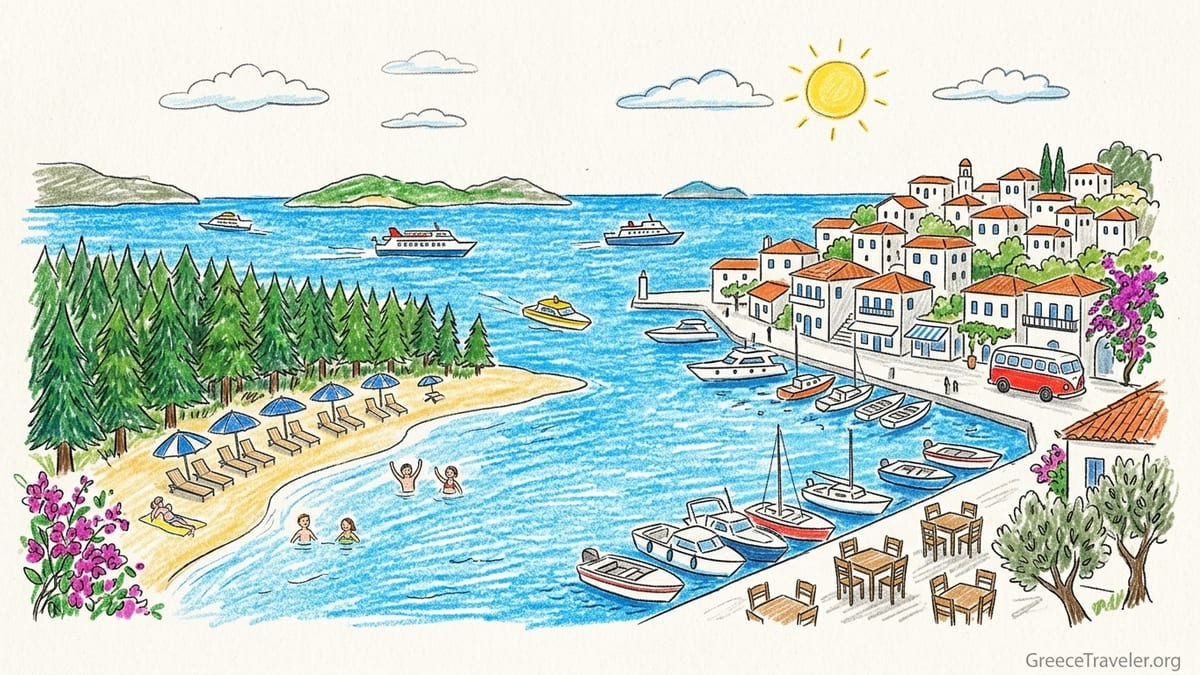
Skiathos: Easygoing Buzz, Big Beaches and Island-Hopping Base
Skiathos is the natural entry point to the Sporades, with frequent summer flights from European cities into its small airport and busy ferry connections from Volos. For many visitors, this is the island that feels most familiar: a lively main town wrapped around a harbor, plenty of beach hotels along the south coast and nightlife that runs to the early hours in July and August. If you want a straightforward, no-stress beach holiday with the option of a few adventures and day trips, basing yourself in or near Skiathos Town works well.
Skiathos Town itself suits travelers who enjoy evenings out. The Old Port area is lined with cocktail bars and small clubs where summer visitors spill out onto the quayside until late, especially in high season. A typical drink at a harbor-front bar might cost around 8 to 12 euros, with simple taverna dinners of grilled fish or souvlaki often landing in the 15 to 25 euro range per person, including a house wine. The town also makes logistics easy: water taxis and excursion boats leave from the harbor to beaches and to neighboring islands, and the island bus starts right behind the waterfront, making it possible to skip car rental entirely if you are happy to follow its route.
For beaches, the south-coast stretch between Megali Ammos and Koukounaries is Skiathos at its most user-friendly. Koukounaries, in particular, is often singled out as one of the island’s finest beaches, a deep curve of soft sand backed by pine forest and a protected lagoon. In summer there are several organized sections with sun loungers, umbrellas and beach bars serving coffees, salads and club sandwiches, alongside a quieter zone at the far end if you bring your own umbrella. Reaching it is simple: regular buses connect Skiathos Town with Koukounaries in about 25 to 30 minutes, and taxis queue on the road behind the beach for the return journey.
The island’s wild card is Lalaria, a dramatic white-pebble cove on the north coast, accessible only by sea. Boat trips to Lalaria are widely advertised along Skiathos Town’s harbor, many combining the beach with stops at the sea caves and the tiny fortified islet of Tsougriaki. Prices vary by operator but often fall around 25 to 40 euros per person for a half- or full-day cruise. Because the north side of Skiathos is exposed to the meltemi winds, sailings are regularly canceled when the sea is rough, especially in early summer and September, so it is worth building flexibility into your schedule rather than leaving Lalaria for your final day.
Who Skiathos Works Best For
Skiathos is generally the best fit for travelers who want a beach base with plenty of facilities and easy logistics. Families with older children and teens appreciate the island bus, organized beaches with lifeguards in high season and the short transfer times between the airport, Skiathos Town and the main resorts. Koukounaries, Troulos and Megali Ammos are particularly practical choices if you like to split your day between the sea and a pool, with supermarkets, beachwear shops and casual tavernas in walking distance.
Nightlife seekers and groups of friends often choose to stay in Skiathos Town or at nearby beaches such as Megali Ammos, where it is possible to walk back from the bars after midnight rather than relying on taxis. Summer visitors describe the bar scene as lively without feeling overwhelming: think open-air cocktail bars with music rather than giant nightclubs. This makes Skiathos an appealing compromise if you want evenings out but still plan to visit quieter destinations like Skopelos or Alonissos during the day.
Skiathos also works as a flexible base for those hoping to combine islands without packing and unpacking too often. Several boat operators run day cruises from Skiathos to Skopelos and even on to Alonissos, often marketed around Mamma Mia filming locations on Skopelos or snorkeling in the Alonissos Marine Park. In practice, this means you can test the feel of nearby islands before deciding whether to return for a longer stay another year. If your priority is a low-friction holiday with beaches, infrastructure and options for organized excursions, Skiathos is usually the strongest choice in the Sporades.
Skopelos: Mamma Mia Backdrops, Village Life and Pine-Fringed Bays
Skopelos sits a short ferry ride east of Skiathos but feels noticeably greener and a little more low-key. For many visitors, the name is inseparable from the film Mamma Mia, which used the island’s beaches, chapels and olive groves as its primary outdoor set. The reality in 2026 is that no film sets remain, but the locations are still there: Kastani Beach on the southwest coast, the cliff-top chapel of Agios Ioannis near Glossa and the piney coves around Cape Amarantos are all easily reached by car, scooter or organized boat trips and now function like ordinary, if particularly photogenic, corners of the island.
Skopelos Town, the island’s main port, tumbles up the hillside in a jumble of whitewashed houses, tiled roofs and tiny chapels. It is the best base if you value traditional atmosphere with creature comforts. In the evenings, locals and visitors gather along the waterfront for grilled fish and meze at long-established tavernas, while smaller bars tucked into the old town lanes stay open into the small hours in July and August. Prices are similar to Skiathos, though accommodation can be better value; simple studios within walking distance of the harbor often cost less than comparable rooms in Skiathos Town, especially in shoulder season.
If you prefer a quieter village vibe, consider Glossa at the northwest tip. Perched high above the sea, it overlooks the islet of Skiathos and the channel between the islands. The main reason many travelers come here, however, is proximity to Agios Ioannis Kastri, the small church perched on a rocky outcrop that appears in Mamma Mia’s wedding scenes. The chapel is reached by about 200 stone steps, and summer visitors report that arriving before 10 a.m. or in the late afternoon avoids both the fiercest heat and the peak of tour groups. Combining a visit with an afternoon swim at nearby beaches, then a sunset drink in Glossa, makes for a satisfying day.
For beaches, Skopelos has a generous mix. Kastani, famous from the film, is now an organized beach with a bar, sunbeds and music, while Milia and Panormos offer longer stretches of sand-and-pebble coastline backed by dense pine forest. On the northeast coast, smaller coves such as Perivoliou and Chondrogiorgos are less developed and best visited with a hire car, rewarding the effort with clear, cooler water and a quieter feel. Although beach clubs remain relatively modest compared to more commercial islands, the infrastructure is sufficient for families and couples who like a balance of nature and comfort.
Who Skopelos Works Best For
Skopelos tends to appeal to travelers who gravitate toward characterful towns and film-scenery landscapes rather than big nightlife. Fans of Mamma Mia will obviously find plenty to enjoy, from recreating the steps up to Agios Ioannis to swimming at Kastani, but you do not need to have seen the film to appreciate the combination of green hills, stone-built villages and sheltered bays. Couples, walkers and photographers often prefer Skopelos to Skiathos for exactly this reason; it feels lush and spacious, with enough development to be comfortable but not so much that you lose a sense of place.
For families, Skopelos offers a more relaxed pace. Skopelos Town has playgrounds, relaxed promenades and several small beaches within a short drive, while Panormos and Stafylos provide easy access to the sea plus a handful of tavernas for simple lunches. Because the island is bigger than Skiathos, having a car or scooter is helpful if you plan to explore beyond your immediate area. That said, organized Mamma Mia bus and boat tours run regularly in season, which can be a practical solution for visitors who would rather not navigate mountain roads themselves.
Nightlife on Skopelos is social rather than wild, centered on cafes, cocktail bars and low-key clubs in Skopelos Town that stay open until late in August. If your idea of a perfect evening is a long dinner by the harbor followed by a few drinks and live music, this island is a strong choice. If you are hoping for beach parties that run until dawn, Skiathos will serve you better. Overall, Skopelos is ideal if you want the cinematic landscapes of the Sporades with enough energy to keep evenings interesting, but without the full-on buzz of a party island.
Alonissos: Marine Park, Old-Village Charm and Quiet Bays
Alonissos lies another step east into the Aegean and feels immediately more remote. Ferries arrive in Patitiri, a small port town backed by steep hillsides and surrounded by rocky coastline. Patitiri is practical rather than pretty, but it concentrates much of the island’s life: the port, bus stop, supermarkets, travel agencies and the small promenade of cafes and tavernas. This is also the main jumping-off point for boat trips into the National Marine Park of Alonissos and Northern Sporades, a vast protected area established in the early 1990s that covers islands, islets and open sea where endangered Mediterranean monk seals still find refuge.
Old Alonissos, known locally as the Old Village or Chora, sits high above Patitiri and is the island’s postcard scene. After an earthquake in the 1960s, many residents moved permanently down to the port, leaving the old stone houses to crumble until they were gradually restored, mostly as holiday homes and guesthouses. Today the village is a warren of cobbled lanes, stone archways and bougainvillea, with tavernas and bars tucked into terrace corners that overlook the Aegean. Evening buses and taxis connect Patitiri to Old Alonissos in season, and many visitors choose to stay up here precisely for the tranquility and sunset views, driving or riding down to beaches by day.
The island’s biggest natural draw is the Marine Park. Several small operators in Patitiri run day cruises that typically include snorkeling stops in clear coves, visits to uninhabited islets within the park and swimming from quiet beaches accessible only by boat. Prices generally sit in the range of 45 to 80 euros per person, depending on boat size and itinerary, often including a simple lunch and snorkeling gear. While actual encounters with monk seals are never guaranteed and remain relatively rare, guides will point out sea caves, seabird colonies and stretches of sea-grass meadows that are crucial to the ecosystem’s health.
On land, Alonissos has a reputation among walkers and divers. Waymarked hiking routes lead from Patitiri and the Old Village up to viewpoints such as Tourkovigla, which looks over much of the southern island, and across to small chapels and remote bays. In practice, this means you can start a morning walk from your accommodation, follow shady paths through pine forest and olive groves, swim at a quiet beach such as Megalos Mourtias or Chrisi Milia, then return to the village for a late lunch. Several dive centers operate from Patitiri and nearby Steni Vala, offering wreck dives and trips to underwater archaeological sites within regulated zones of the Marine Park, making Alonissos one of the most interesting diving bases in the Sporades.
Who Alonissos Works Best For
Alonissos is the natural choice for travelers whose priorities are nature, hiking, diving and quiet. There is little in the way of organized nightlife beyond a handful of bars in Patitiri and the Old Village, where live music nights are occasional rather than nightly. If your idea of an ideal evening is a slow dinner overlooking the sea, followed by a walk under dark skies and stars, the island’s tempo will suit you. Those seeking beach clubs, loud music and a bar crawl will find more to their taste in Skiathos or Skopelos.
For families, Alonissos works best with school-age children and teens rather than toddlers, mainly because of the island’s hills and the need to rely on buses, taxis or hire cars to connect beaches, the Old Village and Patitiri. On the other hand, kids who enjoy boat trips, snorkeling and wildlife tend to thrive here; a full-day Marine Park cruise that includes swims off uninhabited islands can easily become the highlight of a family trip. Accommodation is more scattered than on Skiathos, but small family-run hotels in Patitiri and apartments in or near the Old Village offer good value compared to more famous Greek islands.
Travelers who are noise-sensitive or simply looking to switch off will find Alonissos especially appealing in shoulder season. In June, early July or September, some evenings in the Old Village can feel almost village-like in the literal sense: neighbors chatting on stoops, music drifting faintly from one or two tavernas, and a breeze carrying the smell of pine. For repeat visitors to Greece who have already done the headline islands and want a gentler experience rooted in nature, this is often the island they come back to.
Skyros: Distinctive Interior, Traditional Life and Under-the-Radar Calm
Skyros sits slightly apart from the rest of the Sporades, both geographically and in character. It is reached via ferry from the mainland port of Kymi or by seasonal flights from Athens, and because it is less connected to the Skiathos–Skopelos–Alonissos ferry chain, it sees fewer island-hoppers. The main draw here is not a long list of famous beaches but a distinctive landscape and culture: a hilltop Chora crowned by a castle, an interior of stone-built hamlets and terraced hillsides, and a long tradition of local crafts and customs that are still woven into everyday life.
Skyros Chora, the capital, climbs steeply from the lower town of Magazia and Molos up to the remains of a Byzantine and Venetian fortress. The settlement is car-free at its core, so visitors typically park on the outskirts and explore on foot along cobbled lanes lined with low, cubic houses. Cafes and ouzeris cluster around the main squares, while small shops sell Skyrian ceramics and carved wooden furniture, reflecting the island’s artisanal heritage. Walking up toward the castle and the monastery of Agios Georgios reveals wide views over the Aegean and the shoreline beaches below, especially beautiful in the late afternoon light.
Beyond Chora, Skyros’ interior is where the island shows its most individual side. The north is relatively green and wooded, while the south, known as Vouno, is wilder, with low scrub, rocky hills and grazing areas for the small Skyrian horses that are native to the island. Hiring a car for a day or two allows you to explore traditional villages such as Atsitsa or the hamlets above Magazia, stop at small chapels and viewpoints and seek out tavernas where set menus focus on goat, local cheeses and foraged greens. Because tourism remains modest, you are more likely to share these places with Greek weekenders than with large international tour groups.
For beaches, the main stretch runs along the east coast from Magazia to Molos and Gyrismata, a chain of sandy bays with relatively shallow water. In summer, a few beach bars and tavernas operate here, renting sunbeds and umbrellas and serving simple lunches, but even in August the atmosphere is sleepier than in Skiathos or Skopelos. Smaller coves and swimming spots also exist on the west and south coasts, often reached via rough tracks and best attempted with local advice or a sturdy rental car. Combined with hikes on the interior trails and visits to local farms or stables, Skyros offers a holiday that leans more toward local life and landscapes than toward resort-style comfort.
Who Skyros Works Best For
Skyros is best suited to travelers who value authenticity, walking and quiet over facilities and famous sights. If you have already visited several Greek islands and now want to dig a little deeper into local culture, this island’s distinctive architecture, crafts and landscape will likely resonate. Couples and solo travelers who enjoy independent exploring, unhurried cafe time in Chora and long walks across the interior hillsides often find Skyros especially rewarding.
Families can also enjoy Skyros, particularly those with children used to simple, nature-focused holidays. Days tend to revolve around the main beaches near Magazia and Molos, where the sea is accessible and there are enough tavernas to vary your lunches, while occasional excursions to see Skyrian horses or to explore the castle break up the routine. Because public transport is limited, renting a car for at least part of your stay makes a big difference, opening up inland villages and viewpoints that would be hard to reach otherwise.
Travelers seeking vibrant nightlife or a wide range of organized activities may find Skyros too quiet, especially outside August when many Athenians visit for their own holidays. On the other hand, if your priority is to slow down, sleep well and wake to church bells rather than club music, this island delivers. Skyros works particularly well when combined with a night or two in Athens or another more urban stop, giving you contrast between city energy and island stillness.
How to Choose: Beaches, Nightlife, Nature and Families
When you line the Sporades up side by side, clear patterns emerge that can guide your choice. For classic, fully serviced beaches with easy access and plenty of options for sunbeds, watersports and nearby tavernas, Skiathos and Skopelos lead. Koukounaries on Skiathos offers the broadest, most resort-like beach experience, while Kastani, Panormos and Milia on Skopelos add a backdrop of dense pine forest and film history. Families who prioritize straightforward beach days can happily base themselves near any of these areas, using buses or rental cars to explore neighboring coves.
For nightlife, Skiathos Town has the liveliest scene, with a concentration of bars and small clubs around the harbor and along its narrow streets. Skopelos Town comes next, with a more laid-back but still sociable mix of waterfront tavernas and cocktail bars. Alonissos and Skyros both keep evenings quiet; you will find drinks and occasional live music in Patitiri, Old Alonissos and Skyros Chora, but little in the way of organized bar crawls or parties. Travelers who want at least a couple of late nights out will usually be happiest splitting a trip between Skiathos or Skopelos and a quieter island.
If your priority is traditional towns and village life, Skopelos Town, Glossa, Old Alonissos and Skyros Chora are the strongest candidates. Skopelos Town offers the liveliest blend of local life and visitor infrastructure; Glossa and Old Alonissos give a more intimate village experience with sweeping views; Skyros Chora adds a distinctive architecture and the drama of its hilltop castle. For Mamma Mia locations specifically, Skopelos is the clear winner, with Kastani Beach and Agios Ioannis Kastri as the headline sites, while Skiathos plays a supporting role as a base for boat trips that combine Lalaria and Skopelos film spots in a single day.
Nature, hiking and diving tip the scales toward Alonissos and Skyros. The Alonissos Marine Park, with its protected islands and dive sites, is unmatched elsewhere in the Sporades for underwater interest. On land, Alonissos offers waymarked routes through pine forest and olive groves, while Skyros brings a mix of greener northern hills and austere southern landscapes where small Skyrian horses graze. For families and couples who want to spend as much time walking and swimming in quiet places as sitting in tavernas, these two islands are particularly attractive choices.
The Takeaway
Choosing between Skiathos, Skopelos, Alonissos and Skyros is less about which island is best and more about which one matches the holiday you have in mind. If you want maximum convenience, easy beaches and a taste of nightlife, Skiathos will make your life simple. For cinematic scenery, a working island town and the chance to walk through Mamma Mia backdrops between pine forest and sheltered bays, Skopelos is hard to beat. Travelers who put nature, quiet and diving at the top of their list will find Alonissos especially rewarding, while Skyros is ideal for those drawn to traditional interiors, hilltop villages and an under-the-radar feel.
For many visitors, the ideal Sporades trip involves combining at least two islands. A common pattern is to fly into Skiathos for a couple of nights in town, then take the ferry to Skopelos or Alonissos for a longer, more relaxed stay. Those with more time and a taste for quieter, more individual places might add Skyros either at the beginning or end of their itinerary, linking it with Athens via Kymi. However you structure your journey, thinking in terms of your priorities – beaches, nightlife, traditional towns, film locations, nature, diving, family needs and appetite for quiet – will help you choose the Sporades island that feels like it was waiting for you.
FAQ
Q1. Which Sporades island is best for a first-time visitor?
For a first visit, Skiathos is usually the easiest choice thanks to its small airport, frequent ferries, straightforward bus system and wide range of beaches and accommodation close to Skiathos Town.
Q2. Where should I stay if I want Mamma Mia filming locations?
Base yourself on Skopelos, ideally in Skopelos Town or Glossa, to be within easy reach of Kastani Beach and the Agios Ioannis Kastri chapel, with organized tours and rental cars available locally.
Q3. Which island is best for families with young children?
Families with younger children often find Skiathos most practical, especially around Koukounaries or Megali Ammos, where there are shallow waters, organized beaches and short transfer times from the airport and port.
Q4. Where can I find the quietest beaches and villages?
Alonissos and Skyros generally offer the quietest experience, with small bays, limited nightlife and traditional villages like Old Alonissos and Skyros Chora that stay low-key even in high summer.
Q5. Which island is best for diving and snorkeling?
Alonissos is the top choice for diving and snorkeling, with several dive centers in Patitiri and Steni Vala offering trips to wrecks, reefs and underwater archaeological sites inside the National Marine Park.
Q6. Do I need a car on the Sporades islands?
On Skiathos, the main bus route covers most south-coast beaches, so a car is optional. On Skopelos, Alonissos and Skyros, a hire car or scooter makes it much easier to reach remote beaches, chapels and interior villages.
Q7. Which island suits travelers who want nightlife?
Skiathos has the liveliest nightlife, centered on Skiathos Town. Skopelos Town offers a milder version with waterfront bars and late-opening cafes, while Alonissos and Skyros remain very quiet after dinner.
Q8. Is Lalaria Beach suitable for small children?
Lalaria’s white pebbles, boat-only access and changeable north-coast conditions make it better for confident swimmers and adults; families with small children usually prefer the sheltered south-coast beaches on Skiathos.
Q9. How many days do I need to visit two Sporades islands?
A week allows you to split time between two islands, for example three nights on Skiathos and four on Skopelos or Alonissos, giving enough time for beaches, village exploring and at least one boat trip.
Q10. Which island is best outside the main summer season?
In May, June and September, Skopelos and Alonissos offer a good balance of open services, mild temperatures and fewer crowds, while Skiathos remains convenient for flights and Skyros feels especially peaceful.