


If you are drawn to the Sporades but unsure whether Skiathos, Skopelos, Alonissos or Skyros is the right island for you, you are not alone. These four neighbours in the northwest Aegean share glass‑clear water and pine‑covered hillsides, yet the experience on each feels very different, from Skiathos’s easy fly‑in beaches to Skyros’s quietly independent, almost self‑contained world. This guide walks through how they compare on beaches, nightlife, scenery, traditional character, family friendliness, couples’ appeal, hiking, diving, accommodation, ferries, airports, car use and crowds, so you can match the right Sporades island to the trip you actually want.
Big Picture: How The Four Sporades Islands Differ
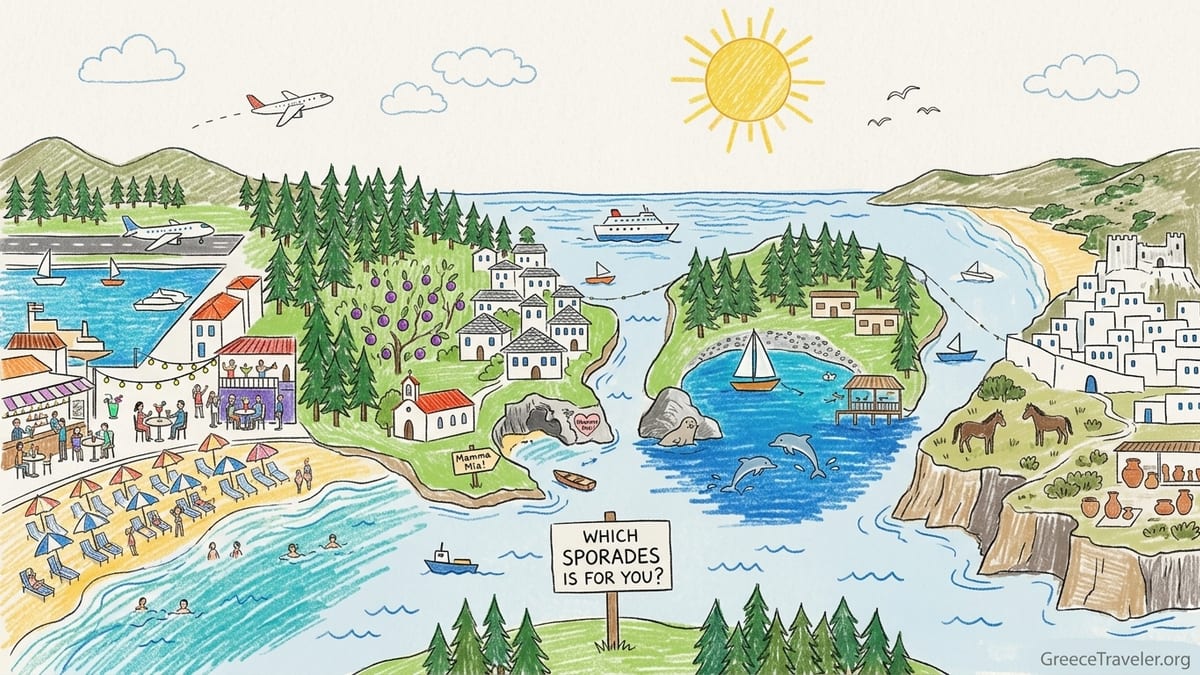
Skiathos, Skopelos and Alonissos form a tight northern cluster, easily linked by short ferries and sharing a similar pine‑green, relatively lush look. Most visitors start by flying into Skiathos, then either stay put or island‑hop east to Skopelos and Alonissos. Skyros sits much further to the southeast, physically separate and psychologically too: fewer package holidays, more Greek visitors, and a sense that life here would carry on much the same without tourism.
For many travellers the choice is now framed in a fairly consistent way. Skiathos is the convenient hub, with a small international airport close to town, a wide choice of sandy beaches and the liveliest nightlife in the group. Skopelos is the greener, more village‑focused option, famous for its stone‑built chora and “Mamma Mia” film locations. Alonissos is quieter still, oriented to nature, hiking and the protected waters of the National Marine Park of Alonissos and Northern Sporades. Skyros appeals to visitors who value authenticity over convenience, with strong local traditions, its own small horse breed and a different, more independent feeling.
In practical terms, that means you can usually match each island to a clear travel style. If you want an easy fly‑in week of beaches and bar‑hopping, Skiathos is hard to beat. For couples and families who like pretty villages and scenic drives between low‑key coves, Skopelos often comes out on top. If you care more about marine life, quiet coves and long walks than nightlife, Alonissos is the obvious choice. And if your idea of a Greek island trip involves local festivals, pottery workshops and remote coves reached by your own wheels, Skyros will feel like a find.
Beaches, Sea and Scenery
All four islands share that classic Sporades mix of pine forest meeting bright blue sea, but the beaches themselves feel quite different. Skiathos has the headline variety, with around 60 named beaches packed onto a relatively small island. Koukounaries is the best known: a long crescent of soft sand backed by a pine forest and lagoon, with sunbeds, watersports, tavernas and a shallow, family‑friendly shoreline. Closer to town, Megali Ammos is almost an extension of Skiathos Town, lined with small hotels and beach bars where you can step from your breakfast terrace straight onto the sand.
Skopelos trades quantity for atmosphere. The coast is more rugged, and while there are sandy spots, many beaches mix pebbles with sand. Panormos offers a wide, protected bay with clear water and a pebble‑sand mix, popular with families staying in nearby apartments. Kastani and Milia, on the west coast, gained fame as “Mamma Mia” locations, and you still feel that cinematic sweep of pine hills dropping into turquoise water when you stand on the sand. The scenery in Skopelos’s interior is arguably the richest in the Sporades, with dense pine forests, plum orchards and monasteries perched on ridges.
Alonissos’s beaches are quieter again and tend slightly more to pebbles, which pays off in particularly clear water. On the south and east coasts you find low‑key coves like Chrisi Milia, where a small belt of sand shelves into vivid blue sea, or Kokkinokastro, beneath red cliffs. Because the island sits at the heart of the Marine Park, you often share anchorages with sailing boats rather than beach clubs. The old hilltop village, Chora, rebuilt after a 1960s earthquake, looks out over a scatter of uninhabited islets that give the island a “small boats and big horizons” feel.
Skyros’s coastline is a split personality: the northeast has long sandy beaches like Molos and Magazia, lined with small hotels and rooms, while the southwest is wilder and rockier, with fewer access roads and little development. The main town, Skyros Chora, climbs steeply from the sea up to a castle, more reminiscent of the Cyclades in its whitewashed streets than of the northern Sporades. Inland, you move from pine forest in the north to more barren, almost island‑of‑two‑halves scenery in the south, where semi‑wild Skyrian horses sometimes graze.
Nightlife, Atmosphere and Traditional Character
Nightlife is where Skiathos pulls away from the others. In peak season Skiathos Town’s waterfront and back streets buzz with cocktail bars, small clubs and late‑opening restaurants. The Old Port area in particular fills with people moving between wine bars and music bars, many with tables right on the water’s edge. It is not on the scale of Mykonos or Ios, but for the Sporades it is clearly the nightlife hub, which is why you will see plenty of British, Scandinavian and Italian package visitors in July and August.
Skopelos offers a softer, more Greek‑leaning nightlife. Skopelos Town has bars scattered through its stepped alleys, a handful of places with live music and a promenade of tavernas where tables spill onto the quay. You might stay out late in August, but the tone is more about lingering over carafes of wine and meze than clubbing. The town itself feels very traditional, with slate roofs, old churches tucked into corners and locals sitting on stoops as you walk back to your room.
Alonissos is quieter again in the evenings. Patitiri, the port, has a relaxed strip of tavernas and a couple of low‑key bars, but people tend to turn in earlier, especially outside August. The more atmospheric night scene is in the old hilltop village, where a handful of bars and cafes string fairylights along narrow lanes and small terraces look out over the dark sea. It is the sort of island where a “big night out” might be an open‑air cinema screening or a long dinner that runs into midnight.
Skyros feels the most self‑contained and traditional of the four. Skyros Chora has a small bar scene around its central plateia, and in high summer the streets around the square can be lively, but most visitors come for its local character rather than nightlife. Craftspeople still produce carved wooden furniture and pottery in small workshops, and if you visit around Carnival or local saints’ days, you see how strong those traditions remain. Many visitors stay in family‑run guesthouses where owners offer home‑baked pies or home‑made spoon sweets, adding to the sense of being in a lived‑in community rather than a purely touristic resort.
Families, Couples and How Quiet Each Island Feels
For families, Skiathos’s combination of easy access, sandy beaches and short distances between hotel, town and beach makes it a straightforward choice. A family flying from London, Manchester or a Scandinavian city can often pick up direct summer flights to Skiathos, then be in a sea‑view room within 30 minutes of landing. Koukounaries, Agia Paraskevi and Vromolimnos all have shallow water, sunbed rentals, simple tavernas and nearby minibuses or local buses, so you do not need to hire a car for every day of the trip.
Skopelos works well for families and couples who value space and greenery over nightlife. Many people split a week between Skopelos Town and a beach area like Panormos or Stafilos, combining evenings in the lively harbour with quieter days by the sea. Villas and small complexes with pools are common in the countryside, giving families room to spread out. Because there is no airport, the island rarely feels overrun, although the harbour can be busy when ferries arrive from Skiathos and the mainland in high season.
Alonissos is best suited to couples and families who are comfortable with a slower pace. It tends to attract repeat visitors who want simple rooms near quiet coves, maybe a hire car for a few days, and boat trips into the Marine Park. Children who love boats and snorkeling usually thrive here, but teenagers looking for nightlife may find it too calm. Even in August the island generally feels less crowded than Skiathos, in part because many beaches are pebble rather than soft sand, filtering out the purely bucket‑and‑spade crowd.
Skyros is ideal for independent travellers, couples and families who are happy to trade a bit of travel complexity for a strong local feel. You see more Greek families here, especially from Athens and central Greece, and more long‑stay visitors renting the same rooms year after year. Outside August, Skyros can feel very quiet, and English may be less widely spoken in smaller villages than on Skiathos. The upside is that you share beaches and tavernas largely with domestic visitors rather than tour groups.
Hiking, Diving and Nature Experiences
Hikers will find good options on all four islands, but the emphasis varies. Skiathos has a surprisingly extensive signed trail network, including routes through its pine forests and inland monasteries. A popular example is the walk from Skiathos Town up to the Evangelistria Monastery, which takes you past olive groves and offers views over the airport and bay. That said, the island’s compact size and developed coastline mean that serious long‑distance walkers might find more variety elsewhere.
Skopelos is arguably the best all‑round hiking island in the group. Old mule tracks link monasteries, hilltop chapels and remote coves, and the interior remains thickly forested. Walks above Glossa, for example, take you through pine and oak to viewpoints where you can see Skopelos, Skiathos and Alonissos in one sweep on a clear day. In early summer you pass through meadows dotted with wildflowers, while in late summer the shade of the trees is a major advantage.
Alonissos is the standout for marine life and diving. The National Marine Park of Alonissos and Northern Sporades is one of the largest protected marine areas in Europe, covering the island, several smaller islands and a wide expanse of surrounding sea. Boat trips from Patitiri and Steni Vala visit remote islets where you may spot dolphins and seabirds, and the area is known as a key refuge for the Mediterranean monk seal. In recent years an underwater museum has opened near the islet of Peristera, allowing divers to explore a classical shipwreck site under supervision on organized excursions. Even for non‑divers, snorkeling around rocky coves often brings encounters with shoals of fish in very clear water.
Skyros’s appeal is more terrestrial than underwater. The island’s contrasting north and south make for interesting hikes: in the north you follow pine‑shaded trails, while the south feels almost Cycladic, with low scrub and big sea views. Nature‑focused visitors often combine walks with visits to see the small Skyrian horses at local farms or sanctuaries. While there are some diving and snorkeling options, Skyros does not compete with Alonissos on that front; it is better thought of as a place for coastal walks, birdwatching and exploring small monasteries rather than a specialist dive destination.
Access, Ferries, Airports and Getting Around
Access is one of the biggest practical differences between the islands and strongly shapes who ends up where. Skiathos has a small but busy international airport officially named Skiathos Alexandros Papadiamantis, with summer flights from cities such as London, Manchester and several northern European hubs, alongside domestic flights from Athens and Thessaloniki. The runway famously lies very close to the sea and just a short taxi ride from Skiathos Town, which means you can feasibly go from plane to beach in well under an hour.
From Skiathos, regular ferries and fast catamarans run to Skopelos and Alonissos in summer. The crossing to Skopelos Town can be around 45 minutes on a fast boat, and to Alonissos around 1.5 to 2 hours, depending on the route and stops. This makes it easy to plan twin‑center trips such as three nights in Skiathos followed by five in Skopelos or Alonissos, without needing to touch the mainland again. Skopelos and Alonissos also have direct ferries from Volos, Agios Konstantinos and other mainland ports, useful if you are including a road trip on the Pelion peninsula or central Greece.
Skyros is deliberately more of an effort. There is no direct ferry from Skiathos, Skopelos or Alonissos. Instead, most travellers come via the mainland port of Kymi on Evia, a few hours by bus or car from Athens, then take a ferry of around 1 hour 40 minutes to Skyros. Alternatively, Skyros’s small airport in the north receives domestic flights from Athens and, in summer, often from Thessaloniki, plus occasional international charters. Schedules change year to year, so you need to check current timetables, but broadly Skyros remains less connected than Skiathos.
These access patterns affect how dependent you are on a car. On Skiathos, a main bus runs along the south coast from Skiathos Town to Koukounaries, with numbered stops serving many of the most popular beaches and resorts. Visitors who are happy to stick to that bus route and the town can skip car hire entirely. Skopelos has buses linking Skopelos Town with beaches like Stafilos and Panormos, but services are less frequent, and many of the nicest spots, such as remote chapels and hilltop viewpoints, are easier with a hire car or scooter. Alonissos has limited buses between Patitiri, the old village and a few beaches; in practice, most visitors who want freedom to explore hire a car for at least part of their stay.
On Skyros, public transport is sparse and largely built around connecting the port, the main town and the main beach area of Molos. To explore the wilder south of the island or reach smaller coves you will need a rental car or scooter. That need for your own wheels is part of what makes Skyros feel more independent; you do not see the same density of package coaches or organized excursions as on Skiathos, and your days are more about choosing your own route.
Where to Stay: Hotels, Villas and Overall Costs
Skiathos has the broadest accommodation range, from simple studios just back from Megali Ammos beach to polished four‑star hotels around Vasilias and upscale villas above Agia Paraskevi. Package deals from the UK and northern Europe often keep entry‑level prices competitive in shoulder season, though in late July and August sea‑view rooms at popular beaches can command rates comparable with mid‑range Cyclades islands. If you are happy to stay slightly inland or away from the main bus route, you can still find family‑run pensions at moderate prices even in high summer.
Skopelos leans more to small family hotels, villas and apartments scattered around Skopelos Town, Glossa and beach areas like Panormos and Stafilos. Because there is no airport, prices can be a little softer than on Skiathos for similar standards of room, especially outside the peak weeks around early to mid‑August when Greek holidaymakers arrive. Villas with pools are common on the slopes above Skopelos Town, appealing to extended families and groups of friends who want space and privacy but still be a short drive from tavernas.
Alonissos’s accommodation stock is smaller and generally low‑rise. In Patitiri you find a cluster of simple hotels and studios, many with good sea views over the harbour. Around beaches like Chrisi Milia and Leftos Gialos, small complexes of rooms to let back onto olive groves and pine forest rather than built‑up resort strips. Prices are often a bit lower than on Skiathos, reflecting the quieter scene and pebble beaches, but in August availability can still tighten quickly because the total number of beds is more limited. Booking early is wise if you want a particular view or walking access to a favourite cove.
Skyros has fewer large hotels and more guesthouses, rooms and small boutique properties, many clustered around Skyros Chora and the beach area of Molos‑Magazia. A typical stay might be a whitewashed pension a few minutes’ walk from the sand, with breakfast served on a terrace facing the Aegean. Self‑catering houses and villas, often renovated traditional homes, are increasingly available and suit longer stays. While individual room rates can be similar to those on Skopelos, overall trip costs may be slightly higher once you factor in the extra transport legs and the likelihood of needing a rental car for most of your stay.
The Takeaway: Which Sporades Island Is Best For You?
If you are weighing Sporades islands in 2026, current comparisons tend to converge on a clear pattern, and it remains a useful way to decide. Choose Skiathos if you want beaches and convenience above all. The combination of direct flights, a busy little town, sandy, well‑served beaches and good bus connections means you can enjoy a very low‑effort holiday, whether that is a week of sunbeds and beach bars or a base for day trips to Skopelos and Alonissos.
Pick Skopelos if your priority is greenery, villages and the “Mamma Mia” style scenery of pines plunging into bays and chapels perched on rocks. You trade airport access and some nightlife for quieter harbours, traditional architecture and excellent driving and walking country. Couples and families who like a blend of beach days and wandering photogenic streets tend to rate Skopelos very highly.
Opt for Alonissos if you are drawn to quiet nature, hiking and time on or under the water. The National Marine Park, monk seal habitat and new underwater museum all underscore that this is the marine‑life island of the group. Expect pebbly coves, clear water, low‑key evenings and a strong chance of sharing your boat trips with birdlife and, with luck, dolphins rather than party music.
Finally, look to Skyros if you want authenticity and are happy with a more independent trip. Getting there usually means connecting via Kymi or a domestic flight, and once on the island you will get more from the experience with your own wheels. In return you find a town with real year‑round life, distinctive local crafts, long sandy beaches that are busy mainly with Greek families in August, and a rugged south that feels far from mainstream resort circuits. For many travellers, that is precisely the point.
FAQ
Q1. Which Sporades island is easiest to reach from abroad?
Skiathos is the easiest, thanks to its small international airport with seasonal flights from several European cities and frequent domestic connections from Athens.
Q2. If I want the best sandy beaches, which island should I pick?
Skiathos has the greatest number of easily accessible sandy beaches, including Koukounaries and Megali Ammos, though Skopelos and Skyros also offer some excellent options.
Q3. Which island is best for nightlife?
Skiathos clearly has the liveliest nightlife, with numerous bars and small clubs in Skiathos Town, while Skopelos has a gentler bar scene and Alonissos and Skyros are much quieter.
Q4. Is Alonissos really better for diving and marine life?
Yes, Alonissos sits at the heart of the National Marine Park, offers access to an underwater museum near Peristera and is known for clear water and good snorkeling and diving.
Q5. Do I need a car on these islands?
On Skiathos you can manage without a car by using the main bus and taxis. On Skopelos, Alonissos and especially Skyros, a rental car or scooter gives you far more freedom.
Q6. Which island is best for a quiet couple’s escape?
Skopelos and Alonissos are top choices for couples, with scenic villages, quiet coves and low‑key evenings. Skyros also suits couples who enjoy a more independent, traditional feel.
Q7. Are these islands suitable for families with young children?
Yes. Skiathos is particularly family‑friendly with sandy, shallow beaches and short transfers, while Skopelos and Alonissos appeal to families who prefer quieter settings.
Q8. How crowded do the Sporades get in August?
August is busy everywhere, but Skiathos sees the heaviest crowds. Skopelos and Alonissos feel less intense, while Skyros is busy mainly with Greek holidaymakers and still relatively calm.
Q9. Can I visit more than one Sporades island in a week?
Yes. A common plan is to fly into Skiathos, spend a few nights there, then take ferries to Skopelos or Alonissos for the rest of the week, returning via Skiathos Airport.
Q10. Which island should I choose if I want a very authentic, local experience?
Skyros is the best choice for authenticity, local festivals and traditional crafts, provided you are comfortable with more complex travel and fewer big‑resort facilities.