


Greek Thrace, stretching from the foothills of the Rhodope Mountains to the Evros River on the Turkish border, is one of Greece’s least commercialized regions. Instead of beach clubs and cruise crowds, you find Ottoman-era old towns, tobacco mansions, forested gorges, wetlands teeming with birds and small cities with a distinctly Balkan rhythm. This guide focuses on the Greek prefectures of Xanthi, Rhodope and Evros, without mixing in Turkish Thrace, Kavala or Thasos, and highlights 25 concrete places where you can actually walk, hike, taste and explore.
Understanding Greek Thrace and How to Get Around
Greek Thrace occupies the northeast corner of mainland Greece, between the Nestos River in the west and the Evros River in the east. Its three main urban hubs are Xanthi, Komotini and Alexandroupoli, linked by the Egnatia Odos motorway and a railway line. For visitors, this makes it realistic to base yourself in one city and make day trips to wetlands, mountain villages or archaeological sites, provided you either rent a car from Thessaloniki or Alexandroupoli, or plan around limited regional buses.
Thrace is still primarily an everyday working region rather than a polished resort zone. In practice that means busier weekdays and very quiet Sundays in smaller towns, tobacco warehouses converted into cultural spaces instead of boutique hotels, and family-run tavernas where menus may be handwritten only in Greek. It also means prices tend to be gentler than in the Cyclades. For example, a mid-range hotel room in central Xanthi for a weekend in spring often runs significantly less than an equivalent room in a Santorini village, and a plate of grilled local sausage or freshwater fish along the Evros usually costs close to what locals pay.
Most of the cultural sites in this article that fall under the Hellenic Ministry of Culture, such as the Archaeological Museum of Komotini or ancient Abdera, follow the standard national schedule. As of late 2026, this generally means daily opening from about 08:30 until mid-afternoon in winter and extended hours into the early evening in summer, with Tuesday as the most common closing day and a full ticket of around 5 euros where admission is charged. However, minor variations occur, especially on public holidays, so it is always wise to confirm current hours by phone or on official Greek Ministry channels before you set out.
The region’s mix of Byzantine fortresses, Muslim monuments, silk mansions and remote wetlands attracts several types of travelers at once. History lovers can spend full days inside museums and walled towns, while birdwatchers focus on the Evros Delta and Dadia-Lefkimi-Soufli Forest National Park. Hikers will gravitate to the Livaditis Waterfall trail or the slopes of Samothrace, and families often combine an easy city base in Alexandroupoli with one or two soft adventures, such as a boat tour into the delta or a short walk to a vulture-viewing hide.
Xanthi: Old Town, Tobacco Heritage and Mountain Escapes
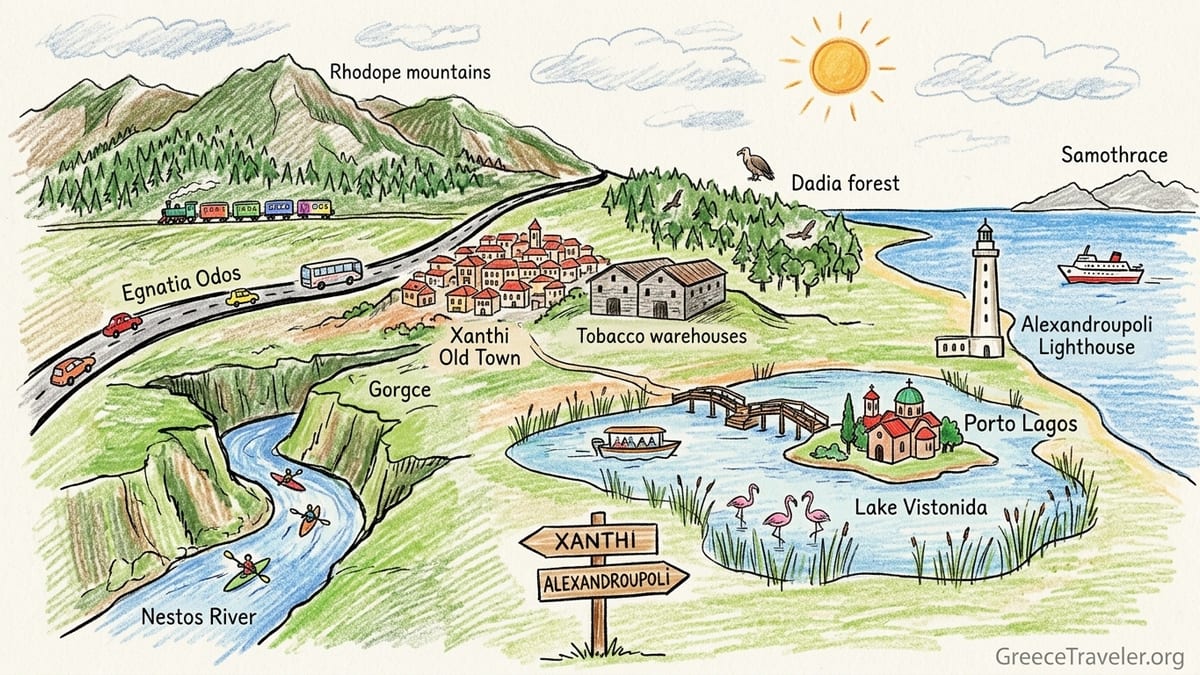
Xanthi is the most atmospheric urban base in Western Thrace, with an old town that climbs a low hill north of the modern grid. Visitors actually see a dense patchwork of cobbled lanes, 19th century mansions built by tobacco merchants and traditional houses that still bear the imprint of Ottoman and Balkan architectural styles. Many of the mansions function today as private homes, small guesthouses or cultural institutions, so the experience is about wandering exteriors, stepping into courtyards where doors are open, and pausing in small squares for coffee rather than ticking off a single monument.
On the southeastern edge of central Xanthi, large tobacco warehouses mark the era when the city was a major tobacco processing hub. Several of these multi-storey stone buildings have been restored and now house the Municipality’s cultural center and other public services. Visitors do not walk through working warehouses anymore, but they can trace façades with tall arched windows, read plaques about the tobacco trade and, in some complexes, enter exhibition spaces if events are on. Reaching the warehouse district is an easy 10 to 15 minute walk from Xanthi’s central square, and you can comfortably explore both the old town and the tobacco quarter in a half day on foot.
North of Xanthi, the Rhodope Mountains rise quickly, offering escape routes into forest and deep ravines. Livaditis Waterfall, one of the tallest in Greece, lies in thick beech and fir forest and requires a drive of roughly an hour from Xanthi followed by a well-marked hiking path. The last kilometers are on mountain roads that can be icy in winter, so most visitors tackle the walk from late spring through early autumn, allowing three to four hours for the out-and-back hike plus time at the falls. The trail itself is free to access but not wheelchair friendly, and there are no formal ticket booths or cafes on the path, so you will need to bring water, snacks and proper footwear.
Farther west, between Xanthi and Kavala but still in the orbit of Xanthi as a day trip, the Nestos Gorge offers another kind of natural spectacle. The river carves tight meanders between steep green slopes, and low-level riverside paths allow families to walk short sections, while more ambitious hikers climb to balcony viewpoints high above the water. Outfitters in the nearby town of Toxotes organize kayak descents and rafting excursions that last half a day, with all equipment and return transport included. Because this is a natural river environment without fixed opening hours, the key practical constraint is weather and water level rather than admission; heavy rain upstream may lead outfitters to cancel trips for safety.
Between Xanthi and Komotini: Lakes, Wetlands and Ancient Abdera
South of Xanthi, the flat Thracian plain sinks into a necklace of lagoons and lakes that open gradually to the Aegean. Porto Lagos, about 25 kilometers from Xanthi, is a small settlement straddling a causeway among the lagoons. What visitors actually see are wooden walkways over the water, small harbors with brightly painted fishing boats and the distinctive island monasteries of Agios Nikolaos and Panagia Pantanassa, connected by bridges. These are active religious sites where dress codes are modest but admission is free, and they work particularly well as a short stop on a driving day between Xanthi and Komotini or as a family-friendly half-day outing with a seaside lunch in one of the simple fish tavernas.
Just inland from Porto Lagos lies Lake Vistonida, one of the most important wetlands in northern Greece. The lake and surrounding marshes form part of a protected national park complex that supports large populations of birds, including flamingos and various herons. There is no single ticketed entry gate; instead, visitors drive or cycle around sections of the shore, stopping at informal viewpoints and watching wildlife with binoculars. Because habitats are sensitive, you should remain on existing tracks and respect any seasonal access restrictions that local authorities put in place to protect nesting birds. Timing matters here: serious birdwatchers often schedule dawn or late afternoon visits in spring and autumn, when migrations peak and the light is soft for photography.
To the west of Lake Vistonida, ancient Abdera provides one of Thrace’s most satisfying archaeological excursions. Once an important classical city connected with the philosopher Democritus, the site today consists of fortification walls, house foundations and public buildings stretched across low coastal hills, with an associated archaeological museum in the nearby modern village. Visitors typically start in the museum to understand the chronology, then walk through the excavations along signed paths. As part of the national museum network, the archaeological site and museum follow the same general seasonal pattern as other Greek state sites, with a modest admission fee that sometimes covers both. From Xanthi, Abdera is close enough for an easy half-day excursion by car, while from Komotini it becomes closer to a three-quarter day trip, especially if you include time for a swim or seafood meal at the adjacent beach settlements in summer.
Between these major stops, the road network is a patchwork of national highway segments and smaller local roads. If you rely on public transport, connections between Xanthi and coastal points like Porto Lagos exist but are infrequent, often designed around local commuting patterns rather than tourist timetables. In that case, joining a small-group nature or cultural tour out of Xanthi or arranging a private driver for a day can make the difference between seeing a single wetland viewpoint and stitching together a full circuit of lakes, monasteries and archaeological remains.
Komotini and the Heart of Rhodope
Komotini, capital of the Rhodope regional unit, feels less immediately picturesque than Xanthi but is an authentic Thracian city with a strong student population and a multicultural character. The traditional market area around the narrow streets near the central square is the city’s most engaging everyday attraction. Here visitors actually walk through a living commercial zone, with stalls selling local cheeses, cured meats, spices, textiles and everyday household goods. Unlike souvenir-heavy resort markets, most shoppers are locals, and stallholders tend to be patient when visitors ask questions or taste olives before buying a small selection for a picnic.
For history enthusiasts, the Archaeological Museum of Komotini is the city’s key cultural institution. Housed in a modernist building designed by prominent architect Aris Konstantinidis, it displays artifacts from Neolithic to Byzantine times found across Thrace, including grave goods, statues and everyday pottery. According to the Greek Ministry of Culture’s official listing, current opening hours as of autumn 2026 are from 08:30 to 18:00 in the summer season between April 1 and October 31 and from 08:30 to 15:30 in the winter season, with the museum closed on Tuesdays and a general admission ticket of 5 euros. Visitors should keep in mind that last entry is typically about 20 minutes before closing and that national holidays may affect opening times, so a quick phone call to the museum reception before you set out is prudent.
Within easy walking distance of the museum, additional small cultural spaces such as the Folklore Museum of Komotini and minority religious monuments underline the area’s mixed Christian and Muslim heritage. These are not large institutions and can usually be visited in under an hour each, making it realistic to combine the market, Archaeological Museum and one or two smaller museums in a full day of urban exploration. Because Komotini is compact, travelers with limited mobility can manage most main sights with short walks from central hotels or taxi drops, although cobblestones and slightly uneven pavements in older areas remain a factor.
Outside the city, Komotini’s surrounding villages and low mountains offer a window into rural Rhodope. While not as dramatically marketed as the stone villages of Zagori or Pelion, settlements such as the Pomak villages in the Rhodope foothills illustrate the cultural mosaic of Thrace. Greek, Pomak and Turkish languages are all heard in cafes, and village squares see a mix of older men playing backgammon and younger families returning for weekends. Reaching these villages requires a car and some comfort with winding mountain roads, but the reward is an unpolished landscape of chestnut forests, small mosques, old stone bridges and traditional houses, best explored as a relaxed day trip from a Komotini base.
Alexandroupoli, Soufli and the Fortresses of Evros
Alexandroupoli is the main city of Evros and the region’s gateway for many visitors arriving by plane or train. The city’s most recognizable landmark is its lighthouse, standing just inland from the waterfront promenade. Although the interior is not routinely open for public climbs, the white tower serves as a natural meeting point and viewpoint, especially at sunset when locals gather on the promenade for a stroll. Visitors can sit on benches facing the Thracian Sea, watch ferries bound for Samothrace arrive and depart, and sample grilled sardines or mussels in the numerous tavernas that line the nearby streets. The lighthouse area is entirely free to access at any hour and works well for families pushing strollers or travelers with limited mobility.
The wider Alexandroupoli waterfront combines the modern port, a series of beaches stretching westward and an inner grid of streets filled with cafes, pastry shops and small hotels. It is an easy city for travelers to use as a base, partly because services are concentrated along a flat axis and partly because day trips fan out naturally: north to the Evros Delta wetlands, northwest to Dadia-Lefkimi-Soufli Forest National Park, and northeast along the Evros River to Soufli and Didymoteicho. With at least two or three full days here, you can balance urban downtime with serious nature and history excursions.
Soufli, around an hour inland from Alexandroupoli by car or regional bus, built its 19th century wealth on silk. Today, visitors see that heritage in a handful of silk museums and mansions that explain the full process, from mulberry cultivation to silkworm rearing and weaving. Inside, displays include original looms, period photographs and finished silk garments that reveal how a small Thracian town plugged into global trade. Most of these museums keep straightforward daytime hours with a small admission fee and optional guided tours, which are especially valuable for families and travelers with a specific interest in textiles or industrial heritage.
Farther north near the border, the hilltop town of Didymoteicho preserves a powerful medieval fortress. From the base of the town, visitors either drive partway up or walk through narrow streets to reach the citadel walls, where views extend over the Evros plain and into neighboring Turkey. The site itself is a mix of standing walls, gates, foundations and later additions that reflect Byzantine, Ottoman and modern Greek phases. There is no grand visitor center here, and facilities are basic, so it is best to treat a Didymoteicho visit as a half-day exploration from Alexandroupoli or Soufli, pairing it with a lunch in town rather than expecting a polished archaeological park experience.
Wild Thrace: Evros Delta, Dadia Forest and Samothrace
The Evros Delta, where the river empties into the sea east of Alexandroupoli, is one of Europe’s most important wetlands for migratory birds. Rather than a single viewing platform, it is a patchwork of reedbeds, lagoons, sandbars and fields, with controlled access zones to protect sensitive habitats. Visitors typically explore on guided boat tours or minibus safaris run in cooperation with local environmental authorities. These excursions usually last three to four hours and follow fixed routes that maximize wildlife sightings while keeping disturbance low. You can expect to see large flocks of waders, herons and, in certain seasons, Dalmatian pelicans and raptors, as well as grazing water buffalo and free-ranging horses on some floodplains.
Up in the low mountains near Soufli lies Dadia-Lefkimi-Soufli Forest National Park, a mosaic of forest, scrub and meadows that hosts one of Europe’s highest concentrations of birds of prey. The core visitor experience begins at the park’s visitor center near the village of Dadia, reached by an inland road from Alexandroupoli or Soufli. From there, visitors either hike a forest trail or take a shuttle vehicle toward a vulture observatory, where a hide overlooks a feeding site used by black vultures, griffon vultures and Egyptian vultures. The national park has its own set of regulations and opening hours that can change with fire risk, weather and conservation needs, so travelers should check the latest conditions locally rather than relying on older guidebooks.
For hikers, Dadia offers waymarked paths of various lengths through oak and pine forest, with modest elevation gain and a good chance of spotting smaller birds, reptiles and wildflowers. However, summer heat can be intense and ticks are present, so long trousers, insect repellent and sufficient water are essential. There is typically a small fee or donation associated with shuttles and certain services coordinated by the park’s management body or associated NGOs, while general access to many trails from the visitor center area remains free. Birdwatchers commonly plan at least one full day in Dadia, timing vulture hide sessions for the morning and dedicating the afternoon to quieter walks or a visit to Soufli’s silk museums.
Across the water from Alexandroupoli, the island of Samothrace rises steeply out of the sea, linked to the mainland by regular ferries that complete the crossing in around one hour. While Samothrace feels like a separate destination, it is closely tied to the region and works well as a one or two night extension from an Alexandroupoli base. The defining cultural site is the Sanctuary of the Great Gods, a wooded archaeological complex where the famous Winged Victory of Samothrace statue once stood before being taken to the Louvre. Today visitors walk along shaded paths past ruined halls, altars and theater remains, reading interpretation panels that explain the mystery cults practiced here. The archaeological site has formal opening hours and a small admission fee, and because it lies inland from the port, visitors typically combine it with a drive into the island’s mountainous interior or a swim in one of Samothrace’s rock pools.
Maroneia, Coastal Villages and Lesser-Known Stops
Along the Aegean coast east of Komotini, the ancient city of Maroneia and its surrounding villages reward travelers who are comfortable navigating smaller roads and less-developed sites. Ancient Maroneia features scattered ruins across a broad hillside, including a well-preserved theater, remnants of walls and building foundations. There is usually minimal staff presence, and access can feel more like walking through a historical landscape than visiting a fenced, heavily signed site. For visitors who prefer structure, it is worth arranging a local guide through tourist offices in Komotini or Alexandroupoli to help interpret what you see and to highlight how Maroneia connected Thracian interiors with Aegean sea routes.
Nearby modern coastal villages double as relaxed swimming and dining stops. Small harbors shelter fishing boats rather than yachts, and beach bars are low-key compared to those on more famous Greek islands. Families often appreciate the shallow, calm waters and the ease of pairing a morning at an archaeological site with an afternoon on the sand. In practical terms, you will want a car for this stretch of coast, since public buses are sparse and may not drop you directly at the archaeological entrance or the quieter beaches.
Back inland, smaller museums and viewpoint chapels dot the landscape. Hilltop churches and public viewpoints above towns like Alexandroupoli, Soufli or Didymoteicho offer free panoramas over the plains and, in some cases, across borders to Bulgaria or Turkey. These are not formal attractions with set hours, but they can be a useful way to break up long drives, stretch your legs and take photographs. Cyclists sometimes design loops that connect a series of such viewpoints with rural cafes, using lightly trafficked secondary roads.
For travelers intent on avoiding heavily commercialized environments, these lesser-known stops often become the highlight of a Thracian journey. You might, for example, leave Komotini after breakfast, stop for a mid-morning coffee and sweet in a village cafe where the television plays regional news, explore Maroneia’s ruins for two hours, swim at a nearby cove, linger over grilled fish and local wine at a simple taverna, and return to the city after sunset with a sense of having slipped into local time rather than into a tourist circuit.
Planning Your Itinerary: Bases, Day Trips and Longer Stays
Because distances in Greek Thrace are moderate, a thoughtful choice of bases goes a long way toward making your trip efficient. Xanthi works especially well for travelers whose top priorities are architecture, urban wandering and accessible mountain excursions. From here, Xanthi’s Old Town, the tobacco warehouses, Nestos Gorge, Lake Vistonida, Porto Lagos and ancient Abdera are all realistic day trips by car, and Livaditis Waterfall is a natural fit for a dedicated hiking day. History-focused travelers could easily spend three nights in Xanthi, combining one urban day, one lake and archaeological day and one mountain day.
Komotini is centrally positioned between Xanthi and Alexandroupoli and makes sense if you want a balanced blend of city life, rural excursions and flexible onward travel. The Archaeological Museum and market justify at least a full day in town, and additional days can be spent driving to Maroneia or exploring minority villages in the Rhodope foothills. Public transport connections from Komotini to both Xanthi and Alexandroupoli are decent by regional standards, so travelers without cars can still build a multi-stop itinerary using trains and buses, though this requires patience and attention to local schedules that change with the season.
Alexandroupoli is the most versatile base for nature and cross-border landscapes. From the city you can day-trip to the Evros Delta, visit Dadia-Lefkimi-Soufli Forest National Park and call at Soufli and Didymoteicho in a series of loops. The waterfront, lighthouse and urban amenities also provide a gentle landing space between more demanding field days. Serious birdwatchers and hikers might dedicate four or more nights here, especially if they add a short stay on Samothrace. The ferry schedules are subject to weather and operational changes, so you will want to check current departures locally and consider padding your schedule with an extra night in Alexandroupoli before any onward flight or long-distance train.
For a focused three-day trip within Greek Thrace, one strong option is to concentrate on a single base. A Xanthi-centered itinerary might allocate day one to Xanthi Old Town and the tobacco warehouses, day two to Lake Vistonida, Porto Lagos and ancient Abdera, and day three to the Nestos Gorge balcony viewpoints or the Livaditis Waterfall hike. Alternatively, a three-day Alexandroupoli base could cover the lighthouse and city waterfront on arrival afternoon, the Evros Delta on the second day and Dadia Forest with a brief stop in Soufli on the third.
Travelers with a week can meaningfully combine all three prefectures. One practical seven-day route could start with two nights in Xanthi for old town explorations and either Nestos or Livaditis, continue with two nights in Komotini to delve into the Archaeological Museum, traditional market and nearby villages or Maroneia, and finish with three nights in Alexandroupoli to access Soufli, Didymoteicho, Dadia Forest and the Evros Delta. Those interested in the Sanctuary of the Great Gods might adjust this pattern to include one or two nights on Samothrace, trimming a night from either Xanthi or Komotini while still preserving at least one full day for Alexandroupoli’s waterfront and lighthouse.
FAQ
Q1. Is Greek Thrace safe for independent travelers?
Greek Thrace is generally considered safe, with crime levels similar to other rural and small-city regions of Greece. Normal precautions apply: keep valuables discreet, lock rental cars and avoid leaving bags unattended in busy markets. Because some areas lie close to land borders and military zones, you should respect any signage restricting photography or access and carry your passport when driving near frontier roads.
Q2. Do I need a car to visit places like Dadia Forest and the Evros Delta?
A car makes travel in Thrace significantly easier, especially for reaching nature sites such as Dadia-Lefkimi-Soufli Forest National Park, the Evros Delta, Livaditis Waterfall and scattered archaeological ruins. Guided tours from Alexandroupoli and, to a lesser extent, Xanthi and Komotini can substitute for a car on specific days, but public bus access to trailheads and wetland viewpoints is limited and rarely timed for early-morning or sunset visits.
Q3. When is the best time of year to visit Greek Thrace?
Spring and autumn are the most rewarding seasons. From April to June and late September to early November, temperatures are comfortable for walking in old towns and hiking mountain and forest trails, wetlands host large numbers of migratory birds, and summer heat and humidity are either still building or have already eased. High summer can be very hot on the plains, while some services in smaller towns reduce hours in winter.
Q4. Are the main archaeological sites and museums accessible for visitors with reduced mobility?
Major museums like the Archaeological Museum of Komotini and many modern cultural centers in Xanthi and Alexandroupoli offer step-free access and basic facilities such as lifts and accessible toilets. Archaeological sites and medieval fortresses, including ancient Abdera, Maroneia, Didymoteicho and the Sanctuary of the Great Gods, often involve uneven terrain, slopes and occasional steps, which can be challenging. Travelers with reduced mobility may prefer to prioritize museums, waterfronts and selected viewpoints reachable by car.
Q5. Can I visit Samothrace as a day trip from Alexandroupoli?
It is technically possible when ferry schedules align, but most travelers find a day trip too rushed to do justice to the island and the Sanctuary of the Great Gods. An overnight stay on Samothrace allows you to explore the archaeological site in depth and still have time for a drive into the interior mountains or a swim in the island’s natural rock pools before returning to the mainland.
Q6. How expensive is accommodation and food compared to other parts of Greece?
Greek Thrace is generally more affordable than heavily touristed islands and Athens. Mid-range hotels in Xanthi, Komotini and Alexandroupoli often price rooms at levels closer to those found in secondary mainland cities, and meals in local tavernas usually reflect what residents pay. That said, prices vary between coastal and inland areas and can rise during local festivals, so advance booking is advisable during major holidays and summer weekends.
Q7. Is it easy to travel between Xanthi, Komotini and Alexandroupoli without flying?
Yes. The three cities sit along the Egnatia Odos motorway and are linked by regional buses and trains, making overland travel straightforward. Journeys between each pair of cities usually take between one and two hours by road, so you can feasibly change bases several times during a week-long trip. Schedules change seasonally, so it is important to check current departure times once you arrive in the region.
Q8. What should birdwatchers prioritize if they have only a few days?
Birdwatchers with limited time should focus on the Evros Delta and Dadia-Lefkimi-Soufli Forest National Park, using Alexandroupoli as a base. A two or three day window allows for one full day in the delta on a guided excursion, one day in Dadia centered on the vulture observatory and forest trails, and, if time permits, a shorter visit to Lake Vistonida near Xanthi on the way into or out of the region.
Q9. Are English and other foreign languages widely spoken?
In city centers, hotels and larger restaurants in Xanthi, Komotini and Alexandroupoli, staff commonly speak at least some English and occasionally other European languages. In smaller villages, markets and rural tavernas, communication may rely more on basic English, gestures and patience, though younger residents often have some language skills from school. Learning a few Greek phrases for greetings and ordering food goes a long way toward smooth interactions.
Q10. Is Greek Thrace suitable for families with children?
Yes. The region’s mix of walkable city centers, gentle waterfront promenades, short wetland boat tours and manageable hikes makes it well suited for families who enjoy low-key outdoor activities and do not require resort-style entertainment. Children often enjoy feeding pigeons along Alexandroupoli’s lighthouse promenade, watching flamingos at Lake Vistonida from a safe distance and exploring fortress walls at Didymoteicho, provided parents bring sun protection, snacks and water for days with limited facilities.