


Crete is one of the few Greek islands where your decision to rent a car can completely change the shape of your trip. Two busy airports, Heraklion and Chania, serve a mature rental market with dozens of local and international suppliers, one-way drop offs, automatic and manual cars, and a maze of insurance options. At the same time, the island’s KTEL bus network is extensive, and famous routes such as Heraklion–Rethymno–Chania operate year round. Knowing whether you genuinely need a car, where to pick it up, and how far you can legally drive it, especially near Balos, is crucial to avoiding stress and surprise costs.
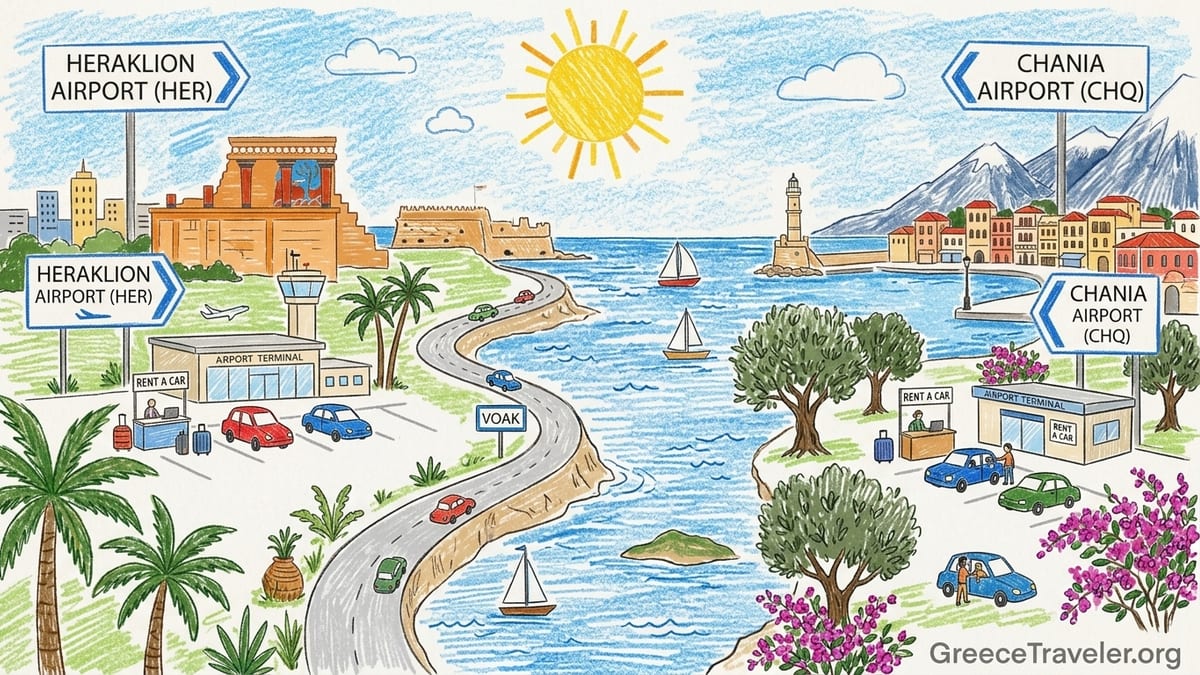
Heraklion vs Chania Airport: Where To Start Your Rental
Most visitors to Crete arrive at either Heraklion or Chania airport, and both have well developed rental car clusters. Heraklion, the island’s largest city and busiest airport, has a dense strip of desks just outside arrivals, including well known international brands and a large number of Cretan companies that offer meet and greet service in the parking area. Chania airport is smaller but similar in structure, with several big-name agencies inside the terminal and local firms operating directly opposite the building or delivering to the parking lots. In practical terms, you will find plenty of choice at both, from small hatchbacks to family SUVs.
If you are planning a classic north coast itinerary, such as a loop from Heraklion to Rethymno, Chania, and back along the VOAK / National Road 90, renting at the airport where you land is usually the simplest option. For example, a couple flying into Heraklion for a week that includes Knossos, a few days in Rethymno, and a finale in Chania often picks up at Heraklion airport, drives west in stages, then either returns the car in Chania and buses back to Heraklion for their outbound flight, or pays a one-way fee to drop off at Chania airport and departs from there. Families flying in and out of Chania, on the other hand, frequently keep their rental base there and use it to explore Balos by boat from Kissamos, Falassarna, and Elafonissi without changing airports at all.
Prices between the two airports are broadly similar for comparable dates and car classes, though Heraklion can be slightly more competitive at peak times because of the sheer number of suppliers. For instance, summer quotes for a small manual car booked early might cluster around a similar daily rate at both airports, but Heraklion’s local agencies sometimes include extras like a second driver or child seat more often in the base price. Chania’s advantage is convenience for those staying along the northwest coast; if your entire holiday is based near Chania Old Town or in beach areas west of it, choosing Chania airport avoids a two and a half hour transfer after a flight.
Operationally, both airports feed directly onto the main north coast highway. From Heraklion, you join the VOAK heading either east towards Agios Nikolaos or west towards Rethymno. From Chania, you are quickly on the same corridor travelling west to Kissamos or east to Rethymno and Heraklion. The roads themselves are similar in character along this axis, with a mix of dual carriageway and conventional highway, frequent speed limit changes, and local traffic entering from side roads, so your choice of airport should be guided more by your itinerary than by perceived road difficulty.
Who Really Needs a Car in Crete, and Who Does Not
Crete’s KTEL bus companies connect all the main towns and many villages, which means not every traveler needs a rental car. A first timer staying four nights in Chania Old Town and three nights in Heraklion, focusing on the Venetian harbors, museums, Knossos, and one or two organized beach excursions, can function comfortably without driving. Regular intercity buses run between Chania, Rethymno, and Heraklion, and local buses serve places like Knossos from Heraklion and nearby beaches from Chania, allowing you to rely on public transport and day tours.
On the other hand, visitors wanting to explore inland villages, mountain plateaus, small archaeological sites away from the main axis, or remote south coast coves will find a car close to essential. A couple staying in Argyroupoli or the Amari Valley, for example, would struggle to reach tavernas in neighboring hamlets or late evening viewpoints by bus. Likewise, basing yourself in a south coast village such as Plakias, Fragokastelo, or Loutro and hoping to reach trailheads early in the morning usually pushes you toward renting a car for at least part of your trip, even if you still rely on ferries between some coastal settlements.
A hybrid strategy suits many itineraries. One real-world pattern is to spend the first few nights in Heraklion or Chania car free, relying on airport transfers and walking, then pick up a rental later when you move on to a beach or village base. For example, a family might enjoy the first two nights in Heraklion without a car, visit the museum and Knossos via bus or taxi, then collect a car at the city office before driving to a villa near Rethymno. Others do the reverse: pick up on arrival at Heraklion airport, use the car for a week exploring the island, then drop it in Chania and spend car-free days in the pedestrian lanes of the Old Town before flying out.
Budget and comfort also matter. Solo travelers and couples on a tight budget can save notable amounts by combining buses with day trips. For instance, taking the intercity bus to the port of Kissamos and joining a boat excursion to Balos and Gramvousa can work out cheaper than renting a car, buying extra insurance, and risking damage on rough access roads. Meanwhile, larger groups of friends or families of four or five often discover that a mid-size rental car or compact SUV becomes cost effective when weighed against multiple bus tickets and airport transfers, especially in high season when tour prices climb.
One-Way Rentals, Automatics vs Manuals, and Deposits
One-way rentals between Heraklion and Chania are now routine, particularly in summer. Many local companies advertise pick up at one airport and drop off at the other, and international brands follow the same pattern. In practice, you might collect a car from a desk outside Heraklion arrivals, drive west over five days with stops in Rethymno and Chania, then return the vehicle at Chania airport before flying out. A one-way surcharge is usually added for this convenience, which might range from a modest fee that barely affects the total, to a more noticeable charge in peak season. Some agencies soften this by offering free one-way between their own offices in the two cities when you rent for a minimum number of days, so it is worth checking the terms carefully when you compare quotes.
Gearbox choice still shapes availability and price. Manuals remain the default in Greece, and most of the cheapest advertised prices are for small manual hatchbacks in categories often labelled A or B. Automatics are widely available at both airports but in a smaller proportion of the fleet, so they tend to book out earlier and cost more per day. Travelers who are used to automatic transmission at home, or who anticipate frequent hill starts in villages and mountain roads, generally find the extra cost worthwhile. In a typical high season example, a compact manual might be quoted at an approximate daily rate significantly below an automatic of the same size from the same supplier, but the automatic saves the stress of managing unfamiliar clutch work on steep lanes or when parking on slopes.
Deposits and payment holds vary sharply between suppliers. Some local Cretan companies advertise no deposit and no credit card hold for basic categories, taking payment only for the rental itself, while still verifying your license and ID. Others, including many international chains, preauthorize a security amount on your credit card at pickup, especially if you opt for standard insurance with an excess. For example, you might see a rental where the excess is a certain amount and the company blocks a portion of that on your card as a guarantee until you return the car undamaged. Travelers who do not carry a credit card or prefer not to have a large sum frozen sometimes look for local agencies offering full insurance packages that reduce or remove the need for a traditional deposit, in exchange for a higher daily rate.
Whichever airport you use, reading the booking confirmation and terms in advance is key. Details such as fuel policy, cross-island drop off fees, young driver surcharges, and required documents rarely appear in big search results summaries. Checking these specifics for a Heraklion based firm versus a Chania based firm before you lock in the reservation can prevent awkward conversations at the counter after a late-night flight.
Insurance, Fuel Policies, Parking and Mountain Roads
Almost all Cretan rental companies, whether at Heraklion or Chania, include some form of Collision Damage Waiver in the base rate, but with an excess that can be substantial. Many then sell additional coverage at the desk or online, variously labelled full insurance, super CDW, or zero excess, which reduces or removes your liability for damage under specified conditions. Crucially, all of these products contain exclusions. Off road use, damage to tires and wheels, and underside damage are common carve outs, meaning that if you hit a rock on a dirt track, even a zero excess package is unlikely to protect you fully. Some local firms explicitly explain that their cars are intended for paved public roads and that leaving them on rough dirt tracks is at your own risk.
Fuel policies also deserve attention. A fair fuel or full to full arrangement is common, where you receive the car with a full tank and are expected to return it full. This works well if you remember to brim the tank at a station just before the airport; there are several along the approach roads to both Heraklion and Chania. A full to empty policy, where you prepay a tank and return it as is, appears less frequently now but still exists; it tends to favor the company unless you arrive nearly on fumes. Checking the policy before booking lets you factor an approximate refueling cost into your budget and avoids end-of-trip disputes, such as being charged a service fee for returning the car short of full.
Parking in the major cities differs by area. Around Heraklion and Chania airports themselves there is usually ample space in the rental lots, so your main challenge comes in the historic centers. Many travelers leave the car in a long-stay lot on the edge of Chania Old Town or near the harbor in Heraklion and then walk into the pedestrian cores. For example, visitors sometimes choose accommodation in Chania slightly uphill from the harbor where street parking is more realistic, using the car primarily to escape the city during the day. In village and beach areas you are more likely to find informal roadside parking, though you should still respect signs and avoid blocking narrow lanes where buses or farm vehicles pass.
Mountain and rural roads demand realistic expectations rather than fear. The main north coast highway connecting Heraklion, Rethymno, Chania, and Kissamos is undergoing upgrades but remains a mix of faster and slower sections, while cross-island routes into the interior and south coast often narrow and twist. You will encounter local driving habits such as vehicles partially straddling the hard shoulder to facilitate overtaking and frequent slow-moving trucks or agricultural vehicles. Renting a car with enough power for hills, using low gears on descents, and avoiding ambitious night drives on unfamiliar mountain roads are practical steps that apply at both ends of the island. Visitors who are very nervous about heights or exposed roads might choose to skip certain drives entirely and reach those areas with organized tours.
Balos, Rough Roads and Supplier Restrictions
Balos Lagoon is the flashpoint where rental freedom meets hard restrictions. The last stretch of road from the turn-off above Kissamos to the Balos parking area is an unpaved, rocky track with steep drop-offs and loose stones. Most Cretan rental companies, including those based at Heraklion and Chania airports, explicitly classify this track and similar dirt routes as off road and exclude them from any insurance. Some even name Balos directly in their terms, explaining that if you drive a rental car on that road and suffer damage, breakdown, or tire issues, you are fully liable for all costs and may also face a fixed penalty fee on top.
In practice, this means that even if you rent an SUV or a higher clearance vehicle from Heraklion or Chania, it does not automatically grant permission to tackle the Balos road. Companies often stress that their cars, including SUVs, are intended only for paved surfaces, and that taking them onto dirt, gravel, or rocky tracks voids your coverage. A traveler might rent a compact SUV at Chania airport, see that it handles village lanes comfortably, and then assume the Balos road is allowed, only to discover in the small print that any damage incurred there, from a torn tire to a damaged suspension, is entirely their responsibility.
Local businesses and experienced travelers increasingly recommend reaching Balos by sea or by public transport plus footpath rather than by standard rental car. A common pattern is to drive or take a bus to Kissamos, board a boat excursion that visits Balos and Gramvousa, and enjoy the lagoon without worrying about insurance. Another option is to use the bus to reach a higher paved parking area and then change to a local shuttle that covers a portion of the rough approach, followed by the well known downhill hike to the lagoon. These methods may add a modest extra cost compared with trying to drive all the way, but they remove the risk of returning a damaged rental and facing a repair bill many times higher than the day’s excursion price.
Balos is not the only place where rough roads collide with rental contracts. Tracks leading to certain gorges, remote beaches, or inland churches can be similarly excluded. When in doubt, the safest practice is to ask the company directly at pickup, pointing to your planned destinations on a map. Staff based at Heraklion and Chania airports are used to these questions and often give clear verbal guidance along with written terms. If you mention names such as Balos, Agiofarago, or other known rough approaches, they will usually state whether these routes are permitted, discouraged, or explicitly banned, allowing you to plan alternatives like organized excursions or boat trips where necessary.
Combining KTEL Buses, Excursions and Short-Term Car Hire
Crete’s two main intercity bus companies, based around Heraklion–Lasithi and Chania–Rethymno, operate a dense grid of routes along the north coast and into many inland towns. Buses link Heraklion with Rethymno and Chania, Chania with Kissamos and coastal villages, and each major hub with smaller destinations. For many visitors, combining this network with targeted car hire delivers the best of both worlds. For example, budget travelers might take a bus from Heraklion airport into the city, spend two nights exploring on foot, then use another bus to reach Rethymno, and only then rent a small car locally for a three day loop into the nearby mountains and south coast beaches.
Organized excursions fill the gaps left by both buses and rental restrictions. In the Chania region, day trips by coach and boat to Balos and Gramvousa run frequently in season, typically starting with a morning bus pick up from hotels in or near the city, continuing to Kissamos port, and then switching to a boat. Similar packages exist for Samaria Gorge hikes, Elafonissi beach days, and other highlights. A traveler who dislikes mountain driving can therefore stay in Chania Old Town, take no car at all, and still reach these headline sites via escorted excursions. On the Heraklion side, organized trips to places like Knossos, the Lassithi Plateau, and Matala serve a similar role.
Short-term rentals dovetail neatly with this structure. One realistic model is for a couple staying ten nights split between Chania and Heraklion to rent a car only in the middle four days, when they plan to explore inland villages, wineries, and lesser known beaches. They rely on airport transfers and buses on their arrival and departure days, saving on both rental and parking costs when they are mainly in urban areas. Another example is a group of friends based in Rethymno who use buses for nightlife and old town wandering, then rent a car at a city office for a weekend to reach mountain tavernas and remote coves that lie beyond the bus grid.
This mixed strategy also cushions against fatigue. Driving in Crete, especially for those unused to southern European traffic norms, requires concentration. By clustering your driving days and interspersing them with bus or boat days, you avoid the feeling of having to manage a vehicle every single day of your holiday. Whether you pick up at Heraklion or Chania airport, knowing that you can hand the keys back and still move around efficiently lowers the pressure to keep a rental car parked outside your hotel all week just for occasional use.
The Takeaway
Renting a car in Crete is not an automatic requirement, but a tool that should match your itinerary, comfort with driving, and desire for independence. Both Heraklion and Chania airports support a rich ecosystem of rental suppliers, one-way options between the two ends of the island, and a choice between manual and automatic vehicles. Reading terms around deposits, fuel policies, and above all insurance exclusions, especially off road and Balos clauses, is just as critical as comparing headline prices.
If your plans focus on cities, major archaeological sites, and a few classic beaches, you can lean on the KTEL bus network and organized excursions, perhaps adding a short rental for targeted exploring. If you are dreaming of village tavern evenings, quiet monasteries, and little signed tracks to south coast coves, a car, even for part of the trip, becomes far more valuable. Whichever camp you fall into, treating Balos and other rough access roads as special cases, respecting supplier restrictions, and choosing airport or city pickups that align with your route will help ensure that your Cretan road story is memorable for the right reasons.
FAQ
Q1. Is it better to rent a car at Heraklion airport or Chania airport?
It depends on your itinerary. If you are exploring the east and central part of Crete, Heraklion airport is usually more convenient, while Chania airport works best for northwest bases such as Chania Old Town, Kissamos, and nearby beaches. Both airports have plenty of rental suppliers and similar road access to the main north coast highway.
Q2. Do I really need a car in Crete if I stay only in Chania and Heraklion?
No, not necessarily. If you are mainly visiting old towns, museums, Knossos, and a couple of well known beaches or gorges on organized tours, you can rely on buses, taxis, and excursions. A car becomes more useful if you want to explore inland villages, remote beaches, or stay in rural accommodations outside the main transport corridors.
Q3. Are one-way rentals between Heraklion and Chania common?
Yes, many local and international companies allow you to pick up a car at one of these airports and drop it at the other, often for an additional fee. This is practical for travelers flying into one city and out of the other or planning a linear road trip along the island’s north coast.
Q4. Should I book a manual or automatic car for driving in Crete?
Manual cars are cheaper and more common, but automatics are increasingly available and are a good choice if you are not confident with a manual on hills or in unfamiliar traffic. If you strongly prefer an automatic, book early, especially for summer, because the automatic fleet is smaller and sells out faster.
Q5. How do deposits and credit card holds usually work with Cretan car rentals?
Some local companies operate with no traditional deposit, especially if you buy their full insurance, while many international brands place a security hold on your credit card at pickup. The amount depends on the chosen insurance and car category. Always check your booking confirmation so you know what funds will be frozen on arrival.
Q6. Is it allowed to drive a rental car to Balos beach?
Most rental companies clearly state that the rough dirt road to Balos is off limits and not covered by insurance, even if you rent an SUV. Damage or breakdown on that track is usually your full responsibility. The safer alternatives are boat trips from Kissamos or using buses and shuttles combined with the walking path.
Q7. What type of insurance should I choose for driving around Crete?
At minimum, you will have basic Collision Damage Waiver with an excess, but many travelers choose extra coverage to reduce their liability on normal paved roads. Remember that off road use, tires, and underside damage are often excluded even from full packages, so no policy is a license to ignore road conditions.
Q8. How difficult are the mountain roads in Crete for visiting inland villages and the south coast?
Mountain roads are generally paved but can be narrow, winding, and occasionally exposed with steep drops. Local drivers know them well and may drive faster than visitors. If you drive cautiously, avoid night journeys on unfamiliar stretches, and allow more time than the map suggests, most routes are manageable for confident drivers.
Q9. Can I rely on buses instead of a car to see the main sights?
Yes, for many popular routes. Buses link Heraklion, Rethymno, Chania, and larger towns, and there are services to ports like Kissamos and many resort areas. You can combine these with organized excursions to reach places such as Balos, Samaria Gorge, and Elafonissi without renting a car for your entire stay.
Q10. What is the usual fuel policy for rentals at Heraklion and Chania airports?
The most common policy is full to full, meaning you receive the car with a full tank and must return it full, refuelling at a nearby station before drop off. Some companies offer prepaid fuel options, but these are generally less economical unless you expect to return the car nearly empty.