


Exploring the Greek islands without a car is not only possible, it can be one of the most relaxing ways to experience the Aegean. On the right islands, you can step off the ferry, roll your suitcase to your hotel, and spend the rest of the week walking coastal paths, hopping on local buses and using water taxis instead of worrying about parking, fuel and narrow mountain roads. This guide compares some of the best Greek islands for car-free travel and explains where to stay on each to minimise transport headaches.
How Easy Is It to Visit the Greek Islands Without a Car?
Car-free travel in the Greek islands comes down to three things: island size, settlement layout and public or boat transport. Compact islands with a single main village and beaches within a few kilometres are generally easy to explore on foot. Larger islands can still work well if they have a reliable bus network linking key beaches and towns, and if you stay close to a bus stop or port.
In practice, many travellers combine walking with local KTEL buses, small private shuttle vans, and water taxis. On islands such as Santorini and Paros, summer bus services run frequently along the main tourist routes, with sample fares often around 1.80 to 2.50 euros per ride for popular routes like Fira to Oia or Parikia to Naoussa. On small car-free islands such as Hydra and Koufonisia, you will mostly rely on your own feet and on small boats connecting beaches.
If you are planning a car-free trip, it is important to remember that Greek islands are highly seasonal. A route that runs every 20 minutes in July may only run a few times a day in May or October. Schedules for island buses are usually published a few weeks before the peak season and can change year to year, so always double-check times locally when you arrive. In shoulder season, choosing your base near the main bus hub or port becomes even more important.
Finally, car-free travel affects the kind of accommodation that works best. On a road trip you can stay in isolated villas, but without a car it is smarter to prioritise central guesthouses, small hotels near the port, or apartments near bus stops. In many places you can walk from your ferry to your room in under 10 minutes and be on the beach 15 minutes later without ever seeing a steering wheel.
Hydra: Classic Car-Free Island Close to Athens
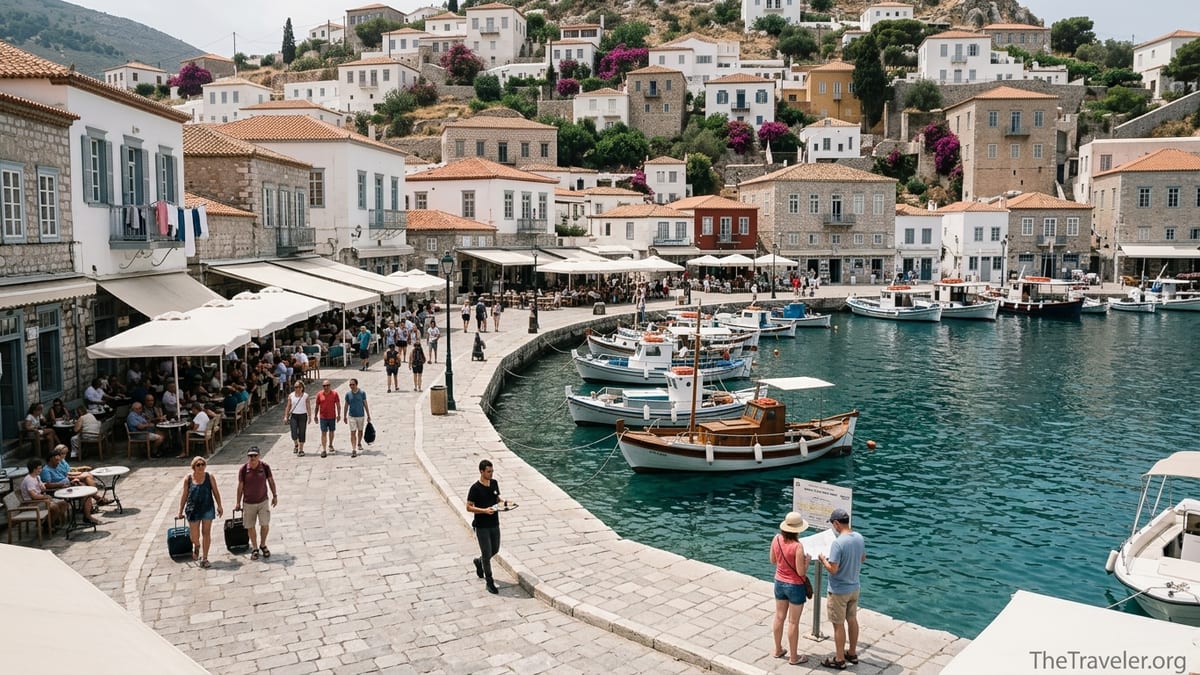
Hydra is one of Greece’s best-known car-free islands. Located in the Saronic Gulf, it is reachable in around 1 hour 40 minutes by high-speed ferry from the port of Piraeus near Athens. The island’s main town arcs around a horseshoe harbour, and by municipal decision there are no private cars, motorbikes or buses in town. Goods and luggage are moved by handcarts, donkeys and small utility vehicles restricted to specific uses, which keeps the streets unusually quiet and walkable.
For visitors, this means that almost everything you need is within walking distance of the port: tavernas, bakeries, small supermarkets and many guesthouses. A typical arrival day might involve rolling your suitcase for five minutes along the harbourfront to a stone mansion-turned-hotel, dropping your bags, and heading straight out on the coastal path towards Kaminia, a fishing hamlet about 15 minutes’ walk west of town, where you can swim from a rocky platform and have grilled fish for lunch.
Beaches on Hydra are spread along the coast and are reached on foot, by water taxi or by excursion boat. Popular spots such as Vlichos can be reached on foot in around 30 to 40 minutes from Hydra Town along a scenic seaside path, or you can take a short boat ride from the harbour. Further beaches, including Bisti and Agios Nikolaos, are usually accessed by small excursion boats that depart from the main port and sell round-trip tickets, which is particularly convenient if you do not want to hike in the summer heat.
To minimise transport issues on Hydra, stay in or immediately around Hydra Town. Rooms rise steeply up the hillside, so check the number of steps involved if you have mobility issues; some pension owners will send a porter with a handcart to meet specific ferries for a fee. Outlying guesthouses in Kamini and Vlichos offer quieter stays, but keep in mind that you will be walking that 15 to 40 minutes back from dinner each evening, often on dimly lit paths. Hydra suits travellers happy to walk on uneven stone lanes in exchange for a truly vehicle-free atmosphere.
Koufonisia and the Small Cyclades: Walkable Paradise
Koufonisia, usually referring to Ano (Pano) Koufonisi in the Small Cyclades, is one of the easiest Greek islands to enjoy entirely on foot. The main village, port and most accommodation cluster around the small harbour on the south coast. The island is tiny, and there is a minimal road network, with only one small bus running a simple shuttle route and no conventional car rental. Many visitors comment that they never needed anything beyond walking and the occasional boat ride.
From the port, you can walk east along a flat coastal path, passing a string of beaches such as Finikas, Fanos and Italida before reaching Pori beach after roughly 45 minutes at a relaxed pace. In summer, a small wooden boat, often called a “lantza,” shuttles between the port and several beaches, which is helpful during the midday heat or for families. A local bus route also usually connects the village with Pori, providing an alternative to the walk for a few euros per person.
Your choice of base on Koufonisia is straightforward: most travellers stay in or immediately above the main village so they can walk to the port, tavernas and first beaches within a few minutes. Typical guesthouses advertise distances in minutes on foot, for example “8-minute walk from the port” or “5 minutes to Ammos beach.” This kind of proximity removes most transport stress and makes it easy to pop back to your room between swims. If you stay further inland, check whether your host offers transfers for arrival and departure, as taxis are scarce.
Nearby islands in the Small Cyclades, such as Iraklia and Donousa, also work very well without a car, particularly if you are content with a few beaches and a peaceful village rather than a long list of sights. Boat connections between these islands and Naxos mean you can put together a multi-island trip where your “commute” is simply walking from one small port to the next ferry, without ever needing to drive.
Santorini Without a Car: Buses, Crowds and Smart Bases
Santorini is larger and far more built-up than Hydra or Koufonisia, but it remains one of the easiest Greek islands to visit without driving because of its central bus network. The main bus station is in Fira, the cliffside capital. Almost every bus route starts and ends there, including services to Oia, Kamari, Perissa, Akrotiri and the port. In high season, buses on the busy Fira to Oia route can run as frequently as every 20 to 30 minutes, with fares commonly under 3 euros per journey, paid in cash on board.
However, ease of movement has trade-offs. Buses can become extremely crowded in July and August, with travellers often standing in the aisle and sometimes queuing for the next departure, especially after sunset in Oia. If you are travelling without a car, it is worth planning your day around these peaks: for example, watching sunset from Fira or Imerovigli instead of Oia, or returning to your base on an earlier bus. For airport or port transfers, many hotels arrange group shuttles, which can cost more than the public bus but save you from dragging luggage through packed bus stations.
Where you stay on Santorini matters greatly if you are relying on buses. Fira is the most practical base because you can walk from your hotel to the bus station in a few minutes and reach almost every part of the island without changing buses. Imerovigli and Firostefani are within walking distance of Fira along the caldera path, so they are also strong options for those who prioritise cliff views without constant bus changes. If you prefer a beach base, Kamari and Perissa both have direct bus connections to Fira, but make sure your accommodation is not significantly uphill from the bus stop, especially in peak summer heat.
Taxis are limited on Santorini, and ride-hailing services operate in a restricted way, so it is unwise to assume you can quickly call a car in the middle of the night. Budget for the possibility that you might occasionally use a hotel-arranged private transfer for early ferries or flights. With this in mind, Santorini works well without driving if you accept the bus crowds, choose a central base, and avoid scheduling tight connections around the busiest bus times.
Paros and Antiparos: Reliable Buses and Walkable Villages
Paros has become a favourite among travellers wanting a blend of attractive villages, beaches and nightlife without needing to rent a car. The island’s KTEL bus system connects the port town of Parikia with Naoussa, Piso Livadi, Alyki and several popular beaches. During the main season, buses on routes such as Parikia to Naoussa typically run multiple times per hour during the day, and while delays are possible in traffic, many recent visitors report that routes are generally reliable enough to plan days around.
For a car-free stay, Parikia and Naoussa are the two most practical bases. Parikia, the ferry port, allows you to walk from the ship to your hotel in 5 to 10 minutes in many cases, and you have immediate access to shops, the seafront promenade and local buses. Naoussa, further north, is a picturesque harbour town with a maze of lanes filled with bars and restaurants. If you stay close to the small bus station or main road in Naoussa, you can easily catch buses to Parikia and onward to other parts of the island, then return on late services after dinner.
Beach access without a car is straightforward on Paros. From Naoussa, small boats operate in summer to beaches such as Kolymbithres and Monastiri, functioning almost like water buses. You pay per leg or buy a day ticket and simply hop on and off at different coves. On the east and south coasts, beaches such as Golden Beach and Alyki are on established bus routes from Parikia or Naoussa, making it easy to spend a day by the sea without thinking about parking.
Just across a short ferry from Paros lies Antiparos, a smaller island that works beautifully without a vehicle. The main village is right by the port, and many guesthouses are on quiet streets within a short walk. Beaches such as Psaraliki and Sifneiko are walkable from town, and in high season small local buses connect the village with more distant beaches and the famous cave. A popular car-free routine is to stay on Antiparos, walk to the beach in the morning, and take the frequent local ferry to Paros for an afternoon or evening in Parikia or Naoussa when you want more bustle.
Skiathos: One Simple Bus Route Along the Coast
Skiathos in the Sporades group is often recommended as one of the easiest islands to manage without a car, partly because its main beaches stretch along a single coastal road. A numbered bus line runs from Skiathos Town, near the port, westwards past a series of beaches and resorts, terminating at Koukounaries. Bus stops are clearly numbered, so many travellers refer to beaches by their stop number, which simplifies navigation considerably.
In high season, buses along this route can be frequent, often every 15 to 20 minutes during the day, and fares are relatively low. Because almost all passengers are heading to or from the beach, the buses can be crowded at peak times, but the system is straightforward: you board near your accommodation, watch for the stop numbers displayed inside the bus, and hop off when you reach your chosen beach. This layout makes Skiathos especially attractive for families or first-time visitors who feel anxious about complex networks or transfers.
Choosing where to stay without a car in Skiathos depends on your priorities. Staying in Skiathos Town gives you easy access on foot to the port, nightlife and supermarkets, and you can catch the bus to beaches each day. Alternatively, you can base yourself at one of the mid-route beach areas, perhaps around stops in the low 10s or 20s, where you are a short walk from the sand and still able to bus into town in the evenings. If you choose a more remote villa up a hill, check whether the owner provides transfers, because walking back from the bus stop in the dark on narrow roads can be uncomfortable.
Boat transport adds another layer of flexibility. From Skiathos Town, you can join boat excursions to more remote beaches such as Lalaria (weather permitting) or to neighbouring islands like Skopelos. These trips generally include transport, so you simply turn up at the harbour at the arranged time, step aboard and let the crew handle logistics. For a car-free holiday, combining the simple coastal bus, a central base and one or two boat days usually covers everything most travellers want to see.
Other Car-Free Friendly Islands to Consider
Beyond the headline names, several other Greek islands work particularly well for travellers without cars. Spetses, another Saronic Gulf island, restricts private cars in much of the main town and relies on horse-drawn carriages, bicycles and a limited number of taxis and buses. Like Hydra, accommodation clusters around the harbour and seafront promenade, meaning many visitors walk or cycle everywhere. For a smoother experience, staying near Dapia, the main port area, keeps you close to water taxis and buses that run to beaches such as Agia Marina.
Naxos is larger and more rural but is frequently recommended for car-free travel thanks to its decent bus network. KTEL buses connect Naxos Town (Chora) with popular beaches such as Agios Prokopios, Agia Anna and Plaka, as well as mountain villages like Halki and Filoti. Many travellers stay either in Naxos Town itself or in beach areas within walking distance of a bus stop, making day trips into the interior entirely feasible on public transport. The key is to pick accommodation that lies on or near one of the main bus routes rather than in an isolated farmhouse far from the road.
Closer to Athens, Aegina and Poros both suit car-free breaks or short add-ons to a mainland itinerary. Aegina’s main town and harbour area are compact, and local buses and taxis reach key sites such as the Temple of Aphaia and the fishing village of Perdika. On Poros, the small waterfront town directly facing the Peloponnese is mostly walkable, and water taxis shuttle constantly between the island and the mainland village of Galatas, making it easy to combine an island stay with mainland excursions without ever driving yourself.
When choosing among these islands, think about your travel style. If you want a strong sense of being away from cars entirely, Hydra, Koufonisia and Spetses are top choices. If you prefer more nightlife, shopping and varied landscapes, Paros, Naxos, Santorini and Skiathos balance good transport with more options. The common thread is that you can step onto these islands and realistically plan an entire week of activities without renting a car or scooter.
Practical Tips for Car-Free Greek Island Travel
Regardless of which island you choose, a few practical habits will make your car-free trip run more smoothly. First, build some flexibility into your schedule. Buses and boats can be delayed or full, especially on weekends or around public holidays. If you need to catch a flight or an onward ferry, aim for an earlier bus rather than the last possible one. Many travellers who rely only on the very last bus of the day find themselves anxiously watching the clock, whereas leaving an extra hour or two for connections leaves room for unforeseeable delays.
Second, pack with walking in mind. A wheeled suitcase is fine if your accommodation is near the port and the streets are paved, as in Paros or Santorini’s main towns, but on islands with cobbles, steps and dirt lanes such as Hydra or Koufonisia, a lighter bag or a backpack is more comfortable. Good walking sandals or trainers are essential, as you may easily log several kilometres each day moving between your room, bus stops and beaches. A small daypack for water, snacks and a lightweight towel makes impromptu swims and longer walks much easier.
Third, make the most of local knowledge. Hotel and guesthouse owners know the current bus times, boat departure points and rough taxi costs far better than any printed guide. On arrival, ask them which bus stop name to use, what time the last return bus runs from your chosen beach, and whether there are any changes to the schedule this week. Many will circle key stops on a paper map or send you a photo of the timetable by message so you do not have to rely on outdated information.
Finally, be realistic about your mobility and heat tolerance. A 25-minute walk on a coastal path in May can feel pleasant, but the same route in late August under a midday sun can be exhausting. On small islands, it often makes sense to walk out in the cooler morning hours and take a boat or bus back in the afternoon. If you are travelling with young children, older relatives or anyone with limited mobility, build in extra rest time and choose accommodation as close as possible to the port or main bus station to minimise uphill walks.
The Takeaway
The Greek islands are far more accessible without a car than many first-time visitors expect. On compact, car-free islands like Hydra and Koufonisia, walking and boats cover almost every need. On larger, better-connected islands such as Paros, Skiathos, Naxos and Santorini, a combination of buses, taxis and occasional hotel transfers makes it entirely feasible to enjoy beaches, villages and viewpoints without ever signing a rental contract.
The key to a stress-free car-free trip lies in trip design rather than improvisation. Choose islands with reputations for good public transport or small size, book accommodation that places you within an easy walk of the port or a main bus stop, and travel with the expectation that you will be on your feet more than you might be at home. In exchange, you gain freedom from driving on unfamiliar roads, hunting for parking on busy August afternoons, or limiting who in your group can enjoy a glass of wine with dinner.
With a little planning, travelling the Greek islands without a car can feel like stepping back to a slower, more human pace of life. Your days revolve around the sun, the sea and the next bus or boat, not fuel gauges or parking fines. For many travellers, that trade-off becomes part of the magic and a reason to return to the islands again and again.
FAQ
Q1. Which Greek island is the easiest to visit without a car for first-timers? For many first-time visitors, Paros or Skiathos are ideal. Both have straightforward bus networks serving major beaches and towns, and compact, walkable port areas with plenty of accommodation and dining options.
Q2. Can I rely only on buses in Santorini, or do I need taxis too? You can usually rely on buses for most sightseeing in Santorini, especially between Fira, Oia and the main beach resorts. However, because buses can be crowded and schedules thin out late at night, it is wise to budget for an occasional taxi or hotel-arranged transfer for early morning ferries or flights.
Q3. Is Hydra suitable for travellers with limited mobility if there are no cars? Hydra’s lack of vehicles creates a peaceful atmosphere, but the town is built on a hillside with many steps and uneven stone lanes. Travellers with limited mobility should choose accommodation close to the harbourfront and check in advance about luggage assistance, as walking steep slopes can be demanding.
Q4. How do I get to beaches on Koufonisia without a car or scooter? On Koufonisia, most beaches are linked by an easy coastal path, so you can walk from the main village to several coves in under an hour. In summer, small boats and a local bus usually connect the port with more distant beaches such as Pori, offering an alternative to walking back in the heat.
Q5. Are taxis easy to find on Greek islands if I choose not to rent a car? Availability varies widely. On larger islands like Paros and Naxos, taxi ranks can be found at the port and near main squares, but in peak season cars may be busy. On smaller islands such as Koufonisia or Hydra, taxis are very limited or nonexistent, so you should not rely on them and instead plan around walking, buses and boats.
Q6. What is the best area to stay on Paros without a car? Parikia and Naoussa are the most practical bases. Parikia lets you walk off the ferry straight into town and to the main bus hub, while Naoussa combines a pretty harbour with frequent buses and boat connections to nearby beaches, as long as you stay near the bus stop or port area.
Q7. Is Skiathos a good choice for families who do not want to drive? Yes, Skiathos is popular with families travelling without cars because one main bus route serves a line of beaches along the south coast. Parents can base themselves in town or near a mid-route stop, ride the bus to different beaches during the day and return easily in the evening.
Q8. How far in advance are island bus timetables usually published? Island bus companies typically publish their main summer timetables a few weeks to a couple of months before the high season, and they may update them again in July or August. Because details can change, it is best to check the latest schedules online just before your trip and confirm again locally on arrival.
Q9. Can I visit multiple islands without a car on the same trip? Yes, many travellers combine two or three islands in one car-free itinerary, using ferries between them. A common example is pairing Paros with Antiparos, or visiting Naxos and then spending a few nights on Koufonisia, walking from each island’s port to centrally located accommodation.
Q10. What type of luggage is most practical for car-free island travel? Compact, easy-to-carry luggage is best. A medium-sized wheeled suitcase works in towns with paved streets, while a backpack is more comfortable on islands with steps and rough paths. Keeping your bag light makes it much easier to walk between the port, bus stops and your accommodation.