


I arrived in Komotini hungry, slightly lost, and following the smell of sugar. Within ten minutes I was standing in front of Nedim, the old pastry shop near the central market that locals kept mentioning whenever I asked where to taste “the real Komotini.” Inside, behind steamed-up glass, rows of long, white-dusted soutzouk loukoum were coiled like soft ropes. I ordered a single piece with walnuts, about 200 grams, for just over 3 euros. The young man behind the counter cut it with a practiced hand, wrapped it in paper and smiled when I tried my first bite right there at the counter. The loukoum was dense and stretchy with grape must, sweet but not cloying, the crunch of whole walnuts running through the center. He told me his grandfather had been making it since the mid twentieth century, following a recipe that came with refugees from Asia Minor. That first bite set the tone for my days in Komotini: a city where every flavor seems to carry a story of movement, coexistence and quiet resilience.
Finding Komotini’s Flavors Around the Old Market
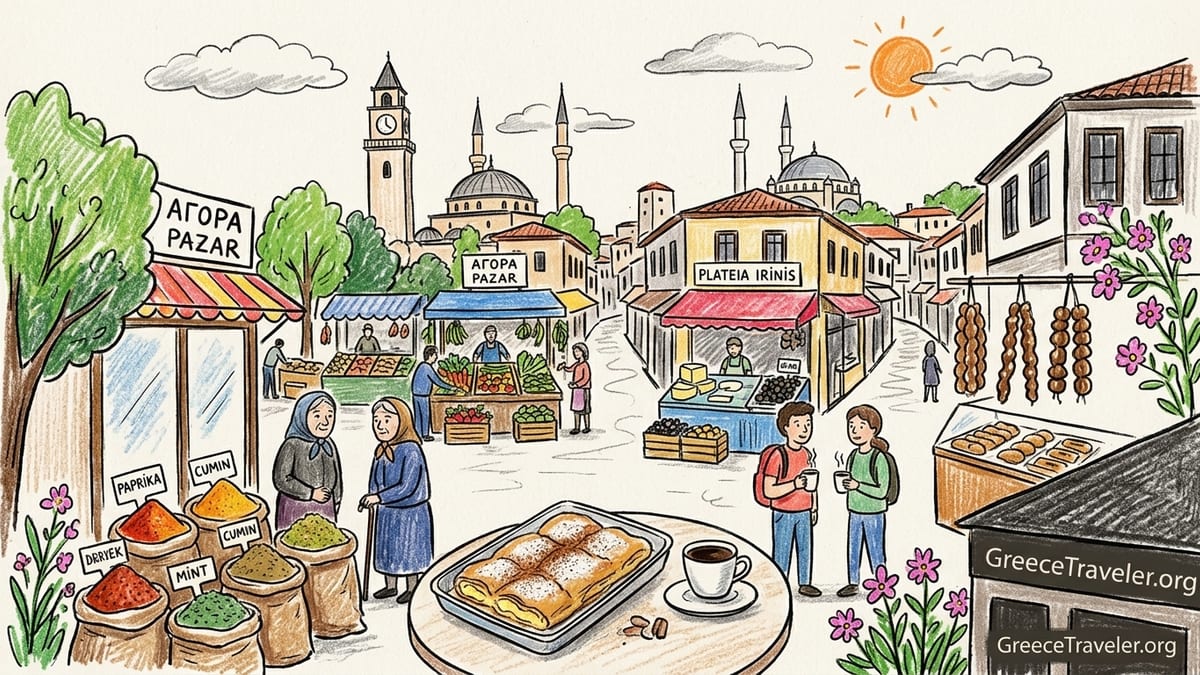
Most of my Komotini food days began in and around the old market district, a tight web of streets between the central Plateia Irinis and the mosques of the historic center. On a Saturday morning the covered and open-air sections were busy, with stalls of vegetables, cheese and olives side by side with fabrics and household goods. The produce market operates mainly on Saturdays, and the mood feels more like a weekly social ritual than a simple grocery run. Elderly women in headscarves inspected tomatoes with forensic care, students darted through with takeaway coffees, and the calls of vendors rose above the murmur in both Greek and Turkish.
Just off the market streets I stopped at a small spice shop whose shelves were stacked high with sacks of paprika, cumin, dried mint and sumac. The owner weighed out a modest mix of sweet and smoked paprika for me, about 150 grams for roughly 2 euros, along with a paper cone of roasted chickpeas, or stragalia. These chickpeas are a quiet Komotini staple, sold plain, salted or with chili. The ones I tried were lightly salted and astonishingly crunchy, the kind of snack you keep reaching for absent-mindedly. As we chatted, the shopkeeper pointed out that stragalia cross all lines in the city; everyone eats them, whether they come from Christian, Muslim or refugee families.
From the market it is only a few minutes on foot to Plateia Irinis, the central square that students from the local university have practically claimed as their living room. Modern cafés spill out onto the pavements here, but if you thread back into the older streets you quickly re-enter a different rhythm of Komotini’s food life: wooden-fronted bakeries, traditional coffee roasters and family pastry shops that carry names known in the city for generations. This close proximity between old market alleys and contemporary café culture is the daily reminder that Komotini’s culinary identity is not frozen in time but layered.
Walking these blocks between the clock tower, the Yeni Mosque and the covered market is the best way to understand the city’s food. In less than fifteen minutes I could pass a Christian bakery preparing tsoureki sweet bread for Easter, a Muslim butcher hanging spiced sausages for Ramadan, and a café where young people drink freddo espresso while nibbling syrup-soaked baklava. That coexistence, sometimes fragile in politics but remarkably relaxed at street level, is the lens through which every dish I tried began to make sense.
Breakfast: Bougatsa, Tahini Pastries and Strong Coffee
My first morning started at Guru Awaken the Senses on Plateia Irinis, a café-bakery that local students had recommended for bougatsa. I ordered a portion of cream-filled bougatsa, dusted with powdered sugar and cinnamon, plus a Greek coffee, and paid just under 5 euros. The bougatsa arrived cut into bite-sized squares, the phyllo thin and crisp around a velvety semolina cream that tasted of vanilla and warm milk. Sitting on the square while the city eased into the day, it felt like half Thessaloniki-style breakfast, half Komotini social scene.
Later that morning I followed a side street toward the old mosque quarter and found a small bakery with trays of tahini-filled pastries in the window. Tahini appears in many Thracian and refugee recipes, and here it was swirled into spiral pies known locally as tahinopita. I bought a palm-sized spiral for around 1.50 euros. The crust was more rustic than the delicate bougatsa phyllo, with a faint smokiness from the oven, while the filling combined tahini, sugar and a hint of cinnamon. The result was rich but not buttery, a reminder that many of these recipes were shaped by times when olive oil and sesame paste were more available than animal fats.
In Komotini, coffee culture bridges Greek and Turkish influences in small but telling ways. At a traditional café near the market, older men were drinking what the menu simply called “coffee,” served in the familiar small cup with grounds at the bottom. When I ordered mine, the waiter asked in Greek if I wanted it “sketo, metrio, gliko” and then repeated the same choices in Turkish for the next table. The flavor was dark and concentrated, with the slow-roasted character you find in long-established coffee roasteries. I paired it with a piece of sesame-covered simit-style bread from a nearby baker, and together they formed an improvised breakfast that felt identical on either side of the Aegean.
For travelers with dietary needs, breakfast in Komotini can adapt quite easily. Many bakeries now display labels for cheese-free, meat-free or fasting-friendly pies, often made with olive oil instead of butter for Orthodox fasting periods. At the same time, the presence of tahini and nuts in many pastries provides vegan-friendly options, although strict vegans still need to ask about honey or traces of dairy. In practice, I found staff willing to answer questions patiently, even if English was limited.
Sweet City: Soutzouk Loukoum, Syrupy Classics and Modern Pastry
Komotini’s signature sweet, soutzouk loukoum, kept reappearing throughout my stay. At Nedim, where I had my first taste, the display included thick strings of grape-must loukoum threaded around walnuts. The texture is firmer than ordinary Turkish delight, designed to be cut in slices rather than cubes. The staff offered samples of variations flavored with rose and citrus, but it was the traditional grape and walnut combination that best expressed the city’s history as a crossroads between Thrace and Asia Minor. It made sense that locals mentioned it first whenever I asked what to take home as an edible souvenir.
A short walk from the market I visited another well-known pastry shop that focused on syrupy sweets: trays of baklava, kataifi, saragli, seker pare and hanoum bourek. The last two, small semolina cookies soaked in syrup and layered pastry filled with custard, arrived in this region with refugees in the early twentieth century. I ordered a mixed plate with a small piece of baklava, one seker pare and one hanoum bourek for just under 4 euros. The baklava was heavy with walnuts and a deep amber syrup scented with clove. The seker pare was softer, almost cake-like inside, while the hanoum bourek combined crisp layers and a lightly lemony cream. Eating them together it was easy to taste how Ottoman dessert traditions had been localized and slightly lightened over time.
To compare this with more contemporary pastry culture, I stopped at Nikos Pastry Shop, a name that appears often in local guides. Behind the glass I found their more modern creations alongside classics: chocolate “Jamaica” cakes, Ferrero-inspired pastries, and neat squares of karioka made from chocolate and ground nuts. I tried a single Jamaica-style slice for about 3 euros and paired it with an espresso from the café corner. The cake was unapologetically rich, with dark chocolate ganache and a boozy undertone, more patisserie than traditional workshop. Looking around at the clientele, mostly young people in casual clothes, the contrast with the older, mostly male customers at the traditional kafeneia was obvious, yet both worlds coexist within a few hundred meters.
Another sweet discovery came in the form of loukoumades at a specialist shop on Plateia Irinis, where the sign simply announced “Loukoumades.” I ordered a small portion, around 3.50 euros, topped with honey and cinnamon. The doughnuts were fried to order, crisp on the outside and fluffy inside, and the honey came from producers in the wider Rhodope region according to the staff. Loukoumades are pan-Hellenic, but in Komotini they sit in a landscape already saturated with syrups, grape must and spice. By the time I left, fingers sticky with honey, I had begun to accept that there is no such thing as a “light” dessert course in this city.
Savory Thrace: Kavourmas, Keskek, Lahmacun and Pies
Komotini’s savory food is less internationally known than its sweets, but it was here that I felt the Thracian character most clearly. In a small taverna near the old market, recommended by a local friend, I finally tried kavourmas: spiced preserved meat, often beef or mixed meats, cooked slowly in its own fat and set like a terrine. The waiter brought thin slices lightly warmed in the pan and served alongside pickled peppers and village bread. The flavor was intensely meaty, with notes of allspice and black pepper, somewhere between confit and cured sausage. A small plate cost roughly 7 euros and was more than enough as a meze with a glass of tsipouro.
Another emblematic dish in the region is keskek, a slow-cooked wheat and meat stew with deep roots in Anatolia and Thrace. In Komotini I found it more often as a special than a daily menu item, mostly in places that cater to families with roots in nearby villages. When I finally ordered a portion in a modest restaurant just off the center, it arrived as a thick, almost porridge-like mound of cracked wheat cooked down with shredded lamb. The seasoning was simple, mainly salt and pepper, allowing the flavor of the grains and meat to dominate. A plate cost around 9 euros. The owner explained that in many households keskek is still tied to religious festivals and village celebrations, and that restaurant versions are a way to keep the dish present in urban life.
The Ottoman and Muslim minority heritage of Komotini is perhaps most visible in the everyday presence of lahmacun and related flatbreads. In a small pide and lahmacun shop near the Yeni Mosque, I watched as the baker stretched thin rounds of dough, spread them with a finely minced mixture of meat, onion, tomato and parsley, and slid them into a wood-fired oven. I ordered one lahmacun and one cheese-filled peinirli-style boat, paying about 6 euros in total. The lahmacun arrived blistered at the edges, topped with a squeeze of lemon and a handful of raw onion and parsley. The peinirli was softer, a canoe of dough cradling melted cheese with a faintly sour tang. Both were served cut into easy-to-share strips, underlining how much of Komotini’s food culture is built around sharing plates.
Pies form another important link between Thracian, Pontic and refugee communities. In a neighborhood bakery slightly north of the main center, I tasted a tray-baked spinach and herb pie that the baker simply labeled “hortopita.” The phyllo was thicker and oilier than the bougatsa style, and the filling combined spinach with leeks and local herbs. A generous square, enough for a light lunch, cost just under 3 euros. For vegetarians this kind of pie is one of the most reliable options in Komotini, and bakers often have versions with cheese, greens or mixed vegetables. Asking which ones are made with olive oil rather than butter can make a big difference for those with dietary restrictions.
Markets, Minority Culture and the Stories Behind the Recipes
It is impossible to understand Komotini’s food without a sense of its multicultural make-up. The city is home to one of Greece’s largest officially recognized Muslim minorities, including Turkish-speaking, Pomak and Roma communities, alongside Greek Orthodox residents and descendants of refugees from Asia Minor and Eastern Thrace. Walking from the clock tower to the old market you hear Greek, Turkish and occasionally Romani; you see women in headscarves choosing sweets next to students in jeans picking up coffee. This mix has not always been easy, but in culinary terms it has produced a rare density of influences in a relatively small urban space.
In the Saturday bazaar on the edge of the center, the atmosphere shifts slightly from the daily old market. Here, among stalls of fresh produce, olives and herbs, stands also sell spices typical of Anatolian kitchens, dried pulses by the kilo, and small-batch tahini and halva. I bought a jar of locally produced tahini for around 4.50 euros from a stall run by a family whose grandparents arrived as refugees in the 1920s. A few rows away, another vendor from a nearby Muslim village sold homemade pickles and hot pepper pastes. This is where I began to understand how products like tahini pastries, kavourmas and keskek live at the intersection of different communities.
Architecture and food intersect in places like the neighborhood around the Tabak Hané mosque, where a newer café of the same name has attempted to marry design with tradition. When I visited, I found shelves with local products from Thrace, including jams, herbal teas from the Rhodope mountains and regional olive oils. My coffee there cost roughly 3 euros, similar to modern cafés elsewhere in Greece, but the setting among old courtyards and the quiet square gave it a different weight. It felt like a curated version of Komotini’s identity: contemporary, self-aware, yet rooted in the mixed urban fabric that grew up around mosques, churches and workshops.
Even cultural stops like the Archaeological Museum and the remnants of the Byzantine wall, a short walk from the center, feed indirectly into the food story. Exhibits trace the ancient agricultural life of Thrace, from early grains to amphorae that once carried wine and oil across the region. Stepping back out into modern Komotini, then tasting a dish like keskek made from wheat and lamb, it becomes easier to see these foods not as quaint survivals but as part of a long, adaptive continuum.
Traditional Sweet Shops vs Modern Cafés and Tourist Restaurants
Over several days I developed a rough personal map of Komotini’s food personalities. On one end were the traditional sweet shops like Nedim and the smaller family bakeries around the market, where recipes have changed little in decades. The service here tended to be direct but warm once I attempted a few words of Greek. Staff were quick to offer small samples of soutzouk loukoum or halva, and prices were usually displayed clearly by the kilo. These places cater primarily to locals, with tourists as a welcome bonus rather than the target market. The décor is often simple, with tiled floors and glass counters, and the focus unmistakably on the product.
On the other end were the modern cafés ringing Plateia Irinis and nearby pedestrian streets. Here freddo cappuccino and brunch-style offerings sit beside a few token local sweets. Menus may feature pancakes, club sandwiches and burgers, foods that speak more to student life and national trends than to Komotini specifically. I stopped at one such café for a late brunch of avocado toast and eggs, paying around 9 euros including coffee. It was competent, even good, but could have been in any medium-sized Greek city. These venues are excellent for people-watching and for those needing Wi-Fi and a familiar café experience, but they are not where Komotini’s culinary distinctiveness shines.
Between these two poles stand a handful of restaurants and meze places that try to bridge local and broader Greek tastes. In one grill house near the Eski Mosque I ate exceptionally grilled chicken and a smoky eggplant salad, dishes that would not look out of place elsewhere in northern Greece but were seasoned with a slightly heavier hand of paprika and cumin. Prices here were moderate, roughly 12 to 15 euros per person for a generous shared meal including drinks. The clientele was mixed, both in terms of age and background, with headscarved women at one table, students at another and a Greek family celebrating a birthday in the corner.
Komotini is not a heavily touristed city compared to island destinations, so explicitly tourist-focused restaurants are relatively few. Most places that might be called “touristic” are simply central tavernas with bilingual menus and a somewhat generic selection of Greek staples. When I did sit down at such a place on a busy evening, the moussaka and grilled octopus were perfectly serviceable but could have been transplanted from Athens or Thessaloniki. The difference lay less in flavor and more in the absence of dishes like kavourmas, keskek or local-style pies. For travelers specifically interested in Komotini’s unique food identity, it pays to step a street or two away from the main square and follow where locals seem to be eating.
Vegetarian and Dietary Options in a Meat‑Loving City
At first glance Komotini’s menus lean heavily on meat, from skewers and soutzoukakia to spiced sausages and kavourmas. Yet I found that vegetarians and flexitarians can still eat quite well with a bit of guidance. In traditional tavernas around the center, a section of the menu was often dedicated to “oresis” or appetizers, many of which are naturally meat-free. I routinely ordered plates like grilled mushrooms, fava puree, fried zucchini, gigantes beans in tomato sauce and simple tomato-cucumber-onion salads. Combined with a slice of spinach pie or a basket of bread, these easily formed a satisfying meal at 10 to 12 euros per person.
Bakeries are another ally for those avoiding meat. Beyond classic cheese and spinach pies, some Komotini bakeries include potato, leek or mixed vegetable pies that are filling and inexpensive, usually under 3 euros for a generous slice. Tahini pastries, olive rolls and sesame breads provide vegan options, though asking about butter or egg washes is still important. In the sweet realm, soutzouk loukoum, many types of halva and sherbet-based sweets are free of dairy and eggs, though they do contain sugar in abundance.
Gluten-free travel here is more challenging. Wheat is at the core of many traditional dishes, from pies and bread to keskek and desserts based on semolina or flour. Few establishments in the historic center advertised explicitly gluten-free items when I visited. However, grilled meats without marinades, fresh salads, roasted vegetables and some bean dishes can be safe options if cross-contamination is not a primary concern. Communication is key, and carrying a translated explanation of dietary needs in Greek can be very helpful.
Lactose-intolerant travelers will find some relief in the region’s reliance on olive oil and plant-based fats. While yogurt and feta appear widely, many savory dishes are cooked without dairy, especially those tied to Orthodox fasting traditions or to Anatolian backgrounds where olive oil was historically central. Simple grilled fish, pulses, vegetable stews and many meze are naturally dairy-free. In Komotini, as in much of Greece, staff were ready to suggest alternatives when I mentioned dietary preferences, as long as I framed them clearly and simply.
Suggested Food Routes: Half‑Day and Full‑Day Tasting Walks
For a half-day introduction focused on the city center, I would start around 9:00 in Plateia Irinis with breakfast at Guru or another central bakery for bougatsa and coffee. From there, walk a few minutes to the old market, browsing produce stalls if it is Saturday and dropping into a spice shop for stragalia and paprika. Around late morning, circle back toward Nedim for a measured indulgence in soutzouk loukoum, buying a small piece to eat on the spot and perhaps a box to take away. Spend midday wandering through the streets between the Yeni Mosque, Eski Mosque and the Byzantine wall remnants, stopping for a simple lunch of lahmacun or peinirli near the mosques. Finish with a coffee at a traditional café watching the ebb and flow of locals in the narrow lanes.
A full-day food route allows more time to appreciate the range of Komotini’s table. Begin again at the central square with bougatsa or tahini pastry, then head to the Archaeological Museum for a short visit that frames Thrace’s agricultural history. Late morning, explore the old market in depth, sampling olives, cheeses and dried fruits where available and stocking up on tahini, halva or local teas. Lunch can be at a taverna near the market where you specifically seek out kavourmas, grilled meats and a selection of vegetable meze. In the slower afternoon hours, retreat to a café like Tabak Hané in the historic quarter for coffee and a light sweet such as seker pare or baklava.
As evening approaches, walk toward the areas just beyond the most central streets, where neighborhood bakeries still display their last pies of the day and small meze places open for the dinner crowd. If you can find keskek on a menu or as a special, this is the moment to try it, ideally accompanied by a glass of wine or tsipouro. End the day back near Plateia Irinis with loukoumades or one final piece of soutzouk loukoum, completing a circle that connects Komotini’s past, present and quietly evolving future through taste.
Throughout both routes, the distances are walkable, rarely more than ten or fifteen minutes between stops. This compactness makes it easy to improvise based on what looks appealing or busy. Following the rule of choosing places where groups of local families or mixed-age tables are eating served me well, often leading to more interesting dishes than any pre-planned list alone.
The Takeaway
Looking back at my days in Komotini, the city’s food memory is not tied to a single spectacular meal but to a series of layered impressions: grape-must sweetness dusting my hands outside Nedim, the smoky warmth of kavourmas in a crowded taverna, the snap of stragalia between sips of strong coffee, and the comfort of tahini spirals eaten on the move between market errands. Komotini is not a polished food destination in the manner of a capital city or famous island. It is, instead, a place where everyday eating still carries the weight of history and coexistence.
The most memorable individual dishes for me were the soutzouk loukoum with walnuts, which encapsulated the city’s East-meets-West character in each chewy slice, and the hearty, humble plate of keskek that tasted more of home cooking than restaurant showmanship. Lahmacun and peinirli near the mosques, tahini pastries from small bakeries, and syrupy sweets such as hanoum bourek rounded out a picture of a city that comfortably speaks several culinary languages at once.
Is Komotini worth visiting specifically for its food culture? If you are looking for Michelin stars or elaborate tasting menus, probably not. If, however, you are drawn to places where food is an everyday expression of mixed histories and identities, Komotini rewards curiosity. It offers an unusually dense concentration of traditional pastry shops, spice stores, minority-influenced grills and unpretentious tavernas within a small area that can be covered on foot. Prices remain reasonable compared with more touristed destinations, and the relative absence of mass tourism means that most venues cook first for locals.
For travelers tracing the broader culinary map of northern Greece and Thrace, Komotini deserves at least a full day, and ideally two, devoted almost entirely to eating, walking and talking with vendors. Come hungry, prepared to snack as you go, and open to the idea that the most revealing dishes may appear not on glossy menus but behind fogged-up glass counters and in steaming trays carried from kitchen to table in simple neighborhood joints.
FAQ
Q1. Is Komotini a good destination for vegetarians?
Yes, vegetarians can eat well in Komotini by focusing on pies with greens or cheese, vegetable meze like beans and grilled vegetables, and tahini or olive-oil-based pastries. It helps to ask staff which dishes contain meat stock or hidden animal fats.
Q2. Where can I try soutzouk loukoum in Komotini?
Traditional pastry shops around the old market and near the city center, including long-established family businesses, are the best places to find soutzouk loukoum sold by the kilo and in gift boxes.
Q3. Are there food tours available in Komotini?
At present, organized food tours are limited, and many visitors create informal tasting walks on their own. Local tourism offices and some small agencies can sometimes arrange private guided walks that include markets and selected eateries.
Q4. What time does the Komotini market operate?
The daily old market streets near the center stay active throughout the morning and early afternoon, while the larger open-air bazaar with produce, clothing and household items takes place mainly on Saturdays from morning until early afternoon.
Q5. Is Komotini suitable for travelers with gluten intolerance?
Komotini can be challenging for strict gluten-free diets, since many staples involve wheat. However, grilled meats, salads, bean dishes and some vegetable plates may be suitable if cross-contamination is not a major concern and needs are clearly explained.
Q6. How expensive is eating out in Komotini?
Eating out in Komotini is generally affordable. A bakery breakfast with coffee often costs 4 to 5 euros, while a full meal at a simple taverna with shared dishes and drinks can range from 12 to 18 euros per person.
Q7. Can I find halal options in Komotini?
Yes, because of the significant Muslim minority, there are butchers and eateries that follow halal practices, especially in neighborhoods around the mosques. It is still advisable to ask directly if halal preparation is important to you.
Q8. What local products are best to bring home as gifts?
Popular edible souvenirs from Komotini include soutzouk loukoum with walnuts, locally made halva and tahini, regional herbal teas, jams and packets of roasted chickpeas or other nuts from spice shops.
Q9. Do restaurants and cafés accept credit cards?
Most central cafés, pastry shops and restaurants accept credit or debit cards, though very small bakeries and market vendors may prefer cash, especially for low-value purchases like individual pastries or snacks.
Q10. Is English widely spoken in Komotini’s food venues?
In many central cafés and some restaurants staff speak basic English, while in traditional bakeries and markets communication may rely more on gestures and a few key words. A small phrase list in Greek can make interactions smoother and more enjoyable.