


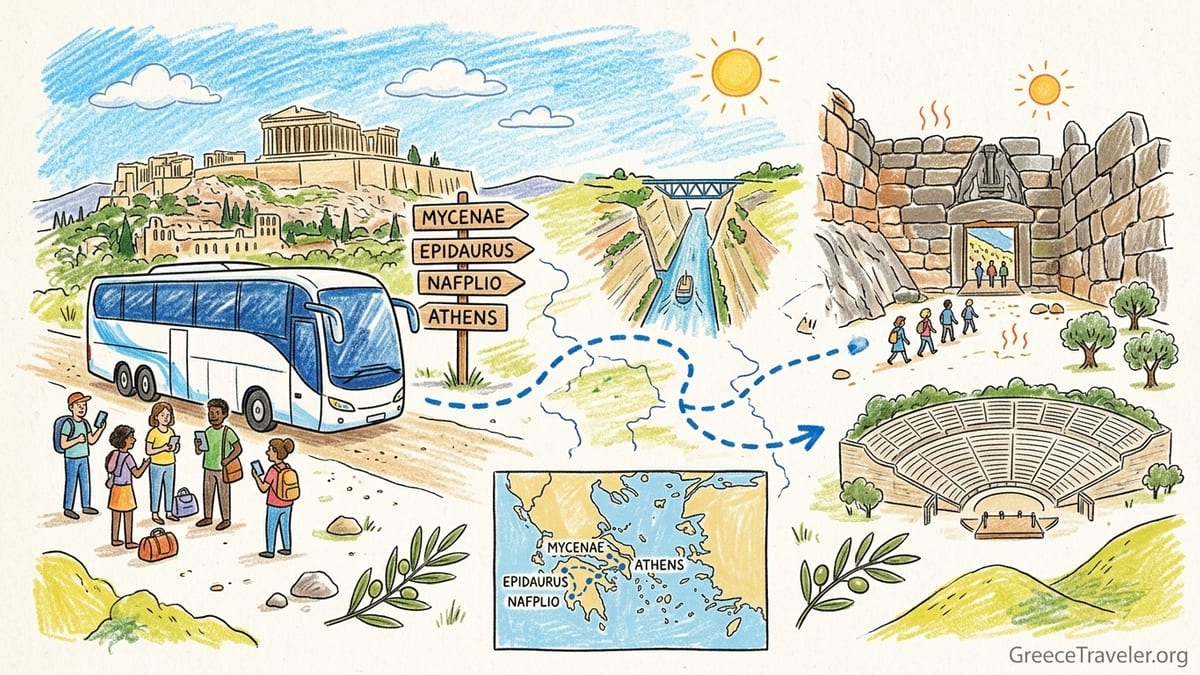
There is a particular kind of Athens morning where the city feels half-awake: espresso machines hissing behind hotel glass, scooters darting through empty lanes, and tourists quietly assembling with backpacks that are too small for the day they are about to have. That was the mood when I joined a full-day group excursion to Mycenae, Nafplio, and Epidaurus, the trio that dominates Athens day-trip search results for good reason. In theory, it is a clean loop through the Argolid: Bronze Age citadel, seaside old town lunch break, then a world-famous theater and healing sanctuary before you roll back into the capital at night. In practice, the day is a negotiation between distance, heat, and the reality that three headline sights plus a canal photo stop still have to fit into one bus schedule.
Morning Pickup In Athens: The Part Nobody Mentions
My tour day began with logistics, not ruins. Many current group tours run on a “central meeting points” model rather than true door-to-door pickup, and it matters because Athens traffic is unpredictable and those early minutes set the tone. I chose one of the standard downtown pickup points and arrived early enough to watch other travelers drift in, checking vouchers on phones and asking the same question in different accents: “Is this the Mycenae one?” On some listings, you will see hotel pickup described as “free pickup from selected centrally located hotels,” and in reality it is often a short transfer to the main departure coach, or a pickup only if your hotel is on their predetermined list.
The vehicle that finally pulled up was exactly what I expected for this route: a modern, air-conditioned coach with high-backed seats and a luggage hold underneath. Not glamorous, but comfortable. The seat spacing felt fine for a full day, though once everyone settled in, the truth became obvious: you are going to spend a lot of time sitting. I kept a light jacket within reach because coach air-conditioning can be aggressive even when the day outside is scorching.
As we rolled out of Athens, our guide did what good guides do on long drives: they built a framework for what we were about to see and how to see it efficiently. That included the unglamorous advice that ends up being the most useful later, such as using restrooms whenever they are available, carrying more water than you think you need, and not assuming shade exists just because a place is ancient.
On The Road: The Corinth Canal Stop And The Reality Of Distance
Most Mycenae, Epidaurus, and Nafplio itineraries include a quick stop at the Corinth Canal, and mine did too. It is the kind of stop that sounds like a bonus and functions like a pressure valve: a short break from the bus, a chance to stretch, and a photogenic reminder that Greece is not just temples and tavernas. The canal viewpoint is dramatic in the simplest way, a hard cut through rock with water far below, and the stop is typically brief enough that you can feel the schedule breathing down your neck.
After the canal, the bus time becomes the dominant feature of the morning. The Argolid is not far on a map, but the combination of highway distance, group pacing, and multiple sites means you will be looking at more windshield than many travelers expect. I watched the landscape change from urban Athens to wider, drier stretches, with that Peloponnese light that feels sharper than the Attica haze.
Here is what surprised me: how much mental energy is spent simply managing the day. You start doing math without trying. If the tour is roughly 10 to 12 hours overall depending on operator, and you have three major stops plus breaks, how much time can each place realistically get? This is where group tours feel both liberating and limiting. You do not have to navigate, park, or worry about route planning, but you surrender control over the clock.
Mycenae In The Heat: Lion Gate, Treasury Of Atreus, And Chasing Shade
Mycenae is the stop that feels most physically demanding, especially in warm months. It is open-air, exposed, and built on a rise that asks you to climb. The first sensation stepping off the bus was the heat radiating upward from stone and dust. Even with a hat, the sun can feel relentless, and the shade that does exist is often claimed quickly by people who know what is coming.
Walking toward the Lion Gate is a moment that cuts through fatigue. Photos do not fully prepare you for how the approach feels, with the Cyclopean walls pressing in and the entrance narrowing your view until the carved lions appear above. It has a gravity to it, less like a “sight” and more like a threshold. The guide’s narration was strongest here, translating archaeology into story without turning it into myth-only theatrics. When guides are good at Mycenae, they connect the layout of the citadel to how people lived and moved, and they point out details you would otherwise pass, such as the way entrances control flow and defense.
The Treasury of Atreus, often marketed as the “Tomb of Agamemnon,” was the most visceral space of the Mycenae portion for me. The beehive-shaped chamber swallows sound, and stepping inside is like entering a cool pocket after the glare outside. This is also where I most wanted extra time. Group pacing tends to turn the Treasury into a quick in-and-out, and I would have liked a quieter few minutes to absorb the geometry and the stillness without a line forming behind me.
Ticketing is worth understanding before you go, because 2026 pricing and rules are not something you want to guess on the spot. Official listings for the Archaeological Museum of Mycenae show an adult ticket price of 20 euros, and the same price is presented for both summer and winter periods on current Ministry of Culture pages. The same official information indicates the ticket includes the archaeological site, meaning your entry covers the core Mycenae experience rather than requiring separate payments for the essentials.
Opening hours also shape the experience more than most travelers realize. Official information for Mycenae’s museum lists summer period hours generally spanning 08:00 to 19:00. That sounds generous, but on a group tour you are constrained by bus arrival and departure windows, not by the site’s full operating day. My biggest “if I could change one thing” moment at Mycenae was simple: I wanted either an earlier arrival, when the site is cooler and quieter, or more time so I could move slower and choose shade strategically instead of taking photos quickly and pushing on.
Guide Quality: What Helped, What Felt Scripted
On a day like this, guide quality can determine whether you come back exhilarated or simply exhausted. My guide struck a practical balance: clear meeting times, reminders about water, and enough context to make each stop feel distinct rather than a blur of “ancient stone.” They were especially strong at explaining why Mycenae matters historically, not just aesthetically, and they did not pretend that the day would be unhurried.
That said, there were parts that felt inevitably scripted, especially on the long stretches between stops. Some of this is unavoidable, because a guide has done the same route hundreds of times and needs to keep a coach of strangers aligned. Still, I found that the best moments were when the guide shifted from broad history to practical micro-advice: where the shade collects at Mycenae, how to approach the theater steps at Epidaurus without slipping, and how to spend a short Nafplio break so you do not waste half of it just deciding.
One detail that matters for travelers choosing an operator in 2026: not every “guided tour” is guided the same way. Some tours emphasize an in-person tour leader, while others advertise audio guidance or app-based narration, sometimes paired with a tour leader for logistics. Gray Line’s current description, for example, highlights roundtrip transport, a tour leader, audio guidance, and even a virtual reality device on certain departures, plus optional entry fees depending on the option selected. That variety changes what “guide quality” actually means day-of, so it is worth confirming whether you will have a licensed guide inside the sites or a coordinator who keeps time and leaves the storytelling to audio.
Nafplio Midday: Lunch, Free Time, And The Clock You Can Feel
After Mycenae, Nafplio felt like a reward. The temperature still mattered, but the experience changed from exposed archaeology to a living town with shade, cold drinks, and the psychological relief of choice. Most group itineraries build in free time here rather than a fixed group lunch, and that flexibility is welcome because people are hungry at different speeds and want different experiences. Some travelers immediately hunt for a table; others head straight for a coffee and a harbor stroll.
My own Nafplio break was defined by one priority: maximize “sense of place” in minimal time. I grabbed a simple lunch and then walked toward the waterfront, using the town’s narrow streets to escape the midday sun. Nafplio’s charm is real, but on a full-day tour it can also feel like the stop you never quite get enough of. I wanted more time for a slow loop through the old town and, ideally, enough margin to tackle a bigger climb like Palamidi, but that is not realistic in most group-day formats unless the tour explicitly builds it in.
This is also where I most felt the day’s trade-off. Nafplio is not merely a lunch stop; it is a destination that can carry an overnight stay on its own. On the tour, it becomes a compressed highlight reel. You can absolutely enjoy it in a short window, but if Nafplio is the part of the itinerary that excites you most, a one-day triple-stop tour may leave you wishing you had booked something slower.
Pickup and meeting logistics vary by operator, and that variation influences the Nafplio rhythm too. I have seen current listings that specify multiple fixed Athens pickups with exact times, such as early morning pickups in central locations. One example itinerary for a similar day trip lists pickup points including the Melina Mercouri Monument in Plaka around 07:45, the Hellenic Parliament around 07:50, Omonoia Square around 08:00, and Karaiskaki Square around 08:05, with travelers instructed to wait at a specific hop-on, hop-off bus sign. Details like that sound small, but they explain why some departures feel tightly choreographed from the first minute.
Epidaurus: The Theater, The Sanctuary, And The Best Late-Day Light
By the time we reached Epidaurus, the group had the distinct energy of people who know they are in the second half of a long day: quieter on the bus, more sun-warmed, a little less interested in perfect photos and a little more interested in finding a bench. Epidaurus, though, has a way of resetting attention. The theater is not just intact, it is elegantly scaled, and it feels purposeful rather than ruinous.
The first thing I noticed was the sense of order in the space, the way the seating rises and curves with calm geometry. Even if you have seen photos for years, standing there makes the design logic obvious. People naturally spread out, some climbing higher for the view, others staying low to test acoustics in the center. The guide handled this portion well by giving a short orientation and then letting the site speak for itself. There is a fine line at Epidaurus between explaining and over-explaining, and a little restraint helps.
Ticketing at Epidaurus is another place where 2026 details matter. Official Ministry of Culture pages for the Archaeological Museum of the Asklepieion at Epidaurus list a standard ticket price of 20 euros, and note that the ticket includes entry to the archaeological site as well. Summer hours are listed broadly as 08:00 to 19:00. That range may sound generous, but in a group itinerary you are still operating within a fixed afternoon window. If Epidaurus is the main reason you are taking the tour, you may find yourself wishing for a longer stay here, especially if you want to explore the sanctuary beyond the theater.
What I most wanted at Epidaurus was time to walk the sanctuary at an unhurried pace. The theater is the headline, but the larger Asklepieion complex is the point of the UNESCO inscription and the reason the place feels different from other ancient sites. With more time, I would have lingered longer on the quieter edges, where the crowds thin and you can imagine the sanctuary functioning as a healing center rather than a sightseeing stop.
Sightseeing Versus Bus Time: How The Day Really Broke Down
Every full-day triple-stop tour lives or dies on one question: how much time are you actually out of the vehicle? My honest answer is that the day felt like a near-even split, and sometimes less than even, depending on traffic. The coach time is substantial: Athens to Corinth Canal, canal to Mycenae, Mycenae to Nafplio, Nafplio to Epidaurus, then Epidaurus back to Athens. Each leg is manageable on its own, but together they add up to a lot of seated hours.
On my day, the sightseeing windows felt like this in practice: a short canal photo stop, a meaningful but time-conscious Mycenae visit, a Nafplio lunch and free time break that passed faster than I wanted, then an Epidaurus visit that delivered a powerful theater moment but left less margin for the wider sanctuary than I would have liked. If you are expecting leisurely wandering at each stop, you may feel rushed. If you are expecting a curated sampler that hits the essentials, it works.
The moments I most wanted more time for were the Treasury of Atreus at Mycenae and the sanctuary grounds at Epidaurus. In both places, the schedule encourages you to prioritize the most famous “frame” and then move on. That is not a flaw so much as a structural reality of doing three major highlights in one day.
So, did it feel rushed? Yes, at points. But not in a way that made it pointless. It felt like a well-produced highlights tour that makes sense for travelers with limited days in Athens and a strong desire to see beyond the city. The trade-off is that you will come away with at least one “next time” note in your head.
The Takeaway
If your goal is to see Mycenae, Nafplio, and Epidaurus in a single day without driving, this group-tour format delivers exactly what the search results promise: a full, classic Argolid loop with big-name sights and minimal planning effort. The bus is comfortable, the stops are logically ordered, and the day gives you just enough time at each place to understand why it matters.
If, however, you are the kind of traveler who likes to sit quietly inside a tomb-like chamber until the crowd noise fades, or who wants to walk the full sanctuary at Epidaurus without watching a clock, doing all three in one day will feel compressed. My strongest recommendation is to treat this tour as a scouting trip. It lets you sample three destinations and decide which one deserves a slower return.
Next time, would I do a group tour again? If I were traveling solo, short on time, and mainly wanted to tick off the classics, yes. But if I were traveling with a partner or family, I would seriously consider either a private driver or a rental car. A private driver would keep the convenience while giving back the one thing a group tour cannot: control over time. A rental car would be the most flexible and potentially the most cost-effective for a small group, but it comes with the real-world friction of navigation, parking, and being fully responsible for schedule decisions in the heat.
For my own travel style, a private driver would be the upgrade I would choose. The ability to arrive earlier at Mycenae, extend Epidaurus by even 30 to 60 minutes, and linger in Nafplio until dessert without worrying about a coach departure whistle would transform the day from a highlight reel into something closer to travel.
FAQ
Q1. How long is the Mycenae, Epidaurus, and Nafplio day tour from Athens?
Most current group tours run roughly 10 to 12 hours door to door, depending on pickup points, traffic, and the operator’s schedule.
Q2. Do these tours usually include a Corinth Canal stop?
Many do include a short Corinth Canal photo stop, but not all itineraries are identical, so it is worth confirming before booking.
Q3. What are the current ticket prices for Mycenae in 2026?
Official Ministry of Culture information lists an adult ticket of 20 euros for Mycenae, and notes the ticket includes the archaeological site along with the museum.
Q4. What are the current ticket prices for Epidaurus in 2026?
Official Ministry of Culture information lists an adult ticket of 20 euros for the Epidaurus museum, and notes the ticket includes the archaeological site as well.
Q5. What are the opening hours for Mycenae and Epidaurus?
Official listings show both sites generally operating in summer around 08:00 to 19:00, but exact hours can vary seasonally and may change on specific dates.
Q6. How much time do you actually get at Mycenae, Nafplio, and Epidaurus?
Expect the day to feel time-conscious at every stop. You will have enough time for the headline highlights, but not enough for slow, deep exploration at all three.
Q7. Does doing all three in one day feel rushed?
It can. The experience is best viewed as a curated sampler rather than a relaxed deep dive, especially in hot weather or heavy traffic.
Q8. Is a group tour or private driver better for this route?
A group tour is easiest and usually cheaper. A private driver typically offers the best balance of convenience and flexibility, letting you linger longer where you care most.
Q9. Can I do this day trip by rental car instead?
Yes, and it can be a great option if you are comfortable driving. It gives maximum control over timing but adds parking, navigation, and fatigue to a long day.
Q10. What should I bring for this full-day excursion?
Bring water, sun protection, comfortable shoes with grip for uneven stone, and a light layer for strong coach air-conditioning.