


The North Aegean islands are some of Greece’s most rewarding yet least understood destinations. Spreading in a loose arc from Thassos and Samothrace off northern Greece down to Samos and Ikaria near the Dodecanese, they mix big, lived‑in islands with tiny outposts that feel a world away from the polished Cyclades. For a first‑time visitor, the key to enjoying them is understanding that they are scattered, diverse and not built for fast island hopping, but ideal for slow, immersive travel.
How the North Aegean Differs from the Cyclades and Dodecanese
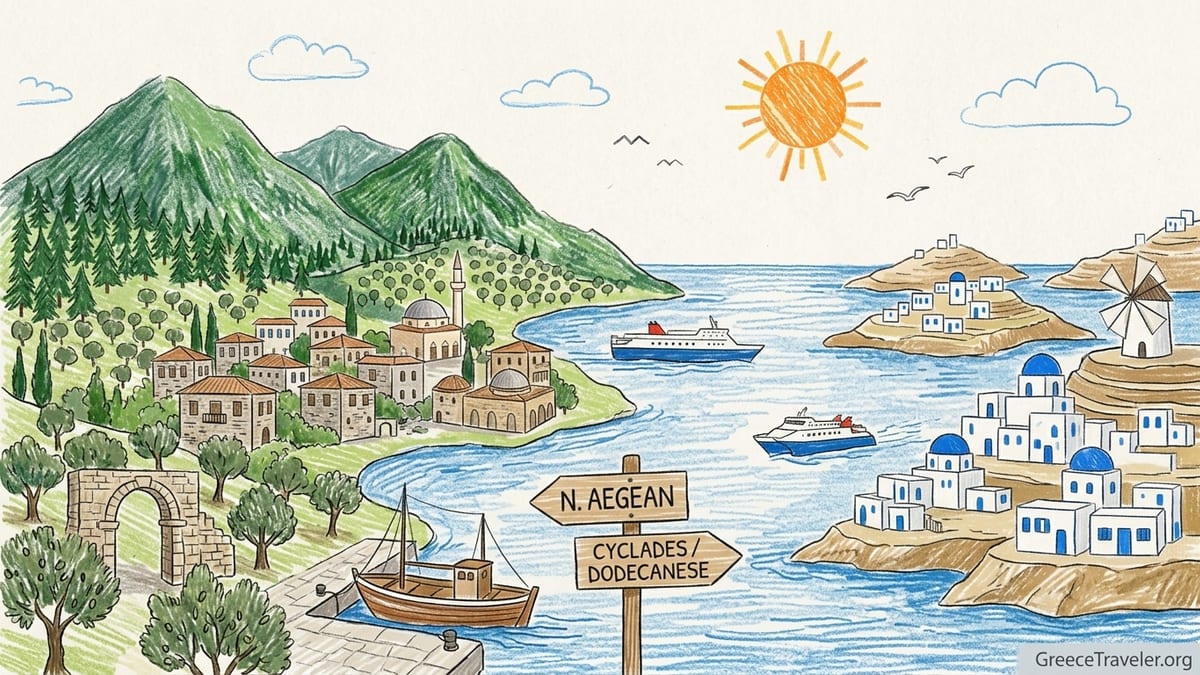
First‑time visitors often picture Greek islands as a chain of white cubes and blue domes, easily linked by short ferry hops. That image belongs mainly to the Cyclades. The North Aegean is different. Islands like Lesvos, Chios, Samos and Lemnos are large, green and agricultural, with working towns, pine forests and olive groves. You are more likely to see stone mansions in a 19th‑century port, a mosque or an Ottoman fountain than the minimalist Cycladic architecture of Santorini or Mykonos.
Distances are also longer. While Cycladic ferries might take one or two hours between neighboring islands, sailings in the North Aegean often run overnight or in long daytime stretches from Piraeus or Kavala. Trips such as Piraeus to Lesvos or Samos can be 10 to 13 hours, and connections between islands might operate only a few times a week. That makes it harder to string together multiple islands in one short trip and rewards choosing one or two bases instead.
Compared with the Dodecanese, which have grown around a clear tourist backbone with frequent ferries linking Rhodes, Kos and smaller islands, the North Aegean has developed more slowly. Many villages survive on fishing, agriculture and shipping, with tourism as a supplement. On quieter islands like Ikaria, Fourni or Agios Efstratios, you can still find family‑run rooms on the beach for roughly 40 to 60 euros per night in June, and tavernas where dinner for two with local wine stays under 35 euros.
Culturally, these islands look east as much as west. Their proximity to Turkey has left traces in food, architecture and history. In Mytilene on Lesvos and Myrina on Lemnos you can still see old hammams and Ottoman‑era townhouses, and in Chios the mastic villages feel closer in mood to fortified Anatolian settlements than to the sleek Cycladic resorts. This blend of Greek, Anatolian and maritime traditions is a big part of the region’s appeal.
Key Islands: Lesvos, Chios, Samos and Ikaria
Lesvos is one of Greece’s largest islands and an excellent introduction to the North Aegean. The capital, Mytilene, is a real city with a Byzantine castle, waterfront cafes and year‑round life. On the north coast, Molyvos combines a steep medieval village with pebble beaches, while the Gulf of Kalloni is known for birdwatching and sardine fishing. The western side hosts the Petrified Forest near Sigri and remote beaches like Eressos, popular with independent travelers and yoga retreats. Hot springs at Eftalou and Thermi hint at the island’s long spa tradition.
Chios is famous for its mastic, a resin harvested from trees in the villages of southern Chios. Towns like Pyrgi and Mesta, with narrow alleys and tower houses, feel far removed from mainstream resort development. The main town has a Genoese‑influenced castle quarter, while beaches range from dark‑pebble Mavra Volia near Emporios to family‑friendly Karfas close to town. Chios also acts as a small hub, with local ferries to satellite islands Psara and Oinousses and onward connections on longer routes linking Kavala, Lesvos and Samos.
Samos, just off the Turkish coast, is lush and mountainous. It offers a rare combination of substantial archaeological interest and easy resort areas. Near Pythagoreio you will find the remains of the ancient city, including the famed aqueduct tunnel associated with the engineer Eupalinos, as well as a harbor lined with tavernas. On the north coast, Kokkari has become a favorite for windsurfers and independent travelers, with pebble beaches backed by pine‑clad hills. Inland, villages like Vourliotes or Manolates are a good place to try local muscat wine and slow‑cooked dishes in shaded squares.
Ikaria lies a short ferry or catamaran hop from Samos but has a very different feel. Known as one of the world’s “Blue Zones,” it has a reputation for longevity and a relaxed lifestyle. Villages such as Christos Raches are famous for staying open late into the night, with shops and bakeries buzzing at hours when other Greek villages are long asleep. The north coast around Armenistis, Mesakti and Livadi offers a string of sandy beaches and simple studios, while the settlements of Therma and Agios Kirykos are known for thermal baths used since antiquity.
The Northern Edge: Lemnos, Thassos and Samothrace
Lemnos sits roughly midway between mainland northern Greece and the central Aegean. It sees fewer foreign visitors than Lesvos or Samos, but offers long sandy beaches, volcanic landscapes and low‑key villages. The main town, Myrina, curves around twin bays beneath a dramatic castle. Nearby beaches like Platy and Riha Nera are shallow and family‑friendly, while further afield you will find volcanic sand dunes near Gomati and windsurf conditions in Keros Bay. Small island ferries connect Lemnos with Agios Efstratios, one of the region’s most remote inhabited islets.
Thassos, off the coast of Kavala, is the easiest northern island to reach from the Balkans and northern Greece. Ferries from Keramoti take about 35 minutes, making Thassos feel more like an extension of the mainland. It is particularly popular with road‑trippers who drive their own cars over, then circle the island on the coastal road. Highlights include the marble‑rimmed cove of Saliara, the inland village of Theologos with its stone houses, and the restored ancient theater overlooking Limenas. Prices in busy resort areas like Golden Beach rise in August, but in June and September you can still find midrange rooms around 60 to 80 euros.
Samothrace is quite different again. A steep, rugged island accessed by ferry from Alexandroupoli, it attracts hikers and nature lovers rather than beach seekers. Mount Saos rises over 1,600 meters, feeding streams that tumble into plunge pools known locally as vathres. The most famous are near the village of Therma, where you can spend a day scrambling from pool to pool, swimming beneath waterfalls in dense green ravines. On the coastal plain near Paleopoli lie the Sanctuary of the Great Gods and the remains of the ancient city, an evocative archaeological site where the famous Winged Victory of Samothrace once stood before it was moved to the Louvre.
Because Thassos and Samothrace connect more naturally to the ports of Kavala and Alexandroupoli than to the southern North Aegean islands, very few travelers combine them with Lesvos or Chios on the same trip. To do so usually means overnight ferries or backtracking through mainland airports. For a first‑time visitor, it is more realistic to pair Thassos with a northern road trip, or Samothrace with a few days in Alexandroupoli or Thessaloniki, rather than viewing them as stops on a single island chain.
Smaller Satellites: Fourni, Psara, Oinousses and Agios Efstratios
The small islands of Fourni, Psara, Oinousses and Agios Efstratios give a good sense of how remote the North Aegean can feel. Fourni, between Samos and Ikaria, is actually a small archipelago of rocky islets once associated with pirates. The main village has a low‑key harbor with a handful of kafeneia and fish tavernas, supplied by the local fishing fleet. Beyond town, dirt tracks lead to coves like Petrokopio and Kasidi, where you might share the beach with only a few other visitors, especially outside August.
Psara lies west of Chios and is tied to the history of the Greek War of Independence. Today it is a quiet place with a single main settlement, a sheltered harbor and a scattering of rooms to rent. Daily life revolves around the sea, and visitors often find that the most memorable experience is a long dinner at a quayside taverna, working through plates of grilled octopus, fresh fish and chickpea dishes flavored with local herbs. Oinousses, northeast of Chios, is known as an island of shipowners, with elegant houses above the harbor and a feeling of discreet prosperity.
Agios Efstratios, south of Lemnos, is one of the least visited islands in Greece. It has a single village and limited tourism infrastructure, which is part of its charm. Connections by ferry to Lemnos and occasionally to other islands mean that schedules can change seasonally and sailings may be canceled in bad weather. Travelers who do make it there are usually looking for quiet, unspoiled beaches and simple hospitality rather than a long checklist of sights.
These smaller islands illustrate why the North Aegean cannot be approached as a straightforward hopping route. Timetables between Fourni, Psara, Oinousses, Agios Efstratios and the larger islands often run only a few times per week, sometimes linking into longer routes from Piraeus, Kavala or Thessaloniki. Miss a connection, and you may find yourself staying several extra nights. For your first trip, it is easier to treat these islands as side excursions from a main base like Chios, Samos or Lemnos rather than as a separate chain.
Beaches, Villages, Food and Local Traditions
The North Aegean has beaches to rival better known destinations, but they are usually more low‑key. On Lesvos, Petra and Anaxos offer long, sandy bays with a mix of family hotels and simple rooms, while the beach at Vatera stretches for many kilometers with relatively little development. On Samos, Tsamadou and Lemonakia are classic pebbly coves with clear, deep water, and in Ikaria the wide bay of Nas combines a small beach with views of the sea where the local river meets the waves. Thassos adds its own highlights, from the natural rock pools at Giola to the pine‑backed sands of Paradise Beach.
Traditional villages are one of the region’s main strengths. The mastic villages of southern Chios, such as Pyrgi with its geometric black and white facades, or the walled settlement of Mesta, are unlike anything in the Cyclades. On Lesvos, mountain villages like Agiasos, with stone houses and a famous church, offer cool summer air and cafes where locals play backgammon under plane trees. In Ikaria, small settlements such as Christos Raches or the hillside hamlets of the Raches area stay lively late into the night, especially during summer festivals known as panigyria, where you can share long tables of grilled meat, local wine and live violin music.
Food is a highlight almost everywhere. Lesvos is synonymous with ouzo and olive oil; many visitors try different brands of ouzo in waterfront tavernas in Mytilene or Plomari, often paying around 8 to 10 euros for a small carafe of house ouzo and meze plates of sardines, fava and fried zucchini. Samos is known for its sweet muscat wines, widely available by the glass in Pythagoreio and Karlovasi. Chios has mastic‑flavored liqueurs and sweets, and small local bakeries sell mastiha cookies alongside sesame breads. Ikaria’s slow‑cooked goat dishes and greens, often served at panigyri festivals on paper tablecloths, are part of the island’s reputation for simple, communal meals.
Local products make good souvenirs and help support small producers. On Lemnos you might pick up bags of local pasta such as flomaria or bottles of island wine. In Thassos, visitors often buy jars of honey and locally pressed olive oil at roadside stalls. In Chios and Lesvos, shops in the main towns sell soaps, cosmetics and sweets made with mastic or olive oil. Prices are generally lower than on high‑profile holiday islands, but still check for labels that indicate cooperatives or small family producers if you want your spending to stay local.
Archaeology, Hiking and Thermal Springs
While these islands do not have a single emblematic ancient site like the Acropolis or Delphi, they are rich in archaeology. On Samos, the Heraion sanctuary and the remains of the ancient city near Pythagoreio give a sense of how important the island was in antiquity, while the partially accessible aqueduct tunnel showcases ancient engineering. Lesvos offers the Roman aqueduct at Moria, early Christian basilicas and the UNESCO‑listed Petrified Forest near Sigri, created by volcanic activity millions of years ago. On Chios, the Nea Moni monastery is noteworthy for its Byzantine mosaics and hilltop views.
Samothrace’s Sanctuary of the Great Gods is one of the most atmospheric archaeological sites in the northern Aegean. Scattered across a wooded valley above the sea, it combines ruined temples, theater seats and surviving columns, with information boards that help you imagine ceremonies that once took place there. Thassos has its own set of ruins, including an ancient agora and a theater that sometimes hosts summer performances. None of these sites see the crowds that flock to famous mainland attractions, so it is common to wander them in relative quiet, especially in shoulder season.
For hikers, the North Aegean offers variety rather than a single long‑distance trail. On Ikaria, paths link the north coast to mountain villages, with waymarked routes above Armenistis and Evdilos that take you through pine forests and past stone terraces. Samothrace’s network of paths around Mount Saos and the vathres is more demanding but rewarded with waterfalls and panoramic views. Thassos has routes from the coast to the island’s interior peaks, and Lesvos offers walks through olive groves and along old mule paths near places like Agiasos and Molyvos. Conditions can be hot and rough underfoot in July and August, so spring and late September are usually more comfortable.
Thermal springs add another layer. Ikaria is particularly known for them, with facilities at Therma and around Agios Kirykos where you can bathe in mineral‑rich waters in simple spa buildings or sea‑level pools. Lesvos has several springs, such as those at Eftalou facing the Turkish coast and at Thermi and Gera. Some are housed in old stone bathhouses with modest entrance fees, while others are more informal, with locals bringing towels and using basic changing cabins. Opening hours and conditions vary, so it is wise to check locally once you arrive instead of relying on out‑of‑date listings.
Flights, Ferries and Driving: How to Move Around
Reaching the North Aegean usually requires more planning than a hop to the Cyclades. Major islands such as Lesvos, Chios, Samos, Ikaria and Lemnos have airports with domestic flights from Athens, and often seasonal links from Thessaloniki or other Greek cities. Flight times from Athens are generally 40 to 60 minutes. Schedules can change between summer and winter, and some routes operate only a few times a week, so it is worth checking your chosen month’s timetable before locking in accommodation.
Ferries provide the backbone of connections but are not designed for classic island hopping. Large overnight or long‑haul ferries link Piraeus with Chios, Lesvos and Samos, while Kavala and sometimes Thessaloniki serve Lemnos, Chios, Lesvos, Samos and Ikaria. Smaller routes connect satellites like Psara and Oinousses to Chios or Fourni to Samos and Ikaria, and there are sailings between Lemnos and Agios Efstratios or from Alexandroupoli to Samothrace. Sailings may run only on specific days of the week, and strong meltemi winds in July and August can cause delays.
The practical result is that you cannot treat these islands as a single easy chain where you wake up each morning and choose the next stop. For example, you might be able to sail from Lesvos to Chios on one day of the week and from Chios to Samos on another, but there may be no direct boat from Lesvos to Ikaria at all when you visit. For a first‑time trip, a realistic approach is to fly into one island, spend a week or more there with a rental car, and if ferry schedules allow, add just one neighboring island that has a clear connection.
Driving is one of the best ways to explore the larger islands. Road networks on Lesvos, Chios, Samos and Lemnos are generally good but slow, with plenty of bends and occasional livestock in the road. Distances that look short on the map can easily take an hour or more. Rental cars in high season often start around 40 to 50 euros per day for a small vehicle, dropping outside August. On Ikaria and Samothrace, narrow mountain roads require caution and daylight driving, especially if you are not used to rural Greek conditions. On very small islands like Psara or Agios Efstratios, you may not need a car at all, as everything is within walking or short taxi distance.
Planning Your First North Aegean Trip
For most first‑time visitors, the best strategy is to pick one main island and treat it as a base rather than trying to “collect” several. A week on Lesvos, Chios, Samos, Ikaria, Lemnos or Thassos is enough to combine beaches, villages and day trips without constant packing and unpacking. If ferry schedules line up, you can add a night or two on a neighboring smaller island, such as a short hop to Psara or Oinousses from Chios, or to Fourni from Samos or Ikaria, but this should feel like a bonus rather than the backbone of the itinerary.
When deciding which island suits you, think about your priorities. If you want a large island with a city feel, varied landscapes and hot springs, Lesvos is a strong choice. For medieval villages and distinctive architecture, Chios stands out. Samos works well for a balance of archaeological sites, resorts and green hills, while Ikaria is ideal if you are drawn to a slow pace, panigyri festivals and hiking. Lemnos is good for wide beaches and low‑key tourism, Thassos for easy access by car from northern Greece, and Samothrace for rugged landscapes and waterfall pools.
Season matters. July and August bring higher prices and more domestic visitors, particularly in popular resort areas and villages that host big festivals. June and September usually offer warm seas, quieter beaches and easier availability of rooms, while May and October can be excellent for hiking but may coincide with reduced ferry and flight schedules. In shoulder season, small island services such as beach tavernas or boat rentals may not operate every day, so it is worth asking your accommodation owner what will be open.
Finally, build flexibility into your plan. Because ferries can be delayed by weather or schedule changes, avoid tight same‑day connections to international flights. If you are flying home from Athens after a stay in Samos or Chios, consider returning to the mainland a full day before your onward flight. That buffer allows you to adapt to any disruptions and end your trip with a relaxed evening in a mainland city instead of watching departure boards anxiously in an island port.
The Takeaway
The North Aegean islands reward travelers who are willing to trade convenience for character. Instead of a tidy island‑hopping circuit, you will find large, lived‑in islands and remote outposts tied together by long sea routes and regional flights. That scattered geography can feel complicated when you first look at timetables, but on the ground it translates into quieter beaches, more authentic villages and a sense of place that is hard to find in more intensively developed regions.
Approach these islands with a base‑and‑explore mindset, not as a hop‑every‑two‑days checklist. Choose one or two islands that match your interests, give yourself time to drive into the hills, linger in village squares and try local dishes, and treat any side trips to smaller islands as a bonus rather than a guarantee. If you do, your first visit to the North Aegean is likely to feel less like a quick holiday and more like an invitation into the everyday life of a corner of Greece that still largely moves at its own pace.
FAQ
Q1. Can I easily island hop between all the North Aegean islands on one trip?
In practice, no. The islands are scattered and ferry links are designed around long routes from ports like Piraeus, Kavala and Alexandroupoli. Direct connections between islands may run only a few times a week or not at all in certain seasons, so for a first visit it is better to focus on one or two islands with clear links rather than trying to create a continuous hopping chain.
Q2. Which North Aegean island is best for a first‑time visitor?
Lesvos, Chios and Samos are the most popular starting points because they combine good transport links, a range of accommodation and plenty of things to do. Lesvos is large and varied with hot springs and a lively main town, Chios offers distinctive medieval villages and mastic culture, and Samos balances beaches, archaeology and green hills. Your choice should depend on whether you prioritize history, hiking, beaches or village life.
Q3. Do I need a car to explore these islands?
On larger islands such as Lesvos, Chios, Samos, Ikaria, Lemnos and Thassos, having a car makes a big difference, as buses may be infrequent and many beaches and villages are spread out. Rental cars in summer often start around 40 to 50 euros per day for a small model, with lower prices in shoulder season. On very small islands like Psara, Oinousses or Agios Efstratios, you can usually get around on foot or by occasional taxi.
Q4. How do I get to the smaller islands like Fourni, Psara and Agios Efstratios?
These smaller islands are reached by local ferries or small ships that usually connect them to a nearby larger island or a mainland port. For example, Fourni is typically linked to Samos and Ikaria, Psara and Oinousses to Chios, and Agios Efstratios to Lemnos and sometimes to the mainland. Sailings can be infrequent and subject to change, so it is wise to check current timetables close to your travel dates and allow flexibility in your plans.
Q5. When is the best time of year to visit the North Aegean?
June and September are often the sweet spot, with warm seas, long days and fewer crowds than in July and August. High summer brings busier beaches, more panigyri festivals and higher prices, especially in popular resorts and villages. May and October can be ideal for hiking and village exploration, but ferry and flight schedules may be reduced and some seasonal businesses may be closed.
Q6. Are the North Aegean islands more affordable than the Cyclades?
In general, yes. While prices vary by island and season, you are more likely to find simple seafront rooms in the 40 to 70 euro range and taverna meals for two under 30 to 35 euros, especially outside August. The absence of high‑end mass tourism on many islands keeps everyday costs such as coffee, baked goods and local bus fares relatively modest compared with high‑profile islands like Mykonos or Santorini.
Q7. What kind of beaches should I expect?
Beaches in the North Aegean range from long sandy bays to secluded pebble coves. Lesvos has extensive sandy stretches like Vatera, Samos offers pebbly coves such as Tsamadou, Thassos has pine‑backed sands and natural rock pools, and Ikaria mixes wide bays with more rugged shorelines. Many beaches have at least one taverna or beach bar, but you will also find undeveloped spots where you should bring your own shade, water and snacks.
Q8. Is English widely spoken on these islands?
English is commonly spoken in hotels, restaurants and shops that deal regularly with visitors, especially on the larger islands and in main towns. In smaller villages and on lesser‑visited islands, older residents may speak little English, but they are often patient and helpful, and basic phrases in Greek combined with gestures usually go a long way. Having a few key words and a translation app can make interactions smoother.
Q9. Are the North Aegean islands suitable for families?
Yes, many of these islands work very well for families who prefer relaxed holidays over nightlife. Thassos, Lesvos, Samos and Lemnos all have sheltered, shallow beaches and family‑run hotels or apartments. Driving distances can be longer than on small resort islands, so it helps to choose accommodation near a good beach and plan day trips with travel time in mind. In peak summer, book ahead for larger family rooms and car rentals.
Q10. How far in advance should I book ferries and accommodation?
In July and August, it is sensible to book key ferries and your main accommodation several weeks in advance, especially if you are bringing a car on the boat or need family rooms. In June and September, you often have more flexibility, though booking the first nights and any crucial ferry legs still helps. For smaller islands with limited rooms, advance reservations are advisable even in shoulder season so you are not left searching on arrival.