


I arrived in Xanthi on a Friday afternoon with a vague idea of an “oriental-flavoured” town and a very specific wish list: to walk its cobbled Old Town, understand how tobacco money shaped its mansions, and feel the everyday pace of a modern university city. Forty‑eight hours later, my camera card was full of peeling pastel facades, Ottoman-style eaves and café tables, but what stayed with me most was the mix of Greek, Ottoman and broader Balkan influences that still hum softly through the streets.
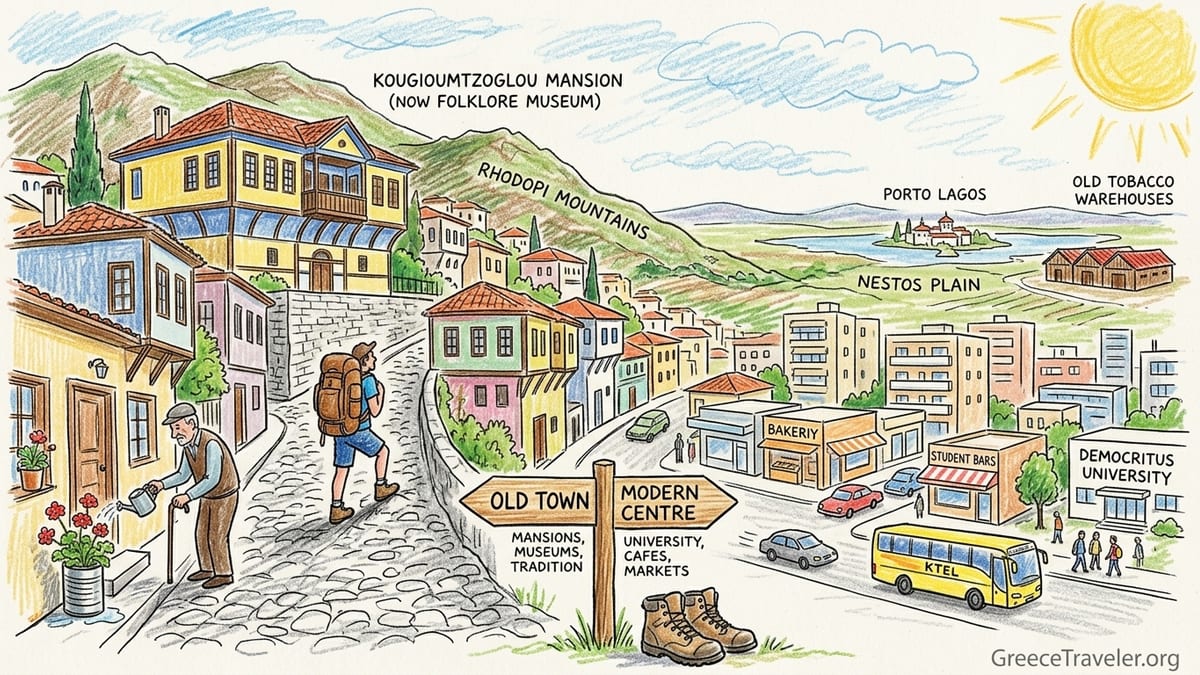
Arriving in Xanthi and First Impressions of the Old Town
I reached Xanthi by intercity bus from Thessaloniki, a journey of just under three hours that rolls past fields, low hills and the occasional view of the Nestos plain. The bus station is in the modern part of town, surrounded by apartment blocks, bakeries and students heading to the Democritus University campus. From there, it took me about fifteen minutes on foot, uphill, to step into a very different world: the preserved Old Town, laid across the lower slopes of the Rhodopi mountains.
The transition is almost abrupt. Modern shopfronts give way to cobbles, the traffic noise drops, and the soundscape shifts to clinking glasses, church bells and the distant call to prayer from neighbourhoods further out. The first lane I walked, Antika Street, tilted steeply upwards between stone houses with wooden balconies leaning toward each other, as if gossiping over the passers-by. Small plaques on corners mark the streets in Greek and Latin script, and within a few minutes I had to slow down, both for the gradient and to take in the architectural details.
Arriving in the late afternoon helped set the mood. Light slid along the plaster of ochre and pale blue facades, picking out carved wooden eaves and iron balconies. On Kougioumtzoglou Mansion’s side street, a group of children were kicking a ball, while an elderly man watered geraniums in tin cans outside his front door. More than any guidebook description, those first few minutes told me that Xanthi Old Town is still lived in, not just preserved for visitors.
Because the Old Town sits on a hill, luggage matters. I had only a backpack, which made the ten-minute pull from the flat new centre manageable. Anyone arriving by car should know that streets here are narrow and often one-way, with sections closed to non-resident traffic in the evenings. I was glad I had not tried to drive to my guesthouse door.
Staying Among the Mansions and Comparing with the New Town
For this weekend I chose a small guesthouse in the heart of the Old Town, on a side lane branching from Antika Street. The house occupied an early twentieth‑century building that once belonged to a tobacco merchant’s family, now converted into a handful of simple but atmospheric rooms. My window opened onto a tiled roofscape, with a sliver of the plain visible between chimneys, and in the mornings I woke to church bells from the nearby Metropolitan Cathedral and the gentle murmur of a café setting up tables in the lane below.
Staying in the Old Town had clear advantages. I could step outside and be in the middle of the preserved quarter within seconds, which made it easy to wander between the Folklore & Historical Museum, the Municipal Art Gallery on Orfeos Street and the nearby churches without thinking about transport. At night, the walk back to my room took minutes, even after lingering over dessert in a taverna. The trade-off was practical: streets are steep, paving stones can be slippery after rain, and there is effectively no casual parking. My host pointed me toward a public parking area just below the Old Town boundary, roughly a five‑ to ten‑minute uphill walk away; on Saturday evening it was already close to full.
By contrast, the modern centre of Xanthi, spread out around Plateia Dimokratias and the commercial streets nearby, offers wider roads, more straightforward parking and a larger choice of mid‑range hotels. Prices there tend to be slightly lower than in the characterful guesthouses of the Old Town, where you are paying in part for preserved architecture and location. If you are planning day trips by car, such as drives to Porto Lagos or the Nestos gorge, basing yourself in the new town can make logistics easier. For a short weekend focused on atmosphere, however, I appreciated being able to dip in and out of the Old Town at will, even if it meant climbing the same slopes several times a day.
Another difference I noticed was noise. The modern centre hums late into the night with student bars and cafés. The Old Town was lively around dinner time, especially on the lanes near popular restaurants, but by midnight most of the quarter had fallen quiet, with only distant laughter drifting up from the lower streets on Saturday.
Walking the Cobbled Streets and Tracing Tobacco Wealth
My main way of understanding Xanthi was to walk it. On my first evening I followed Antika Street uphill, then meandered along Vasilissis Sofias and the smaller alleys branching off it. These streets are narrow and occasionally very steep, with irregular cobbles that ask for flat shoes and a relaxed pace. Many houses have stone ground floors and upper levels built in timber frame and plaster, their bay windows protruding above the street. Some are freshly restored, painted in pastel greens, yellows and blues; others show their age, with flaking paint and exposed brick that hint at better days.
This visible layering ties directly to the city’s nineteenth‑century tobacco boom. As I walked past large mansions such as the Kougioumtzoglou residence, which now houses the Folklore & Historical Museum, and the Kalavras family mansion on Orfeos Street, now used as the Municipal Art Gallery, it was easy to imagine the fortunes made in the warehouses on the plain below. Wealthy tobacco merchants built imposing homes that combined local Macedonian and Thracian forms with Central European and Ottoman touches: symmetrical facades, neoclassical pediments, carved wooden ceilings and interiors decorated with painted ceilings and elaborate plasterwork.
Lower down, closer to the border between old and new town, I followed my curiosity toward the old tobacco warehouses. Huge brick and stone buildings with long rows of arched windows line certain streets beyond the historic core. Some are in use for cultural events or storage, others stand shuttered, their faded company names just visible on the walls. These hulking structures are the other half of Xanthi’s story. Tobacco from the surrounding region was processed and traded here, connecting this modest Thracian city to markets across Europe and the Ottoman Empire. When global demand and trade routes shifted in the twentieth century, the boom receded, and the mansions and warehouses were left to age.
Today, that past lives on in subtler ways. On Saturday morning, climbing again toward the upper lanes, I heard a radio playing folk music through an open window, while two neighbours chatted in a mix of Greek and another language, likely one of the regional dialects spoken by communities with roots in Asia Minor or the nearby Pomak villages. The multicultural character that once helped Xanthi thrive as a tobacco trading centre still feels present in the way people move through these streets.
Museums, Churches and Everyday Moments Inside the Old Quarter
My most enlightening morning was spent inside the Folklore & Historical Museum on Antika Street, housed in the Kougioumtzoglou mansion. I arrived shortly after opening time. The museum’s entrance is modest, but once inside, the building reveals its former grandeur: symmetrical staircases, richly carved wooden ceilings, painted friezes and rooms furnished as late nineteenth‑century bourgeois interiors. Beyond the furniture and costumes, what stayed with me was the sense of living inside a tobacco merchant’s world, with displays about commercial life and the social fabric of Xanthi during its peak years. The ticket price was modest, a few euros, and photography without flash was allowed in most rooms, which made it easy to capture details of ceiling paintings and patterned floors.
From there I walked a short distance to the Metropolitan Cathedral area, around the small square often referred to as Plateia Mitropoleos. Here the Old Town opens out for a moment, with views across rooftops and down toward the modern city. The cathedral’s presence anchors the Greek Orthodox heritage of Xanthi, but just walking a few more minutes along Orfeos Street, with its art gallery housed in another former mansion, you are reminded that this was also a cosmopolitan, mercantile town where Christian, Muslim and Jewish communities all left traces on the urban fabric.
Between formal sights, I found the greatest pleasure in ordinary pauses. On Saturday late morning, after visiting the museum, I stopped at a small café tucked into a corner building on Antika Street. Several tables sat directly on the cobbles, and the clientele included both visitors and locals. Over a strong Greek coffee and a glass of cold water, I watched a delivery van carefully negotiate the tight bend below, waited for by a taverna owner who greeted the driver by name. A cat threaded between chairs, pausing hopefully by each table. There were no grand views here, only an everyday scene in a historic setting.
Not everything was open. One smaller cultural space in the Old Town was closed for maintenance that weekend, and a notice on the door suggested calling ahead on weekdays. For short stays, it is wise to check current opening hours for museums and galleries, since they can shift seasonally and some smaller institutions keep reduced hours outside peak periods.
Eating in Xanthi: From Thracian Plates to Syrupy Sweets
Even if you came to Xanthi only for the food, you would leave satisfied. The city’s cuisine reflects Thracian traditions, Asia Minor influences and elements brought by various communities over time. In the Old Town and surrounding streets, meat dishes are prominent, with local specialities such as kavourmas, spicy sausages, pastourma and rich offal-based plates alongside comforting pies and slow-cooked stews.
On my first night I had dinner in a traditional restaurant in the Old Town, housed in a stone building with vaulted ceilings and a small courtyard. The menu leaned heavily on Thracian recipes: I chose kavourmas served in a small pan with eggs, along with a green salad and thick slices of village bread. A carafe of local red wine rounded out the meal. Portions were generous; for one person, a main dish and shared appetiser would have been sufficient. My bill, including wine, came to a bit under twenty euros, which felt fair for both quality and setting.
The following day, for lunch, I walked slightly out of the strict Old Town boundaries toward a taverna popular with locals, where grilled meats and hearty oven dishes dominated the menu. I ordered pork cooked with pickled cabbage, a dish tied to winter traditions, and a side of hand‑cut fries. Service was brisk but friendly, with staff happy to explain unfamiliar items. Prices were again reasonable, with mains generally under fifteen euros. It was easy to see why many Athenians and Thessalonians speak fondly of Xanthi’s food scene.
For dessert and coffee, I returned to the centre, where Xanthi’s reputation as a “capital of sweets” becomes obvious. In a pastry shop just off the main square, I tried a portion of saragli, a rolled baklava rich with walnuts, and sampled a small piece of kariokes, the city’s famous chocolate‑coated walnut sweets. The butter and syrup aroma that hangs in the air of these patisseries is intense. Prices per piece are low enough that you can easily sample several different sweets without a big bill, and many shops offer boxed selections for taking home.
Because my time was short, I could not test all the well‑known establishments. Restaurants such as Palea Polis, a long‑standing Thracian kitchen set among the stone lanes of the Old Town, and Ta Fanarakia, a family‑run taverna operating since the late 1950s in the wider city, are often recommended by locals and recent visitors as reliable options for traditional flavours and thoughtful service. These are researched suggestions rather than places I personally dined at, but they illustrate how deeply food culture runs in Xanthi.
Old Town vs Modern City: Students, Nightlife and Everyday Rhythm
One of the surprises of Xanthi is that behind the postcard images of mansions and cobbled lanes lies a very contemporary, student‑heavy city. Walking from the Old Town down toward the modern centre, the atmosphere shifts from historic charm to everyday bustle in the space of a few blocks. Cafés spill onto sidewalks, clothing stores and bakeries line the streets, and the demographic visibly skews younger, thanks to the university campus that anchors much of the local life.
This contrast is particularly clear in the evening. After an early stroll through the Old Town, where most activity clusters around a handful of tavernas and quiet squares, I descended toward the main square and surrounding streets. Here, bars were full, with music drifting into the street and groups of students chatting over drinks. It would be easy to spend a weekend entirely in this newer part of Xanthi and hardly set foot in the preserved quarter, but combining both sides of the city gives a more complete picture of its character.
The multicultural background of Xanthi, shaped by centuries of Greek, Ottoman and Balkan interactions, also shows in more subtle ways than architecture alone. In markets and bakeries you notice products and recipes that carry traces of Asia Minor and the nearby Pomak villages. Conversations on the street switch between Greek and other languages. This diversity feels integrated rather than staged, part of the city’s living identity.
From a practical standpoint, the new town is where you find larger supermarkets, most banks, bus connections and a wider range of accommodation categories. For drivers, multi‑storey car parks and wider streets reduce the stress of navigating narrow one‑way lanes. For travellers interested in nightlife and café culture, it provides a livelier backdrop than the mostly tranquil Old Town, while the historic quarter remains within easy walking distance for daytime explorations.
Festivals, Seasonal Life and When to Visit
Even outside peak events, my September weekend in Xanthi felt animated, but local calendars suggest that the city truly transforms during major festivals. The most famous is the Xanthi Carnival, part of a broader Thracian Folklore Festival period, which fills the city with parades and visitors in the weeks leading up to Lent. Another key event is the Old Town Festival in early September, when cultural associations set up stands along the traditional streets, offering food, drink and live music amid the preserved architecture.
I did not attend either of these, but research beforehand and conversations with locals in cafés described them as intense, colourful occasions that draw crowds from across Greece and neighbouring countries. During such periods, accommodation in both the Old Town and modern centre can book out well in advance, prices rise and the normally quiet lanes thrum late into the night. For travellers specifically seeking the festival atmosphere, these dates can be a highlight; for those who prefer to experience the Old Town at a gentler pace, visiting outside those weeks may be wiser.
Weather also shapes the experience. Shoulder seasons, especially late spring and early autumn, offer mild temperatures that make climbing the Old Town’s slopes comfortable and sitting outdoors pleasant both at midday and in the evening. Summer heat can be intense in the lower city, though the elevated lanes of the Old Town catch breezes from the mountains. Winter visits bring a different mood, with potential rain making cobbles slippery and encouraging longer café stops and museum visits.
Regardless of season, comfortable walking shoes are essential. Many lanes are uneven, and some routes between the Old Town and modern centre involve notable elevation changes. The reward for this effort is a city that reveals itself gradually, corner by corner, rather than in a single sweeping view.
Day Trips: Porto Lagos, Lake Vistonida and the Nestos Area
One of the advantages of basing yourself in Xanthi is the ease of quick escapes into nature and coastal landscapes. With a car, Porto Lagos and Lake Vistonida lie roughly a half‑hour’s drive to the southeast. Porto Lagos is a small fishing settlement set between the lagoon and the Thracian Sea, known for its tranquil harbour and the picturesque monastery complex built on small islets connected by bridges. Even a short visit offers a sharp contrast to the tiled roofs and cobbled streets of Xanthi, with flat water, reeds and, in certain seasons, rich birdlife.
Closer to Xanthi, the broader Nestos area to the west provides options for river and gorge excursions. Outfitters in the region offer activities such as gentle rafting, kayaking and hiking along the Nestos straits, where the river snakes between steep, wooded slopes. From Xanthi, these can be organised as half‑day or full‑day outings, returning in time for an evening meal in the city. During my weekend, I limited myself to a brief drive out toward the Nestos valley on Sunday afternoon, enough to appreciate how abruptly the urban landscape gives way to countryside.
For travellers with more than two days, combining a stay in Xanthi with time on the coast near Porto Lagos or in villages along the Nestos can deliver a rounded picture of Thrace: urban history, tobacco heritage, religious sites, wetlands and mountain foothills all within relatively short drives. Without a car, options are more constrained, as public transport to smaller settlements is limited in frequency, but local taxis and organised excursions can help bridge that gap.
Suggested Two‑Day Itinerary and Whether Xanthi Deserves a Dedicated Stay
My own weekend unfolded roughly as follows, and it is a rhythm I would recommend to other first‑time visitors. On Day One, arrive by late morning, check into accommodation in either the Old Town or modern centre, then orient yourself with a slow walk through the historic lanes. Follow Antika Street uphill, loop via Vasilissis Sofias and nearby alleys, pause for coffee on a cobbled corner and take note of landmarks such as the Folklore & Historical Museum, the Metropolitan Cathedral square and Orfeos Street with its mansions. After a rest, enjoy a long dinner in the Old Town, tasting Thracian specialities and perhaps finishing with a stroll under the warm light that spills from tavernas into the streets.
On Day Two, dedicate the morning to interiors and stories. Start at the Folklore & Historical Museum to understand tobacco‑era life from the inside, then continue to the Municipal Art Gallery and, time permitting, another small museum or church that catches your interest. Have lunch either in the Old Town or just beyond, then spend the afternoon exploring the modern centre: wander the commercial streets, sample sweets from one of the well‑known patisseries and experience the student‑driven café scene. If you have a car and an early start, you could instead use part of this second day for a quick drive to Porto Lagos or a short Nestos excursion, returning to Xanthi for a final dinner before departure.
Does Xanthi deserve a dedicated stay rather than a brief stop on a wider northern Greece itinerary? After a weekend there, my answer is yes, at least for travellers who care about architecture, layered history and everyday atmosphere as much as big marquee sights. Two days felt like just enough to sketch the outlines of the city’s story, but not enough to exhaust its corners. Another day would have allowed a slower pace and a more relaxed side trip into the surrounding landscape.
Xanthi is not a place of single, iconic monuments. Its appeal lies in the sum of small experiences: the play of light on a tobacco merchant’s mansion, the sound of footsteps on uneven stones, a plate of kavourmas in a vaulted dining room, a student bar buzzing a short walk away, and the knowledge that tobacco warehouses and lagoon waters, church domes and mountain foothills all sit within an easy radius. For travellers willing to match its unhurried rhythm, it rewards a dedicated weekend and perhaps a little more.
FAQ
Q1. Is it better to stay in Xanthi’s Old Town or the modern centre?
Both areas work well, but for a short, atmospheric visit I found the Old Town more rewarding, since you step straight into the preserved streets. The trade-off is steeper lanes and limited parking. The modern centre offers easier car access, slightly lower hotel prices and closer proximity to nightlife and shops, while still being within walking distance of the historic quarter.
Q2. Do you need a car to explore Xanthi Old Town?
No, you do not need a car inside the Old Town itself, and driving there can be stressful because of narrow, one-way streets and scarce parking. I explored everything on foot, from museums and churches to restaurants and small squares. A car is useful only for regional trips, such as to Porto Lagos or the Nestos area, and can be left in parking areas below the Old Town.
Q3. How challenging are the cobbled streets and slopes?
The Old Town is built on a hillside, so expect frequent slopes and some steep sections, especially along streets such as Antika. Cobblestones are uneven and can be slippery when wet, which makes sturdy, flat shoes important. Most reasonably fit visitors will manage without difficulty, but travellers with mobility issues may find certain streets demanding.
Q4. What are the must-see sights for a weekend in Xanthi?
For a two-day stay, I would prioritise walking the Old Town lanes, visiting the Folklore & Historical Museum in the Kougioumtzoglou mansion, spending time around the Metropolitan Cathedral square, seeing the former tobacco mansions on streets like Orfeos and glancing at the old tobacco warehouses below the historic core. Adding a stop at a local patisserie for Xanthi’s famous sweets rounds out the experience.
Q5. How much should you budget for meals in Xanthi?
Based on my recent visit, a generous dinner in a traditional restaurant, including a main dish, shared appetiser and house wine, came to slightly under twenty euros per person. Lighter meals, such as a simple grilled dish or pie with a drink, can cost less. Sweets and coffee are comparatively affordable, making it easy to sample multiple desserts without a significant expense.
Q6. When is the best time of year to visit Xanthi?
Late spring and early autumn offer the most comfortable balance of mild temperatures and outdoor life, ideal for climbing the Old Town slopes and sitting at café tables. Winter can be atmospheric but brings rain and cold, while summer can be hot in the lower city, though evenings in the elevated Old Town are often pleasant. Festival periods like Carnival and the Old Town Festival add energy but also crowds and higher demand for rooms.
Q7. What role did tobacco play in shaping Xanthi?
Nineteenth- and early twentieth-century tobacco wealth transformed Xanthi from a modest settlement into a thriving commercial city. Profits from processing and trading high-quality tobacco financed the construction of large mansions, warehouses and public buildings. Today, those tobacco-merchant houses in the Old Town and the brick warehouses on the plain are key visual reminders of that economic boom.
Q8. Are there good day trips from Xanthi without changing base?
Yes. With a car, a popular half-day or full-day outing is to Porto Lagos and the Lake Vistonida area, about half an hour away, where you can see lagoon landscapes and a monastery complex on small islets. The Nestos region to the west offers river and gorge scenery, with options for light hiking or water activities arranged through local providers, all reachable while keeping Xanthi as your base.
Q9. Is Xanthi suitable for families with children?
Xanthi can work well for families, especially those with school-age children who enjoy walking and exploring historic streets. The Old Town’s traffic-calmed lanes feel relatively safe for supervised wandering, and museums like the Folklore & Historical Museum provide visual, room-sized exhibits that many children find engaging. Parents should be prepared for slopes and steps, and strollers may be awkward on cobbles.
Q10. How many days do you recommend staying in Xanthi?
I found two full days ideal for a first visit focused on the Old Town, basic museums and a taste of the modern centre. This allows time for unhurried walks, meals and a short excursion to the surrounding countryside. Travellers who want to combine Xanthi with more extensive Nestos activities or multiple coastal stops near Porto Lagos might extend their stay to three or four nights.