

On 3 July 2026, I set off for the first Fonias waterfall on Samothrace with what I thought was sensible preparation: trail shoes with decent grip, a light backpack, 1.5 litres of water, and the comforting memory of sunlit Instagram posts showing people floating in turquoise pools. By the time I reached the second set of vathres further up the gorge, I was on all fours on slick rock, inches from a drop, trying not to look down at the churning water below. The air smelled of wet stone and plane trees. The path I had followed simply disappeared into the stream, and the only way forward was an exposed scramble over polished slabs that felt more like a beginner canyoning route than a hike. That day changed how I see Samothrace’s waterfalls, and it made me deeply sceptical of the way travel photos and articles sell them as a string of easy natural jacuzzis.
How Pictures Turn Serious Terrain Into a “Forest Spa”
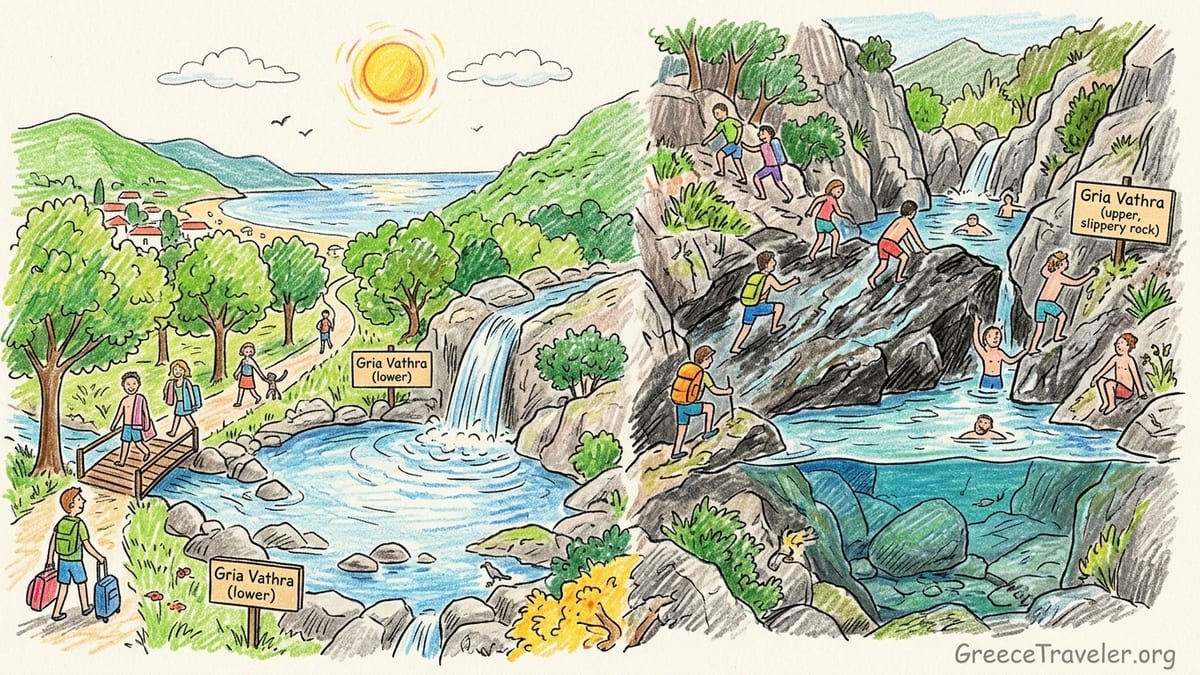
Before arriving on Samothrace, almost everything I read about the island’s waterfalls used the language of wellness: “natural spa,” “emerald pools,” “hidden paradise.” Official and semi‑official guides describe Gria Vathra as a place where you stroll from Therma village for ten or fifteen minutes under plane trees to reach a shaded green pool, and Fonias as a short family‑friendly walk to a first waterfall with a broad swimming basin. None of that is entirely false. The first sections of these routes are relatively straightforward in dry summer weather. You really can walk from the road bridge at Fonias to the first major pool in about twenty minutes, and the lower Gria Vathra pools are close enough to Therma that people wander up in flip‑flops from the beach.
The problems start where the photos and marketing copy usually stop. Many travel articles either skip over the transition from walking to scrambling, or reduce it to a vague “continue further up the gorge if you are feeling adventurous.” On social media, the upper Fonias and Gria Vathra vathres appear as a seamless continuation of the easy lower pools: same clear water, same people smiling in swimwear, same captions about “a short hike.” The camera crops out the steep slabs, the loose dirt paths above drops, and the sections where you must wade, commit to moves you cannot easily reverse, or rely on handholds that are slimy from algae.
My own mistake was to assume that progressing from the first waterfall to the next ones would feel like adding a few extra kilometres on a woodland walk. What I found instead were short but consequential passages where a slip could mean uncontrolled sliding into rocks or water. Yet if you search for the hashtag of Samothrace’s vathres, you will see far more photos of carefree cliff jumps than of people edging awkwardly across wet rock in proper footwear. That imbalance encourages travellers with little scrambling experience to treat the upper pools as an extension of the beach, not as the semi‑technical terrain they really are.
Samothrace’s vathres are not uniquely treacherous by mountain standards. What makes them risky is the gap between perception and reality, especially for visitors who would never think of climbing a gorge or attempting canyoning at home. In this article, I focus on Fonias, Gria Vathra and Kremastos, because they span the full range from accessible family walk to remote canyon, and they appear together in many guides as if they were variations on the same casual theme.
Fonias: A Gentle First Waterfall Hike That Turns Serious Higher Up
The first Fonias waterfall, roughly a kilometre from the coastal road east of Therma, earns its reputation as a relatively easy walk. A clear path runs alongside the river, shaded by plane trees, with only modest elevation gain. In normal summer conditions, this stretch suits families with school‑age children and people in basic walking shoes. When I visited on 3 July 2026 after a dry week, the trail was busy but manageable: Greek families carrying coolers, a group of Romanian hikers in approach shoes, a pair of French visitors wearing fashion sneakers but coping fine on the packed dirt and occasional stones.
At the first fall, the setting is as photogenic as advertised. A wide, roughly fifteen‑metre cascade drops into a spacious pool deep enough for competent swimmers, with rock ledges for sitting and shaded spots along the bank. It genuinely feels, for a moment, like an alpine lake scene transplanted to the Aegean. If you arrive early in the day, the atmosphere is calm, and the worst hazards at this lower basin are sunburn and slippery entry points along the edge where people climb in and out.
The tone shifts abruptly when you decide to push beyond that first basin. The path turns into a user‑made route along the gorge, braided into multiple options: some hugging the bank, others ascending crumbly dirt above drops where a fall would send you into the ravine. On my July visit, I watched two different groups hesitate at a section of polished rock where the “trail” angled up steeply beside a small cascade. One local guide, leading four clients in helmets and proper hiking shoes, coached them across one at a time. A few metres behind, a couple in plastic sandals arrived, looked at the same slope, and tried to crawl up on hands and knees, visibly scared. There were no warning signs, no ropes, and no indication of how much more of this kind of terrain lay ahead.
Further up, the gorge narrows into sequences of smaller vathres where reaching the next pool requires either wading waist‑deep or committing to short scrambles that many visitors would classify as climbing, not hiking. Where the rock is dry, these moves are manageable with experience and good shoes. Where it is wet, the stone feels like soap. More than one local source mentions injuries “every season” from people losing their footing on these slabs. The combination of clear water, blue sky and social‑media fame makes upper Fonias look like a playground, but on the ground it feels closer to an introductory canyoning route without fixed protection.
Gria Vathra: Easy Lower Pools, Misleadingly “Casual” Upper Sections
Gria Vathra, near Therma, is marketed even more heavily as Samothrace’s forest spa. The lower route from the village to the first pool is indeed short, roughly ten to fifteen minutes through shady woodland. The path crosses small wooden bridges and finishes at a popular artificial basin and a nearby natural vathra beneath a modest fall. On a warm morning in June 2026, I counted at least fifty people rotating through this lower area: families with inflatable toys, older couples who had walked up from the hot springs, people wearing street shoes and carrying nothing but a towel. For this short stretch, “easy” is a fair description, though the rocks at water level are still slick.
Yet the same guides and posts that lure people with words like “gentle” and “accessible” often add, almost as an afterthought, that “adventurous visitors can continue to higher pools.” Higher, in this context, means steeper ground, occasional use of hands, and sections where the obvious continuation is a rock step or narrow ledge perched directly above the stream. In very dry weather, someone with good balance and a cool head might barely register these moments. Under any moisture, each becomes a potential fall.
On my own day at Gria Vathra in mid‑June, an afternoon storm the previous day had left the rocks darker and slicker than they appeared in the bright sunlight. I watched a group of backpackers from central Europe, drawn by social media posts, attempt to reach a third pool. They wore trail runners but carried heavy overnight packs. At one cramped corner, the person in front hesitated on a move that required stepping around a protruding boulder with the stream a few metres below. There was no exposure by alpine standards, but for them it was terrifying. They argued about turning back, feeling pressure from photos they had seen of crystal bowls higher up that now felt unfairly out of reach.
What bothered me was not that the terrain demanded care, but that none of the popular English‑language articles I had read beforehand had stressed how quickly Gria Vathra shifts from a family pool walk to low‑grade canyoneering. Some even suggested that visitors “keep going as far as you like” in generic water shoes. On wet rock with no helmets, no ropes and no route marking, that kind of language borders on irresponsible. The upper pools remain beautiful, but they should be treated as a different activity entirely from the first basin.
The Remote Reality of Kremastos: Not Just Another Swimming Hole
If Fonias and Gria Vathra illustrate how easy hikes can morph into something harder, Kremastos shows the opposite problem: a truly remote waterfall casually listed in some travel content as just another place to swim. Kremastos is one of Samothrace’s most dramatic falls, dropping directly into the sea on the south coast. It is usually reached by organised boat trips from the port of Kamariotissa or from Therma, though there are also demanding canyon routes that descend the gorge from inland ridges used by experienced mountaineers and canyoners, not casual walkers.
On 27 June 2025, a 49‑year‑old Romanian tourist died after a fall at the base of Kremastos. Greek media reported that he had suffered a fatal head injury and that rescue teams, including specialised disaster response units, recovered his body in a remote area accessible only by sea. The tragedy is important context, because it confirms that serious accidents do happen around Samothrace’s waterfalls, and not only in dramatic mountaineering scenarios. At the same time, it did not occur at the first Fonias waterfall or at any easily reached vathra. It reinforces two truths at once: that some parts of the island’s freshwater landscape are truly wild, and that internet discussion can blur distinctions and leave visitors either unduly alarmed about the wrong spots, or complacent about the right ones.
Standing on a boat near Kremastos in calm July seas, I could see how easily its image could mislead. From a distance, swimmers in bright inflatables bobb around the outflow, and cliffs frame the fall like a film set backdrop. What you do not see in those wide‑angle photos is how fast conditions change if wind rises or if someone ventures onto wet rock near the base. Unlike at Fonias or Gria Vathra, there is no quick road access, no shaded path back to a car, and no simple way for an ambulance to reach you. Any incident here depends on coordination between coast guard, local authorities and specialised rescue teams, with response times that cannot match those of an urban accident.
Kremastos should be treated, mentally, as a remote canyon mouth at sea level rather than as “just another vathra.” If you visit on a licensed boat trip and stay within the guidance of the crew, the main risks are surf, slippery rock and cold water. If you try to improvise a coastal approach in a rented kayak, or climb unsupervised around the fall, you are entering a very different category of exposure, one that tourism marketing rarely explains.
Guided Hikes, Emergency Access and the Illusion of Safety
One striking thing about Samothrace is how informal much of the waterfall access remains. There are some warning signs at popular trailheads, but on my July 2026 visit I saw no systematic difficulty ratings posted at the transitions between easy and more serious sections, and no clear indication of where families or inexperienced walkers should turn back. Instead, visitors rely heavily on travel blogs, social media captions and word of mouth from guesthouse owners or campsite neighbours.
There are, however, local guides and small outdoor companies on the island offering structured hikes to upper Fonias, higher Gria Vathra pools, and technical canyon descents such as Kremastos or Vatos. When I spoke informally to one guide after watching his group negotiate the tricky slab above the first Fonias waterfall, he described a pattern: people arrive having read about “magical vathres,” attempt upper sections in sandals or thin water shoes, and occasionally slip or freeze on exposed steps, requiring others to help them back down. Guided groups, by contrast, are usually equipped with sturdier footwear, drybags and at least basic helmets on more serious terrain. The guide carries a first aid kit, has a rough sense of mobile reception pockets along the gorge, and knows the timings for summoning help.
Emergency access on Samothrace is limited by the island’s size and topography. In Greece, the general emergency number 112 connects you to services that can coordinate police, fire and medical response. On Samothrace, mountain or gorge rescues often involve the local fire service and, for more complex incidents, regional disaster response units travelling from the mainland by helicopter or boat. That is a far cry from the quick response time visitors may expect in a dense European city. In parts of Fonias and remote canyons like Kremastos, mobile phone coverage is patchy or absent. During my hikes I had intermittent signal near the coast road and at a few higher clearings, but lost connection entirely in deeper sections of the gorge.
This matters because many people unconsciously treat their smartphone as a safety net. When that net disappears between rock walls, experience and judgment have to replace it. A guided hike is not a magic shield, and accidents can still happen. But compared to improvising your own route based on a geotagged Instagram post, joining a local guide can be the difference between understanding when to stop and continuing into terrain that exceeds your ability. It is telling that some reputable travel resources now explicitly recommend hiring a guide for upper Fonias or treating third‑tier pools as objectives only for experienced hikers already comfortable with scrambling.
Why “Just Jump In” Can Be a Dangerous Myth
One of the most persistent tropes in online coverage of Samothrace’s vathres is the cliff‑jump shot. A silhouetted figure arcs off a rock into a perfectly clear pool, water exploding in a white ring. The implied message is that the depth is obvious, the landing safe, and the act joyous. In reality, jumping into mountain pools is one of the most underestimated risks in freshwater environments, even where water looks deep and transparent.
In Fonias and Gria Vathra, many of the popular jumping spots sit above pools with uneven rock bottoms, submerged boulders or sudden shallows near the entry. River dynamics change from season to season and even within a single summer. A ledge that was covered by a metre of water in late spring can sit just below the surface after a hot July, invisible until your feet hit it. Algal growth on cliff edges makes take‑off points slippery. The cold shock of mountain water on a hot day can cause an involuntary gasp or brief disorientation, which is fine for a small hop near shore but risky when combined with a ten‑metre drop.
Local guides I spoke with described an informal rule: never jump into a pool you have not entered calmly first and checked for depth, currents and underwater hazards. Even then, they discourage high jumps for clients without prior experience. Yet this kind of cautious language rarely appears in the captions of viral clips. Instead, visitors see a series of successful jumps and assume the absence of injury equals safety. Half of the equation is missing: the near misses, the bruised legs from misjudged depth, the twisted ankles from slipping on the approach, and the incidents that end up as quiet evacuations rather than news stories.
Photography also compresses distance. A drop that looks small on video may be higher than it seems. A sloping runout may be cropped out of frame. During my time at Fonias, I watched a young traveller climb to a ledge roughly six metres above a pool, clearly aiming to recreate a post they had saved. Two friends below filmed on their phones, shouting encouragement. Only after several minutes of visible fear did the jumper back away and climb down. From the bottom, their chosen point had looked glamorous. From where they stood, toes on the edge, it rightly felt serious.
Crowds, Noise and Subtle Pressures on the Trail
Samothrace is not a mass tourism island on the scale of Santorini or Mykonos, but its signature waterfalls now draw a steady stream of visitors in summer, boosted by social media exposure. On peak days at the first Fonias waterfall or the lower Gria Vathra basins, the pools can feel busy: clusters of people on both banks, music leaking from portable speakers, and queues forming at favourite rock perches. Litter was not overwhelming on my July 2026 visit, but I did notice plastic bottles and snack wrappers tucked behind rocks near rest spots, especially at Fonias, which suggests a growing pressure on the environment.
Crowding itself is not inherently dangerous, but it can nudge people into unwise choices. When you watch a succession of confident swimmers cross a stream barefoot, it is harder to admit that you feel unstable in your own shoes. When a line builds at a narrow scrambling section on the way to an upper pool, people push through more quickly than they otherwise would, rushing movements that really deserve three points of contact and calm focus. At one constriction above the first Fonias basin, I watched a family with small children feel compelled to continue upward because the group behind them insisted that “it becomes easier again soon,” even though the rock clearly steepened.
Noise also changes our relationship with risk. In quiet conditions, your own caution feels louder. When music and laughter echo off rock walls, the atmosphere encourages play. I felt this effect on myself, hesitating at a jump I knew was within my capabilities until a momentary silence allowed me to focus and reassess. It reminded me that the most hazardous ingredient in many mountain accidents is not the technical grade of the terrain, but the social pressure to match what others appear to do effortlessly.
The Takeaway
After several days exploring Samothrace’s freshwater landscapes, I came away with a sharper distinction in mind between the vathres I would happily revisit and the routes I would approach only with a guide or not at all. I would return in a heartbeat to the first Fonias waterfall and the lower Gria Vathra pools, especially in the quieter hours of the morning or late afternoon. With sturdy shoes, awareness of slippery rocks and a willingness to accept cold water, these basins can deliver the joy their photos promise without demanding advanced skills.
I would treat the upper Fonias vathres, higher Gria Vathra pools and any attempt to approach or descend Kremastos on foot as guided or experienced‑party objectives. That means either joining a reputable local operator or travelling with companions who already have a history of scrambling, canyoning or mountaineering, and who carry basic emergency gear. I would also adjust my mindset: thinking of these outings less as “going for a swim” and more as entering a mountain environment where water happens to be present.
For travellers drawn to Samothrace’s waterfalls, a few practical habits can tilt the balance toward safe enjoyment. Bring proper footwear with real tread rather than fashion sandals or flat water shoes. Ask local hosts for current conditions, especially after heavy rain, which can raise water levels and make polished rock treacherous. Decide in advance how far you are willing to go, and be prepared to turn back at the first section that exceeds your comfort. Keep in mind that mobile coverage may fail in gorges, and that emergency response, while real, is limited by geography and access.
Most of all, look at every idyllic photo of a vathra with an editorial eye. Ask yourself what is just outside the frame: the drop below the ledge, the slick moss on the approach, the absence of helmets or life jackets, the boat that brought people to an otherwise unreachable bay. Samothrace’s waterfalls are as extraordinary as the captions claim. They are also wilder, colder and more serious than the “forest spa” label suggests. Respect that reality, and the island will reward you with experiences that feel earned rather than merely consumed.
FAQ
Q1. Are the first Fonias waterfall and lower Gria Vathra pools suitable for children?
They can be, in dry summer weather and with close supervision. The paths to these lower basins are relatively short and straightforward, but rocks at water level are slippery, currents can be stronger after rain, and the water is cold. Families should avoid pushing on to upper pools with children unless everyone is confident on uneven, exposed ground.
Q2. Do I need a guide to visit Samothrace’s waterfalls?
You do not need a guide for the short walks to the first Fonias waterfall and the lower Gria Vathra pools if you have basic hiking experience and proper footwear. For upper Fonias vathres, higher Gria Vathra pools, and any technical canyons such as Kremastos or Vatos, hiring a local guide or joining an organised group is strongly advisable unless you already have strong scrambling and canyoning experience.
Q3. What kind of shoes should I wear to the vathres?
Sturdy shoes with real grip are essential. Trail‑running shoes or light hiking boots work much better than flat sandals or basic beach water shoes. If you bring neoprene or river shoes, choose models with aggressive soles and still carry something supportive for the approach, as the dirt paths and rocks can be steep and loose.
Q4. Is it safe to jump from rocks into the pools?
Jumping always carries risk, even when the water looks deep and clear. Pool depths change with the season, submerged rocks may not be visible, and take‑off points can be extremely slippery. The safest approach is to avoid high jumps altogether, and never leap into a pool you have not first checked calmly for depth and underwater hazards.
Q5. How cold is the water in Fonias and Gria Vathra?
The water comes from Mount Saos and remains cold even in high summer. Many visitors feel an initial shock when entering, and weaker swimmers tire faster than they expect. If you plan to spend time in the water, consider bringing a light rash guard or short wetsuit top, and always get out before you start shivering.
Q6. What should I do if someone is injured at a waterfall?
First, move the person to a safer spot if possible without causing further harm, and try to keep them warm and calm. Call the European emergency number 112 as soon as you have mobile reception, explain clearly that you are on Samothrace and at a waterfall, and follow the operator’s instructions. Be aware that rescue may take time in gorges or remote locations, so basic first aid knowledge is valuable.
Q7. Is mobile phone coverage reliable in the gorges?
Coverage is patchy. Near the coast road and villages you may have a reasonable signal, but inside Fonias Gorge, upper Gria Vathra and around remote canyons, reception often drops out completely. Do not rely on your phone for navigation or as your only safety plan. Download offline maps in advance and tell someone where you are going and when you expect to return.
Q8. When is the best time of year to visit the vathres?
Late spring and early summer often offer the best balance: waterfalls are flowing strongly, temperatures are warm enough for swimming, and crowds are lighter than in peak August. In midsummer, water levels can drop and the lower pools can be busy. After heavy autumn rains or during winter, the gorges can be dangerous and are better left to experienced hikers or canyoners with local knowledge.
Q9. Can I reach Kremastos waterfall on my own without a tour?
Most visitors reach Kremastos by licensed boat trips that approach the waterfall from the sea. While there are demanding inland routes used by experienced canyoners, these involve technical skills and equipment and are not suitable for casual hikers. Attempting to reach Kremastos independently by scrambling along the coastline or descending unfamiliar canyons is risky and not recommended.
Q10. How can I tell if a travel article or social media post is underplaying the risks?
Be cautious if descriptions focus only on beauty and ease, use phrases like “short walk” without detail, or show people in flip‑flops and swimwear high above pools with no mention of scrambling or exposure. Look for information about trail length, elevation gain, terrain type, required footwear and exit options. If you cannot find those details, assume the reality may be more demanding than the photos suggest and plan conservatively.