


Mainland Thrace in Greece remains one of the country’s most overlooked beach regions. Stretching from the lagoons of Lake Vistonida near Xanthi to the long, open shores west of Alexandroupoli, this corner of the Northern Aegean combines shallow family beaches, low-key beach bars and protected wetlands that attract birdwatchers as much as swimmers. This guide focuses on the mainland coast of Thrace and its long sandy strands, deliberately leaving aside the more mountainous, rocky coastline of nearby Samothrace island.
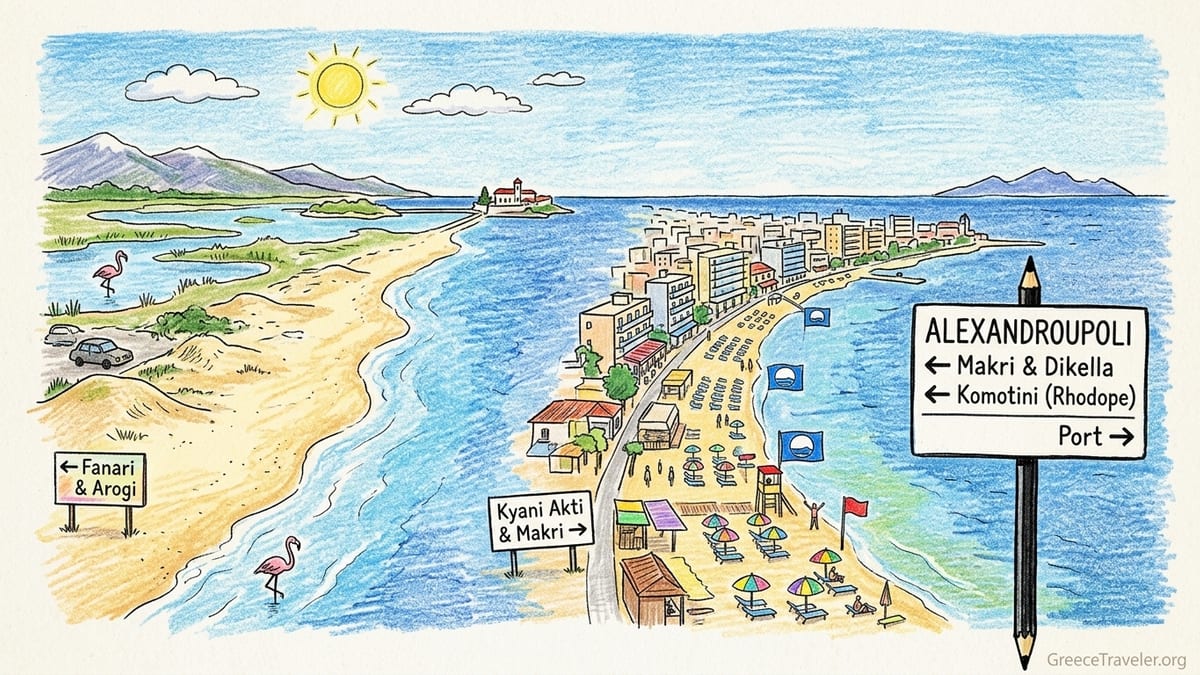
How the Thracian Coast Is Laid Out
The Thracian seaboard runs roughly west to east, split between the Xanthi coast around Fanari and Porto Lagos, the Rhodope coast near Komotini and Maroneia, and the Evros coast around Alexandroupoli, Makri and Dikella. Distances are modest: driving from Fanari to Alexandroupoli takes around two hours, so you can easily base yourself in one town and sample beaches in another on a day trip. What you will notice is a gradual shift from lagoon-backed sandflats in the west to more developed, urban sands in Alexandroupoli and quieter coves again beyond Makri.
Mainland Thrace is about long, shallow, sandy beaches. Fanari, Arogi, Nea Chili, Kyani Akti and the stretches around Makri and Dikella are primarily fine sand with a gently shelving seabed, which is ideal for families and casual swimmers. Pebbly patches do exist, especially near rocky headlands around Maroneia and Mesimvria, but they are the exception rather than the rule. Strong currents are rare on this coast in summer, although afternoon winds can whip up short waves, particularly in wide, south-facing bays like those west of Alexandroupoli.
Because this coastline is still relatively under the radar compared with Halkidiki or the islands, development is patchy. You have full-service organized beaches with lifeguards, changing rooms and cafes, like the municipal beach complexes in Alexandroupoli, contrasting with long, mostly unorganized segments between Arogi and Molyvoti where you may need to bring shade and supplies. That mix is part of the appeal: you can decide each day whether you want a sunbed and a beach club sound system or a quiet stretch with only a few umbrellas and the lagoon birds behind the dunes.
Access is a major differentiator. Alexandroupoli’s municipal beach, Delfini and much of Nea Chili are reachable on foot or by frequent local buses. By contrast, places like Mesi, Molyvoti or the more remote parts of the Arogi shoreline are essentially car beaches, reached on narrow roads with limited, often sandy parking. If you are visiting without a car, plan to base yourself in Fanari or Alexandroupoli and use buses or taxis to reach a manageable selection of nearby beaches.
Xanthi Coast: Fanari, Arogi, Mesi, Molyvoti and Porto Lagos
The Xanthi coastline is defined by the lagoons of Lake Vistonida and Lake Ismarida. Beaches here, including Fanari, Arogi and Mesi, are broad strips of light sand backed by low dunes and wetlands, with the mountains of Rhodope often visible to the north on clear days. The sand underfoot is generally soft and comfortable, and the sea deepens slowly, which suits children and less confident swimmers. On most days in June and early July the sea is calm in the mornings, with a bit of chop appearing when afternoon winds pick up.
Fanari itself is the best developed resort on this part of the coast. Along the main Fanari beach you will find a succession of organized sections with sunbeds, beach bars, showers and changing cabins interspersed with free public areas where you can simply lay your own towel. The sand here is fine and golden, and the water shallow enough in the first several metres for toddlers to splash safely. It is a classic family resort beach, and lifeguard services are present in peak summer on the main organized stretches. Behind the waterfront are tavernas, mini-markets and small hotels and apartments, so you can stay within a short walk of the sea.
Accommodation in Fanari ranges from simple rooms in family-run guesthouses to mid-range hotels with pools. Recent summer price checks show basic double rooms in Fanari village from roughly 70 to 100 euros per night in July and August, with more modern seafront hotels and apartments often in the 110 to 160 euro range depending on facilities and exact dates. Prices drop sharply in June and September, when the same room might be available for 20 to 30 percent less. Fanari is reached by car from Xanthi or Komotini and, in high season, by regional buses, but services are not as frequent as to larger towns, so a car gives far more flexibility.
East of Fanari, the beach continues as Arogi, Mesi and eventually the long spit leading toward Molyvoti. Arogi is less built up than Fanari despite sharing the same continuous sand. The shoreline is longer, with more unorganized sections between small clusters of umbrellas and beach bars. This is a good choice if you like space and are happy to park close to a beach bar for refreshments but sit slightly away from the loudest music. The water remains shallow and sandy, though there can be small patches of pebbles and shells at the high-tide line. Lifeguard coverage is more limited than in Fanari, usually concentrated at the more formal organized spots, so families should stay close to those areas if supervision is a priority.
As you continue toward Mesi and Molyvoti the ambience gets progressively quieter. Access roads narrow, and parking is often informal along sandy tracks. Facilities range from a couple of beach bars and seasonal tavernas to entirely unorganized segments where you need to bring shade, water and snacks. Swimming conditions remain straightforward, with a mostly sandy bottom and gentle depth, but these remote strands are better suited to couples and independent travellers than to families needing constant amenities. This stretch also borders sensitive lagoon habitats connected to Lake Vistonida, so visitors should stick to established tracks and avoid driving onto dunes or into salt-marsh areas.
Ecology and Bathing Water Quality around Lake Vistonida and Porto Lagos
The coastal lagoons around Lake Vistonida and Porto Lagos are part of the wider Nestos–Vistonida–Ismarida protected area, designated under European Natura 2000 rules for its birdlife, wetlands and dune habitats. Flamingos, herons and a variety of migratory species feed in the shallow waters behind the beach, particularly outside the peak heat of the day. Although the main bathing zones such as Fanari and Arogi are officially designated swimming waters, much of the coastline here also serves as critical habitat, so simple behaviour like using marked paths and taking rubbish away makes a real difference.
Greek and European environmental agencies monitor bathing-water quality across the region. Official reports indicate that most coastal bathing sites in Eastern Macedonia and Thrace, including the main beaches around Alexandroupoli and Kyani Akti, consistently receive an “excellent” classification in recent years. Where specific data for smaller named beaches around Lake Vistonida is not individually listed, they often form part of larger monitored coastal segments that are also rated excellent. Swimmers who want confirmation for a particular beach can consult the latest bathing-water profiles published each season by the Greek authorities before travelling.
Despite the presence of wetlands behind the dunes, mosquitoes are less of a problem on the breezy seafront than inland around the lagoons, but they can still be noticeable around sunset. Many accommodation owners in Fanari and Porto Lagos provide screens on windows and advise using repellent in the evenings. In return for that minor inconvenience you gain a rare combination in the Greek summer: long sandy beaches on one side of the road and an internationally significant bird reserve a short stroll away.
Porto Lagos itself is more of a fishing and pilgrimage village than a typical beach resort. The causeway and small bridges out to the island monastery are its signature sight, with low, brackish waters and reedbeds stretching out on both sides. There are small local swimming spots on the nearby coast, generally sandy shallows used by residents, but facilities are minimal. Most visitors combine a walk or drive around Porto Lagos and the lake viewpoints with swimming time at Fanari or Arogi, which are better equipped for a full beach day yet close enough to reach by car in minutes.
Rhodope Coast near Komotini: Avdira, Mandra and Maroneia
Moving east into the Rhodope regional unit, the coastline becomes slightly more rugged in places, with headlands and smaller bays breaking up the long sandflats. Where access and facilities are clearly developed, beaches such as those near Avdira and Mandra offer a relaxed mix of small-scale tourism and traditional agricultural villages a few kilometres inland. The beaches themselves are still mainly sandy with a gently shelving seabed, making entry into the water easy for all ages. However, you may encounter more pebbles and seagrass patches at the tide line than on the manicured urban sands of Alexandroupoli.
Near Avdira and Mandra, swimming conditions are generally calm in the morning with light chop later in the day. There are a few organized beach bars that set out sunbeds and umbrellas for the price of a drink or small fee, alongside long unrestricted sections where you can bring your own gear. These are good options for travellers who want something less built up than Fanari but still appreciate a tavern within walking distance. Lifeguard services, where present, focus on the busiest organized segments in high season, so swimmers should not assume coverage on quieter stretches.
Further east, the coastline around Maroneia feels more isolated and green. Here the beaches are sometimes a mix of sand and small pebbles, particularly close to rocky outcrops. This makes the water clearer than on some of the sandy, shallow bays further west, which in turn suits snorkelling and longer swims. Depth can increase a little faster than at Fanari or Nea Chili, although there are still plenty of gentle entries suitable for older children and confident swimmers. Because this area is more broken up by headlands, you find small coves with natural shade, something in short supply on the flatter Xanthi coast.
Accommodation around Maroneia is more limited and atmospheric rather than resort-style. A small number of hotels and country-house style properties operate in and around the village, with summer double-room prices often in the range of roughly 100 to 170 euros per night in July and August, depending on proximity to the sea, star rating and whether breakfast is included. These figures are based on mid-2025 and 2026 listings. Apartments and guesthouses sometimes undercut hotels slightly, especially a few kilometres inland. A car is practically essential here because local buses to Komotini run on regional timetables that are not tailored to beachgoing, and some beaches are reached only by narrow rural roads.
Evros Coast: Alexandroupoli, Nea Chili and Municipal Beaches
Alexandroupoli is the only true city on this stretch of coast and functions as the transport hub for northern Thrace, with rail, bus and air connections. Its waterfront is lined with a long municipal beach zone that starts a short walk west of the port and runs in stages past the central municipal beach complex, Delfini and on toward Nea Chili. This is where mainland Thrace offers its most urban-style beach experience, with cafes, restaurants and hotels backing directly onto the sand.
The central municipal beach of Alexandroupoli, often still referred to as the old EOT beach complex, is a fully organized facility with Blue Flag status for water quality and environmental management. The sand is light coloured and fine, and the seabed remains sandy and shallow for several metres, giving comfortable conditions for families and less experienced swimmers. Facilities include sunbeds and umbrellas, showers, changing rooms, toilets and accessible infrastructure, including anti-slip walkways, SEATRAC sea-access systems and adapted toilets for visitors with disabilities. Lifeguards are on duty daily in summer, typically between 10:00 and 18:00. Entry is controlled through a gate with a modest ticket fee, while children in certain categories and people with disabilities either pay reduced rates or enter free.
Nea Chili, about ten minutes by car west of the centre, offers a slightly different balance. The village’s main coast road runs along a long sandy beach where most of the shore is free, with residents bringing their own umbrellas and a few sections organized with sunbeds and a beach bar near the village core. The sand is a distinctive fine brown, and the seabed remains shallow and sandy, although light waves can stir up the bottom and cloud the water on busy or windy days. Behind the beach, tavernas and pizzerias line the road, so it is easy to combine swimming with a relaxed lunch without moving the car. Nea Chili is particularly convenient if you are staying in the western suburbs or driving out from the city in the late afternoon.
Between the main municipal beach and Nea Chili are other named sections such as Delfini and smaller organized spots. These continue the pattern of wide sandy shores with gradual depth, basic or full facilities, and variable lifeguard coverage depending on the specific concession. Some, like Delfini, are especially popular with families with young children because of the extended shallow zone and on-site amenities like showers, WCs and beach bars. They trade crystal-clear snorkelling conditions for soft, safe sand, so serious snorkellers often head further west toward the rockier sections beyond Makri.
Within Alexandroupoli itself you find a full range of accommodation, from budget guesthouses and older two-star hotels to modern business and resort-style properties. High-season doubles in the city commonly fall in the 90 to 180 euro per night bracket, based on recent mid-summer checks, with sea-view rooms, newer buildings and four-star facilities at the top end of that range and simple city rooms at the bottom. Staying in town means you can often walk to the main municipal beach or hop on frequent local buses to Nea Chili and outlying villages, which is a significant advantage for travellers without a car.
West of Alexandroupoli: Makri, Agiasma, Kyani Akti, Dikella and Mesimvria
West of Alexandroupoli the coastline gradually leaves the urban strip behind and enters a more relaxed zone of seaside villages, cultivated plains and occasional archaeological sites. The best known beaches in this stretch include Makri, Agiasma, Kyani Akti, Dikella and the coast around Mesimvria. Here you can clearly feel the contrast with the city beaches: while the sand is still widespread and the water remains shallow near shore, development is more scattered and the backdrop is rural rather than urban.
Makri itself is a village with several nearby beaches, including long sandy segments and smaller coves backed by low vegetation. The seabed is usually sandy with some areas of small pebbles, and the water tends to be clearer than in the very shallow urban bays closer to town. Beach bars and small tavernas sit right behind the sand, and some organized sections offer sunbeds and umbrellas for the price of a drink. Makri’s coastline is especially popular with Alexandroupoli residents on weekends who come for a change of scenery and slightly cooler waters. Local bus routes from Alexandroupoli run to Makri and the nearby Agia Paraskevi and Kyani Akti bathing areas, although the most flexible way to explore multiple beaches in a single day is by car.
Kyani Akti, listed as a separate bathing-water site for monitoring purposes, has an excellent official rating for bathing-water quality in recent years. The shore is sandy with some shingle patches, and the sea deepens gradually, making it safe for swimmers of varying abilities. In high season lifeguard coverage is provided at key points, and local beach bars offer refreshments, toilets and sometimes showers. Because Kyani Akti is a little removed from the city and has fewer large buildings on the waterfront, it feels more open and less hemmed in than the municipal beach while still being relatively easy to reach.
Farther west, small settlements like Agiasma, Dikella and Mesimvria sit close to a sequence of beaches that blend sand and small pebbles. Here the coastline begins to break up with low rocky features that give the water added clarity and a more interesting underwater landscape for mask-and-snorkel swimming. Some organized zones offer sunbeds and a simple menu, but you will also find long stretches with only a few scattered umbrellas. Parking is usually roadside or on packed earth behind the dunes, and shade is limited, so bringing your own umbrella is wise if you plan to stay all day. These strands appeal most to travellers who are happy with simpler facilities and want to escape the city buzz.
Bus services from Alexandroupoli extend to several of these villages, including Makri and Dikella, typically with more departures in July and August and fewer shoulder-season runs. For a visitor staying in Alexandroupoli without a car, it is realistic to use public transport for a day at Makri or Dikella, but less so if you want to beach-hop along the smaller coves in one day. Families with young children often prefer to keep logistics simple by choosing one or two favourites within easy bus reach and returning to the municipal beach or Nea Chili on other days.
Seasonality, Crowds and Prices from June to September
Weather in mainland Thrace’s beach season is broadly aligned with the rest of northern Greece. June offers warm days, cooler evenings and sea temperatures that are pleasant but not yet at their peak. Crowds are light to moderate, particularly outside national holidays, and accommodation prices are at their lowest summer levels. In Fanari, you might find a double room in a family-run pension in early June around the lower end of its annual range, while Alexandroupoli business hotels sometimes offer attractive weekend rates before school holidays begin.
July and August bring the full high season. Daytime temperatures are hot, the sea is at its warmest and Greek families arrive from inland cities. Fanari’s organized sections fill up late morning, Arogi and Nea Chili develop a continuous line of umbrellas, and the municipal beach in Alexandroupoli sees steady activity from opening until early evening. This is also when lifeguard services and beach buses are most reliable and when beach bars host evening events. Accommodation prices reach their annual peak, especially in the first three weeks of August, and seafront rooms in Fanari, Alexandroupoli and Maroneia can sell out if you leave booking too late.
September is perhaps the best month for many travellers. Sea temperatures remain high after the summer, but crowds thin dramatically once schools reopen. On weekdays you may find long stretches of beach almost empty outside the central sections, and even on weekends the mood is relaxed. In Fanari and Alexandroupoli, hotel rates often fall back close to June levels by mid-September, and it becomes easier to secure last-minute rooms. Some seasonal beach bars and facilities begin to scale back operations from late September, so if you rely on organized infrastructure, plan your visit for the first half of the month rather than the very end of the season.
In practical terms, families tied to school holidays might consider late June or very early July to balance warm weather with more moderate crowds and prices. Couples with flexible schedules often choose mid or late September, when they can have large parts of Arogi, Mesi or the strands near Dikella almost to themselves while still enjoying long swims in the open sea.
Who Each Beach Suits Best
Families will gravitate toward beaches with gentle depth, lifeguards and complete facilities. Fanari’s central beach, the Alexandroupoli municipal beach complex and organized sections at Arogi, Delfini and Kyani Akti all tick these boxes, offering shallow sandy entries, showers, toilets and nearby food. A family staying in Alexandroupoli, for example, can walk or take a short taxi ride to the municipal beach in the morning, safe in the knowledge that lifeguards are present, and shift to Nea Chili for an evening swim and pizza with the sunset over Samothrace island in the distance.
Couples and independent travellers looking for quieter surroundings may prefer longer, less structured stretches. The more open parts of Arogi toward Molyvoti, the smaller coves around Maroneia and the beaches near Mesimvria and Agiasma offer a feeling of space and fewer crowds, especially outside August weekends. Here you can park on a dirt track, walk over low dunes and set up your umbrella well away from any organized section. The trade-off is the lack of lifeguards and sometimes the absence of toilets or freshwater showers, so this style of beach day suits those happy to be self-sufficient.
For travellers who enjoy organized beach clubs with full-service sunbeds, drinks and occasionally louder music, the central parts of Fanari, the main municipal beach of Alexandroupoli, sections of Nea Chili and the better known bars at Makri and Kyani Akti are the natural choices. You can expect to pay for sunbeds either through a minimum-spend system or a fixed fee, but in return you gain shade, service at your lounger and convenient facilities. These areas are at their liveliest in July and August, particularly on weekend afternoons and evenings.
Nature-focused visitors and those interested in birdwatching should base themselves near the Xanthi coast and Lake Vistonida or consider day trips from Komotini or Alexandroupoli. Combining a morning walk along the tracks around Porto Lagos, watching flamingos and herons feeding in the shallows, with an afternoon swim at Fanari or Arogi makes for a varied day. Respecting protected zones by staying on marked paths and using existing access roads ensures that this mix of wildlife and seaside recreation can continue to coexist.
FAQ
Q1. Do I need a car to explore the beaches of Thrace?
A1. A car is highly recommended if you want to visit quieter spots such as Mesi, Molyvoti, Maroneia’s coves or the stretches around Mesimvria and Agiasma. Fanari and Alexandroupoli’s main beaches can be reached by intercity and local buses, and there are seasonal routes to Makri and Dikella, but schedules may not align with your ideal beach hours, especially outside July and August.
Q2. Which beaches in Thrace are best for families with small children?
A2. Fanari’s central beach, the municipal beach of Alexandroupoli, Delfini, Nea Chili and Kyani Akti are particularly suited to young children thanks to their sandy seabeds, shallow entry and, in the case of the organized sections, lifeguard presence and full facilities. Many families choose to stay close to these zones and take occasional day trips to quieter beaches once children are confident swimmers.
Q3. Are there lifeguards on all beaches?
A3. No. Lifeguards are concentrated at officially organized bathing sites such as the municipal beach complex in Alexandroupoli and certain sections of Fanari, Arogi and Kyani Akti during the main summer season. On less developed stretches like parts of Arogi toward Molyvoti, or smaller coves near Mesimvria and Maroneia, there may be no supervision at all, so swimmers should exercise extra caution.
Q4. How is the water quality along the Thracian coast?
A4. Official monitoring by Greek and European agencies rates the vast majority of designated bathing waters in Eastern Macedonia and Thrace as excellent in recent years, including many sites around Alexandroupoli and the Northern Aegean coast. Where smaller beaches do not appear under their own name, they often form part of larger monitored segments with similarly high ratings. Travellers who want the latest figures should consult current-season bathing-water reports before swimming.
Q5. What is the difference between Fanari and Arogi?
A5. Fanari is more compact and developed, with a promenade atmosphere, closely spaced beach bars, hotels and apartments right behind the sand. Arogi shares the same continuous sandy shore but stretches much farther with fewer buildings and longer unorganized sections. Fanari suits those who like having everything within a short walk, while Arogi is better for visitors who value more space and a slightly quieter feel without sacrificing access to occasional beach bars.
Q6. How do urban beaches in Alexandroupoli compare to those west toward Makri?
A6. Alexandroupoli’s municipal beach and Nea Chili are urban or semi-urban, with easy access from hotels, full facilities and a lively local crowd. The water is shallow and sandy, but can be a little cloudy when busy. West of the city toward Makri, Kyani Akti, Dikella and nearby coves feel more rural, with fewer buildings and clearer water, sometimes over mixed sand-and-pebble seabeds. These western beaches are calmer and better for snorkelling, though they often require a short drive or bus ride.
Q7. When is the best time between June and September to visit?
A7. June and September offer warm weather, swimmable sea temperatures and lower crowds, along with more attractive accommodation prices. July and August have the hottest weather and liveliest beach scene but also the highest prices and busiest sands, especially around mid-August. Many travellers consider mid to late September ideal for quieter swimming with still-warm water.
Q8. What should I expect to pay for accommodation in Fanari and Alexandroupoli in summer?
A8. In Fanari, recent checks indicate basic doubles in small hotels and guesthouses typically around 70 to 100 euros per night in July and August, with newer seafront properties often 110 to 160 euros. In Alexandroupoli, city and seafront hotels span roughly 90 to 180 euros for a double in high season, depending on star rating, location and demand. Prices can be 20 to 30 percent lower in June and September.
Q9. Are there quieter beaches suitable for couples who prefer less infrastructure?
A9. Yes. The more remote stretches of Arogi and Mesi, parts of the coastline near Maroneia and the beaches around Mesimvria and Agiasma are all good choices. They may have only a small beach bar or no facilities at all, so couples should be comfortable bringing their own shade, snacks and water. In return they gain more privacy and a landscape that feels far removed from mass tourism.
Q10. How does mainland Thrace compare with Samothrace for beach holidays?
A10. Mainland Thrace offers long sandy beaches, shallow entries and easy car or bus access, which suits families, casual swimmers and travellers who value convenience. Samothrace, by contrast, is a mountainous island known more for rocky coves, waterfalls and hiking than for broad sandy strands. Many visitors base themselves on the mainland for relaxing beach days and then visit Samothrace separately for its wilder scenery and walking trails.