

I first went to Dadia National Park in May 2018, long before the word “megafire” became synonymous with this corner of Greece. Back then, the forested hills that rise behind the village of Dadia felt endless: dark pines running to the horizon, broken by pale rock outcrops where griffon vultures hung on thermals. At the official observatory a short minibus ride from the visitor centre, staff quietly pointed out cinereous vultures cruising in from their nests. The whole place felt like a self-contained stronghold for raptors, a refuge that might somehow be insulated from the wider climate crisis. Standing there again in October 2024 and June 2026, after the devastating wildfires of 2022 and the record-breaking Evros fire of August 2023, that illusion was gone.
What I Actually Saw on the Ground After the Fires
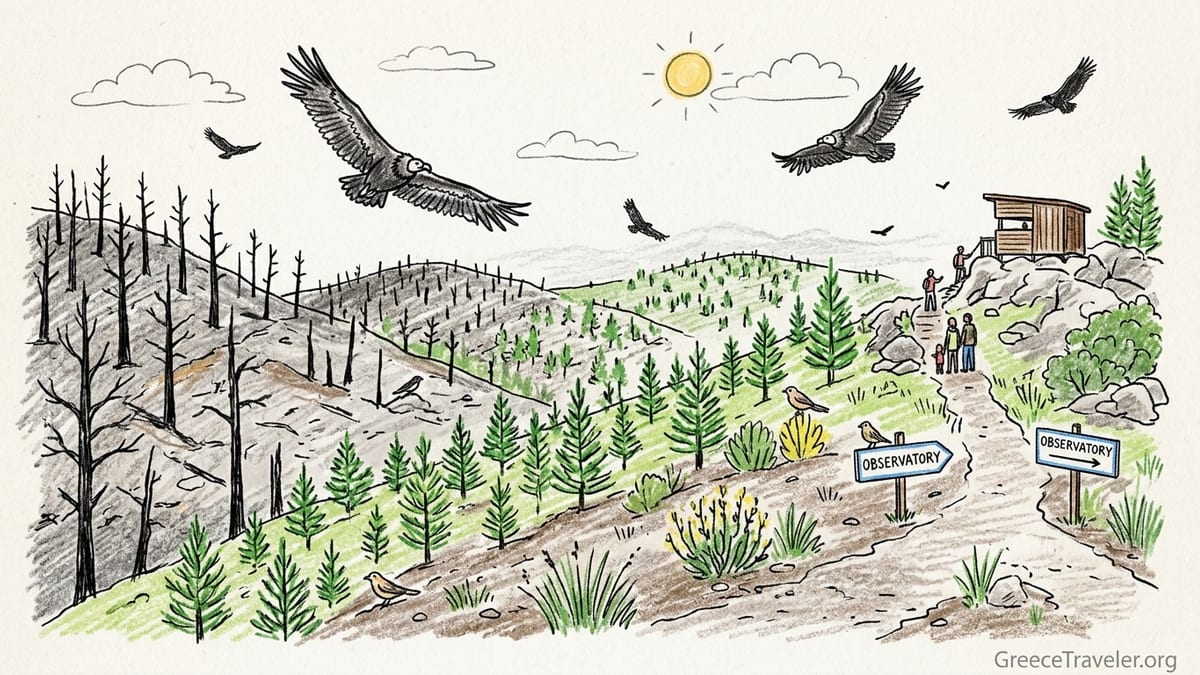
My most recent visit to Dadia was in early June 2026, on a hot, hazy day that hit 34°C by midday. Driving up from Alexandroupoli, the change became obvious long before I reached the village. Hillsides that I remembered as dense, shadowed pine slopes in 2018 were now a patchwork of blackened trunks and bright green regrowth. In some stretches the trees stood like charcoal matchsticks, their crowns completely gone. In others, fire had crawled low through the undergrowth, scorching bark but leaving a canopy of needles above.
Inside the national park boundary the contrast was even more brutal. Behind the Information Centre, one of the classic short walking routes that used to lead quickly into mature pine has been rerouted around a broad band of burned forest. The soil on these slopes is still bare and grey in places, littered with ash and cracked, burned cones. Between them, tough pioneer plants have moved in: low broom and rockrose, clumps of grass, and here and there the soft green of young pines rising to knee or waist height. It is not a lush landscape. It is a work-in-progress scar.
On a guided visit to the Bird of Prey Observatory, the scale of it was clearer. From the hide’s viewing slit, looking across the valley that once felt like an unbroken carpet of mature trees, the view is now sliced by great tongues of burned land. Some slopes are still reasonably intact, with dark pine crowns sheltering what are likely to be surviving nest trees. Others are open and raw, sun glaring off pale soil. This mixed mosaic matters for raptors, but visitors expecting an untouched “primeval” forest will be shocked by how much has changed.
Yet the picture is not one of total loss. Even in severely burned areas I saw clear signs of life. Hoopoes probed in the open soil, woodlarks sang from regenerating clearings, and in the air overhead, vultures continued to circle in real numbers. Dadia has not died. It has been severely damaged, and that damage is what any honest guide now has to describe.
The Scale of the 2023 Evros Megafire and Why Dadia Matters
No one planning a trip to Dadia in 2026 should underestimate what happened here in August 2023. The Evros fire that year burned for roughly sixteen days and has been described by European agencies and researchers as the largest single forest fire recorded in the European Union since comparable records began. Assessments using satellite data put the total burned area in Evros at around 94,000 to 96,000 hectares, with roughly 58 percent of Dadia National Forest Park affected. Large swathes burned at high severity, meaning virtually all above-ground vegetation was killed.
This is not just another Mediterranean woodland. Dadia is one of Europe’s flagship raptor landscapes. The park covers a mix of pine and oak forest, scrub and pasture that historically supported all four of Europe’s native vulture species: cinereous (often called black) vultures, griffon vultures, Egyptian vultures and, occasionally, bearded vultures. It is the only forest in Europe where this full quartet has been recorded together. Crucially, Dadia holds the only breeding colony of cinereous vultures in the Balkans, with earlier monitoring in the 2000s and 2010s typically finding around 30 to 35 breeding pairs clustered in and around the park.
When you stand in the observatory today and scan the sky, you are looking at the last stronghold of this species in south-eastern Europe. These huge scavengers, with wingspans reaching close to 3 metres, rely on old-growth trees for their nests and on a wide foraging radius across the wider Evros landscape. The 2023 fire did not simply burn some trees. It burned through the heart of their nesting colony, and it rearranged the patchwork of feeding and roosting sites across tens of kilometres. For griffon and Egyptian vultures, which also use Dadia and the wider Evros and Rhodope region, the loss of forest cover and potential food sources has similar implications.
For visitors, this context matters. You are not just driving into a “nice forest walk with some birds of prey.” You are entering a post-disaster landscape that still carries the ecological shock of losing more than half of its forested area in two consecutive years of large fires. Appreciating that scale is the first step to forming realistic expectations for a visit now.
Old Guidebooks, New Reality: Why Outdated Advice Is Misleading
Planning my 2024 and 2026 trips, I was struck by how many English-language guidebooks and blogs still describe Dadia almost exactly as I first saw it in 2018. Some popular print guides continue to talk about “a vast, unbroken pine forest” and “practically guaranteed” views of all three main vulture species from a single short walk. Several online articles published before 2022 are still being recycled or lightly updated without any mention of the fires, illustrated with pre-fire photographs that show a completely intact canopy.
Even some nature-focused blogs that were updated in 2024 gloss over the devastation. They might insert a line acknowledging that “recent fires have affected parts of the park” but then proceed to list the same easy circular trails, the same picnic spots in the shade of tall pines, and the same expectation that the landscape feels wild and timeless. In my own experience, that is misleading. One of the short routes from the visitor centre now passes through a landscape of standing dead trunks and exposed rock for long stretches. It can be beautiful in its own stark way, but it does not match those pre-fire descriptions.
This matters because it shapes how visitors behave. I met one couple from northern Europe in October 2024 who had driven up from Thessaloniki on the strength of a 2019 birding guide that raved about “almost continuous raptor activity over pristine forest.” Standing with them at the observatory, looking over a valley with large burned wedges cut into it, they were visibly bewildered. Yes, we saw cinereous and griffon vultures, but there were quiet spells and long views over burned hillsides. Their disappointment was not because Dadia had nothing left to offer, but because their expectations had been anchored in a landscape that no longer exists.
If guidebooks and blogs continue to present Dadia as if 2022 and 2023 never happened, they are not only disrespecting local communities and conservation staff who lived through the fires. They are also encouraging the wrong kind of tourism: people turning up for a generic “evergreen” forest experience instead of choosing to visit a recovering, fire-altered protected area with open eyes and a willingness to support long-term restoration.
Is Dadia’s Wildlife Really Recovering? What the Numbers Say
In the immediate aftermath of the 2023 fire, Greek media carried grim reports that many cinereous vulture nests had been destroyed and that the colony might be on the brink of collapse. On the ground in late 2024, that sense of anxiety was still palpable among local conservationists I spoke to. Yet by 2026 there is also cautious evidence of resilience and even growth. Recent reporting from Greek projects monitoring vultures in Dadia and across the Balkans suggests that the cinereous vulture breeding population has not only persisted but may have increased, with around 47 breeding pairs recorded in or near the Dadia colony area.
That figure needs to be treated carefully. Different organisations use slightly different definitions of what counts as a “breeding pair,” and post-fire monitoring is logistically difficult in a landscape with large burned zones. But the direction of travel is encouraging, especially given that the wider European population of the species is also benefiting from reintroduction work in Spain, Portugal and Bulgaria. Dadia’s birds are part of that bigger story. Conservation projects have used artificial nesting platforms in parts of the Balkans to encourage cinereous vultures to breed in safer, better-placed trees, and some of that experience has informed efforts in and around Dadia after the fires.
From a visitor’s perspective, the important point is that large vultures are still a realistic highlight here. On my June 2026 visit, during a single two-hour session at the observatory, I saw more than a dozen individual cinereous vultures and a similar number of griffon vultures, along with short-toed snake eagles and booted eagles. Egyptian vultures are fewer and more seasonal, but the staff at the Information Centre could still point to recent sightings. The massive loss of forest cover has not emptied the sky.
What has changed is the underpinning habitat. Many nesting trees, especially in core breeding zones, were lost in both 2022 and 2023. Some pairs have apparently shifted to surviving pockets of mature forest or to artificial platforms. Ground surveys and satellite tracking data also suggest that vultures are now ranging over even larger areas of Evros in search of food. For the casual visitor, that means more variability in what you see on a given day and more reason to respect restricted areas where active nests are being protected.
Visitor Centre, Minibus and Trails: What Is Actually Open in 2026
Amid all this change, the basic visitor infrastructure at Dadia is functioning again. According to the Management Unit of Evros Delta and Dadia National Parks, which now operates under Greece’s Natural Environment and Climate Change Agency, the Dadia Information Centre is open daily from 08:00 to 16:00, except on 1 January, Easter Sunday and 25 December. On both my 2024 and 2026 visits I found it staffed, with exhibits explaining the park’s ecosystems, maps highlighting burned versus unburned areas, and up-to-date fire information pinned near the entrance.
The official 15-seat minibus to the Bird of Prey Observatory currently runs four scheduled departures every day: at 08:30, 10:00, 11:30 and 13:00. Seats can be reserved in advance by phone, which I strongly recommend in spring and early summer when birdwatchers and nature tour groups converge. Tickets for the bus and observatory access are sold at the Information Centre; recent visitors, including myself in 2026, have paid modest fees that go directly to the park’s management, though exact prices can change and should be confirmed directly with the centre when you plan your visit.
There is an important caveat that many older articles do not mention. The Management Unit has clearly stated that bus services to the observatory do not operate on days when the national Wildfire Risk Forecast Map classifies Evros as level 4 (very high risk), or when local temperatures exceed 40°C. This is not hypothetical. With increasingly hot summers, there are already several days each year when either the risk level or the temperature threshold is reached, and visitors who arrive expecting a guaranteed bus ride can be disappointed. On high-risk days, other accesses within the park may also be limited or discouraged for safety reasons.
Trail access is more complicated than a simple “open or closed” list. Some traditional walking routes starting near the village remain partially open but now cross large burned sectors. In a few places, temporary signage redirects walkers away from unstable slopes, erosion-prone gullies or areas with high numbers of standing dead trees. On my June 2026 walk, I followed one such detour that added almost an hour to a loop I had previously done in less than two. None of this is unmanageable if you come prepared for flexible plans and heat, but it is very different from the tidy trail descriptions still printed in pre-2022 hiking guides.
Conservation Tours, Local Guides and How to Visit Responsibly
Given the post-fire complexity, I would not recommend a first-time visitor rely solely on an out-of-date map and an old blog post. Fortunately, Dadia still has a small but active network of local guides and conservation-focused tour operators who have adapted their itineraries since 2023. During my 2024 trip I joined a half-day small-group tour from Alexandroupoli that combined a stop at the Dadia Information Centre, a minibus visit to the observatory and a short guided walk along a partially burned ridge. In 2026, similar tours were still being advertised through local hotels and regional tourism offices, often run in coordination with the park’s management.
These operators are worth seeking out because they monitor access changes week by week. When wildfire risk spikes, they know which areas are off-limits and can switch to visits to the Evros Delta wetlands or to cultural sites in Soufli, Didymoteicho or Alexandroupoli instead. Several guides I spoke with were blunt about needing visitors to understand that a confirmed “Dadia day” can still change at 24 hours’ notice during peak fire season. A responsible operator will build that uncertainty into its terms and conditions rather than promising fixed, inflexible itineraries.
Inside the park, responsible wildlife viewing now means more than just keeping your distance from nests. Feeding stations and “vulture restaurants” that supplement natural carcasses are carefully managed to reduce disturbance, disease risk and the chance that vultures ingest poisoned baits. Visitors should not expect to approach these sites directly. Instead, the observatory remains the main vantage point for distant, unobtrusive watching. Guides and wardens are rightly cautious about disclosing the exact locations of sensitive nesting or roosting trees.
Even simple choices matter. On my last visit, I watched a guide quietly but firmly ask a group to lower their voices and avoid leaning cameras out of the observatory slits when birds were settling to feed. Flash photography, loud playback of bird calls and flying consumer drones are all behaviours that, while sadly common in some other wildlife hotspots, are strongly discouraged or outright banned here. If you are not willing to accept those constraints, Dadia today is not the place for you.
Poisoning and Other Ongoing Threats to the Vultures
Fire is not the only danger shaping Dadia’s future. Conservation staff and regional experts repeatedly raise another, more insidious threat: poisoning. Across the Balkans, the illegal use of poisoned baits to kill wolves, jackals or stray dogs has caused repeated mass mortality events for vultures. A single carcass laced with a banned pesticide can kill dozens of scavenging birds within hours. Dadia’s vultures are no exception, and there have been documented poisoning incidents affecting the population in the past decade.
In response, Greek and international projects have deployed anti-poison dog units, increased public awareness campaigns and worked with livestock farmers to promote non-lethal predator control. They have also tightened protocols around supplementary feeding, so that carcasses offered at official feeding sites are carefully sourced and monitored. These measures reduce risk but do not eliminate it. For a small, isolated colony like Dadia’s cinereous vultures, even one major poisoning event in the next few years, on top of the fire impacts, could be catastrophic.
Other pressures are quieter but still real. Proposals for new wind power developments in parts of Greece and the wider Balkans raise collision risk for large soaring birds, including griffon and cinereous vultures. Studies modelling cumulative risk suggest that poorly sited wind farms could significantly increase mortality for already vulnerable populations. While Dadia’s relative isolation has so far shielded its vultures from the densest clusters of turbines, the broader trend across their range is hardly reassuring.
Visitors cannot control these macro-level threats, but they can choose operators who support anti-poison initiatives, respect no-go zones near nesting cliffs or old-growth stands, and donate directly to conservation work instead of channelling all spending into generic package tours. Asking a prospective guide, “How do you contribute to anti-poisoning efforts or monitoring?” is not an awkward question here. It is part of travelling responsibly.
Should Casual Tourists Still Come, and What Is Worth Seeing?
After walking through burned slopes and listening to local frustration about policy failures, it is tempting to say that Dadia is now only for hardened birders and ecologists. I do not agree. However, I would not recommend that a casual tourist treat Dadia as an interchangeable “green day trip” from Alexandroupoli in the way some older travel itineraries suggest. If your ideal outing is a cool forest picnic under tall pines with a vague chance of seeing “some big birds,” you will likely be disappointed by the heat, the starkness of burned hillsides and the unpredictability of access in peak summer.
What remains compelling is different. It is the chance to watch one of Europe’s rarest vulture populations hold its ground above a landscape that has been radically altered, and to witness the early stages of forest regeneration on a vast scale. From the observatory, seeing a cinereous vulture glide over both blackened ridges and surviving green pockets brings home, more than any report can, what climate-driven fire seasons mean for real places and species. On the ground, walking through regenerating clearings where seedlings push up through ash is sobering and strangely hopeful.
For travellers who care about conservation, that makes Dadia an important, if emotionally demanding, destination. A realistic itinerary in 2026 might include a morning at the Information Centre and observatory, a short guided walk chosen in consultation with park staff, and then time spent in nearby villages, talking to local people whose livelihoods intersect with the park. Combining Dadia with the Evros Delta wetlands, where herons, pelicans and waders still gather in impressive numbers, can make for a richer, more balanced nature trip that spreads your impact and your spending.
The key is to arrive with expectations aligned to reality. You will not find the continuous, shaded forests that older photographs and guidebooks still showcase. You will find a recovering, wounded landscape where both trees and vultures are adapting under intense pressure. If that sounds too heavy for a holiday, it is better to choose another destination than to demand that Dadia perform a pre-2023 fantasy it can no longer deliver.
The Takeaway
Looking back to my first visit in May 2018, I remember Dadia as a place where the main story was abundance: abundant trees, abundant vultures, abundant promise that Europe could still protect a few last strongholds for its largest birds of prey. Returning in October 2024 and June 2026, the story is more complicated. The Evros megafire of 2023, on top of the major 2022 blaze, has burned through more than half of the park and reshaped the landscape for decades to come. The cinereous vultures and their fellow scavengers have not vanished, but they now fly over a patchwork of scars and green islands rather than an unbroken forest.
Whether you should visit Dadia today depends on what you expect and what you are willing to contribute. If you are prepared to check current conditions with the Management Unit, accept that the official minibus may not run on high fire-risk or extreme-heat days, and potentially reshape your plans around closures, then a visit can be both meaningful and unforgettable. Booking local guides or conservation-minded tours that coordinate with park staff is not an optional extra. In the post-fire reality, it is the most reliable way to see the vultures without adding pressure to a stressed ecosystem.
Most importantly, coming to Dadia in 2026 is not about consuming a postcard-perfect forest. It is about standing in a living case study of how climate, land use and policy collide, and choosing to support the people and projects trying to hold the line for some of Europe’s rarest raptors. If that resonates with you, then by all means come, look up, and let the sight of a cinereous vulture circling above a regenerating hillside reframe what a “successful” nature trip can be.
FAQ
Q1. Is Dadia National Park open to visitors after the 2022 and 2023 fires?
The park is open in 2026, with the Information Centre operating daily and official minibus trips to the observatory on most days, but specific trails and services can change depending on fire damage, restoration work and wildfire risk.
Q2. Can I still see cinereous and griffon vultures in Dadia now?
Yes. Monitoring indicates that the cinereous vulture colony has survived and may have grown, and both cinereous and griffon vultures are regularly seen from the Bird of Prey Observatory, although sightings can vary by day and season.
Q3. How have the 2022 and 2023 fires changed what the forest looks like?
Large areas of former dense pine forest are now a mix of standing burned trunks, open slopes and patches of regenerating vegetation, interspersed with surviving green pockets of mature trees, so the landscape feels much more fragmented than before.
Q4. Are the official minibus and observatory always operating?
No. The minibus does not run on days when the national wildfire risk map shows level four for the area or when local temperatures exceed 40°C, and exceptionally dangerous conditions can also lead to wider access restrictions.
Q5. Do I need a guide to visit Dadia National Park?
You can visit independently using the minibus and signposted trails, but in the current post-fire situation a local or conservation guide is highly recommended to navigate access changes, interpret what you see and reduce your impact on sensitive wildlife.
Q6. Is it suitable for a casual day trip from Alexandroupoli with children?
It can be, but families should be prepared for heat, stark burned landscapes, possible last-minute cancellations due to fire risk and a focus on quiet observation rather than playground-style facilities or shaded picnic areas.
Q7. What should I do to plan a responsible visit?
Contact the Dadia Information Centre shortly before your trip to confirm opening hours, minibus schedules and trail status, book with operators who work closely with the park and follow all guidance on fire safety, noise, waste and wildlife disturbance.
Q8. Are there still poisoning risks for vultures in the area?
Yes. Illegal poisoned baits aimed at predators remain a serious regional threat to scavenging birds, and ongoing anti-poison campaigns and dog units operate partly thanks to support from conservation projects and responsible tourism.
Q9. Can I walk to the vulture feeding sites or nesting areas on my own?
No. Access to feeding stations and core nesting zones is restricted to minimise disturbance and poisoning risk; visitors should watch vultures from the official observatory or other viewpoints recommended by park staff or guides.
Q10. Why visit Dadia now if the forest is so damaged?
Visiting in 2026 offers a chance to witness both the vulnerability and resilience of a globally important vulture stronghold, to support local communities and conservation work, and to adjust expectations away from pre-2023 postcards toward a more honest, climate-aware form of nature tourism.