


Mount Parnassos is Greece’s busiest ski mountain and Arachova is the country’s most famous winter town, a lively base for Athenians who head up for weekends of skiing, eating and late-night bars. What you do not get here is a purpose-built, ski-in ski-out resort beside the lifts. Instead, you stay in Arachova or nearby villages and drive or take a ski bus up to the slopes each morning. This guide explains how the Parnassos Ski Centre works, how Arachova, Livadi, Kellaria, Fterolakka, Eptalofos, Polydrosos, Amphiklia and Delphi fit together, what to expect from passes and prices based on the 2025–2026 season, and how to build a realistic winter weekend budget for two.
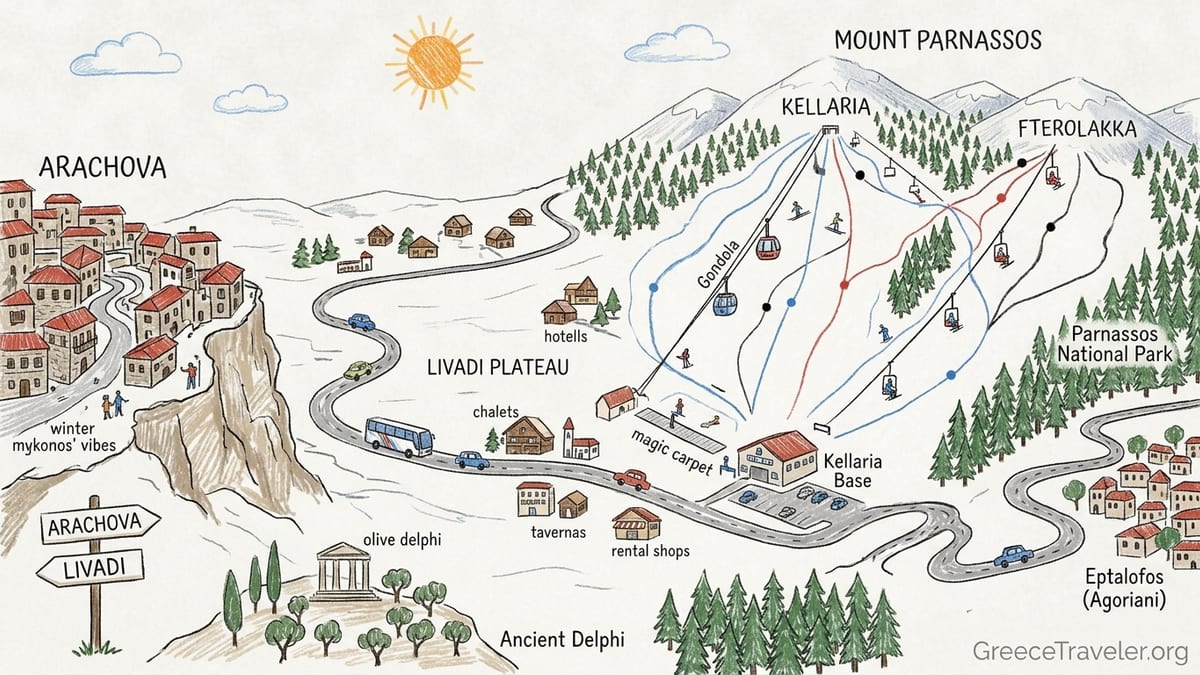
How Arachova, Livadi and the Parnassos Ski Sectors Fit Together
Arachova sits at around 960 to 1,000 metres on the southern slopes of Mount Parnassos, about 180 kilometres northwest of Athens by road. It is a historic cliff-edge town overlooking the Pleistos valley, often called the “Winter Mykonos” for its nightlife and boutique hotels. The Parnassos Ski Centre lies higher up the mountain, spread between roughly 1,600 and 2,250 metres in the Kellaria and Fterolakka sectors. You do not walk from your guesthouse to the lifts. Instead, you drive or take a ski bus 20 to 30 minutes each morning, depending on weather and traffic.
Leaving Arachova, the main road climbs gently across the Livadi plateau, a broad alpine meadow dotted with chalets, small hotels, tavernas and rental shops. Livadi is not a separate resort but a high plateau neighborhood of scattered accommodation and services between Arachova and the ski area. From Livadi, the road continues through the forest towards Eptalofos before branching to the Kellaria base area, which is the main gateway for most skiers, with parking, rental shops, ticket offices and cafés. Fterolakka, slightly further and higher, has its own access road and parking but is also linked to Kellaria by lifts and pistes.
On the northern side of Parnassos, the villages of Eptalofos (also called Agoriani), Polydrosos and Amphiklia sit among fir forests and fields, connected by their own roads to the Fterolakka or Kellaria side. They are quieter, more rural bases than Arachova, with a mix of guesthouses and tavernas. Delphi, by contrast, is famous for its archaeological site and modern village perched above the Gulf of Corinth; it lies to the west of Arachova and does not have direct road access up to the ski lifts. Travellers often combine Delphi’s ancient sanctuary with a separate ski day from Arachova or Livadi.
In practice, that means you will choose your base according to the kind of trip you want. Arachova offers dense accommodation, nightlife and quick access across Livadi to the main Kellaria parking. Livadi offers more space, easier parking and the shortest morning drive. The northern villages offer a quiet mountain feel and typically lower prices, at the cost of a slightly longer, more winding approach to the lifts. Delphi is ideal if ancient history is your priority and skiing is an optional add-on by car tour or taxi.
The Parnassos Ski Centre: Lifts, Pistes and Beginner Areas
Parnassos is widely described as Greece’s largest ski area, operated by the Hellenic Public Properties Company. The official material outlines around 13 main lifts, including a mix of detachable chairlifts and gondolas, plus several beginner lifts and magic carpets. The skiable terrain is split across Kellaria and Fterolakka, with Gerontovrachos, a smaller drag-lift area, across a ridge. The lift network connects the two main sectors so that, in good conditions, confident skiers can ski from one side to the other without returning to base.
Marked pistes range from gentle green and blue runs near the base areas and mid-stations to more demanding red and black routes on the upper slopes. Two runs, Vakhos and Iniohos, have been certified for international competition, which gives some idea of the gradient and quality that advanced skiers can expect. In a good snow year, off-piste options open between the trees and along the ridgelines, although conditions vary and are increasingly affected by warmer winters.
Beginners usually start at Kellaria, where there is a designated learning zone with a short drag lift or magic carpet and wide, low-gradient slopes near the base buildings. The ski schools tend to cluster around this area so that first-timers can rent equipment, meet instructors and step onto the snow within a short walk. Families with young children often spend most of the weekend between these beginner areas and the mid-mountain cafés, where non-skiers can sit in the sun and watch.
Fterolakka is popular with stronger skiers and snowboarders, thanks to longer red runs and fewer crowds on busy weekends, although this depends heavily on weather, open lifts and snow cover. When winds are high, the resort may close exposed lifts while keeping lower ones running, which can effectively shift the busiest area from one sector to the other. Before you leave Arachova in the morning, it is worth checking the resort’s live lift and piste status via Greek-language ski sites or the operator’s updates, especially during marginal snow or stormy weather.
Lift Passes, Sightseeing Tickets and 2025–2026 Prices
The Parnassos Ski Centre sells several categories of ticket at the base-area ticket offices. The main product is the daily skier pass, which grants access to the lifts for downhill skiing and snowboarding. There are also reduced categories for children, students with valid identification, seniors and families, plus non-skiing “sightseeing” tickets for visitors who simply want to ride specific lifts to mountain cafés or viewpoints without skiing.
During the 2025–2026 winter season, the regular adult lift passes followed a weekday and weekend structure. Publicly available price lists and tourism guides cited daily skier tickets at about 35 euros on weekends and peak days, 30 euros on Mondays and Fridays, and 20 euros from Tuesday to Thursday. These figures should be treated as historical examples. The operator typically updates prices each autumn, and 2026–2027 rates may change, so travellers should confirm the latest tariffs directly with the Parnassos Ski Centre before finalising their budget.
Student, youth and family passes usually offer a discount off the standard day rate when you show the required documents or buy tickets as a household unit. Conditions can include specific age limits, Greek or EU student cards, or a minimum number of family members purchasing together. Sightseeing tickets are normally cheaper than full ski passes and may be sold per uplift or for a limited area such as a gondola to a mid-station café. They are aimed at non-skiers who want snow views rather than full access to the piste network.
It is worth noting that lift passes are almost always dated for a specific day. On very busy weekends, queues can build at Kellaria ticket windows shortly after opening. Time-conscious skiers sometimes arrive early to secure passes and rentals before the main Athens crowd reaches the mountain. Multi-day passes may be available depending on the season’s policy, but many weekend visitors simply buy separate day tickets for Saturday and Sunday to retain flexibility in case of weather-related closures.
Ski Schools, Rentals, Parking and Access Roads
Parnassos attracts a wide range of Greek and international visitors, so there is a competitive market in ski schools and rentals. At Kellaria, you will find several private ski and snowboard schools that offer group lessons, private instruction and kids’ classes, usually by the hour or in two-hour blocks. English is commonly spoken, and some schools advertise Italian or French-speaking instructors during busy holiday periods. Advance booking by phone or online is strongly advised for peak weekends and Greek school holidays.
Equipment rental is available both on the mountain and in the villages. At Kellaria base, rental shops in and around the main buildings offer skis, boards, boots, helmets and sometimes clothing. Prices are typically higher than in Arachova or Livadi but convenient if you are driving up only for a single day or using a ski bus that arrives close to lift opening. In Arachova, streets off the main road host specialist rental stores and multi-sport shops where you can pick up gear the evening before, often at slightly lower daily rates if you keep equipment for two or three days.
The ski centre’s main access roads climb from opposite sides of the mountain. From Arachova and Livadi, you follow the paved mountain road towards Eptalofos, then turn off for Kellaria or Fterolakka. From the north, separate roads lead up from Eptalofos, Polydrosos and Amphiklia. All approaches are proper mountain roads that can see snow, ice and fog. In winter, Greek authorities and the ski centre regularly recommend carrying snow chains or using winter tyres, particularly after fresh snowfall or during cold snaps. Police sometimes perform checks and may restrict access for cars without appropriate equipment when conditions deteriorate.
Parking at Kellaria and Fterolakka is in open, surface lots near the base buildings. On busy Saturdays, especially around January and February, these can fill quickly. Late-morning arrivals may be directed to more distant areas or face a longer walk to the lifts. Some Athens-based ski-bus companies, such as well-known operators that advertise daily trips from the capital, drop passengers very close to the base, which can be an advantage if you want to avoid the parking pressure. However, ski buses usually run on fixed schedules, so you trade flexibility for convenience.
Getting to Arachova and the Ski Centre from Athens
Athens is the main gateway for Mount Parnassos. By car, the journey to Arachova is roughly 180 kilometres and usually takes around two and a half to three hours, depending on traffic. You head northwest on the national highway towards Lamia, exit near Livadia, then continue through rolling countryside before the road climbs to Arachova. From town, the ski centre is roughly another 25 to 30 kilometres by the mountain road across Livadi to Kellaria or Fterolakka, so allow at least 40 to 50 minutes in winter conditions.
Public transport is possible but less convenient for skiing. Intercity buses run from Athens’ Liosion bus station towards Delphi, with several daily departures that stop in Arachova. Travel times vary but typically take around three hours each way. From Arachova to the Parnassos Ski Centre there is no regular public bus listed by either the ski operator or the regional bus company. That means that if you arrive by KTEL coach you will need a taxi, private transfer, or pre-booked ski bus to reach the snow. For non-skiers planning to visit Delphi and spend an evening in Arachova, this is perfectly manageable; for skiers, it makes for a short day on the mountain.
Several private companies run ski buses from Athens directly to Parnassos during the winter season, sometimes in partnership with rental shops or tour agencies. These buses usually depart very early in the morning from central pick-up points, arrive at the ski centre around opening time, and return to Athens in the late afternoon. Some include lift passes or rental gear in package prices, while others sell simple transport-only seats. Because operators and timetables change from year to year, and most information is in Greek, travellers should search in advance and compare at least two providers before booking.
For visitors flying into Athens International Airport and heading straight to the mountains, an airport express bus connects the terminal with the main intercity bus stations in the city. However, once you factor in transfers and the limited bus schedule to Arachova, renting a car directly at the airport is often the most efficient option, particularly for weekend trips with luggage and ski gear. Whatever your approach, bear in mind that winter driving in Greece involves potential rain, fog and snow on mountain sections, and that congestion can build on Friday evenings and Sunday afternoons when Athenians come and go.
Where to Stay: Arachova vs Livadi vs the Northern Villages vs Delphi
Arachova itself offers the densest cluster of accommodation, dining and nightlife. Along the main street and on the lanes that climb the hillside you will find everything from simple guesthouses and traditional pensions to compact design hotels with spa facilities. Weekend prices in high season vary widely, but it is fair to say that Arachova is among the more expensive villages in the region, especially for rooms with fireplace, view or direct access to the centre. Street parking can be tight in the old core, although many newer hotels provide small private lots or arrangements with nearby spaces.
Livadi, on the plateau between Arachova and the ski area, feels more like a scattered hamlet of chalets and low-rise hotels set among fields and trees. Here, access to the slopes is very quick, often less than 15 minutes by car, and parking in front of your lodging is usually straightforward. Accommodation tends to be slightly better value than central Arachova at the same comfort level, with a focus on family-run inns, self-catering apartments and a handful of more upscale chalets. Several tavernas and cafés line the main road across the plateau, meaning you can eat locally without driving down to town.
On the northern side, Eptalofos, Polydrosos and Amphiklia are traditional mountain villages with stone houses, squares shaded by plane trees and a slower rhythm. They appeal to travellers who prioritise peace, hikes in the fir forest and evenings in local tavernas over late-night bars. Room prices here are often lower than in Arachova during peak ski weekends, with good-value guesthouses and agritourism-style lodgings. Parking tends to be easier, both in the villages and at the northern access points to the ski centre, although driving times up to the lifts can be slightly longer and more affected by snow.
Delphi, about a 20-minute drive west of Arachova, offers a very different experience. The modern village clings to the mountainside above the ancient sanctuary and looks out over olive groves to the sea. Accommodation ranges from simple rooms to comfortable mid-range hotels that mainly serve archaeological visitors. Winter rates are often attractive, and parking along the main road is usually less competitive than in Arachova. On the other hand, staying in Delphi adds extra driving time to reach Parnassos and positions you away from the concentrated après-ski scene. It works well for culture-focused trips with one flexible ski day built in, rather than for dedicated ski weekends.
Snow Conditions, Season Dates and On-Mountain Experience
Like much of southern Europe, Mount Parnassos has seen snow patterns become more variable in recent years. The 2025–2026 ski season at Parnassos reportedly ran from 23 December 2025 to 19 April 2026, but that relatively long operating window depended on a combination of natural snowfall, temperatures cold enough to preserve the base and operational decisions by the resort. Future seasons may open earlier or later and could end sooner if spring arrives quickly.
Most local skiers consider January and February to be the core winter months, with a decent chance of reliable snow cover on the main pistes, especially at higher elevations. December can be hit-and-miss, ranging from green slopes at Christmas to mid-winter conditions, while March often brings softer snow, longer days and a more relaxed atmosphere. When a strong storm system passes through central Greece, Parnassos can see significant fresh snowfall, but wind can force lift closures on exposed ridges, leaving only certain areas open.
On weekends with good snow, expect crowds and a lively mood on the mountain. Morning queues form at the base lifts, and popular red runs can feel busy late in the morning. Lunchtime in the mountain chalets is a social event, with skiers and non-skiers sharing tables for hearty dishes like baked pasta, grilled meats and soups. Weekdays, particularly Tuesday to Thursday, are far quieter and often significantly cheaper in terms of day passes, as the historical 20 euro midweek pricing from 2025–2026 illustrates. For visitors with flexible schedules, planning around those quieter days can transform the experience.
Because the resort does not offer on-slope accommodation, après-ski happens back down in the villages. In Arachova, skiers stop at cafés and patisseries as soon as they return from the mountain, then disperse to restaurants and bars later in the evening. Livadi and the northern villages offer a calmer version of the same pattern, with dinners centred on local recipes by the fireplace. For non-skiers, a typical winter day might involve a late breakfast in Arachova, a scenic drive to Delphi or a short hike in the Parnassos National Park, followed by joining their group for drinks when the lifts close.
Budgeting a Two-Person Winter Weekend
Costs vary widely by taste and timing, but a realistic framework helps first-time visitors. Take a couple planning to leave Athens on a Friday, ski Saturday and Sunday, and return Sunday evening. If they rent a compact car for three days from the airport or city agencies, they might expect to pay a mid-range rate for winter weekend demand, plus motorway tolls and fuel for roughly 400 kilometres of driving. Fuel consumption will be higher on the mountain section, particularly if chains are needed in heavy snow.
Accommodation for two nights in Arachova in high season can range from modest guesthouses to luxury suites. A mid-range double room with breakfast in a centrally located pension or small hotel will usually sit in the middle of that spectrum per night, potentially less in January outside holidays and more on long weekends. Choosing Livadi or one of the northern villages often brings that nightly cost down while adding a little extra driving. Self-catering apartments can further reduce costs if you cook some meals, though dining out is part of the attraction for many visitors.
Using the 2025–2026 example prices purely as context, two regular adult skier passes for Saturday and Sunday would have come to around 70 euros per person for the weekend, assuming a 35 euro daily rate on peak days. If the pair instead visited midweek at the old 20 euro Tuesday to Thursday rate, they would have paid far less for lift access. For equipment, renting skis, boots and poles or a snowboard and boots on the mountain for two days might equate to a reasonable per-person fee, while renting in Arachova or Livadi could save a modest amount over the same period. Helmets are strongly recommended and may add a small daily fee.
Food and entertainment complete the picture. Lunch on the mountain for two, with main dishes and hot drinks, can be comparable to mid-range city cafés, while dinners in Arachova’s well-known tavernas and bistros cover the full range from casual souvlaki to multi-course meals with local wine. Adding one evening of drinks at a popular bar and another spent in a quieter wine bar or hotel lounge allows room in the budget for nightlife without excess. Transfers by private taxi from Arachova to the ski centre, if you choose not to drive, should also be factored in, especially if used both days.
Recommendations for Different Types of Travellers
Beginners are usually best served by staying either in Arachova or Livadi and focusing on the Kellaria sector. From there, they can reach beginner zones quickly, book lessons with established ski schools and retreat to village comforts once tired. Booking a private or small-group lesson on the first morning can dramatically improve confidence and safety, especially for those new to snow sports. Choosing quieter midweek days if possible will reduce pressure on crowded beginner slopes.
Experienced skiers who want to make the most of the terrain may prefer to stay close to the Livadi plateau or in one of the northern villages, giving them slightly quicker and often less congested access to both Kellaria and Fterolakka. Planning early starts, checking live lift and piste reports, and being flexible when wind or fog affects parts of the mountain all help ensure a rewarding trip. For these skiers, exploring the full network, including the competition-certified runs and any open off-piste sections, is part of the appeal.
Families with children need a balance of practicalities and atmosphere. Arachova offers easy access to pharmacies, shops and restaurants, along with pedestrian streets and squares where children can stretch their legs in the evening. However, parking and crowds can be stressful. Livadi or Eptalofos often prove ideal compromises, with doorstep parking, family rooms in small hotels and quieter evenings, while still being within reasonable driving distance of children’s ski schools and beginner areas at Kellaria.
Couples may be drawn to Arachova’s reputation for stylish guesthouses with fireplaces, rooftop or valley views and spa corners, paired with leisurely dinners and late-night bars. For a more secluded mood, a stone-built chalet or guesthouse in Polydrosos or Amphiklia offers walks in the fir forest, long lunches in small tavernas and starry night skies with much less noise. Non-skiers in any group can plan parallel days visiting Delphi’s archaeological site and museum, exploring traditional villages, snowshoeing with local guides or simply relaxing in Arachova’s cafés and wine bars while friends and family are on the mountain.
The Takeaway
Mount Parnassos and Arachova offer a distinctly Greek take on winter sports: not an Alpine mega-resort with slopeside hotels, but a lively mountain town paired with a sizable ski area a short drive higher up. Understanding the geography is key. Arachova is your accommodation and après-ski hub, Livadi is your high plateau shortcut to the lifts, Kellaria and Fterolakka are where the skiing happens, and Eptalofos, Polydrosos, Amphiklia and Delphi are alternative bases that tilt the trip towards quiet nature or classical culture.
When planning, treat past lift-pass prices and season dates as guides, not guarantees. The 2025–2026 structure of 35 euro peak weekend passes, 30 euro Mondays and Fridays and 20 euro Tuesday to Thursday, and the 23 December to 19 April operating window, illustrate what has been possible in recent years, not what will necessarily be offered next winter. Climate trends are making snow conditions more variable, and operators adjust accordingly. Always confirm current passes, discounts, opening dates and transport options directly with official or long-established local sources before you commit.
If you build your itinerary around an early start from Athens, suitable tyres or chains for the access roads, realistic expectations about crowds and weather, and a base that matches your style and budget, Parnassos can deliver memorable days on Greek snow. For some travellers it will be a novelty ski side-trip combined with Delphi’s ruins, for others a regular weekend ritual from the city. Either way, the combination of mountain light, stone villages and the view down to the Gulf of Corinth makes this corner of central Greece one of the country’s most appealing winter playgrounds.
FAQ
Q1. Is Arachova a ski resort village with lifts in town?
Arachova is a mountain town near Mount Parnassos but not a ski-in ski-out resort. The Parnassos Ski Centre is about 25 to 30 kilometres away by road, so you must drive or take a ski bus or taxi to reach the lifts each day.
Q2. How long does it take to drive from Athens to the Parnassos Ski Centre?
In normal winter conditions, expect around two and a half to three hours from Athens to Arachova and a further 40 to 50 minutes from Arachova up to the Kellaria or Fterolakka base areas, allowing extra time when there is snow, fog or holiday traffic.
Q3. Do I need snow chains or winter tyres to drive up to the ski area?
Greek authorities and local drivers strongly recommend carrying snow chains or using winter tyres for the access roads, especially after fresh snowfall. Police may restrict access during bad weather for vehicles without suitable equipment, so it is safer to be prepared.
Q4. What were the lift-pass prices at Parnassos in the 2025–2026 season?
As a historical example, regular adult day passes were widely reported at about 35 euros on weekends and peak days, 30 euros on Mondays and Fridays and 20 euros from Tuesday to Thursday. These figures are for context only; travellers must check the official 2026–2027 price list before their trip.
Q5. When did the 2025–2026 ski season run at Parnassos?
The 2025–2026 season reportedly ran from 23 December 2025 until 19 April 2026. Future opening and closing dates will depend on snowfall, temperatures and operational decisions and may differ from one winter to the next.
Q6. Are there ski schools and English-speaking instructors at Parnassos?
Yes. Several ski and snowboard schools operate mainly from the Kellaria base, offering group and private lessons. Many instructors speak English and are used to teaching international visitors, especially on busy weekends and holidays.
Q7. Is there public transport from Arachova to the ski centre?
There is no regular public bus listed between Arachova and the Parnassos Ski Centre. Skiers either drive, book private taxis, arrange transfers through their hotel, or join private ski buses that run directly from Athens to the mountain and sometimes stop near Arachova.
Q8. Which village is best for cheaper accommodation near Parnassos?
For lower prices than Arachova on busy winter weekends, consider Livadi on the plateau or northern-side villages such as Eptalofos, Polydrosos or Amphiklia. They generally offer better-value guesthouses and easier parking, at the cost of a slightly longer drive to certain lifts.
Q9. Can non-skiers enjoy a weekend in Arachova and Parnassos?
Non-skiers can visit Delphi’s archaeological site, explore traditional villages, walk short trails in the Parnassos National Park, ride sightseeing lifts where available and enjoy Arachova’s cafés, patisseries and wine bars while friends or family ski.
Q10. Do I need to book everything in advance for a winter weekend?
For peak winter weekends and holiday periods it is wise to reserve accommodation, ski-bus seats, ski-school lessons and sometimes rental equipment in advance. Midweek in January or March is often quieter, but checking availability ahead of time still avoids surprises.