


Central Greece rewards travelers who are willing to get behind the wheel and leave the big-name islands behind. Within a few hours of Athens you can stand at the omphalos of the ancient world at Delphi, drive through deep fir forests in Evrytania, or swim off Evia’s long beaches looking back at the mainland mountains. This guide sets out two genuinely different one-way loops from Athens through the heart of Sterea Ellada, with realistic driving times, hotel costs and transport tips so you can choose the road trip that fits your style and budget.
Understanding Central Greece and How This Guide Uses Sterea Ellada
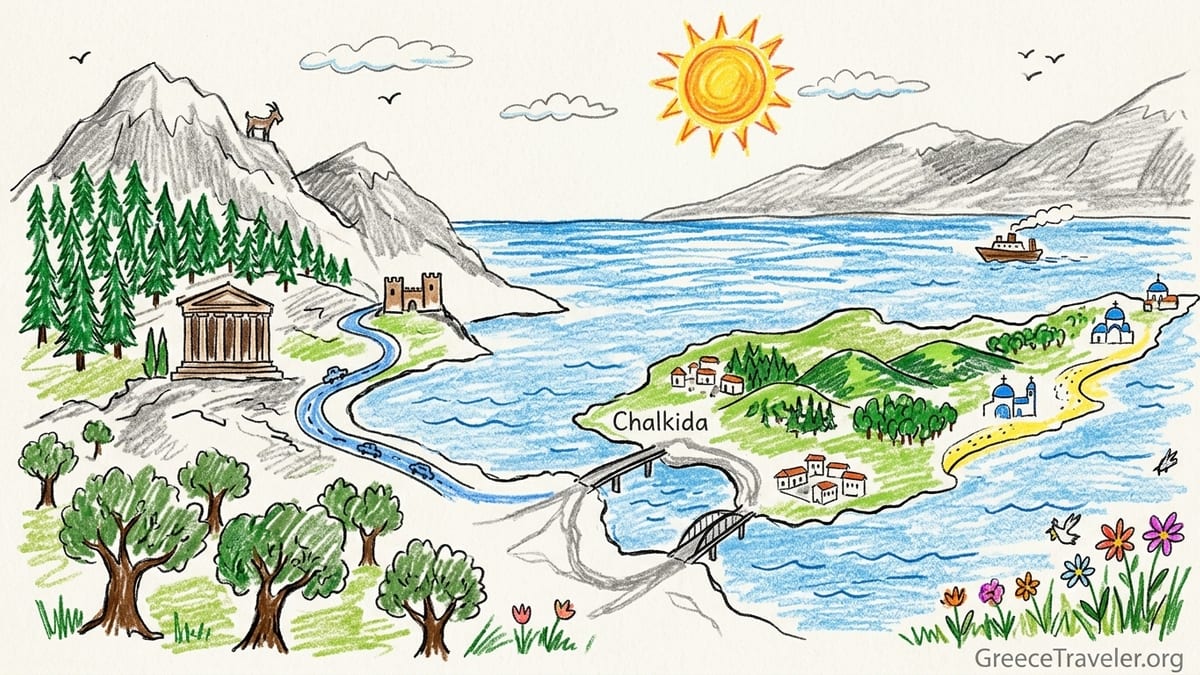
On maps and in Greek administration, Central Greece is usually called Sterea Ellada and covers Boeotia, Phocis, Phthiotis, Evrytania and the island of Evia. That means famous names like Livadia and Thebes in Boeotia, Delphi and Galaxidi in Phocis, Lamia and Thermopylae in Phthiotis, the highland town of Karpenisi in Evrytania, and the bridge-linked island of Evia with Chalkida, Eretria and Kymi on its shores. Some tourism guides and tour operators use a broader “Central Greece” label that stretches as far as Meteora or parts of the Peloponnese. This article keeps to the stricter Sterea Ellada definition so you can picture a coherent region and realistic driving days.
The two itineraries below are designed so that you are not racing around trying to tick off every part of Central Greece on one trip. The seven-day route focuses on the mainland spine of Sterea Ellada, from the monasteries of Hosios Loukas through Arachova, Delphi and Galaxidi to the battlefields of Thermopylae and the green valleys of Evrytania. The ten-day route shifts emphasis to Evia, using Chalkida and Eretria as easy coastal gateways, then crossing to the more remote east and north coasts, with the island of Skyros suggested only where current ferry timetables and extra nights make it practical.
Distances in this part of Greece are modest, but travel times depend heavily on whether you use the modern toll highways or slower mountain and coastal roads. The Athens to Lamia motorway is fast and predictable, whereas the routes into Evrytania or across Evia are slower, twistier and often affected by weather or roadworks. Throughout this guide, drive times assume normal conditions in spring to early autumn and an unhurried pace with occasional photo stops.
All prices mentioned are recent examples available in late 2026 from Greek hotel sites, booking engines and transport providers. They are intended as realistic guidance for planning, not guaranteed quotes. Shoulder-season rates in May, June, September and October tend to be significantly lower than peak July and August, and some mountain and beach accommodation closes or reduces capacity in winter.
Planning Your Road Trip: Car Rental, Buses and Ferries
For both itineraries, the simplest start is to collect a rental car at Athens International Airport. Comparison sites and local agencies indicate that a compact manual car collected at the airport typically runs around 25 to 40 euros per day in spring and autumn if booked in advance, with economy models sometimes lower on special offers and automatic cars usually 20 to 30 percent more. Taxes and airport surcharges are normally included in the headline daily rate, while extras such as an additional driver or child seats add roughly 4 to 8 euros per day each, depending on provider. Fuel and tolls are always on top of that and should be factored into your daily budget.
Public transport can cover parts of these routes, especially for travelers who prefer not to drive into or out of Athens. KTEL intercity buses run from Athens to Livadia, Arachova, Delphi, Lamia, Chalkida and several towns on Evia. For example, buses from Athens to Delphi via Arachova operate several times a day and take about three hours including a change, while Athens to Chalkida can be as quick as 1 hour 15 minutes on direct services. However, once you move deeper into Evrytania’s smaller villages or the less-populated stretches of northern Evia, buses become sparse and inconvenient, often running only a few times per day and not connecting smoothly with each other.
Ferries are relevant mainly for the Evia-focused itinerary. Evia is linked to the mainland by bridges at Chalkida, so you do not need a ferry just to reach the island. To continue to Skyros or connect different parts of Evia, you enter the coastal ferry network. The most common crossing to Skyros is from Kymi on Evia’s east coast, usually with one or two departures per day in high season and fewer in low season. Car and passenger fares vary by season but are a significant addition to your budget; recent schedules show typical one-way prices for a car and two adults totaling around 70 to 90 euros. Weather and occasional technical issues can disrupt services, which is why this guide treats Skyros as an optional add-on rather than a fixed element.
If you choose to start without a car in Athens city, one practical pattern is to take the airport train or express bus into central Athens, spend two or three days visiting the Acropolis and museums on foot, then travel back out to the airport on the suburban rail or bus to collect your rental car just before you begin the road trip. This avoids driving in the dense central traffic and means you only pay for the days you truly need the vehicle.
Seven-Day Mainland Central Greece Loop from Athens
The seven-day itinerary is designed as a compact loop that gives you Delphi and its mountain setting, a taste of the Gulf of Corinth at Itea and Galaxidi, and a memorable finale in the fir-covered slopes of Evrytania. Daily mileages are moderate so you can sightsee without feeling rushed, yet you cover a varied cross-section of Boeotia, Phocis, Phthiotis and Evrytania.
On average, expect total driving over the week of around 750 to 900 kilometers, with a mix of the Athens to Lamia highway and slower regional roads to mountain villages. Tolls on the main motorway sections between Athens and Lamia can add up to around 20 to 30 euros for the full round trip depending on exact exits. Fuel costs for a compact petrol car over this distance will generally fall somewhere in the 120 to 170 euro range at current prices, depending on your driving style and whether your car is especially efficient or not.
For accommodation, the examples below use current midrange hotel prices in Arachova, Delphi, Galaxidi, Lamia and Karpenisi to give a realistic picture. In late spring and early autumn, double rooms in three or small four star hotels in these towns commonly sit in the 70 to 140 euro per night range, rising toward 180 euros or more for popular weekends or Christmas in the mountains. Village guesthouses can be a little lower but may not include breakfast or may only accept cash.
The itinerary assumes Day 1 is a morning or early afternoon departure from Athens Airport or central Athens, and Day 7 is a relaxed return, finishing at the airport if you have an evening flight or in Athens if you are continuing your trip.
Mainland Itinerary Day by Day: Delphi, Galaxidi, Thermopylae and Evrytania
Day 1: Athens to Livadia, Hosios Loukas and Arachova. From Athens Airport, drive northwest toward Livadia, using the modern highway for most of the journey. The distance is roughly 150 kilometers and takes about 2 hours without long stops. Break for a coffee in Livadia’s town center, where riverside cafes overlook the Herkyna stream, then continue another 35 minutes on smaller rural roads to the UNESCO listed monastery of Hosios Loukas, with its mosaics and views over the olive plain. From there, it is around 45 minutes to Arachova, a lively mountain town perched on the slopes of Mount Parnassus. In shoulder season, double rooms in good midrange hotels in Arachova often run between 90 and 140 euros per night, with higher rates around the nearby ski season. Stay one night and dine at a local taverna on hilopites pasta or slow-cooked lamb.
Day 2: Arachova and Delphi, overnight in Delphi. It is a short 15 kilometer drive, about 25 minutes, from Arachova to Delphi village along a scenic winding road. Park early and spend at least half a day exploring the archaeological site and the museum, where you will see the Charioteer of Delphi and the ruins of the Temple of Apollo. After sightseeing, check into a hotel in Delphi village. Recent surveys of local accommodation show midrange doubles in the 70 to 120 euro range most of the year, with a bump to around 130 to 170 euros in peak summer. You can find rooms with balconies facing the deep olive-filled valley down to the Gulf of Corinth, which is one of the classic views of Central Greece. Enjoy sunset drinks in the village and a simple dinner of souvlaki or grilled fish.
Day 3: Delphi to Itea and Galaxidi. From Delphi, the road winds down through terraces of olive trees to Itea on the waterfront, about 20 kilometers and 35 minutes of driving. Itea is a straightforward modern port town, worth a coffee stop and a walk along the seafront promenade. Continue west along the coast to Galaxidi, another 16 kilometers and roughly 20 minutes of easy coastal driving. Galaxidi has a more preserved harbor atmosphere, with neoclassical houses and small hotels facing the water. Current prices for a midrange sea-view room here commonly fall between 90 and 150 euros per night in shoulder season, with smaller guesthouses sometimes a little less. Spend the afternoon swimming off the nearby small beaches or visiting the local maritime museum, then have dinner at a fish taverna on the quay.
Day 4: Galaxidi to Lamia via coastal and inland roads, visiting Thermopylae. Leave Galaxidi and follow the coast east as far as Itea or further to coastal towns before cutting inland toward Lamia. The full distance to Lamia is around 170 to 190 kilometers depending on the exact route and typically takes 3 to 3.5 hours, much of it on regional roads before you reach the main north south highway. Stop at the Thermopylae site just before Lamia, where a small visitor area and monument mark the battle between the Spartans and Persians and hot springs still bubble nearby. In Lamia, you will find mainly functional city hotels; recent checks show three star double rooms around 60 to 90 euros per night for most of the year. Lamia’s center also offers plenty of low to mid priced tavernas where two people can eat a full meal for about 25 to 40 euros excluding drinks.
Day 5: Lamia to Karpenisi. Today the drive into Evrytania is both the highlight and one of the slower legs. From Lamia to Karpenisi is roughly 75 kilometers but takes close to 1.5 to 2 hours because of the winding mountain road, with several bends, river crossings and climbs. The reward is a landscape thick with fir forests and deep valleys. Karpenisi itself sits around 960 meters above sea level, with views of Mount Velouchi. Mountain weather here is cooler than the plains; even in July evenings can feel fresh, and from late autumn to early spring you should expect frequent rain and possible snow. Recent Greek travel guides report average rates for quality family friendly hotels in Karpenisi between 120 and 190 euros per night in season, while simpler central hotels often list double rooms around 80 to 120 euros. Spend the afternoon exploring the town, tasting local cold meats and cheeses and planning which nearby villages to visit next day.
Day 6: Exploring Evrytania villages from Karpenisi. Use Karpenisi as a base and choose one or two villages rather than chasing too many. Megalo Chorio and Mikro Chorio are popular, both about 15 to 25 kilometers from Karpenisi along narrow but paved roads that usually take 30 to 45 minutes each way. In Megalo Chorio you can wander stone streets and enjoy a slow lunch at a taverna overlooking the gorge, while Mikro Chorio offers forest walks and a calmer feel. For more active travelers, rafting or canyoning in the nearby rivers are offered in season by local outfitters, with half day trips typically starting around 50 to 70 euros per person depending on group size and water levels. Return to your Karpenisi hotel for a second night.
Day 7: Karpenisi to Athens via Lamia. Drive back from Karpenisi to Lamia, again allowing about 1.5 hours, then join the main highway south to Athens. Lamia to Athens Airport by motorway is about 215 kilometers and usually takes just over 2 hours in normal traffic. The full day’s driving time is around 3.5 to 4 hours depending on stops, so with a morning departure from Karpenisi you can comfortably catch an evening flight from Athens Airport. Factor in a final 20 to 30 euros in motorway tolls and fuel to close the loop.
Ten-Day Evia-Focused Loop: Chalkida, Eretria, Kymi and Northern Beaches
The longer ten-day route shifts emphasis to Evia, Greece’s second largest island, which feels like a bridge between mainland and island Greece. Because Evia is connected to the mainland at Chalkida, it is easy to reach but still under the radar compared with famous destinations like Mykonos or Santorini. This itinerary uses Chalkida and Eretria as your entry points, then sends you across to the greener, more rugged east coast and up to the long beaches and pine forests of northern Evia.
Total driving distance over ten days normally ranges from 650 to 900 kilometers depending on optional detours and whether you add Skyros. Driving on Evia combines straight segments close to the coast with mountain crossings where speeds are low, so it is more a journey of times than pure distances. A 60 kilometer stretch can take 1.5 hours in the hills, especially where winter damage or summer repairs have narrowed the road. This is also part of Greece where summer wildfires have periodically affected forests and road accessibility, so it is sensible to check local news or ask your hotel for updates if traveling in late July, August or early September.
Accommodation prices on Evia tend to be a little lower than in the most famous islands, especially outside peak August. Recent searches show modern seafront hotels in Chalkida with double rooms around 80 to 140 euros per night in May, June, September and October, with smaller studios and rooms often under 90 euros. On the northern Evia coast around Pefki and Rovies, beach hotels and apartments typically advertise double rooms starting around 70 to 120 euros in shoulder season, rising in August. Services such as tavernas and cafes are widely available in the main towns but become more spaced out along wilder stretches, so plan fuel and meal stops around the larger centers.
This itinerary works particularly well for travelers who want a mix of swimming, short hikes and low key archaeological or historic sights without changing hotels every night. It can also combine with a short stay in Athens at the beginning or end, using Chalkida’s direct road link to the capital to keep transfers simple.
The outline assumes a rental car from Athens Airport for the full ten days, but you could also reach Chalkida by bus or train and collect a car there to avoid driving around Athens. Doing so may slightly reduce your rental and toll costs but can complicate pick up and drop off, so many visitors still find an airport rental easiest.
Evia Itinerary Day by Day: From Chalkida to Northern Beaches and Optional Skyros
Day 1: Athens Airport to Chalkida. From Athens Airport, follow the Attiki Odos and then the main road north toward Chalkida. The distance is around 95 kilometers and normally takes 1 to 1.5 hours on a combination of toll highway and regular road. Chalkida sits on both sides of the narrow Evripos strait, linked by bridges and known for its strong tidal currents. Check into a seafront hotel or modern business style property; room rates in early summer and autumn often fall between 80 and 130 euros per night for a comfortable double. Spend the afternoon strolling the waterfront promenade, exploring the old bridge area and enjoying grilled octopus or meze plates at a local taverna.
Day 2: Chalkida to Eretria. The drive to Eretria along Evia’s west coast is a gentle 30 to 40 kilometer trip that rarely takes more than 45 minutes. Eretria has an archaeological site and small museum that make an enjoyable half day visit, as well as beaches and cafes. Some travelers without a car reach Eretria using the small car ferry from the mainland near Oropos, but if you already have a vehicle it is simpler to continue driving along the island. Hotels and apartments here often advertise shoulder-season doubles from around 70 to 120 euros per night depending on proximity to the sea and facilities such as pools or kitchens. Stay one night and enjoy a sunset swim in the calm waters of the Euboean Gulf.
Day 3: Eretria to Kymi via the island interior. From Eretria, strike eastward across Evia’s hilly center toward Kymi on the island’s eastern side. The route is roughly 85 to 100 kilometers and can take 2 to 2.5 hours, climbing through pine forests and small villages with panoramic views back to the mainland. Kymi itself has both a hilltop town with neoclassical houses and a small port below. It is one of the key gateways to Skyros, but even if you do not continue by ferry, it is worth a night for the atmosphere and seafood. Guesthouses and small hotels commonly offer doubles around 70 to 110 euros, with sea views at the upper end of that bracket outside peak August. Local tavernas by the water serve fresh fish, fried zucchini and the region’s white wines at prices similar to the mainland coast.
Day 4: Optional Skyros side trip or extra day around Kymi. If current ferry schedules between Kymi and Skyros show morning and afternoon sailings that work with your dates, you can consider a one or two night side trip. The crossing usually takes around 1 hour 40 minutes to 2 hours, and car plus passenger fares for a couple can easily reach 70 to 90 euros one way, so the budget impact is significant. Accommodation on Skyros ranges from simple rooms to family run hotels, with prices broadly comparable to Evia. Because ferries can be disrupted by rough seas or technical issues, travelers on tight schedules might treat Skyros as an optional addition only when they can spare an extra night or two. If you skip the island, use Day 4 to explore nearby beaches east of Kymi or small inland villages, returning to the same base at modest extra driving cost.
Day 5: Kymi to central east coast beaches. Continue north along Evia’s east coast to quieter beaches and villages. Depending on your chosen stop, you might drive 60 to 90 kilometers over 1.5 to 2 hours of winding but scenic road. The exact base is flexible; possibilities include smaller settlements with pebble coves or sandy bays backed by pines. Accommodation here is often simple apartments or family hotels, with doubles generally priced from around 60 to 110 euros outside August. Life centers on the beach, a handful of tavernas and maybe a small supermarket, so this is a good place to slow the pace of the trip.
Day 6 and 7: Onward to northern Evia, staying around Pefki, Rovies or nearby. From the central east coast, head north, either hugging the shore where roads exist or cutting across low passes to join the main north coast road. Distances vary, but expect around 80 to 120 kilometers of driving and up to 3 hours including photo stops. Towns such as Pefki and Rovies have long pebbly beaches, pine woods and views across the water to Mount Pelion on the mainland. Recent hotel searches show a wide range of studios and hotels, with doubles in the 70 to 130 euro range in shoulder season. Plan to stay at least two nights here so you can have one full, car-free beach day and another for a short hike into the hills or a day trip to a nearby village.
Day 8: Exploring inland northern Evia villages. Use your base on the north coast to venture a little inland. Distances are short 20 to 40 kilometers to reach many villages but roads are slow, so each round trip can still take an hour or more. Inland villages often feature stone houses, chestnut or plane trees and squares with a small cafe or kafenio. Lunch in these places remains relatively good value, with two people often able to eat hearty local dishes and drinks for 25 to 35 euros. Be aware that some smaller businesses may close midweek outside summer or shut entirely in winter, so ask your hotel for current information before you set out.
Day 9: Northern Evia back to Chalkida. To complete the loop, drive south from the north coast back toward Chalkida. This is a longer day on the road, often around 160 to 190 kilometers and 3.5 to 4 hours of driving, depending on whether you favor inland routes or stay closer to the west coast where possible. Use rest areas and larger towns for coffee and fuel breaks; fuel stations are less frequent in some rural stretches, so refuel before your tank is low. Spend a final night in Chalkida, revisiting your favorite taverna or walking the promenade once more.
Day 10: Chalkida to Athens Airport. The final leg mirrors your first day, with around 95 kilometers and 1 to 1.5 hours of driving back to Athens Airport. If your flight is early morning, consider moving to an airport hotel the previous evening; if it is later in the day, a relaxed breakfast in Chalkida followed by a midmorning departure normally leaves plenty of time for a stress free car drop off.
Road Conditions, Weather, Wildfires and Rainy Day Alternatives
Driving in Central Greece means alternating between high quality toll motorways and narrower provincial roads. The main Athens to Lamia highway is well maintained, with clear signage, service stations and predictable speeds around 100 to 120 kilometers per hour where permitted. By contrast, the climb from Lamia to Karpenisi or the crossings within Evia involve numerous bends, occasional rough patches and sometimes livestock on the road. Average speeds here are often closer to 50 kilometers per hour, and in poor weather they can fall lower. Renting a smaller car can sometimes make mountain parking and hairpin bends easier, although travelers with families and luggage may appreciate the space of a compact SUV.
Mountain weather in places such as Arachova, Delphi’s surrounding slopes and especially Karpenisi can be very different from the plains or coast. In winter and early spring, snow is common around Karpenisi and the nearby ski center, and roads may require extra caution or occasionally close. From late spring to early autumn, temperatures in the mountains are generally cooler than in Athens, with daytime highs pleasant for hiking and evenings that can be chilly enough to require a jacket, even in July. Rain is more frequent than on many islands; packing light but waterproof layers and decent footwear is recommended.
Wildfire risk has become a significant factor across many parts of Greece in recent years, including forested areas of Evia and some mainland hills. Fires are most likely in high summer after long dry spells, particularly on windy days. Travelers should pay attention to local fire danger ratings, avoid off road driving into dry grass or forest tracks, and never light barbecues or campfires except in permitted, supervised areas. If smoke is visible near your planned route, local authorities may close roads or order evacuations; in that case, contact your accommodation or police and follow instructions rather than trying to drive around closures on back roads.
Rainy day alternatives are easy to build into both itineraries. The Delphi Archaeological Museum can absorb several hours even in poor weather, as can smaller museums in Lamia or Chalkida. In Galaxidi, cafes along the waterfront offer sheltered harbor views that can be atmospheric in rain. In Karpenisi, cafes and patisseries are a social hub in bad weather, and some hotels have small spas or indoor pools that justify an unplanned rest day. On Evia, a rainy day in Chalkida or Eretria can be spent in cafes, bakeries or local shops, and some travelers use such days for leisurely drives between towns rather than planned hikes or beach time.
Budgets for Couples and Families, and Choosing Your Route Style
For a couple on the seven-day mainland loop, a realistic midrange budget excluding flights might look like this. Car rental for a compact manual car at 30 to 40 euros per day for seven days comes to around 210 to 280 euros. Fuel for roughly 800 kilometers at current prices will usually add about 120 to 170 euros, and motorway tolls between Athens and Lamia plus a few smaller sections may total roughly 30 to 40 euros. Hotel costs assuming 90 to 130 euros per night across Arachova, Delphi, Galaxidi, Lamia and Karpenisi for six nights give a range of about 540 to 780 euros. Daily food and drink for two, including tavern meals, snacks and coffee, commonly falls around 60 to 90 euros per day outside high end restaurants, so around 420 to 630 euros for the week. Add modest sight tickets and activities of 100 to 150 euros, and a total ballpark of 1,400 to 1,850 euros for two people is realistic for a comfortable but not extravagant week.
A family of four following the same route with one car and a family room or two doubles will see different cost patterns. Car rental may rise to around 40 to 60 euros per day for a larger vehicle, or 280 to 420 euros in total, with slightly higher fuel consumption. Family friendly hotels in Karpenisi, for example, show average per night costs in the 120 to 190 euro range for family rooms, while Arachova and Delphi also have quad rooms or connecting doubles. Assuming an average of 130 to 180 euros per night for accommodations that can sleep four, six nights might cost 780 to 1,080 euros. Food for four in tavernas often remains good value, since shared plates and children’s appetites help; a daily food budget of around 90 to 140 euros gives a weekly range of roughly 630 to 980 euros. Including tickets and occasional activities such as rafting or site entries, a total in the region of 1,900 to 2,700 euros for a family of four is a useful planning guide.
On the Evia-focused ten-day itinerary, extra days naturally raise overall costs, but some nights in simpler beach apartments instead of hotels can offset that. A couple renting a car for ten days at an average of 30 to 40 euros per day would spend about 300 to 400 euros on rental, with fuel perhaps in the 140 to 190 euro range for the shorter but more twisting distances. Without adding Skyros, tolls are modest, mostly around Athens and toward Chalkida, often totaling under 30 euros. Accommodation at 80 to 120 euros per night for nine or ten nights suggests 720 to 1,200 euros, while a food budget similar to the mainland, around 60 to 90 euros per day, leads to 600 to 900 euros in meals and drinks. That places a midrange couple’s total roughly between 1,800 and 2,700 euros for ten days, with a Skyros side trip and ferries likely pushing it higher.
When choosing between the two itineraries, think first about whether you prefer culture-heavy days or long swims and coastal drives. The mainland loop packs more major archaeological and historical sites into a shorter trip, particularly Delphi and Thermopylae, and showcases mountain landscapes in Evrytania. It is a good fit if you enjoy changing scenery quickly and do not mind several days with 3 or more hours of driving. The Evia itinerary favors a slower pace, repeated swim spots and the experience of driving on an island without the more intense crowds of Greece’s headline islands. It suits travelers who like to settle into a beach town for a few nights and perhaps take a single optional ferry to Skyros rather than numerous long drives.
In practice, culture lovers might lean toward the seven-day mainland loop, mountain enthusiasts may enjoy adding extra time around Karpenisi and the Parnassus region, while beach focused visitors with children often gravitate to the ten-day Evia route. Both can be adapted by adding or removing nights; for instance, an avid hiker could cut Galaxidi to one night and add a second night in Evrytania, while a sun seeker might trim the inland days and expand their stay on northern Evia’s beaches.
FAQ
Q1. Is it better to start these road trips directly from Athens Airport or from the city center?
For most travelers it is easier and often cheaper to collect the rental car at Athens Airport, especially if you are driving immediately toward Central Greece. If you plan to spend a few days in central Athens first, many people arrive by plane, take the metro or airport bus into the city, then return to the airport by public transport to pick up the car on the day they start the road trip. This avoids driving and parking in the dense city center while still benefiting from competitive airport rental prices.
Q2. How difficult is the driving in Central Greece for someone used to North American or UK roads?
Main highways such as the route between Athens and Lamia are straightforward and feel similar to European motorways, with clear signage and good surfaces. The challenge comes on mountain and coastal roads, which can be narrow, winding and occasionally have limited guardrails. For drivers used to wider, straighter roads, the key is to reduce speed, allow extra time and avoid night driving on unfamiliar mountain sections. Many visitors find that after a day or two they are comfortable with the local conditions as long as they drive conservatively.
Q3. Can I do the seven-day mainland itinerary by public transport instead of renting a car?
You can link some of the main stops by KTEL buses, such as Athens to Arachova and Delphi, Delphi to Itea and back, and Athens to Lamia, but reaching villages in Evrytania and moving efficiently between places like Galaxidi, Thermopylae and Karpenisi becomes difficult without a car. Buses often run only a few times per day and may not connect smoothly, particularly on weekends. For a version of the trip without driving, consider focusing on Athens, Delphi, Galaxidi and maybe Lamia, then joining an organized excursion into the mountains rather than trying to replicate every leg of the loop.
Q4. When is the best time of year to drive through Evrytania and the mountain areas?
Late April to June and September to early November are especially rewarding times. Roads are fully open, rivers and forests are still green, and temperatures are mild for hiking, with cooler nights. July and August bring more visitors and hotter days but still pleasant mountain evenings, while December to March can be beautiful in snow yet more challenging for driving and may require snow chains around ski areas. Always check local forecasts and road reports in winter before attempting high passes.
Q5. How worried should I be about wildfires on Evia and in Central Greece?
Wildfires are a real risk in dry, hot periods, particularly from late July through early September. Most trips pass without incident, but it is sensible to pay attention to weather warnings and any fire danger notices issued locally. Avoid driving into remote forest tracks in peak heat, never discard cigarette butts or light unregulated fires, and if you see smoke or receive alerts, follow instructions from authorities or your hotel rather than attempting to improvise detours. Travel insurance that covers trip disruption due to natural events is also worth considering.
Q6. Are there plenty of fuel stations and ATMs along these routes?
On the main highways between Athens and Lamia, fuel stations and ATMs are easy to find, often at service areas or near junctions. In the mountains around Karpenisi and in the quieter parts of Evia, services are less frequent. A sensible habit is to refuel when your tank reaches half rather than waiting until it is nearly empty, and to withdraw some cash in larger towns such as Lamia, Chalkida or Karpenisi. While most hotels and many tavernas accept cards, small village businesses may still be cash only.
Q7. What kind of car should I rent for these itineraries?
A compact manual car is sufficient for most couples or small groups and handles both highways and village streets well. Families or travelers with more luggage may prefer a compact SUV or larger hatchback for space and slightly better visibility on mountain roads. Unless you specifically need an automatic, manual cars are usually cheaper. Check that your chosen car includes air conditioning and ensure you are familiar with the controls before leaving the rental lot, as you may face hills and tight turns soon after departing the main roads.
Q8. Do I need to book all hotels in advance, or can I find rooms as I go?
Outside July and August and major Greek holiday weekends, it is often possible to find rooms on arrival in towns like Delphi, Galaxidi or Chalkida, especially midweek. However, advance booking gives a better choice of sea or valley view rooms and family accommodation, and is strongly recommended for small mountain villages and peak seasons. For road trips that include weekends in Arachova or Karpenisi, prebooking can prevent disappointment, as many Athenians escape to the mountains at those times.
Q9. Are these routes suitable for children?
Both itineraries can work well for families, but the Evia loop may feel easier with younger children because it involves more time based in beach towns and fewer long mountain drives. Kids can enjoy swimming, building stone towers on pebble beaches and short walks rather than extended sightseeing days. On the mainland loop, consider limiting the length of archaeological visits and ensuring that each drive includes at least one planned break at a playground, cafe or viewpoint to keep the journey enjoyable for everyone.
Q10. How can I adapt these itineraries if I have fewer or more days?
If you have only five days, focus the mainland route on Athens, Delphi and Galaxidi with perhaps a short incursion toward Lamia and Thermopylae, or limit the Evia route to Chalkida, Eretria and one beach town. With two full weeks, you could combine the seven-day mainland loop and part of the Evia itinerary, adding nights in your favorite spots such as Karpenisi or northern Evia. The key is to avoid trying to cover every suggestion; instead, choose two or three bases that match your interests and expand your time there rather than adding more packing and unpacking.