


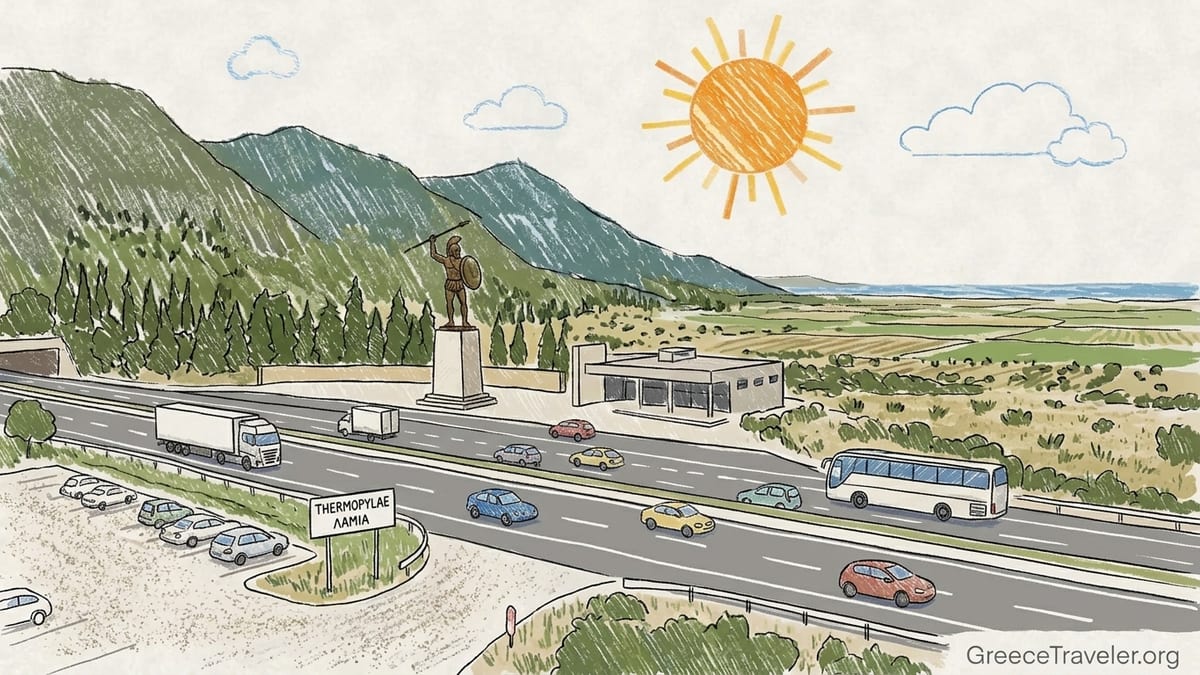
I drove to Thermopylae with Leonidas already in my head. I had read Herodotus, watched the films, traced the narrow “Hot Gates” on maps. In my imagination, this was a steep mountain wall plunging into a wine-dark sea, a bottleneck where a few thousand Greeks held back an empire. Instead, I pulled off the modern A1 motorway into a lay-by that could have been outside any small town in mainland Greece, and my first view of the most famous pass in ancient history was a bronze statue facing a four-lane road and a flat, unremarkable plain stretching toward a distant coastline I could barely see.
The Jolt of Arrival: From Epic Pass to Highway Verge
Approaching Thermopylae today, you do not wind through a dramatic mountain gorge. You follow the A1/E75 motorway from Athens toward Lamia, sharing the road with trucks and long-distance coaches. After roughly two to two and a half hours of driving, depending on traffic, you spot the word “Thermopylae” on a road sign and pull off into what feels like a glorified rest stop. To your left is the busy highway, to your right a parking bay of gravel and cracked asphalt, and beyond that the famous Leonidas Monument gazing across the traffic at a tree-covered low hill. If you are expecting a cinematic reveal of the battlefield, the setting delivers something closer to a service area outside any regional city.
The disconnect hits hard the moment you step out of the car. In the popular imagination, Thermopylae is a claustrophobic choke point where mountains squeeze the shore so tightly that only a narrow track remains. Herodotus described three successive “gates” in the pass, with the sea lapping close to the road. Today, you stand in heat shimmer on a broad agricultural plain. The mountains of Kallidromos rise impressively behind you, but the modern coastline of the Malian Gulf lies roughly five kilometres away, beyond fields and scrub. Centuries of sediment from the Spercheios River and its tributaries have pushed the shoreline steadily seaward, burying the old coastal road and widening the pass into something that looks nothing like the battlefield you came to see.
This is not a small adjustment in perspective. Geological work on the area has shown that in 480 BC the sea reached almost to the foot of the Kallidromos massif and that the pass in places may have been little more than a hundred metres wide. Today, the modern highway, monument and visitor facilities stand on ground that would have been underwater at the time of the battle. That knowledge is fascinating on paper, but as a traveler stepping into the site for the first time, it translates into a simple, deflating insight: you cannot just stand here, look around and see what Leonidas saw.
The Leonidas Monument: Grand Gesture, Uninspiring Context
The main focus for visitors is the Leonidas Monument, erected in the 1950s on the east side of the highway. A larger-than-life bronze Leonidas stands on a high plinth, shield raised, spear in hand, flanked by reliefs and stone walls that carry modern inscriptions and stylised scenes of battle. The phrase “Molon labe” is there in Greek characters, the defiant “Come and take them” tied so closely to Spartan mythology that it now appears on T-shirts and bumper stickers far from Greece. Seen up close, the statue is striking enough, and it easily supports the obligatory photo for anyone who made this detour because of the legend of the 300.
Yet the moment you step back to take in the wider scene, the romance drains away. The monument faces directly onto the highway, and the constant hiss and growl of traffic undercuts the sense of place. Coaches pull in, passengers spill out for ten minutes of photos, and then engines start again and the noise resumes. There is no entrance gate or ticket booth here. You simply park for free beside the road and walk a few metres to the statue. In one sense that openness is admirable. The core memorial at Thermopylae is freely accessible, twenty-four hours a day, which is rare for a battlefield with this level of name recognition. In another sense, the lack of arrival sequence or boundary makes the space feel like an accidental clearing next to a transport artery rather than one of the most evocative ground zeroes in ancient warfare.
Information at the monument is limited. There are some panels that outline the basic timeline of the Greco-Persian Wars and the events of 480 BC, often in both Greek and English, but they tend to condense the story down to the already familiar: Leonidas, the 300 Spartans, the heroic stand. If you already know that the Greek force here numbered several thousand when the battle began and that other cities besides Sparta chose to stay and die when most were dismissed, you will not find that complexity strongly reflected in the outdoor signage. The monument honours courage, which is fitting, but it reinforces the simplified version of the tale that films have already burned into global popular culture.
Kolonos Hill and the Vanished Pass
Directly across the highway from the Leonidas Monument rises Kolonos Hill, a low, scrub-covered mound that Herodotus identifies as the place where the remaining Greek defenders made their last stand. Today the hill is accessed by a small parking pull-out and a short path, with modern stone steps cut into the slope. At the top, a simple stone bears the famous epitaph by the poet Simonides: an address to “strangers” who should go and tell the Spartans that the dead lie here obeying their laws. It is a moving text, but standing on the crest of Kolonos, you must work hard to connect the words to the physical surroundings.
The problem is not the hill itself. Its location and shape still match the ancient description closely enough that scholars accept it as the best candidate for the last stand. The problem is the altered landscape around it. Geological coring and historical mapping show that the ancient shoreline ran not far from the base of Kolonos, turning the area between hill and sea into a lethal funnel. Today that corridor is filled with alluvial soils and crossed by modern asphalt. From the top of the hill you look down at the highway and beyond it to a wide, flat plain. The sea lies off on the horizon, a low glint that, on a hazy day, you might not see at all. For anyone who has studied maps that reconstruct the ancient topography, this knowledge is compelling. For travelers who arrived expecting to stand in a rocky bottleneck between mountain and surf, it is quietly crushing.
The route between the monument and Kolonos Hill also undercuts the experience. There is no pedestrian walkway. To go from one to the other you either drive a short distance and pull into the small parking area near the hill, or you pick your moment and cross the road, which local visitor guides explicitly warn against because of traffic. This practical detail might seem trivial, but in combination with the lack of spatial coherence in the wider landscape, it further fragments the visit into disconnected snapshots: statue, hill, stone inscription, then back into the car. It never really feels like you are walking on a battlefield; it feels like you are hopping between small pockets of memory clinging to the edges of a modern transport corridor.
Beyond the 300: The Story Thermopylae Rarely Tells On Site
If your understanding of Thermopylae has been shaped by movies, you might reasonably expect the site itself to correct some of the simplifications. In particular, you might hope to learn more about the non-Spartan Greeks who fought and died here. Historical sources make clear that Leonidas did not stand alone with only 300 Spartan hoplites. The initial Greek force included contingents from several city-states, perhaps seven thousand men in total at the outset. Crucially, when Leonidas dismissed the majority once the Persian outflanking manoeuvre became clear, he was not only accompanied in the last stand by his personal 300 and the Theban contingent. Around seven hundred Thespians also chose to stay and fight to the end.
The Thespians receive a modern monument of their own at Thermopylae, slightly offset from the main Leonidas statue. It features a figure of Eros and commemorative inscriptions acknowledging their sacrifice. However, in both scale and prominence it inevitably reads as secondary compared to the towering bronze Spartan king. Many casual visitors never even walk over to it, especially if they have arrived on a tight coach schedule and are shepherded directly from parking lot to primary monument, then back to the road. The on-site narrative, in other words, subtly reinforces the marginalisation that popular culture already imposes on the non-Spartan participants.
There is also little in the outdoor area that helps visitors grasp the strategic significance of the pass within the broader Greco-Persian Wars. Thermopylae did not stop Xerxes from advancing into central Greece, but it did buy time and had enormous propaganda value for the Hellenic alliance. Together with naval actions and the eventual victory at Salamis, it forms part of a complex, interlinked campaign. Most of that nuance is largely absent outside, reduced to a few sparse panels. There is a small information centre and museum near the main site, with audiovisual material that offers better context, but it is not always open for extended hours and some visitors, especially those just pulling off the motorway for a brief stop, never make it inside at all. As a result, the simplified narrative many people carry in their heads before they visit is often left largely unchallenged when they leave.
Facilities, Signage and the Reality of a Roadside Site
Practically, the main Thermopylae memorial area is easy to access but limited in amenities. There is free open-air parking right beside the Leonidas Monument, suitable for cars and for the tour coaches that now include Thermopylae as a brief stop on routes between Athens and destinations such as Delphi, Meteora and the northern mainland. There are usually no staff present outdoors, no ticketing booths and no fences. You simply pull in, park and walk up a short incline to the monument. This means there is no admission charge to criticise, but it also means there is little sense of curated arrival or managed visitor flow. On busy days, the area can feel chaotic, with people backing vehicles and children darting toward the statue in gaps between coaches.
Signage is adequate if your aim is to confirm that you have in fact reached the right place and to read a brief summary of the battle. It is underwhelming if you hoped for detailed diagrams, reconstructed maps of the ancient shoreline or interpretive panels that show clearly how sediment from the Spercheios and its tributaries transformed the geography. There are some maps and illustrations, but they are not especially prominent and can look weathered under the intense central Greek sun. For such a significant case study in how landscapes change and how that affects our reading of history, the on-site explanation feels like a missed opportunity. If you want genuine depth, you are better served by reading solid historical and geological work before you arrive, or by hiring a specialist battlefield guide who can verbally fill in the gaps the signs leave open.
Food, toilets and shade are also worth mentioning bluntly. There may be a small café or kiosk open near the information centre, but its hours can vary with season and visitor flow. Many independent travelers end up relying on roadside tavernas a short drive away or on the service stations along the motorway for coffee and lunch. In summer, the memorial terrace around the Leonidas statue can be brutally hot and exposed in the middle of the day, with little shelter from the sun. If you are stopping on a long drive between Athens and northern Greece, that may not matter much because you will not stay long. If you planned to linger and soak in the atmosphere, the combination of heat, lack of shade and roaring traffic can cut your visit shorter than you intended.
Thermopylae as Day Trip from Athens vs Stop En Route
The practical question many travelers face is not simply whether Thermopylae is interesting, but whether it is worth devoting an entire excursion from Athens. Driving from the capital to the site takes roughly two to two and a half hours each way in ordinary conditions. A dedicated Thermopylae day trip from Athens therefore involves around four to five hours on the road for a site that, in raw visiting time, can be thoroughly covered in something like sixty to ninety minutes, even if you climb Kolonos Hill and spend time in the small museum when it is open.
That imbalance between travel time and on-site depth is why many Greek-focused travel planners quietly recommend Thermopylae as a stop rather than a standalone goal. Coach itineraries that travel from Athens to Volos or Thessaloniki, for instance, often include a brief pause at the Leonidas Monument so passengers can stretch their legs and take photos. Private driver services that link Athens with destinations like Meteora or northern ski areas sometimes build in a half-hour break at Thermopylae as a value-add, and several organised tours from Athens that focus on Delphi or Meteora include Thermopylae as a quick roadside tribute to the 300 rather than a central focus of the day.
Used that way, the site works reasonably well. As a twenty or thirty minute leg-stretcher on your way to somewhere richer in visible remains, such as Delphi or the Meteora monasteries, Thermopylae offers a tangible pause at a place you have likely heard about your entire life. You can photograph the statue, walk up Kolonos Hill, read the epitaph inscription and move on. The archaeological poverty and altered landscape become less of a shock when you did not invest a precious Athens day and a long round-trip drive solely for Thermopylae. Seen in comparison with the on-site drama of places like Delphi’s cliff-hugging sanctuary or the rock pillars of Meteora, however, the gap between story and scenery becomes even more obvious.
Managing Expectations: Who Will Appreciate Thermopylae?
Given all this, it is important to be explicit about who is likely to find Thermopylae rewarding, and under what conditions. If your interest in the site is mainly emotional, fuelled by film and myth and a desire to stand where Leonidas “really” stood, you are at high risk of disappointment. There is no preserved Spartan camp, no reconstructed Persian formation, no narrow beach road where you can literally feel the channeling effect of mountain and sea. What you get is a powerful story pinned to a landscape that no longer looks like the place the story describes, marked by a handful of twentieth-century monuments beside a busy modern road.
On the other hand, certain kinds of visitors will still draw real value from coming here, especially if they arrive with adjusted expectations. Serious students of ancient history or military history who have already read detailed accounts of the campaign often find it intriguing to match those narratives to real-world terrain, even in changed form. For them, knowing that the modern highway roughly follows the ancient shoreline and that the ancient battlefield lies effectively across the road from the Leonidas Monument adds an extra layer of meaning to an otherwise unremarkable stretch of asphalt and farmland. The visible disconnect between what you see and what you know can actually sharpen critical thinking about how sites are packaged and remembered.
If you fall somewhere between those two poles, think of Thermopylae less as a destination and more as an interpretive exercise. Arrive understanding that the Spercheios River has transformed this coast over twenty-five centuries, pushing the sea several kilometres away from the pass and burying the original road under metres of sediment. Accept that you will have to imagine the cliffs closer, the sea higher and the gap narrower. With that mental work in mind, a brief visit can still be quietly moving. Without it, the site can feel like a roadside afterthought that has somehow acquired world fame.
The Takeaway
So, is Thermopylae worth visiting? In my experience, yes, but only under specific conditions and not for the reasons that glossy tour brochures and stylised movies might lead you to expect. Thermopylae today is not a dramatic gorge battlefield frozen in time. It is an open, altered landscape beside a major highway, anchored by a few striking but modern monuments and a small museum. The ancient narrow pass no longer exists in visible form because sediment from the Spercheios system has turned a tight coastal defile into a broad inland plain. You cannot stand at the Leonidas statue and see the same geography the Spartans and their allies saw, and no amount of wishful thinking will change that.
If you are a dedicated history enthusiast driving between Athens and central or northern Greece, it is absolutely worth pulling off for an hour or two. In that context, Thermopylae becomes a meaningful pause in a wider journey: you stretch your legs, take in the monuments, climb Kolonos Hill, reflect briefly on the Thespians and other Greek contingents who died here alongside the Spartans, and perhaps watch the short film in the information centre if it is open. Allow around sixty to ninety minutes on site, more if you have a guide with you or if you want to spend time in the nearby thermal springs or explore secondary memorials across the wider area.
If you are based in Athens and considering a dedicated day trip solely to see Thermopylae, I would be cautious. For most travelers, the return drive of four to five hours is hard to justify for such a visually modest site, especially when the same time and effort could be spent at Delphi, Mycenae, Sounion or Marathon, where the physical remains and sense of place are stronger. Thermopylae makes far more sense as a stop folded into an itinerary that already takes you north or west, or as one element in a combined excursion that also includes richer destinations such as Delphi or Meteora.
The key is to align your expectations with the reality on the ground. Thermopylae is not the battlefield you have seen on screen. It is a lesson in how landscapes shift, how stories simplify complex events into accessible myths, and how modern nations choose to memorialise those myths with statues and stone. If you arrive ready for that, you may find the site intellectually satisfying, even if its aesthetics fall flat. If you arrive looking for a perfectly preserved stage for the last stand of the 300, Thermopylae will almost certainly not be what you expected.
FAQ
Q1. Is there an entrance fee to visit the Thermopylae battlefield area?
There is no entrance fee for the main outdoor memorial area at Thermopylae. The Leonidas Monument, Kolonos Hill and the surrounding open space are freely accessible at all times, since the site is ungated and functions as a public roadside memorial.
Q2. How much time should I plan to spend at Thermopylae?
If you only want to see the Leonidas Monument and take a few photos, thirty minutes is sufficient. To include a walk up Kolonos Hill, read the inscriptions, and, when open, visit the small information centre and museum, most visitors find that sixty to ninety minutes is enough.
Q3. Can I visit Thermopylae as a day trip from Athens?
It is possible to visit Thermopylae as a day trip from Athens by car or on an organised tour, but the round-trip drive of roughly four to five hours outweighs the relatively short time you will likely spend on site. For that reason, many travelers prefer to stop at Thermopylae en route to other destinations such as Delphi, Meteora or northern Greece.
Q4. Is there public transportation from Athens to Thermopylae?
There is no simple direct public transport option that drops you at the battlefield memorials. You can travel by intercity bus or train to the regional hub of Lamia and then take a taxi to the site, but this is less convenient than driving or joining a tour that includes Thermopylae as one of several stops.
Q5. What facilities are available on site?
The main memorial area has free open-air parking and basic information panels. A small information centre with exhibits and a short film operates nearby, though hours can vary. For food, drinks and more reliable restroom facilities, most visitors rely on motorway service stations or local tavernas a short drive away.
Q6. Does the landscape still look like the narrow pass from ancient times?
No. Sediment from the Spercheios River and its tributaries has pushed the coastline several kilometres seaward over the last twenty-five centuries, creating a broad plain between the mountains and today’s sea. The ancient narrow coastal pass that made Thermopylae so defensible is no longer visually obvious in the modern terrain.
Q7. Is Thermopylae suitable for children and casual travelers, or only for serious history buffs?
Children who know the story from books or films may enjoy seeing the Leonidas statue and climbing Kolonos Hill, but the lack of extensive ruins or interactive displays means the site can feel underwhelming for casual visitors. Those with a strong interest in ancient history or in how landscapes change over time are likely to get the most from a visit.
Q8. How do I safely get between the Leonidas Monument and Kolonos Hill?
The monument and Kolonos Hill are on opposite sides of the highway. The safest option is to drive the short distance and park in the small pull-off near the hill rather than crossing the road on foot, as local guidance highlights the traffic risk for pedestrians.
Q9. Are there guided tours that include Thermopylae?
Yes. Several tour operators offer itineraries from Athens and other cities that include a brief stop at Thermopylae, often combined with visits to Delphi, Meteora, Lamia or other mainland sites. In many cases, Thermopylae functions as a photo and interpretation stop on a longer regional circuit rather than as the sole focus of the day.
Q10. When is the best time of day or year to visit Thermopylae?
Thermopylae can be visited throughout the year. In summer, early morning or late afternoon visits are more comfortable because the memorial terrace and hill are exposed to intense midday sun. In cooler seasons, the site is generally quieter, but facilities such as the information centre or nearby cafés may operate on shorter hours.