


I arrived in Loutra Edipsou with the kind of anticipation that only a place with three thousand years of bathing history can create. The air smelled faintly of salt and sulfur, the late-afternoon light slid across neoclassical spa facades, and thin plumes of steam rose from the rocks where hot mineral water met the sea. This was not a perfectly polished resort village, but a layered, very real thermal town on the northern coast of Evia, and I had come specifically to feel its hot springs on my own skin.
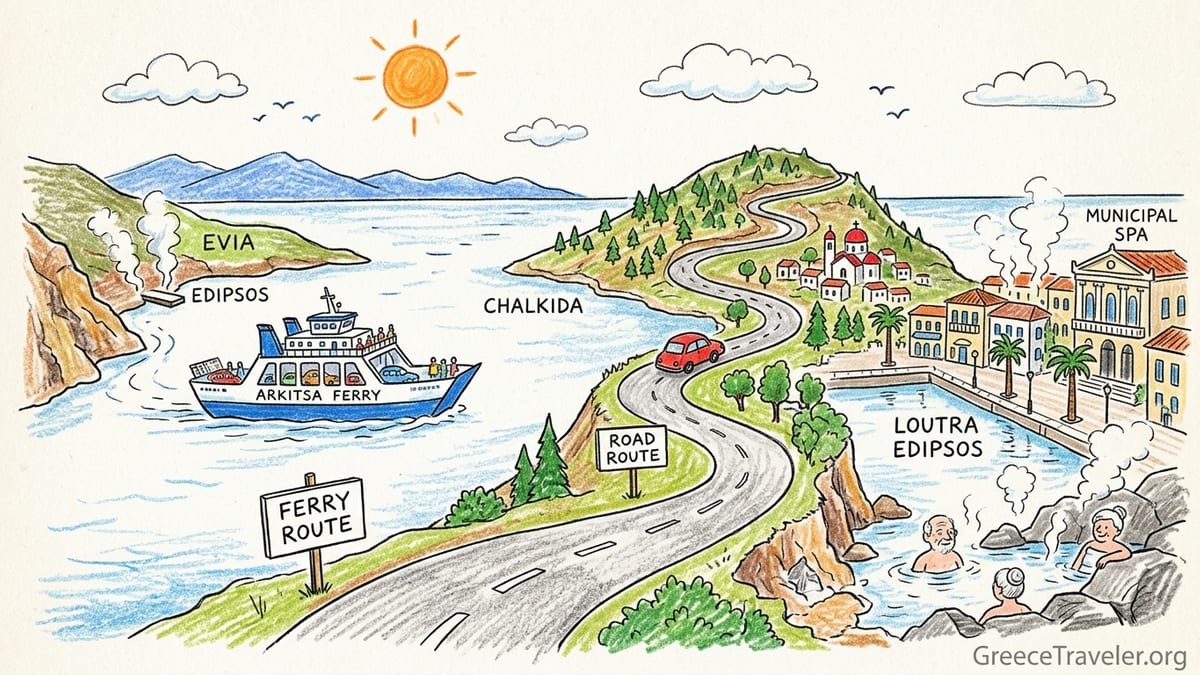
Getting to Loutra Edipsou: Ferry vs Road
Loutra Edipsou sits on the northwest tip of Evia, close to mainland Central Greece, so reaching it from Athens can feel more like a small journey than a quick hop. I decided to experience both classic routes over two different visits: first the Arkitsa ferry across the Malian Gulf, and later the long road drive up the spine of Evia via Chalkida. Each way shaped my expectations before I ever saw the steam on the waterfront.
On my first trip I followed the route many Athenians still favor, driving about 150 kilometers north on the highway toward Lamia and turning off for the tiny port of Arkitsa. From there, the car ferry to Edipsos took about 40 to 45 minutes of smooth sailing, passing low hills and the faint outline of Evia’s coast. Recent published price lists for the Arkitsa–Edipsos ferries show foot-passenger tickets at about 6 euros per person and private cars a little over 20 euros one way, with children’s tickets discounted and small kids travelling free. Services usually run roughly every two hours during the day, with a typical weekday pattern of departures from Arkitsa around 7:00, 9:00, 11:00, 13:00, 15:00, 17:00 and 19:00, though I learned quickly that actual sailings can shift and always need a same-day check at the port or by phone.
On my second visit I chose the road-only option. Leaving Athens, I crossed onto Evia at Chalkida and then followed the main northern road through Prokopi and Istiaia. It is a scenic but slower route, with stretches of curves through forested hills, and without the mental pause that a ferry crossing provides. In good conditions, the drive from Athens to Loutra Edipsou this way took me about three and a half hours without long stops. There were no extra transport charges beyond fuel and tolls on the mainland highway to Chalkida, but I felt the fatigue more on arrival compared with stepping off the ferry almost directly into the spa town.
In pure cost terms, the road route can work out cheaper for solo travelers without a car, using intercity buses that connect Athens with northern Evia, while a family or a couple with a vehicle may find the ferry option reasonable, given the roughly 6-euro passenger fare and a car price around 20 euros. For me, the ferry instantly set the mood for a spa break, and arriving by sea, with the neoclassical facades of Loutra Edipsou unfolding along the waterfront, matched the almost old-fashioned reputation of the place. Whatever route you choose, allow half a day for the journey from Athens so that you still have light left to walk the promenade when you first arrive.
First Impressions: Promenade, Steam and Spa Architecture
Stepping off the ferry, Loutra Edipsou felt compact and surprisingly vertical, climbing up from the coastal road in layers of hotels and low apartment blocks. The main promenade traces the curve of the small bay, with palm trees, benches, and elderly visitors moving slowly between cafés. The air along this strip is not quite like other Greek seaside towns; every few meters, there is a breath of warm, slightly metallic moisture that hints at what runs underneath the asphalt and stone.
As I walked west along the waterfront toward the most famous hot spots, the architecture shifted from ordinary rooms-to-let to grander, fading spa buildings. Some were stately neoclassical hotels from the early 20th century with wide balconies and ornate cornices, testimony to the era when Loutra Edipsou attracted powerful statesmen and glamorous performers for multi-week cures. The paint on several facades was peeling and some balconies clearly needed restoration, but the bones of a great spa town remained obvious. It was easy to picture the wide verandas full of wicker chairs and people in white robes discussing mineral waters decades ago.
Closer to the edge of town, the first plumes of steam rising from the rocks came into view. Even from a distance I could see the color difference where the hottest water reached the sea: bands of orange and rusty brown where minerals had stained the stone over time. The contrast was striking on a clear day, with chalky limestone cliffs above and the pale blue of the Maliakos Gulf in front. Here, Loutra Edipsou changed from just another low-key resort into something much stranger and more elemental, with water hot enough to scald emerging only meters from swimmers bobbing in the cool Aegean.
I had arrived with relatively romantic expectations, informed by tourism brochures that talk about a three‑thousand‑year spa tradition and dozens of thermal springs in the area. Seeing the reality, with cracked pavement in places, utilitarian apartment blocks and pipes jutting from rock faces, forced me to adjust my picture. Loutra Edipsou is not a meticulously restored historic retreat. Instead it is a working Greek spa town where locals, pensioners and a growing number of younger travelers occupy the same streets and share the same steaming pools, and that mix quickly became part of its charm for me.
Meeting the Sea Springs: Free Coastal Thermal Pools
My first actual contact with the hot mineral water happened, as it should in Loutra Edipsou, right on the coast. Walking past the town beach in the direction of the large historic hotels, I reached a cluster of rocks below the road where pipes and channels guide thermal water directly into shallow basins at the waterline. These informal pools, some sculpted by concrete and some simply carved out by years of flow, are free to use and remain one of Edipsos’ biggest draws for budget travelers and curious bathers.
The water here comes out remarkably hot. Published data about Loutra Edipsou’s springs indicates temperatures at the source that can range roughly from the upper 20s Celsius to the mid 80s. Standing near the outlets, I could feel a wave of heat rising in the air and had to ease myself into the shallow pools rather than sit down quickly. In the closest spots to the outlets the water felt well above 40 degrees Celsius, too hot for a long soak, so regulars showed me how to shuffle closer to the edge where fresh seawater mixed with the thermal flow. Within a minute I had found a spot where the water was roughly body temperature to slightly warmer, comfortable enough to linger while still clearly not ordinary seawater.
Cleanliness in these public coastal pools was better than I had feared but more rustic than any organized spa. The basins are open to waves and tides, and the constant exchange with the sea seemed to keep things from feeling stagnant, but mineral deposits on the rocks can appear dirty or slimy at first glance. There is no staff cleaning the area, no lifeguard, and no official changing cabins. Locals arrive already wearing swimsuits under their clothes and leave towels and bags on the rocks or the narrow concrete ledge by the road. Privacy is limited to the fact that most people are absorbed in their own soaking ritual, alternately dipping into the hot basins and then cooling off in the sea a few meters away.
Crowding varies by season and time of day. On a weekday in late shoulder season, I shared the free pools with perhaps fifteen people scattered over several basins, mostly older Greeks quietly talking and a few younger travelers experimenting with the temperature by shifting rocks to adjust the mix of hot and cold water. I was told that in high summer, especially in the evenings, these little pools can feel uncomfortably full, with people waiting for a corner to free up. Because there is no entrance control, the only way to secure a more peaceful soak is to come very early in the morning or well outside peak season. For me, the lack of infrastructure here was forgivable because the interaction with the sea felt so direct: waves lapped at the edges, and each time I stepped out onto the pebble beach, the cool water of the Gulf suddenly seemed even more refreshing.
The Municipal Hydrotherapy Center: Structure, Crowds and Practicalities
To experience a more controlled version of Edipsos’ waters, I visited the municipal hydrotherapy center in town, which serves as the main public institution for balneotherapy. Unlike the free coastal pools, entry here is ticketed. As of the latest published price list for the current operating period, admission to the outdoor mixed thermal pool is 9 euros per person, with reduced rates of around 6 or 7 euros for residents, people with disabilities and specific discount categories. Only the outdoor pool was operating during the season of my visit, with opening hours that generally ran from morning until mid-afternoon.
Compared to the rocky basins by the shore, the municipal pool felt structured and, in some ways, almost old-world. The building is not freshly renovated, and the architecture speaks more of mid-20th-century functionalism than contemporary spa design, but inside there are tiled changing areas, showers and a staffed reception. The changing facilities were the first reality check: basic, somewhat cramped and evidently heavily used. Lockers were limited and some doors showed their age. Cleanliness was acceptable, but anyone used to gleaming wellness centers elsewhere in Europe might find the space tired.
The water itself emerged as the star. The outdoor mixed pool is filled with naturally hot mineral water at a temperature that felt slightly cooler than the scorching rock pools by the sea but still around the high 30s to low 40s Celsius. I stepped down into cloudy, pale aqua water with that faint sulfur scent again, surrounded by people of all ages. There is no elaborate array of jets or hydromassage stations here, just a simple pool where locals float, lean against the edges and chat for long periods, sometimes wearing sunhats to shield themselves from the midday light.
Crowding at the municipal center seemed to peak mid-morning, when organized groups arrived, sometimes bus passengers on short stays. Privacy is minimal, and the mixed pool means everyone bathes together, so modesty may require adjustment for some visitors. The advantage over the free coastal pools is straightforward: there are showers to rinse off, toilets, changing cabins and staff presence. The disadvantage is that the facility itself shows visible signs of age, with worn tiles and some rust stains, and the atmosphere is more clinical than relaxing. I left with the impression that the municipal center is best for those who value the social side of public bathing and want a reliable, regulated dose of hot mineral water at a relatively low cost.
Stepping Up: A Visit to a Private Spa Hotel
To understand the other end of Loutra Edipsou’s bathing spectrum, I arranged to use the thermal facilities at a classic spa hotel in town as a non-resident guest. Historic properties here, including the best-known five-star hotel set directly on the waterfront, build their reputation on more than a century of hydrotherapy, with pools fed by natural springs and treatment menus that combine traditional baths and modern wellness services.
As an external visitor, I paid a day-use fee that granted me access to the spa premises for a limited number of hours, including use of indoor and outdoor thermal pools and basic facilities like showers and loungers. Recent guest feedback indicates that such day passes typically cover about two hours of pool access, with the indoor pool often filled with 100 percent thermal water and the outdoor one diluted with seawater. My own experience matched that pattern. The indoor pool was compact but pleasantly warm, while the outdoor pool felt gentler and invited longer floating sessions, especially when the evening light hit the surface.
The difference in atmosphere from the municipal center and free pools was immediate. Here, staff handed me a towel on arrival, the changing rooms were freshly painted and uncrowded, and lockers worked smoothly. Surfaces were clean and the design leaned toward modern, with soft lighting and well-kept tiles. Privacy improved significantly; although the pools were shared, the number of people inside at any given time was limited, and quiet rules were more or less observed. Most other bathers were hotel guests in robes, moving unhurriedly between the pools and relaxation areas.
The trade-off, inevitably, is cost. While precise current figures vary by property and package, hydrotherapy sessions, access passes and massages in Loutra Edipsou’s higher-end hotels are priced in line with upscale spa standards elsewhere in Greece. It is reasonable to expect to pay several tens of euros for combined pool access and a basic massage, and more for specialized treatments. Room rates at historic spa hotels typically include access to the main thermal pools for guests, but extras like personalized hydrotherapy sessions or long massages are charged separately. Unlike the free coastal pools, there are also softer restrictions: children may not be allowed in certain areas, and time limits are sometimes enforced to keep circulation manageable.
Water, Minerals and the Wellness Tradition
Beyond the subjective impressions of heat and relaxation, the springs of Loutra Edipsou are part of a long Greek tradition of using mineral waters for wellness. Official and academic descriptions of the area highlight that a significant proportion of Greece’s hot springs are found in the wider Aidipsos municipality, and that water temperatures can reach striking levels compared with ordinary groundwater. Historical references place thermal activity and bathing here back to Roman times, and the modern spa town grew from that foundation during the late 19th and early 20th centuries when organized hydrological studies and bath facilities expanded.
The water emerging at Edipsos is classed as mineral-rich, containing elements such as sulfur compounds and other dissolved minerals that leave thick deposits on rocks and pool edges. This composition explains both the color of the stone near outflows and the familiar smell that hangs gently around springs and spa buildings. Locally, these waters are associated with benefits for general relaxation and a sense of physical ease, especially for those who soak over several days. However, the scientific evidence on specific medical outcomes is more nuanced, and I chose to approach my baths as pleasurable, culturally interesting experiences rather than treatments for particular conditions.
What is undeniable is the way this water has shaped the town’s identity and economy. Hotels and clinics advertise hydrotherapy packages that combine baths, showers, mud applications and sometimes inhalation therapies, all based on the local springs. Public institutions like the municipal hydrotherapy center operate seasonally, and the streets around the main spa buildings are lined with rental rooms, cafés and small shops that serve visitors who return year after year. Talking with long-time guests, I met people who had been coming for one or two weeks every autumn for decades, integrating Edipsos into their personal routines in the same way others might book an annual mountain retreat.
Walking back and forth between the rocky coastal outcrops, the municipal pool and the private spa, I felt how the same underlying geological fact can translate into very different experiences. The free basins by the sea are the raw encounter, the water nearly as it emerges from the earth. The municipal center reflects decades of public health thinking, modest but structured. The private spas represent an attempt to wrap the same springs in comfort, controlled ambiance and individualized service. Together, they form a continuum that makes Loutra Edipsou more versatile than its aging facades might suggest.
Life Between Baths: Cafés, Food and Evening Walks
It would be easy to come to Loutra Edipsou and see nothing but water, but daily life in the town unfolds along the promenade and backstreets in a way that complements the baths. Between sessions, I slipped into a rhythm that revolved around cafés, simple tavernas and sea-facing benches. Mornings on the waterfront were dominated by older men and women taking slow walks or sitting in small groups with Greek coffee, discussing the previous day’s soak. I joined them on a shaded terrace overlooking the bay, where the breeze cooled my still-warm skin after an early dip in the coastal pools.
Food in Loutra Edipsou reflects both its coastal position and low-key clientele. On one evening, I ate grilled sardines at a traditional taverna just off the main street, the fish brought directly from nearby waters, sprinkled with lemon and paired with simple salads and local wine. At lunch another day, I opted for a plate of gigantes beans in tomato sauce and village bread at a café that transformed into a casual restaurant at night. Prices felt moderate by Greek resort standards, with main dishes generally hovering in the lower double digits in euros. There were no glitzy fine-dining venues, but the straightforward cooking suited the town’s unpretentious feel.
After sunset, the promenade took on a gentler atmosphere. Families strolled slowly, children eating ice creams, and bathers who had spent the afternoon in hot water now walked to keep their circulation going in the cooler air. The steam from the coastal springs was more visible against the dark, and the orange-tinged rocks glowed faintly under streetlights. I often ended my evenings with a short walk from the center to the far end of the bay and back, watching ferry lights cross the gulf in the distance and feeling the strange combination of seaside calm and geothermal energy that defines the town.
I did not use Loutra Edipsou as a base for wider excursions on this particular visit. Although there are noted destinations along the same coast, including the villages of Limni and Rovies and the small island cluster of Lichadonisia reachable by seasonal boats from elsewhere in the region, my focus remained on understanding the hot springs themselves and how they shape daily rhythms. That meant letting the town’s compact size work in my favor: everything I needed, from bakeries to pharmacies to simple bars, lay within a comfortable walking radius of my guesthouse.
Comparing Bathing Options: Cost, Comfort and Character
After several days of alternating between different spots, I started to see clear trade-offs among the three main bathing choices in Loutra Edipsou: the free coastal pools, the municipal hydrotherapy center and the private hotel spas. Each has its own balance of cost, comfort, cleanliness and character, and the “right” choice depends largely on the traveler’s priorities and sensitivity to crowds, temperature and ambiance.
The free coastal pools stand out for their immediacy and price. There is no admission fee, no opening hours and no dress code beyond common sense. I could slip in for a quick soak at sunrise, cool off in the sea and leave without touching my wallet. The experience is intensely local and elemental, with rough rock surfaces, minimal privacy and water so hot at source that caution is necessary. For budget-conscious travelers or anyone who values raw encounters with natural phenomena, these basins are hard to beat, but people who need structured hygiene standards or who dislike being in close proximity to strangers on a narrow rock shelf may find them stressful.
The municipal hydrotherapy center occupies the middle ground. With an entrance ticket around 9 euros for the outdoor mixed pool, it provides regulated access to hot mineral water, supervised facilities and basic amenities like showers and changing rooms. The temperature feels comfortable for longer soaks than the hottest coastal pools, and the water is refreshed regularly. On the downside, the building’s aging infrastructure is obvious, and at busy times the pool can feel almost as crowded as the free basins, only in a more echoing, less scenic environment. I appreciated the municipal center for giving structure to the day and offering a place to rinse off thoroughly, but the combination of crowds and dated design meant I rarely lingered as long as some regulars did.
The private spas deliver the smoothest experience, at a clear premium. Paying a day-use fee or staying as a hotel guest brought me into a different world of soft towels, controlled numbers, mostly spotless facilities and aesthetically pleasing pools. The water, in my case, felt slightly cooler than the peak temperatures along the rocks, but still pleasantly warm and unmistakably mineral-rich. There were more rules, from time limits to age restrictions in certain areas, and treatments like massages or special hydrotherapy packages raised the final bill considerably. For travelers seeking a restorative weekend rather than an experimental encounter with hot springs, this environment may be ideal, though those expecting cutting-edge spa architecture might still notice touches of dated style.
If I had to pick the most cost-effective and satisfying combination for a short stay, it would be one or two dips in the free sea-fed pools each day, balanced with a single visit to a private spa for the comfort of proper showers, loungers and a massage. The municipal center, while important to the town, felt squarely utilitarian; I was glad to have tried it, but on a future trip I would likely allocate my budget to either the purely free experience or the full comfort of a hotel spa.
The Takeaway
Loutra Edipsou is not a glossy, reinvented wellness destination, and that fact shapes whether it will appeal to a particular traveler. Arriving by ferry across the Malian Gulf, seeing plumes of steam drifting above stained rocks and walking past slightly faded spa hotels along the waterfront, I felt I was entering a living thermal town that has seen decades of visitors come and go without ever fully rebranding itself. The infrastructure can be uneven, with dated municipal buildings and limited changing space at some facilities, and prices for higher-end spa treatments may surprise those who equate worn facades with low costs. Yet beneath these surface impressions, the experience of bathing in naturally heated mineral water where it flows almost directly into the sea remains distinctive.
For me, Edipsos justified at least one overnight stay rather than a rushed day trip. The baths themselves are more enjoyable when not squeezed between long drives, and the town’s rhythm, with morning soaks, leisurely meals and evening promenade walks, reveals itself only over time. I would recommend two or three nights to anyone truly interested in the springs, allowing space to experiment with free coastal pools, try the municipal center once and schedule a focused session at a private spa.
If I were to return and choose just one bathing option to repeat, I would head straight back to the informal coastal pools where hot water seeps through the rocks and pours into the sea. Their rawness, proximity to the open water and the simple pleasure of alternating between very hot and comfortably cool immersions captured the essence of Loutra Edipsou for me in a way that tiled interiors never quite matched. With a towel, a little patience in finding the right temperature spot and an openness to sharing space with locals, those seaside basins offer exactly what I came to Evia for: the feeling of being held, for a short while, by the earth’s own warmth beside the Aegean.
FAQ
Q1. How do I get from Athens to Loutra Edipsou?
Most visitors either drive or take a bus to the mainland port of Arkitsa and then use the car ferry across to Edipsos, a crossing of about 40 to 45 minutes. Others drive the entire way up Evia via Chalkida, which avoids the ferry but takes roughly three and a half hours in total driving time from Athens.
Q2. How much does the Arkitsa to Edipsos ferry cost?
Recent published price lists indicate that foot-passenger tickets are around 6 euros per person one way, while a standard private car costs a little over 20 euros. Children’s tickets are discounted and very young children usually travel free, but it is wise to confirm exact fares close to your travel date.
Q3. Are the coastal hot springs in Loutra Edipsou free to use?
Yes. The rock pools along the seafront where thermal water flows into the sea are free and open to everyone, with no official opening hours or entrance fee. You simply access them from the promenade and step down to the rocks, keeping in mind that there are no lifeguards or staffed facilities.
Q4. How hot is the water in the natural coastal pools?
The water close to the outlets can feel extremely hot, well above normal bathing temperature, so it is important to test slowly with a hand or foot before sitting. By moving slightly away from the sources, where seawater mixes with the spring flow, you can find comfortable spots closer to body temperature for longer soaks.
Q5. What does it cost to use the municipal hydrotherapy center?
The municipal hydrotherapy center in Loutra Edipsou currently lists admission for the outdoor mixed thermal pool at about 9 euros per person, with reduced prices available for residents and certain discount categories. Facilities include basic changing rooms and showers, but visitors should not expect luxury surroundings.
Q6. Can non-guests use hotel spa facilities in Loutra Edipsou?
Many spa hotels in the town allow non-resident visitors to access their thermal pools and wellness areas through paid day-use passes. These usually cover a limited number of hours in the indoor and outdoor pools and may include a towel, with massages and specialized treatments charged separately.
Q7. Is Loutra Edipsou suitable for a family visit with children?
Families do visit Loutra Edipsou, especially in summer, and children can enjoy the sea and some of the milder thermal areas. However, very hot spots near spring outlets require close supervision, and certain hotel spa zones may have age restrictions, so it is important to check policies and stay cautious around extremely warm water.
Q8. How clean are the free hot springs compared with spa facilities?
The free rock pools are naturally flushed by the sea but lack formal cleaning, showers and toilets, so they feel more rustic. Municipal and hotel spas offer treated environments with regular maintenance, showers and changing rooms, though some public facilities show signs of age and may not match the polish of newer wellness centers elsewhere.
Q9. When is the best time of year to visit Loutra Edipsou for the hot springs?
Shoulder seasons such as late spring and early autumn often offer a good balance of pleasant air temperatures, warm sea and fewer crowds. The hottest months can make the thermal water feel intense, while in cooler months the contrast between air and water temperatures can be invigorating but may limit sea swimming.
Q10. Is Loutra Edipsou worth an overnight stay or just a day trip?
In my experience, Edipsos is best appreciated over at least one or two nights. Staying longer allows time to recover from the journey, try different bathing options without rushing and enjoy the slow rhythm of promenade walks and simple meals between soaks.