

I left Karpenisi just after 9 in the morning with a mix of nervousness and excitement, knowing that Panta Vrechi was not a simple sightseeing stop but a river trek that would demand something from me. What I did not yet understand was how much the drive, the cold water and the raw force of the gorge would test both my nerves and my legs before rewarding me with one of the most unforgettable landscapes I have ever seen.
Leaving Karpenisi With Big Expectations
I based myself in Karpenisi for this trip, at a small guesthouse near the center where the owner greeted me with a tray of homemade spoon sweets and a firm warning: “Panta Vrechi is beautiful, but respect the river.” That morning the sky was clear, the fir-covered slopes around town still glistening slightly from showers the previous evening, and the air cool enough that I needed a light jacket as I walked out to meet my guide.
I had booked a river trekking tour to Panta Vrechi through Trekking Hellas, one of the best-known outdoor operators in the region that runs daily excursions in summer to the gorge. The price at the time of my visit was a little over 50 euros per person for a group outing, including hotel pick-up, a guide, all transfers in 4x4 vehicles and a simple snack. There were six of us in total, plus our guide and driver, which turned out to be a comfortable group size for moving safely along the Krikelopotamos River.
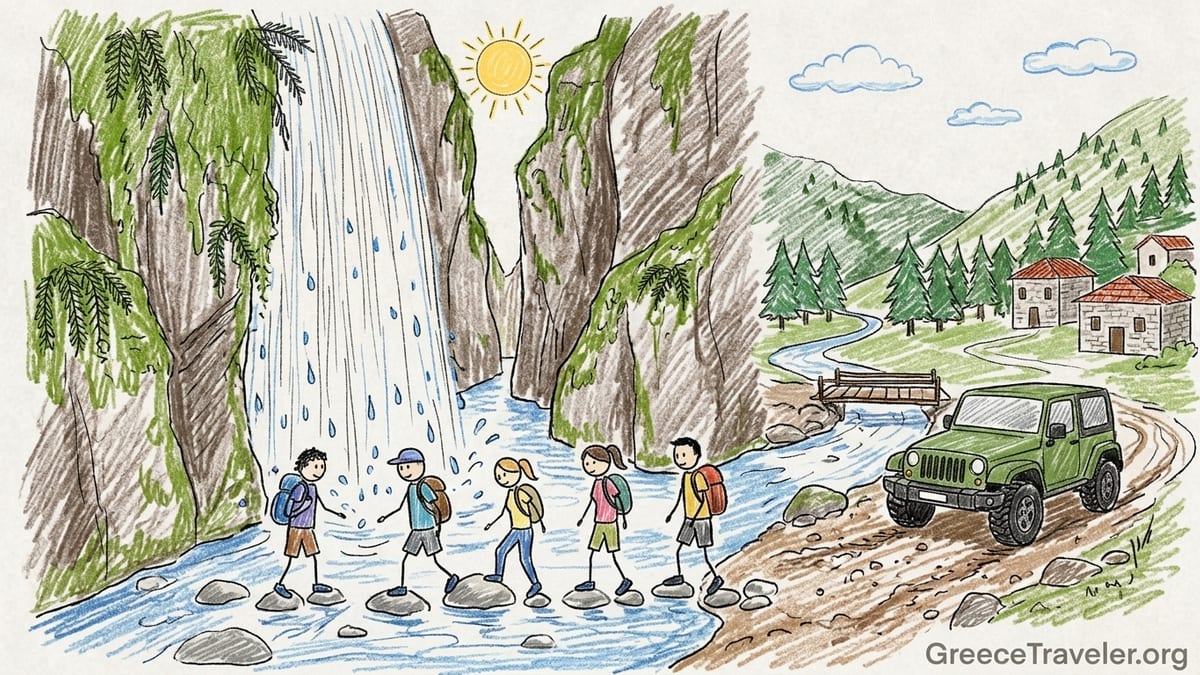
We rolled out of Karpenisi in a sturdy 4x4, the kind of vehicle that already hinted at what awaited us after the main asphalt roads. As we climbed above town the guide talked us through the plan. We would cross the Kaliakouda area by mountain road, descend towards the Krikelopotamos, leave the vehicles near the dirt track by the Stournara Roskas bridge and then start the river trek from there. The walking time, he said, was usually around 40 to 45 minutes each way in the water, depending on conditions and how often we stopped.
My expectations were shaped by photos I had seen of gossamer-thin waterfalls in bright sun and smiling people wading in turquoise pools. What I was less prepared for was how much the approach itself would feel like an adventure, and how different the gorge looks and feels when you are actually inside, with spray in your face and cold water pushing against your legs.
The Rough Road Between Roska and Doliana
From Karpenisi the first part of the drive felt deceptively easy. We followed good asphalt through deep green valleys and villages with stone houses and red-tiled roofs. Somewhere after the turnoff toward the Krikelopotamos valley the character of the road began to change. Patches of rougher tarmac appeared, then longer stretches of gravel, and soon we were on a true dirt mountain road threading between steep slopes.
Between Roska and the wider Doliana area, the road is essentially a mountain track, carved into the hillside above the river. Our guide explained that heavy winter rains and occasional landslides regularly scar the surface. Even in late summer after maintenance, long sections were rutted, scattered with loose rocks and small washouts that the 4x4 had to crawl over in low gear. There were places where one side dropped away steeply toward the gorge and there was no guardrail, only a thin line of shrubs.
Sitting in the back seat, I tried to imagine driving this in a standard rental compact. It did not take long to realize why every local operator insists on a high-clearance vehicle and why many rental contracts specifically exclude damage on such roads. The combination of sharp stones, deep ruts and narrow switchbacks would be punishing on low bumpers and ordinary tires. A simple misjudgment on a wet day could leave you stuck or worse, and mobile phone reception here is patchy enough that help might not come quickly.
By the time we reached the end of the dirt track near the Krikelopotamos, I was deeply grateful not to be responsible for the driving. The 4x4 rocked and slid its way through the last muddy corner before stopping in a dusty clearing among plane trees. Below us, through the leaves, I could hear the muted roar of the river. This was our trailhead: the Stournara Roskas bridge, a simple structure spanning clear, fast-moving water that was about to become our path.
Stepping Into the Krikelopotamos: Cold, Slippery and Alive
From the moment I stepped off the riverbank and into the Krikelopotamos, I understood why Panta Vrechi is described as a river trek rather than a hike. There is no traditional path to follow into the gorge. The riverbed is the trail, and it immediately announces itself as a living, forceful thing that you have to negotiate with every step.
The water was shockingly cold, something close to ice melt, even though the air temperature was comfortably warm. Within seconds I felt it soak through my neoprene socks and press against my ankles like a band of glass. I had chosen closed river shoes with a firm sole, and they gripped reasonably well, but the rocks underneath were worn smooth and often coated in algae. Each step was a careful placement, a slow test before committing my weight. A couple of people in the group who had come in basic trainers struggled more. Their shoes took on water like sponges, and I watched them slip more often on rounded stones.
The current was not violent but it was persistent. In deeper stretches it rose to mid-thigh and leaned hard against my legs, pushing me slightly sideways as I tried to cross. We mostly followed the shallower edges, zigzagging from bank to bank wherever the guide judged the footing to be better. Several times we stopped to help each other across boulders or to brace someone as they moved through a faster channel. It felt more like moving through a living obstacle course than going for a walk.
Progress was naturally slow. Although the general estimate for the route from the bridge to the main waterfall zone is about 30 to 40 minutes, it took our group closer to 50 on the way in. Part of that was deliberate: the guide paused regularly to point out small springs trickling from the rock, hanging ferns and the way the color of the water shifted from deep green to almost milky turquoise where fine sediment swirled in shaded pools. Part of it was simply the reality of differing abilities in the group and the constant need to choose the next step with care.
Inside Panta Vrechi: Walking Through Curtains of Water
The gorge narrowed gradually as we moved upstream, the walls drawing closer, the sunlight thinning into a diffuse glow that bounced off limestone and moss. The sound of the river merged with a new note, a softer but continuous hiss. Around one last bend, the space opened suddenly and Panta Vrechi revealed itself in full.
Here, the cliffs rose high above us on either side, streaked in shades of grey, brown and green. From the left wall, countless thin sheets and threads of water fell from hidden springs and rivulets high above, breaking apart into droplets long before they reached the river. It was not a single waterfall but a whole wall of water, a veil that hung in the air. The name “always raining” made instant sense. It felt as though the sky had descended into the gorge and taken solid form around us.
Walking beneath these water curtains was like stepping into a cool, luminous tunnel. The droplets needled my skin, sharp and refreshing at the same time. In places the flow was heavy enough to drum against my shoulders; in others it was a mist that caught the light and formed tiny, fragmented rainbows. The smell around us was a blend of wet stone, fresh leaves and that almost metallic note you get after a summer storm. Even voices changed; everyone instinctively lowered their tone, as if speaking loudly would disturb some delicate balance.
We spent nearly an hour in the heart of the gorge, longer than I expected. Some people in the group swam briefly in the natural pools that had carved themselves into the rock under the heaviest streams, though the cold limited how long anyone stayed fully immersed. I found myself simply standing still more often than not, turning slowly to watch how the water traced paths down the rock faces, vanishing and reappearing through networks of moss and hanging roots. It was a sensory overload, yet at the same time a strangely meditative space, cut off from the outside world by stone and water.
The Long Walk Back and How It Compares to the “Official” Time
Eventually our guide checked his watch and gave the signal to start heading back. One of the deceptive things about Panta Vrechi is that the return walk feels very different, even though you follow the same riverbed. The novelty has worn off, your legs are more tired, and the slight downstream current that seems helpful at first can make you careless if you are not paying attention.
Going back, we shaved a little time off the approach but not as much as I imagined. We took around 40 minutes from the central waterfall zone to the bridge, which put our total river walking time at roughly an hour and a half, excluding stops. The official descriptions often cite 30 to 40 minutes each way from the Stournara Roskas bridge, and that is certainly manageable for fit, sure-footed walkers in a small, experienced group. In reality, mixed groups with varying levels of confidence, frequent photo stops and a cautious approach to slippery sections can easily push that closer to 45 or even 60 minutes per direction.
By the time I stepped back onto the riverbank I could feel the fatigue in my ankles and hips from constantly balancing on uneven stones. My toes were wrinkled and numb from the cold water. It was only when I sat on a sunlit rock and peeled off my river shoes that I noticed a small bruise where I had misjudged a step against a submerged boulder. None of this felt like hardship though; it felt like the natural price of having been allowed into such a place.
On the drive back, rattling once again along the rough road between Roska and the wider Doliana area, I realized that the published walking times and difficulty ratings tell only part of the story. The real challenge comes from the combination of icy water, slippery rocks, mental concentration and the remoteness of the setting. The distance may be modest, but the experience is intense, especially for those not used to river trekking.
Season, Water Levels and the Realities of Flash-Flood Risk
One of the most important things I learned from both my guide and local information offices in Karpenisi is that the usual mid May to September visiting window for Panta Vrechi is a guideline, not a guarantee. The river and the countless springs that feed the water curtains respond quickly to weather and snowmelt higher up on Mount Kaliakouda. There are summers when a cool, wet early season keeps water levels high well into June, and others when a hot spring reduces the volume quickly.
Even on my late summer visit, when conditions were considered ideal, there were spots where the water reached high on my thighs and the current pressed strongly enough that we crossed only with mutual support. Our guide described days earlier in the season when the same passages are chest-deep and simply not safe for average visitors. Panta Vrechi is not a managed attraction with controlled flow; it is a wild gorge, and it behaves like one.
The other non-negotiable factor is rain. Every operator I spoke to in Karpenisi stressed that trips are cancelled immediately if there has been sustained rainfall in the previous day or two, even in the middle of the official “safe” period. A heavy storm upstream can send a sudden surge of water down the narrow gorge, turning tranquil pools into dangerous torrents. Flash-flood risk may sound abstract until you stand in the confined space between those high walls and imagine the water rising fast with nowhere to go.
For independent travelers this means building flexibility into your plans. You might arrive in Evrytania in what should be prime season and still find the gorge effectively closed by recent weather. It is not a place to visit on a stubborn schedule or to treat as a must-do at all costs. The mid May to September guideline is useful, but the only thing that really matters is the specific river condition on the day you plan to enter. If local guides advise against going, the correct answer is simply not to go.
Independent Exploration Versus Hiring a Guide
Before my trip I had considered skipping a guided tour and attempting Panta Vrechi on my own. Roughly 40 minutes of river walking each way did not sound particularly demanding on paper and renting a car in Karpenisi appeared straightforward. It was only after experiencing both the drive and the river under the supervision of a professional that I fully appreciated the value of going with a guide.
With an operator like Trekking Hellas, or the Karpenisi based agency Alkyoni Travel which runs similar excursions to the gorge, you are collected directly from your accommodation, driven by someone who knows the mountain roads intimately and supplied with necessary gear guidance and safety oversight. The price I paid, just over 50 euros, covered not only transportation and guiding but also the peace of mind that if the guide judged conditions unsafe, the decision to cancel or cut short would be made without emotional attachment to my personal schedule.
Independent travel is certainly possible, and individuals and small groups of experienced hikers do park at the Stournara Roskas bridge and enter the river on their own. The main advantages are flexibility in timing and the freedom to linger wherever you like. The trade-offs are responsibility and risk. You need to be comfortable assessing river depth and current, reading weather patterns, and accepting that your rental contract may not cover any damage sustained on the rough road segments. You also need to bring all of your own equipment, from proper closed-toe water shoes and neoprene layers to dry bags and a basic first-aid kit.
In my case, I was glad I had chosen the guided option. There were several moments when the guide’s local knowledge made an invisible difference: choosing a specific crossing point that looked no different to me than the rest of the river, noticing subtle changes in water color that indicated depth, and keeping track of time so that we exited the gorge before the light dropped too low. For solo travelers, families or anyone new to river trekking, hiring a guide in Karpenisi is not a luxury; it is a very reasonable safety investment.
Guesthouse Nights and Simple Mountain Food
Back in Karpenisi after the trek, the town’s quiet streets and stone houses felt strangely gentle after the wild walls of Panta Vrechi. I stayed in a traditional guesthouse built in local stone and wood, with a shaded terrace that looked toward fir-covered slopes. Rooms in this category in Karpenisi often fall somewhere in the middle price range, offering private bathrooms, good mattresses and homemade breakfasts built around local ingredients such as fresh eggs, village sausages and thick yogurt with Evrytania honey.
The evening after the gorge I walked into the center of town and chose a small taverna on a side street, one of those places with a few tables under grape vines and a menu scrawled partly on a chalkboard. Mountain cuisine here leans toward hearty, simple dishes, exactly what my tired body wanted. I ordered grilled lamb chops, fried potatoes, a village salad with ripe tomatoes and feta, and a plate of wild greens sautéed with lemon. Everything tasted more vivid after a day of exertion and cold water.
Over dinner I chatted with the owner, who was curious why I looked so sunburned yet slightly dazed. When I mentioned Panta Vrechi he nodded knowingly. “People come back from there quieter,” he said, refilling my glass with a local red wine. “The river takes your noise away and gives you something else instead.” It was a poetic way of describing the odd mixture of fatigue and elation I felt, and it captured why Karpenisi makes such a good base. You can return from wild places within an hour’s drive and still sleep in a comfortable bed with a hot shower and proper meal.
I did not manage to squeeze in all the nearby sights on this short trip. Places like the Proussos Monastery, the Black Cave and the traditional villages of Megalo Chorio and Mikro Chorio remained names on a map this time. Rather than rushing, I let Panta Vrechi be the single big adventure of my stay and spent the rest of my time slowing down in town, sipping coffee in the square and watching local life unfold.
What I Got Wrong and How I Would Plan Two Days Around Karpenisi
Looking back, my main preparation mistakes were less about gear and more about underestimating how the combination of cold water and concentration would sap my energy. I had brought decent shoes and a lightweight waterproof bag, but my clothing choices were not ideal. Cotton shorts stayed wet and clammy for hours, and I wished I had worn quick-drying synthetic layers. I also skimped on sun protection, assuming the gorge would be shady. In reality, the approach and some open stretches left my neck and arms more exposed than I expected.
I also underestimated how tired I would feel after returning to the car. In my initial plan I had imagined fitting in a visit to another attraction the same afternoon. Instead, I did little more than shower, eat and sit on the guesthouse balcony watching the light change on the mountains. If you tend to pack your days too tightly, Panta Vrechi is a useful reminder that some experiences deserve to stand alone.
If I were advising a traveler planning a realistic two day adventure around Karpenisi, I would suggest dedicating one full day to the river trekking excursion and one day to a slightly gentler mix of scenic driving and shorter walks. On day one, arrange an organized tour to Panta Vrechi with a reputable operator, accepting that the exact timing may shift depending on weather and group size. Build in nothing more afterward than a slow dinner in town.
On day two, stay mostly on asphalt roads and explore some of Evrytania’s cultural and scenic highlights at a more relaxed pace. Depending on your interests and how far you want to drive, that could mean visiting a historic monastery, strolling through one of the nearby mountain villages and stopping for lunch at a taverna that looks out over the valley. Return to Karpenisi before dark and treat yourself to a final meal of local dishes. In this way, the intense, immersive experience of Panta Vrechi becomes the dramatic centerpiece of a short stay rather than one item in an overstuffed checklist.
The Takeaway
My day at Panta Vrechi was not the longest or the technically hardest trek I have done, but it was one of the most complete adventures I have experienced in Greece. It demanded attention on the drive, care in the water and humility in the face of a landscape that is beautiful precisely because it is not controlled. The gorge’s famous water curtains are more than a photo opportunity; they are a physical sensation of standing inside a living system where stone, spring water and light interact in endlessly shifting patterns.
If you come to Karpenisi expecting an easy walk to a viewpoint, Panta Vrechi will surprise you. If you treat it as a true mountain and river outing, with the right gear, flexible timing and respect for local advice, it will reward you with a sense of immersion that is hard to find in more developed destinations. For me, the strongest memory is not a single image but a combination: the feel of icy water around my calves, the sudden cool shadow when the gorge narrowed, and the sight of countless fine strands of water falling around me like a curtain that I was allowed to pass through for just a short time.
FAQ
Q1. How long does it really take to walk to Panta Vrechi from the starting point?
From the Stournara Roskas bridge, most descriptions quote about 30 to 40 minutes each way, but with photo stops and a mixed ability group my walk took closer to 45 to 50 minutes on the way in and about 40 minutes on the return.
Q2. Do I need a 4x4 vehicle to reach the Krikelopotamos starting point?
You are strongly advised to use a high clearance vehicle or go with a guided tour. The road sections between Roska and the wider Doliana area are rough, narrow dirt tracks with ruts, loose rocks and steep drops that are not suitable for many ordinary rental cars.
Q3. How cold is the water in the Krikelopotamos River?
The water is fed by mountain springs and feels very cold, similar to snowmelt, even in summer. I felt strong chill through neoprene socks, and long exposure can lead to numb toes and tired legs.
Q4. What kind of footwear is best for the trek?
Closed toe shoes with good grip and firm soles are essential, such as dedicated river shoes or light hiking shoes that can get wet. Open sandals and basic trainers without traction make slipping much more likely.
Q5. When is the safest time of year to visit Panta Vrechi?
The generally safer window is from around mid May to September, when water levels are lower and temperatures milder, but conditions still vary year by year and must be checked locally.
Q6. How dangerous is the flash flood risk in the gorge?
The gorge can become dangerous after heavy rain, especially from storms upstream. Guides cancel trips if there has been recent rainfall because water levels and current can rise quickly in the narrow canyon.
Q7. Can I visit Panta Vrechi without a guide?
Experienced hikers sometimes go independently, parking near the bridge and entering the river on their own, but you must be comfortable with rough mountain driving, assessing river conditions and taking full responsibility for safety.
Q8. What should I pack for a day trip to the gorge?
Essentials include closed water shoes, quick drying clothes, a light waterproof layer, sun protection, a small snack, drinking water, a waterproof bag for electronics and a dry change of clothes left in the vehicle.
Q9. Is the trek suitable for children or less fit travelers?
Local operators often accept older children with basic fitness, but anyone joining should be steady on their feet and comfortable walking in cold, moving water on slippery rocks for at least an hour.
Q10. How much does a guided tour to Panta Vrechi cost from Karpenisi?
Prices vary by operator and season, but recent examples for group tours with established companies in Karpenisi are typically a little over 50 euros per person, including 4x4 transfers and guiding.