


Evia looks straightforward on a map, but once you arrive its size, interior mountains and opposing coastlines quickly complicate beach choices. Distances are longer than they seem, roads wind over ridges, and conditions on the sheltered Evian Gulf can be completely different from the surfy Aegean side on the very same day. This guide breaks Evia into north, central and south, explaining what to expect from each coastline, how to reach the most appealing beaches, where to stay, and how to plan a realistic three to five day route.
Understanding Evia’s Geography and Coastlines
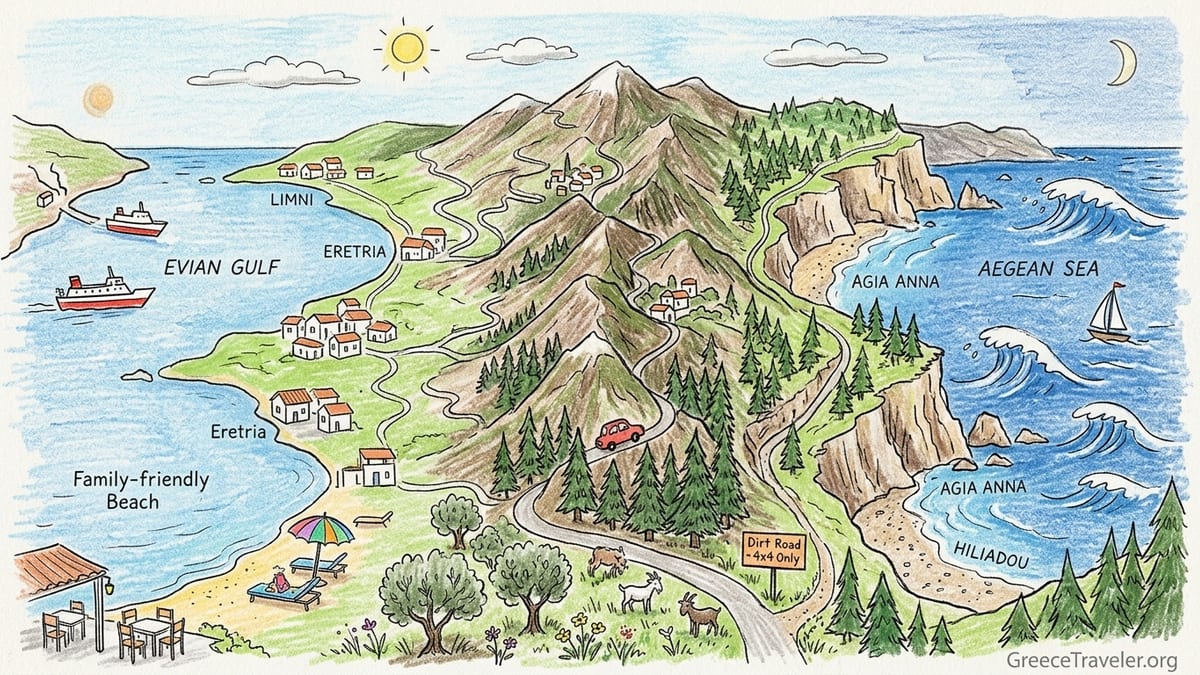
Evia is Greece’s second largest island, roughly 180 kilometres from north to south, joined to the mainland by bridges at Chalkida and served by several short ferry routes. A mountain spine runs down the island and forces most roads to twist inland, turning what looks like a short hop on the map into an hour or more of driving in real time. Before you choose a beach, it helps to decide whether you want Gulf-side calm or Aegean energy, and how much mountain driving you are comfortable with in a rental car.
The island’s western side faces the Evian Gulf, which is narrower and more sheltered. Here beaches such as Eretria, Lefkandi, Limni and Rovies usually have smaller waves, slightly warmer water and gentler depth. Sand or fine shingle is common, and there are more built-up stretches with sunbeds, beach bars and family-friendly tavernas directly behind the sand. In summer, these west-coast resorts are popular with Athenians who drive over for weekends.
On the eastern Aegean side, beaches such as Agia Anna and Agkali, Hiliadou, Limnionas and Thapsa are more exposed to the Meltemi winds that blow from the north in July and August. Swells can be significant, especially in the afternoon, and many beaches drop off more steeply. You will find a mix of coarse sand and pebbles, dramatic cliffs and dense pine forest down to the shore. Facilities are sparser, and several of the most beautiful coves are reached only by steep paved roads or unpaved tracks where a standard hire car is not appropriate.
Because of the island’s size and topography, you should not plan to “do it all” from a single base. For example, the official tourism information for Limni notes that the drive from Karystos in the far south to Limni in the north takes more than four hours, even though the straight-line distance looks modest. It is more realistic to pick one region of Evia and maybe add a night or two in a second base, rather than commute long distances every day.
Northern Evia: Pefki, Gregolimano, Rovies, Limni and Lichadonisia
Northern Evia feels greener and more remote than the south, with pine forests and long gulfside beaches that suit slower trips. Many visitors arrive via the short ferries between Arkitsa and Edipsos or between Glyfa and Agiokampos. These sailings typically take around 45 minutes and can save at least an hour compared with driving all the way from Athens through Chalkida, especially in summer traffic. A common itinerary is to drive the national road north from Athens, board at Arkitsa with the car, and disembark near Loutra Edipsou before continuing along the coast toward Pefki or Rovies.
Pefki sits at the northern tip of Evia and offers a very long sandy and shingle beach on the gulf side. The access road is fully paved and in good condition, and parking is usually roadside along the seafront, with a dedicated free car park at the southern end near several beach bars. In high summer local guesthouses quote double rooms in the range of about 70 to 120 euros per night, with simpler studios a little cheaper in June and September. Pefki’s beach is child-friendly on calm days, although there is not continuous lifeguard coverage, so families should keep a close eye on children when the wind picks up. Tavernas by the harbour serve grilled fish and seafood, and several organise small-boat trips along the coast.
Gregolimano is best known for the large all inclusive resort hidden among pine trees on a peninsula. The surrounding beaches are sandy, with shallow, clear water on the gulf side and more exposed conditions facing outwards. Access without a booking at the resort is limited, so most independent travellers stay instead in nearby villages and visit other stretches such as Rovies and Limni. Roads in this part of the island are paved but narrow in places, and driving at night requires extra care because of occasional livestock and poor lighting.
Rovies and Limni are charming seaside towns on the calm western shore. Limni has a waterfront promenade with several ouzeri and cafés, and small pebbly coves directly in front of town. The coastal road allows easy access with basic street parking; during Greek holiday weekends it can fill up, so arriving early in the morning is sensible. Accommodation in Limni ranges from traditional guesthouses from roughly 60 to 90 euros in June to mid range boutique hotels closer to 130 to 160 euros in August. These towns make relaxed bases for visitors who prefer shorter drives to nearby beaches rather than isolated coves down dirt tracks.
Lichadonisia, at Evia’s northwest tip, is often compared with tropical islets and is best treated as a dedicated boat excursion rather than a regular beach. Small boats and day-trip operators depart from the area around Kavos and Kamena Vourla on the mainland and from nearby Evia ports in summer, taking guests to sand-fringed islets with shallow turquoise water. There are no formal roads or parking on the islets themselves, and facilities range from basic beach kiosks to pop-up sunbeds that may vary year to year depending on local regulations. As with many boat trips in Greece, departures can be cancelled at short notice if the wind strengthens, so it is wise to keep some flexibility in your schedule.
Central Evia’s Aegean Side: Agia Anna, Agkali, Hiliadou, Limnionas and Thapsa
Central Evia’s eastern coast is where the island’s geography makes beach decisions most confusing. On the map Agia Anna, Hiliadou, Limnionas and Thapsa look quite close, but mountainous terrain and winding roads mean that moving between them takes longer than expected. Many visitors base themselves in or near Agia Anna for a few days and then choose one or two more remote beaches as day trips, rather than trying to hop between them every day.
Agia Anna and its main beach Agkali form one of northeastern Evia’s most established resorts, with a long stretch of coarse sand and small pebbles that faces the Aegean. An official description highlights hotels, rooms to let, an organised campsite, beach bars and quieter sections at the northern end where you can spread out with your own umbrella. Agkali is reached via a fully paved road that descends gently from the inland village, and parking is a mix of small off road lots and roadside spaces near tavernas. The sea can have moderate surf when the Meltemi blows, but the seabed here deepens more gradually than at some nearby coves, making it popular with families who are comfortable supervising children in light waves.
Further south, Hiliadou is one of Evia’s most photographed beaches, a mix of pebbles and sand framed by high cliffs and lush vegetation with a small sea cave at one end. The approach from Chalkida takes roughly an hour via a mountain road that is paved but narrow and bendy in sections. There is a parking area close to the shore, yet in late July and August it often overflows and cars line the roadside for some distance uphill. Informal beach bars and tavernas appear in season, but you should not rely on lifeguards or formal shade along the entire beach. Swimmers need to be confident in deeper, sometimes choppy water, and non-swimmers may be more comfortable staying in the shallower shore break.
Limnionas, reached via a winding paved road across central Evia, rewards careful drivers with a dramatic double cove of turquoise water and large pebbles. Travel guides note that there is parking near the small settlement behind the beach and several seasonal tavernas and rooms to rent, but that visitors should not assume there will be sunbeds, showers or accessible toilets outside peak weeks. The seabed drops steeply in sections, and there can be strong waves when the wind is northerly. It is not an ideal choice for small children or anyone unsteady on slippery rocks. The last kilometres have tight curves that can be tiring in a standard hire car; driving slowly, using low gears and avoiding night-time arrivals is advisable.
Thapsa is one of Evia’s most isolated and beautiful coves, with bright turquoise water and pale sand and shingle. However, access is only partially paved, and the final segment is a rough dirt track cut into the hillside. Local drivers with four wheel drive vehicles use it regularly, but many car rental contracts for standard compact cars specifically exclude travel on such roads. Visitors report deep ruts, loose stones and little space to pass opposing traffic. Unless you are travelling outside the main fire season with a suitable vehicle and good off road experience, it is safer to visit Thapsa only by boat excursion from nearby ports. A normal rental car should not be taken down this track, both to avoid damage and to reduce the risk of getting stranded in hot conditions.
Central Evia’s Gulf Side: Chalkida, Eretria, Lefkandi and Kymi
On the more sheltered Evian Gulf, central Evia offers easier access and calmer water, albeit with more developed surroundings. Chalkida, joined to the mainland by two bridges, is the island’s gateway city. It has small urban beaches and promenades but is better treated as a transit point than a dedicated beach base unless you want nightlife and city comforts. Hotel rates here outside August often start around 70 to 100 euros for modern three star properties and rise in August when Athenians come over for short breaks.
Eretria and neighbouring Lefkandi sit further south along the west coast and provide convenient, family friendly beaches and a good range of rooms. Eretria has an organised town beach with shallow, usually calm water and a sandy or gritty seabed, plus more stretches toward Amarynthos. There is roadside and paid parking behind the seafront, and the short ferry crossing to Oropos on the mainland makes it a practical base for travellers who want to combine Evia with day trips back toward Athens. Lefkandi is known among Athenians for its long sandy bay and water sports such as kitesurfing on windier days; several beach bars offer sunbeds and music, while quieter sections toward the ends suit those seeking a low key swim.
Kymi, on the eastern side of central Evia, is reached from the interior by a twisting mountain road that reveals striking sea views as you descend. The main town sits above the port, and beaches are spread along the coastline on either side, ranging from sandy family stretches with basic facilities to smaller pebble coves. Parking is generally straightforward outside peak August weekends, and rooms in Kymi in June and September can be significantly cheaper than in August, sometimes in the range of around 60 to 90 euros depending on standard and sea view. Kymi also serves as a gateway to the island of Skyros, with ferries that take under two hours, useful for travellers planning a combined Evia and Sporades itinerary.
When comparing bases in central Evia, Chalkida suits short stays and travellers who rely on public transport. Eretria and Lefkandi are better for those who prioritize easy, child friendly beaches and quick access from Athens. Kymi feels more remote and is a good choice if you enjoy scenic drives and want to mix Aegean beaches with the option of onward ferries. All three areas have adequate supermarkets, bakeries and rental car offices, though selection is wider in Chalkida and Eretria than in Kymi.
Southern Evia: Marmari, Karystos and Nearby Beaches
Southern Evia is the region where taking a ferry instead of driving often makes the biggest time difference. Instead of driving for several hours from Athens through Chalkida and down the island, many travellers head to Rafina, the secondary port northeast of Athens, and board a car ferry to Marmari. Services are operated by local companies, with several sailings per day in high season, and crossing times of roughly an hour and a quarter. Schedules change by month, but in August recent timetables have shown three or four departures a day between early morning and early evening, which allows you to coordinate easily with morning flights into Athens.
Marmari itself is a small port town with beaches on both the gulf and more open sides. The main seafront is relatively sheltered, with family friendly swimming close to cafés and tavernas, while more exposed, kite friendly beaches lie just outside town. Parking is typically roadside, with extra spaces near the ferry port and around the small harbour. Marmari can work as a quieter base than Karystos, especially if you like to be within walking distance of the ferry and do not need an extensive choice of nightlife.
Karystos, about a 15 to 20 minute drive from Marmari along a paved coastal road, is the main town of southern Evia and has a wide gulf-facing beach fronted by a promenade. The beach itself is sandy to coarse sand, with a gradual entry into the sea along much of its length, and the town provides all the expected amenities, including supermarkets, pharmacies, cafés and a choice of tavernas. Accommodation options range from basic rooms up to modern seafront hotels and apartments. In July and August, well reviewed mid range hotels often quote prices in the region of 110 to 180 euros per night for a double, with better deals in June and late September. Families appreciate the flat terrain, easy parking and presence of organised beach sections with sunbeds and seasonal lifeguards on the busier central strip.
South of Karystos, beaches such as Agia Paraskevi and Megali Ammos provide a mix of sandy stretches and more rugged sections. Access is via fully paved roads that run parallel to the coast, and parking is usually on informal dirt clearings directly behind the sand. The water here tends to be warmer and somewhat calmer than on the exposed central Aegean coast, though it can still become choppy when north winds are strong. Further east, toward the Aegean side, there are remote coves and spots such as Tsakaioi, which have been evacuated during recent wildfires. Reaching these often involves long, partly unpaved tracks that are unsuitable for standard rental cars and should be approached only with local advice, a capable vehicle and careful attention to current fire risk.'
Choosing Your Base: Chalkida, Eretria, Limni, Agia Anna, Kymi, Marmari and Karystos
For a short trip, it helps to compare Evia’s main bases with your priorities clearly in mind. Chalkida works well if you are arriving late into Athens and want a straightforward drive over the bridge for a first night, with city style services and quick access onward to both north and south. Beaches in town are adequate but not special, so beach-focused travellers are usually happier moving on after a night or two.
Eretria is one of the best bases for visitors without a strong desire for wild scenery. It offers short driving times from Athens, a compact town beach, pleasant evening promenade and convenient ferries back to Oropos on the mainland. Families who want shallow water, sunbeds and lots of nearby tavernas often choose Eretria or neighbouring Lefkandi. Limni, by contrast, appeals to those who prefer a more traditional small town atmosphere in the north, with short drives to nearby pebbly beaches and easy access to the wider region via the coastal road.
Agia Anna serves as a practical base for exploring the more dramatic Aegean beaches of central Evia. You can stay in rooms or campsites close to Agkali beach and use it as your everyday swim, then pick calm weather days to tackle the mountain drive to Hiliadou or Limnionas. Travellers who choose Agia Anna should be comfortable driving on bends and be ready for stronger waves than in Eretria or Limni. Kymi is more suitable for those who enjoy hill towns, sea views from above and the option of day or overnight trips to Skyros.
In the south, Marmari suits travellers who value a small town feel within walking distance of the ferry, while Karystos is better if you want the widest range of accommodation and dining plus a long urban beach. Both are excellent choices if you are targeting southern coves or planning to combine beach time with short hikes in the surrounding hills. For visitors arriving on morning flights to Athens in high season, catching an afternoon ferry from Rafina to Marmari can often have you swimming by early evening, instead of still driving down the mainland highway.
Practicalities: Ferries, Driving, Costs and Wildfire Precautions
Evia’s ferry network is designed around short links rather than long, expensive crossings. From the north, Arkitsa to Edipsos and Glyfa to Agiokampos both provide car ferries of around three quarters of an hour, useful if you are driving through central Greece or returning toward Thessaloniki. In the south, Rafina to Marmari remains the key link, with an increase in sailings in late spring, summer and early autumn. Timetables can vary significantly between April, peak August and late October, so it is essential to check current schedules and book ahead if you are travelling with a vehicle in high season.
Driving on Evia combines stretches of smooth regional roads with winding mountain sections and the occasional rough rural track. Standard rental cars are fine for all paved routes described in this guide, such as those to Agia Anna, Limnionas, Hiliadou, Eretria, Kymi, Marmari and Karystos. Problems arise when travellers attempt to shortcut down unpaved roads to remote coves like Thapsa or minor Aegean bays. Many rental contracts in Greece explicitly forbid off road driving and exclude damage from underbody impacts or driving on unsurfaced tracks. If locals describe a road as “only for 4x4” or you see deep ruts, steep drops and loose stones, do not continue in a normal rental car.
Accommodation and car hire costs on Evia are moderate compared with some Cycladic islands, but still vary sharply between shoulder season and peak August. In June and late September, it is common to find double rooms in coastal towns such as Eretria, Limni, Agia Anna, Kymi, Marmari or Karystos in the region of 60 to 100 euros, depending on standard and exact location. In late July and most of August, the same rooms may rise closer to 110 to 180 euros, especially with sea views. Compact rental cars from operators in Athens or on the island itself can start from roughly 35 to 50 euros per day in June if booked early, and from around 60 euros or more per day in late July and August, again depending on availability and insurance level.
Wildfires are a recurring reality in Greece, and Evia has experienced significant fires in recent years. Authorities have strengthened prevention and response, but visitors still need to stay informed in summer. Open fires and barbecues in forests and pine areas are usually prohibited during the high risk period, and penalties for violations can be severe. Travellers should monitor local news and official alerts, pay attention to signage about fire risk levels, and avoid parking vehicles with hot engines or exhausts on dry grass at remote beach approaches. If you receive an emergency message on your phone instructing you to evacuate a specific area, follow the directions immediately and head toward the designated safe zone or larger settlement.
Suggested Three and Five Day Beach Routes
For a three day trip focused on central and southern Evia, one practical route is to arrive in Athens and travel directly to Rafina for a ferry to Marmari. Spend your first night in Marmari or Karystos and enjoy the town beach or a nearby stretch such as Agia Paraskevi. On the second day, explore additional southern beaches accessible by paved roads, with a long lunch in a seafront taverna, then drive northward in the late afternoon toward Eretria or Chalkida for an overnight stop. On the third day, swim at Eretria or Lefkandi, have lunch on the promenade and then return to Athens.
For a five day itinerary that includes more of the island’s contrasts, consider starting again with the Rafina to Marmari ferry and two nights in Karystos. From there, drive back north on day three toward Agia Anna, crossing the interior via Chalkida, and stay two nights close to Agkali beach. Allocate one full day for beach time in Agia Anna and a calmer Aegean morning, and another for an early drive to Hiliadou or Limnionas, returning well before dark. On the final day, leave Agia Anna after a last swim and drive back to Chalkida and on to Athens, allowing extra time for traffic when approaching the capital.
Travellers with a greater interest in northern Evia can instead arrive by road via the mainland and the Arkitsa to Edipsos ferry. Spend two or three nights around Pefki or Rovies, with one day dedicated to exploring nearby coves and another to a boat excursion toward Lichadonisia, weather permitting. If you have a car and a full five days, you might continue down the coast to Limni for a night or two and then cross the interior toward Kymi, finishing with an overnight stay there before heading either back through Chalkida or by ferry to Skyros if your plans include the Sporades.
In all cases, build in more time than you think you need between locations. Distances that look short on navigation apps may involve substantial elevation changes and slow moving traffic behind trucks on mountain segments. Planning to drive earlier in the day, before afternoon heat and winds peak, also makes mountain routes more comfortable, particularly if your hire car is small and fully loaded with luggage and passengers.
The Takeaway
Evia rewards travellers who take its geography seriously. The same mountains that complicate its roads also create quiet valleys, forested headlands and hidden coves. Choosing the right region and base, and knowing the difference between the gentle Evian Gulf and the more demanding Aegean side, is more important here than on many smaller Greek islands. Families who want easy, shallow water and plenty of tavernas will gravitate to Eretria, Lefkandi, Limni or Karystos, while strong swimmers and landscape lovers may prefer Agia Anna, Hiliadou, Limnionas or a boat trip to Lichadonisia.
With thoughtful planning, a realistic driving plan and awareness of seasonal factors such as wildfires, Evia can offer as many beach experiences as several islands combined. Decide first whether you want calm or waves, town comforts or semi wild coves, and then match that wish list to north, central or south. Once you are floating in clear water under the island’s pine clad hills, the time spent studying maps and ferry timetables will feel well rewarded.
FAQ
Q1. Is it better to stay on the Evian Gulf side or the Aegean side of Evia?
The Evian Gulf side, around Eretria, Lefkandi, Limni and Karystos, usually has calmer, warmer water and more facilities, which suits families and first time visitors. The Aegean side, including Agia Anna, Hiliadou, Limnionas and Thapsa, offers wilder scenery and stronger waves, better for confident swimmers and travellers who prioritise landscape over convenience.
Q2. When does taking a ferry to Evia save time compared with driving through Chalkida?
If you are heading to northern resorts such as Pefki or Edipsos from central Greece, using the Arkitsa or Glyfa ferries often cuts driving by an hour or more. For southern Evia, travellers from Athens frequently save time by going via Rafina to Marmari instead of driving through Chalkida and down the length of the island, especially in summer traffic.
Q3. Can I reach Thapsa Beach with a normal rental car?
The last section of the road to Thapsa is a rough dirt track with ruts, loose stones and steep drop offs. Many rental contracts exclude such roads, and getting stuck or damaging the vehicle is a real risk. Unless you have a suitable high clearance vehicle and local advice, it is safer to visit Thapsa only by boat excursion.
Q4. Are Evia’s beaches generally suitable for children?
Many Evian Gulf beaches such as Eretria, Lefkandi, parts of Limni and sections of Karystos have gradual entries, calmer water and nearby tavernas, which work well for families. On the Aegean side, beaches like Agia Anna can be fine for older children on calmer days, but stronger waves and deeper water at places like Hiliadou and Limnionas make them less suitable for small children or non swimmers.
Q5. How expensive are hotels and car rentals on Evia in summer?
In June and late September, double rooms in coastal towns often range around 60 to 100 euros per night, rising closer to 110 to 180 euros in late July and August in popular spots. Compact rental cars can start from about 35 to 50 euros per day in shoulder season and from roughly 60 euros or more in peak weeks, depending on demand and insurance.
Q6. What should I know about wildfire risk on Evia?
Evia has experienced significant wildfires in recent years, and summer conditions can be very dry. Open fires in forests are usually banned, and travellers should avoid off road driving through dense pine, monitor local news and heed any emergency alerts on their phones. Booking flexible accommodation and travel where possible gives you room to adjust plans if an area is affected.
Q7. Is public transport enough for visiting Evia’s best beaches?
Buses connect major towns such as Chalkida, Eretria, Kymi, Limni and Karystos, but services to more remote beaches like Limnionas, Hiliadou and some southern coves are limited or seasonal. To reach the full range of beaches described in this guide, especially on the Aegean side, hiring a car is strongly recommended.
Q8. How long does it take to drive between north, central and south Evia?
Despite the island’s narrow width, driving from Karystos in the far south to Limni in the north can take more than four hours because of winding mountain roads and indirect routes. Short looking trips on the map, such as from Agia Anna to Hiliadou or from Marmari to Kymi, often take an hour or more in practice, so itineraries should be planned with generous time buffers.
Q9. Are lifeguards present on Evia’s beaches?
Organised urban and resort beaches, such as the main stretches in Karystos, parts of Eretria and the busier section of Agkali at Agia Anna, may have seasonal lifeguards. More remote or semi wild beaches, including Limnionas, Thapsa and some coves around Kymi, should be treated as unsupervised, and swimmers need to take personal responsibility for safety.
Q10. Is Evia a good alternative to the better known Greek islands?
Evia can be an excellent alternative if you want a mix of authentic Greek towns, varied beaches and fewer international package crowds, all within relatively easy reach of Athens. It lacks the iconic white villages of the Cyclades, but compensates with forested mountains, diverse coastlines and the practical advantage of bridge and short ferry access rather than long open sea crossings.