


I arrived in Galaxidi on a Friday afternoon expecting a convenient seaside base for Delphi, nothing more. By Sunday evening, sitting on the harbour wall as the fishing boats rocked gently in the Corinthian Gulf’s soft swell, I was trying to justify staying another night. Galaxidi had turned out to be that rare Greek detour which quietly upstages the main attraction.
Getting to Galaxidi: The Road That Shifts the Mood
My weekend in Galaxidi began in central Athens, with the usual ritual of escaping the city on a Friday. I picked up a rental car near Syntagma and joined the National Road heading northwest toward Lamia, leaving behind apartment blocks and traffic lights for the olive groves and low hills of Boeotia. Including a quick coffee stop at a motorway service station outside Thiva, the drive to Galaxidi took just under three hours, which matches what Greek and regional guides suggest for the 200-kilometre journey from Athens to this corner of Phocis.
There are several ways to combine Galaxidi with Delphi, and the one that made sense for the weekend was to drive first to Delphi, then drop down to the coast. From the Athens–Lamia highway I turned off toward Arachova and Delphi, climbing to the slopes of Mount Parnassus on a road that is winding but well surfaced, with regular guard rails and plenty of slow-moving locals to keep your speed honest. After visiting the archaeological site and museum at Delphi in the late morning and early afternoon, I continued along the same road past the modern village and then began the descent toward Itea and the Gulf of Corinth. This is the stretch that people online call “scary,” but driven in daylight and at a relaxed pace it is simply dramatic: hairpins stacked above terraces of silvery olive trees, with glimpses of the sea widening below.
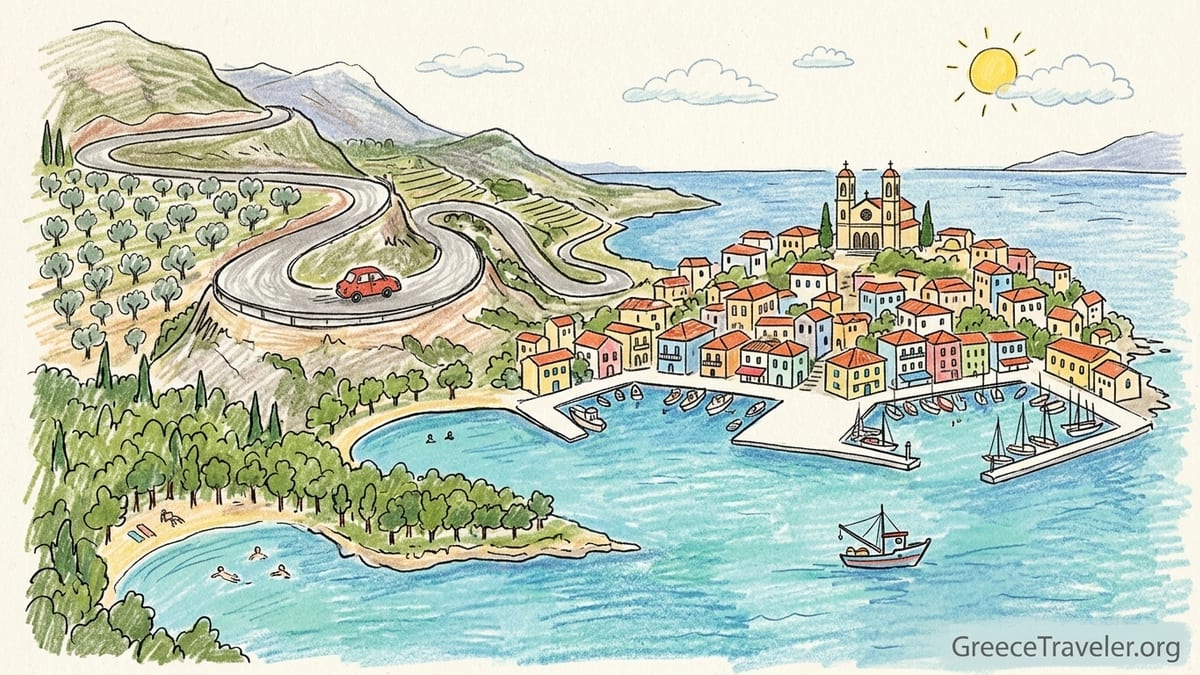
Itea appears first, a low-rise coastal town laid out along its bay, about half an hour’s drive from Delphi. From there, the final leg to Galaxidi feels almost like a palate cleanser. The road follows the shoreline in a gentle curve westward, with the water close on your left and rolling hills on your right. It is an easy 15 to 20 minutes between the two towns, and the moment the road ducks slightly inland and over a rise, Galaxidi reveals itself all at once: a compact cluster of red-tiled roofs, a twin-bell-towered church on the hill, and two small harbours cupped in a natural inlet. Crossing into town, the mood shifts decisively from mountain-daytrip to slow-breath coastal weekend.
First Impressions: Agora Harbour and the Island Feeling on the Mainland
My first real contact with Galaxidi was not through a museum or a monument but by simply parking the car on the edge of the old harbour and walking. Agora, the main port, forms an almost horseshoe-shaped basin where small fishing boats, visiting yachts and local excursion craft tie up side by side. On that Friday afternoon the water was almost unnaturally still, a flat reflective surface broken only by the lazy putter of an inboard engine and the occasional clink of rigging against a mast.
The houses that frame the harbour are the first hint that Galaxidi has more to it than a generic seaside promenade. Neoclassical facades, often two storeys with tall windows and wooden shutters, rise directly from the waterfront lane. Many are painted in soft pastels or whitewashed, with iron balconies and stone doorframes hinting at a more prosperous past. It is easy to see why regional tourism boards describe Galaxidi as having an “island feel” despite being solidly attached to the mainland; there are no high-rise hotels, and the lanes that climb back from the water are narrow enough that cars feel like guests rather than rulers.
On that first walk I followed the curve of Agora harbour from the bus stop and taxi rank at its inner corner out toward the point where cafes give way to pine trees. The air smelled faintly of diesel, grilled fish and pine resin. At the cafes, older men sat facing the water with tiny cups of Greek coffee. Young couples shared mezedes plates under canvas awnings. The mix was notable: this is a town that clearly welcomes visitors but still lives for itself, with a year-round population and businesses that serve more than just a summer rush.
Sleeping by the Sea: My Guesthouse and the Alternatives
For this weekend I checked into Galaxidaki 1857, a renovated guesthouse set one short block back from the harbour and almost behind the Maritime and Historical Museum. The property is in a nineteenth-century house restored with an eye for polished stone floors, exposed timber and quietly modern bathrooms. My double room with a small terrace was compact but well put together, with quality cotton linens and decent sound insulation. The rate in early autumn was just under 90 euros per night including tax but excluding breakfast, which matches recent guest reviews that praise the place as “affordable” while also noting the house’s historic character and central location.
Parking in Galaxidi can be tight in the peak of summer, and even in shoulder season the space directly in front of the guesthouse filled quickly. For my visit in late September I was always able to find a spot within a short walk, but another couple over breakfast mentioned that in August they had sometimes needed to park along the road into town. This is worth considering when choosing between waterside hotels and slightly more inland pensions, especially if you dislike negotiating narrow streets with a rental car.
Staying almost at the centre of town made it easy to compare my choice with other options. Down on the waterfront I walked past Hotel Galaxidi, a family-run hotel close to the inner curve of Agora harbour. Recent price listings suggest double rooms there in the 80 to 120 euro range depending on season, with the advantage of some balconies overlooking the masts and fishing boats. A few doors further along, properties like Galaxa Mansion feature more obviously romantic captain’s house styling, with sea views and breakfast rooms that open almost directly onto the promenade. These typically command slightly higher rates in high season but can be attractive in spring and autumn when the waterfront is calmer.
Looking beyond Galaxidi, Itea offers a different kind of base. It is a working coastal town with a long seafront and a strip of mid-range hotels such as Kalafati Hotel along or just behind the main road. Rooms there can run from around 70 to 110 euros in summer, with the advantage of a broader choice of cafes and a more expansive beach but without Galaxidi’s enclosed harbour charm. Delphi, by contrast, is strung along a mountain road and leans more toward coach-tour hotels, often with impressive valley views but no contact with the sea. For a Delphi-focused trip where you want one place to unpack and a sense of being on holiday rather than on a circuit, I found Galaxidi the most appealing compromise, accepting the 35 to 40 minute drive back up to the ruins in exchange for quiet evenings by the water.
Walking the Historic Center and Up to Agios Nikolaos
Saturday morning began the way many Galaxidi days do, with a climb. From my guesthouse I followed side streets up through the historic centre, trading the flat ribbon of the harbourfront for an irregular grid of alleys. Here, the legacy of nineteenth-century shipping wealth becomes clearer. Several of the houses are unmistakably captain’s mansions, larger and more ornate than their neighbours, with carved stone lintels, arched entryways and sometimes a small courtyard paved in pebble mosaics. A few are freshly restored as boutique lodgings or private homes, others stand in various degrees of gentle decay, shutters weathered and gardens slightly overgrown.
The goal of this short uphill wander was the Church of Agios Nikolaos, the main parish church that crowns the hill above the town. Its twin bell towers are a landmark visible from almost every angle of the harbour, and up close the building is more imposing than you might expect from such a small town: a domed basilica in pale stone with a broad square in front. Stepping inside on a Saturday morning, I found the interior cool and dim, with a carved wooden iconostasis that local guides single out as especially fine, and the faint smell of beeswax and incense lingering from earlier services.
From the square in front of Agios Nikolaos, the reward is the view. Looking down, Galaxidi’s tiled roofs tumble toward the water, with Agora harbour on one side and the smaller cove of Hirolakas on the other. Beyond, the Corinthian Gulf stretches toward the Peloponnese, its far shore faint and blue. Standing there, it is easy to imagine the days when this hilltop looked over a forest of masts and sails rather than the mix of fishing boats and leisure craft you see now.
Looping back down toward the water, I stopped briefly at the church of Agia Paraskevi on the same ridge, a more modest building whose courtyard contains a working sundial and a floor mosaic of the zodiac signs. Details like this, small but distinctive, reinforce Galaxidi’s sense of being a place that accumulated layers of maritime, religious and local history long before modern tourism arrived.
From Agora to Hirolakas: Harbours, Pera Panta and a Town Built on the Sea
Back at sea level, I walked the curve of Agora harbour again and then continued around the point toward Hirolakas, Galaxidi’s second, smaller port. The transition is almost theatrical. Cafes and tavernas thin out, the cobbled lane narrows, and pine trees lean over a stonier shore. Hirolakas is sometimes called the “widows’ harbour” in local lore, a quieter space where boats are repaired and the town’s working rhythm feels more visible. On this visit, fishermen were mending nets in the shade of their boats, and there were more locals than visitors on the benches along the water.
Hirolakas is also a good starting point for the Pera Panta walk, which quickly became my favorite single activity in Galaxidi. From the western edge of the harbour a path and low seaside road lead out along a pine-covered peninsula that protects the town’s bay. Regional guides describe Pera Panta as a coastal grove planted in the late 1920s, and you can still feel that intention: a place deliberately made for walking. The route alternates between sections of paved lane and packed dirt track, always close to the water. On one side there are glimpses back toward Galaxidi’s houses and church domes, on the other small coves with shingle or rock platforms where locals slip into the water for a swim.
In late September the Pera Panta coves became my swimming spot of choice. The water was clear and noticeably calmer than on many open-sea beaches, with shades of turquoise and deep blue changing as clouds passed. There are no organized facilities in most of these little bays, just a handful of ladders bolted into rocks and perhaps a bench under the pines, so you bring your own towel and swim at your own pace. Walking further along, the path eventually reaches a small park with a statue of a Galaxidi woman waving a handkerchief out to sea while holding children at her side, a quiet memorial to the town’s generations of sailors and the families who watched them depart.
Completing the Pera Panta loop in the late afternoon took a little over an hour including plenty of stops for photos and a swim. You could rush it in less time, but the real charm lies in how the walk knits together so many of Galaxidi’s elements: the sense of a sheltered harbour, the proximity of pine forest and sea, the maritime memory in that final statue, and the ever-present profile of Agios Nikolaos on the ridge.
Maritime Memory: Visiting the Nautical and Historical Museum
Galaxidi’s waterfront atmosphere makes more sense after a visit to the Maritime and Historical Museum, which sits in an old mansion just a short climb above Agora harbour. I walked up there on Saturday early afternoon, timing my visit to fit within the museum’s current operating hours. According to both the official information for the museum and recent regional listings, it is open from Tuesday to Sunday between 10:00 and 15:00, with Monday as the main closing day. General admission remains a very reasonable 3 euros, a price confirmed by 2026 updates from national tourism sources and the museum’s own materials.
Inside, the building feels like a time capsule for a town that, in the nineteenth century, was among Greece’s significant shipowning centres. Before the age of steam, Galaxidi built and operated wooden sailing ships that travelled across the Mediterranean and beyond, and the money they brought home financed many of the town’s finest houses. The museum’s ground floor focuses on archaeology and local history, with amphorae recovered from wrecks and inscriptions from the wider region. Upstairs, the core of the experience is a remarkable collection of ship portraits and maritime artifacts. Guides and national tourism descriptions often note that this is one of Greece’s earliest dedicated maritime museums, dating back to 1928, and that it holds one of the country’s most important groups of nineteenth-century sailing ship paintings.
Standing in those upstairs rooms, I found this context transformed the town outside. The paintings depict three-masted barques and brigs under full sail, many identified as Galaxidi-owned, with inscriptions naming captains, destinations and dates. There are navigational instruments, logbooks, sea charts and models that together tell a story of a community that was both deeply local and outward-looking. One display highlights the “Chronicle of Galaxidi,” a manuscript discovered in the nineteenth century that preserves much of the region’s medieval history. It is a reminder that the town’s connection to the sea reaches back well beyond the romantic age of tall ships.
Leaving the museum just before closing time, the harbour below looked a little different. The small fishing boats, the leisure yachts from foreign ports, the ferrying of supplies between quay and deck all seemed part of a shorter, more modest chapter in a much longer maritime narrative. For a weekend visitor, that awareness adds depth. Galaxidi becomes not just a scenic overnight stop after Delphi but a place where Greek seafaring history has a very specific, lived address.
Eating on the Waterfront: Plates, Prices and Atmosphere
Meals in Galaxidi are almost inevitably tied to the water. On my first evening I chose a taverna on the inner curve of Agora harbour, where tables stretched so close to the quay that a curious cat could have stepped straight from boat to breadbasket. The dinner began with a classic Greek salad, thick slices of tomato and cucumber under a slab of feta, for around 8 euros, which is in line with what neighboring tables were paying. A plate of grilled octopus followed, tender and charred in the right places, priced at approximately 16 euros, and a carafe of local white wine of the uncomplicated, maritime kind that suits evenings like this for about 7 euros. Service was brisk but friendly, and while there was a small cover charge per person, the final bill for two came to just under 50 euros including a shared dessert and bottled water.
The next day at lunch I tried a different spot closer to the entrance of the harbour, where the menu leaned slightly away from the greatest hits of Greek beach fare. A dish of chickpeas slow-cooked with herbs and lemon arrived in a clay pot for about 9 euros, and a portion of fresh anchovies fried crisp with a squeeze of lemon cost 11 euros. Here the owner took time to talk through what had come in from local fishermen that morning, and the atmosphere felt more local, with Greek families ordering plates of horta greens and grilled sardines. Prices on the waterfront are certainly higher than what you might pay in a non-touristic inland town, and portions can err on the generous side, so sharing dishes makes sense if you want to sample widely without wasting food.
For breakfast, I relied partly on the guesthouse’s offerings and partly on a bakery-cafe set back a block from the sea, where a spinach pie and a freddo espresso cost a little under 5 euros together. Here the clientele was mostly locals, from schoolchildren grabbing pastries to older residents discussing the day’s news. It was a useful reminder that if you want to soften the impact of waterfront pricing, Galaxidi’s backstreets hold more budget-conscious options without sacrificing quality.
Nightlife in the conventional sense remains limited. On both evenings the harbourfront bars were busy until around midnight, with music at a volume that encouraged conversation rather than shouting. There are no big clubs, and by one in the morning the whole town had fallen quiet, which suited the pace of hiking, swimming and sightseeing. Outside peak months, some restaurants close one or two days a week or shift to shorter hours, so a quick visual survey on arrival, or simply asking your host what will be open, helps avoid disappointment. Even in late September, one of the recommended tavernas in Hirolakas had already moved to a weekends-only schedule.
Afternoon Stop or Full Weekend: How Long to Stay in Galaxidi
The practical question every Delphi-bound traveler eventually asks is how much time Galaxidi deserves. Could you just drop in for an afternoon stroll and a meal after visiting the ruins? The answer depends on what you expect from the sea. In purely logistical terms, an afternoon works: from Delphi you can drive down, walk the harbour, have a late lunch or early dinner, and be back inland or onward to Athens the same night. You would get a worthwhile taste of the waterfront and perhaps the lower part of the historic center.
However, staying one or ideally two nights changes the tone significantly. With a single overnight you can arrive from Athens or Delphi in the afternoon, enjoy a leisurely evening meal, sleep in a stone-built room that creaks slightly as the town settles, then spend the next morning walking Pera Panta, visiting the museum and perhaps swimming from a nearby cove before moving on. A full weekend lets these activities breathe. On my two-night stay, the first day focused on settling in, exploring Agora and Hirolakas and tasting the waterfront; the second day allowed for the climb to Agios Nikolaos, the museum visit, the Pera Panta walk and unhurried swims.
For travelers building a broader Central Greece circuit that might include Arachova, the Hosios Loukas monastery or even Meteora, Galaxidi works well as a coastal anchor. Online trip-planning discussions increasingly describe a pattern of basing for two nights in Galaxidi and doing a day trip up to Delphi from there. This avoids packing and unpacking in multiple mountain villages and gives you evenings at sea level, but it does mean repeating the drive up to the ruins. In my case, experiencing Delphi once on the way to Galaxidi and then sinking into the slower rhythm of the harbour felt like the right balance.
Ultimately, if your interest in the sea runs to a scenic meal and a few coastal photos, an afternoon in Galaxidi is enough. If you enjoy walking, swimming from small coves and letting the character of a place reveal itself gradually through morning bakeries and evening promenades, then one to two nights are justified. I left after a full weekend with the sense that I had met the town properly but could easily have filled a third day with more swimming, a boat excursion in summer or a side trip to nearby beaches like Kentri or Ammouda, both mentioned in regional beach listings as options for clearer water and more open horizons.
The Takeaway
By the time I loaded my bag back into the car on Sunday afternoon, Galaxidi had recast itself from “that coastal town near Delphi” to a place with its own gravity. The harbours of Agora and Hirolakas, the pine-scented loop of Pera Panta, the ship portraits and logbooks of the Maritime and Historical Museum, and the quiet dignity of Agios Nikolaos on its hill together form a coherent story that does not depend on the fame of the oracle up the mountain.
This is not a destination for those chasing nightlife, big resorts or a broad menu of organized activities. Its pleasures are smaller and more cumulative: the way morning light slides across the harbour facades, the sound of rigging in the evening breeze, the feel of pine needles underfoot on a seaside path, the knowledge that the terrace where you sip wine is a few doors down from a captain’s house financed by Atlantic crossings under sail. There are trade-offs in higher waterfront prices, some seasonal closures and a dependence on having a car to get here and explore beyond, but these are manageable with basic planning.
If I were planning another Delphi trip, would I add Galaxidi again? The answer is yes, and more decisively than before this weekend. I would happily base myself here for two nights, accept the daily drive up to the ruins, and trade an extra museum or two inland for another evening watching the boats swing at their moorings. Galaxidi may be close to one of Greece’s most iconic archaeological sites, but it is not simply an add-on. It is a seaside town with its own quiet agenda, one that invites you to stay longer than you meant to.
FAQ
Q1. How long does it take to drive from Athens to Galaxidi?
Driving from central Athens to Galaxidi typically takes between two and a half and three hours by car, using the main Athens–Lamia highway and then turning off toward Delphi and Itea.
Q2. Is Galaxidi a good base for visiting Delphi?
Yes, Galaxidi works well as a base if you are comfortable with a 35 to 40 minute drive each way to Delphi. You trade mountain convenience for evenings by the sea and a calmer atmosphere.
Q3. What are the current hours and ticket price for the Maritime and Historical Museum?
Based on recent official information in 2026, the Maritime and Historical Museum of Galaxidi is open Tuesday to Sunday from 10:00 to 15:00, closed on Mondays, with a general admission ticket of about 3 euros.
Q4. Do I need a car to enjoy Galaxidi?
You can arrive by regional bus and enjoy the town on foot, since the centre is compact, but having a car makes it much easier to combine Galaxidi with Delphi, nearby beaches and inland sights at your own pace.
Q5. Are there good swimming options in or near Galaxidi?
Yes, small coves along the Pera Panta walk offer clear, calm water for informal swims, and beaches such as Kentri and other nearby shores provide more expansive options within a short drive.
Q6. How expensive are meals on the Galaxidi waterfront?
Waterfront tavernas are moderately priced for Greece, with salads around 7 to 9 euros and main seafood dishes from roughly 12 to 20 euros. Eating one or two streets back can lower costs.
Q7. What kind of accommodation is available in Galaxidi?
Accommodation ranges from renovated guesthouses in old mansions to small family-run hotels on or near the harbour. Many offer double rooms in the 80 to 130 euro range in high season, with lower rates in shoulder months.
Q8. How does Galaxidi compare to Itea or Delphi for an overnight stay?
Galaxidi is quieter and more atmospheric than Itea, with a historic harbour and captain’s houses. Itea has a longer beach and more urban services, while Delphi offers dramatic mountain views and immediate access to the ruins but no contact with the sea.
Q9. Is there much nightlife in Galaxidi?
No, nightlife is low-key. Expect harbourfront bars and cafes that stay open until around midnight in summer, but no large clubs or late-night party scene, especially outside peak months.
Q10. How many nights should I plan to spend in Galaxidi?
One night is enough for a taste of the harbour and a short walk, but two nights allow time for the Pera Panta walk, museum visit, swims in nearby coves and unhurried evenings by the water.