


Skyros is the Greek island that people who love Greek islands recommend in a lowered voice, almost as a secret. It sits east of Evia, technically in the Sporades, yet its whitewashed main town could be mistaken at first glance for a Cycladic classic. Spend three days here, though, and the differences become very clear. Skyros is greener, quieter, more artisan than party focused, with a dramatic split between its pine forests in the north and its bare, sculpted rock in the south. It takes effort to reach and to move around, but during my stay the island’s quiet beaches, steep Chora and enduring crafts made that effort feel worthwhile.
Getting to Skyros: A Real Arrival by Sea and Air
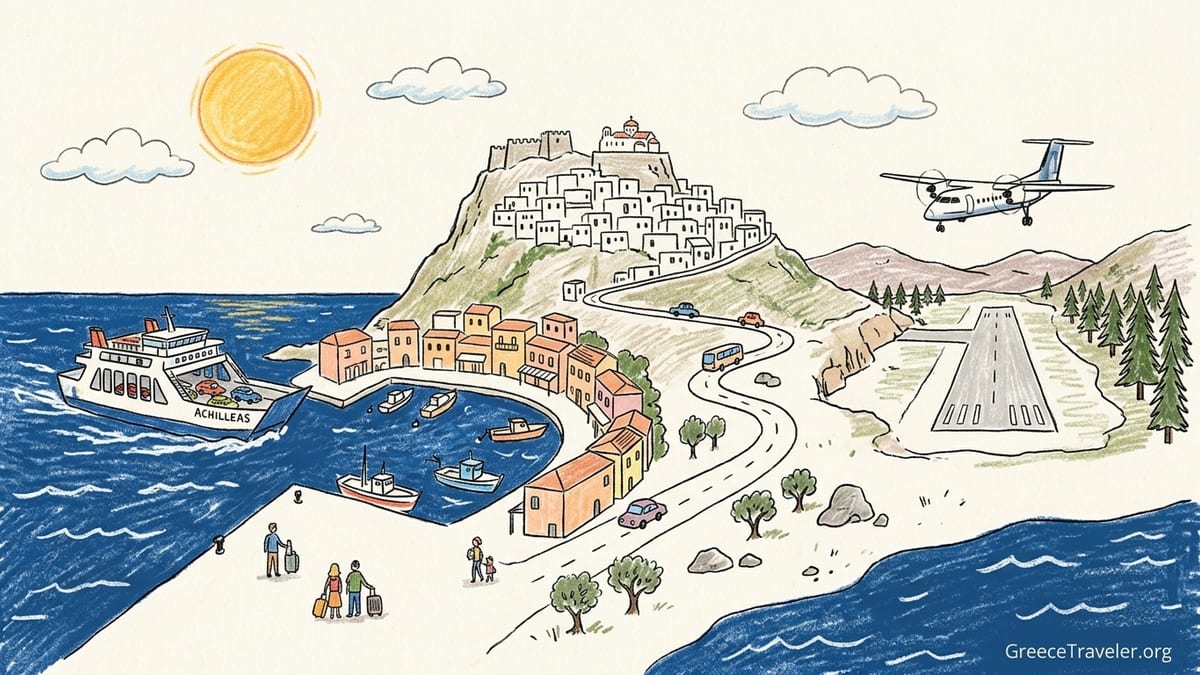
I first arrived on Skyros the way most independent travellers still do, on the ferry from Kymi in Evia. Skyros Shipping Company operates the conventional car ferry Achilleas on this route, usually with one or two sailings a day in summer. On my August crossing, the scheduled duration was around one hour and forty-five minutes, but with a fresh meltemi wind pushing waves straight up the Evian Gulf, our real journey took closer to two and a half hours from casting off in Kymi to the moment Linaria’s small harbour unfolded in front of the bow. Inside, passengers were sprawled on banquettes with cold coffees and cheese pies from the simple cafeteria, cars lashed on the open deck under salt spray.
A standard one-way foot passenger ticket on this Kymi Skyros route in 2026 generally costs around 18 to 20 euros per person, while taking a small car raises that to roughly 60 to 70 euros in total, depending on season and vehicle length. Booking online in advance is not strictly mandatory outside peak weekends, but it is strongly recommended in July and August, especially if you are bringing a car or hoping for a cabin on a late crossing. The approach into Linaria is one of the experiences that sets Skyros apart: instead of a sprawling concrete port, you slide into a compact, amphitheatrical harbour lined with cafes and low houses painted in soft, warm tones.
On a later visit I tried the faster option: the flight from Athens. Skyros Airport, a short drive north of Linaria, is served by domestic carriers on roughly 40-minute flights from Athens and slightly longer services from Thessaloniki, usually with turboprop aircraft carrying around seventy passengers. Fares fluctuate with demand, but in shoulder season Athens Skyros returns can sometimes be found from approximately 120 to 180 euros if booked ahead, although August prices are higher. Landing on the narrow strip hemmed in by low hills and pines felt very different from the slow, anticipatory arrival by sea, but either way, your first impression is that Skyros is smaller and quieter than many Cyclades islands with similar travel times.
At both the port and the airport, the practicalities are modest. A cluster of taxis waits as each ferry or flight arrives, and in 2026 a daytime transfer from Linaria to Chora or the Molos Magazia area typically costs in the region of 15 to 20 euros, depending on luggage and exact drop off point. There is also a seasonal local bus linking Linaria with Chora and the main beaches, priced at a few euros per ride, but services are infrequent and are generally timetabled around the ferry. Compared with the dense bus networks on islands like Naxos or Paros, Skyros’ public transport is sparse, and that fact shaped how I planned my three days.
First Impressions of Linaria and Choosing Where to Stay
Linaria itself is easy to overlook as a place to stay, because many travellers head straight up the hill towards Chora or down to the beach strip at Magazia and Molos. Stepping off the Achilleas, though, I was struck by how unhurried the port felt once the first surge of disembarking vehicles cleared. A couple of waterfront bars served freddo espressos and simple meze plates, fishing boats bobbed side by side with the ferry, and there were more swallows than souvenir shops. It is the kind of port that encourages you to pause for a first drink rather than rush for a taxi.
I had decided to split my short stay between Chora and the beach, to understand the trade-offs. Skyros Town, usually called Chora, sits about twenty minutes’ drive from Linaria, clinging to a sharp hill under the remains of a Venetian castle and the monastery of Agios Georgios. The beach settlements of Magazia and Molos spread out on the east coast below Chora, essentially merging into one sandy bay lined with small hotels, rooms to let, tavernas and a couple of relaxed beach bars. A little farther north, the tiny fishing village of Pefkos curls around a sheltered cove, while to the west Atsitsa faces open sea, pines almost brushing the water.
In Chora, I stayed in a small family guesthouse tucked into the pedestrian lanes, paying around 75 euros per night for a double in early September. The room was simple but characterful, with white walls, painted wooden shutters and a carved chair typical of the island’s traditional furniture. Down by the beach the following nights, a mid range room in the Magazia Molos strip, a minute or two on foot from the sand, cost closer to 100 euros per night in the same period, breakfast included. Prices along the bay vary, but in 2026 it is realistic to expect doubles in summer to range from roughly 80 to 150 euros depending on location, view and level of design. Linaria, by contrast, offered fewer options and quieter evenings, best suited to travellers arriving late on the ferry or wanting a low key base near the water.
The decision about where to stay on Skyros influences your experience more than on many Greek islands. Chora gives you atmosphere, craft workshops and evening life at your doorstep, with the sea a short drive away. Magazia and Molos bring you straight to the main sandy beach but leave you looking uphill at the brilliant white cube of Chora on its rock. Out at Linaria you trade easy beach access for harbour calm, and, crucially, without your own wheels you are largely limited to the bus and taxis. I chose to rent a car, not for status but because I quickly learnt that without it my three days would have been almost entirely confined to Chora and the main bay.
Climbing Through Chora: Castle, Monastery and Steep Whitewashed Streets
Chora is where Skyros most resembles the better known Cyclades, but with less polish, fewer boutiques and more overt signs of everyday life. The lower town starts at a small square that serves as the unofficial arrival point for taxis and buses. From here upwards the streets are mostly car free, and they rise steeply in zigzags that can feel relentless in the midday heat. Whitewashed cubic houses are stacked tightly against each other, front doors almost touching across lanes, cement steps worn into smooth hollows by centuries of feet.
As I climbed, craft shops gradually gave way to quieter residential alleys where geranium pots and laundry shared the same narrow strips of shade. Looking into open doors, I could glimpse the famous miniature furniture of Skyros: low wooden chairs with delicately carved backs, compact tables, shelves loaded with plates. In several places, workshop doors stood open and I could hear the scrape of tools on wood as artisans worked Aleppo pine into new pieces. It felt a long way from the more commercial galleries that cluster in Cycladic hotspots like Oia or Naoussa; here the scale was smaller and the conversation more relaxed, with owners willing to explain techniques over a slow afternoon.
The climb ends at the ruined castle crowning the rock, itself dominated by the Monastery of Agios Georgios. Reaching the monastery involves one last push up exposed steps cut into the stone, but the reward is a sweeping view over Chora, the bay of Magazia and Molos and, on a clear day, the distant outline of Evia. Inside the small monastery complex, frescos line chapel walls and the atmosphere is cool and introspective even when Chora below is busy. The monasteries of the Cyclades often feel on the tourist circuit; Agios Georgios still feels like a working religious site first and a viewpoint second.
Back in the main square as evening approached, Chora’s mood shifted. Locals strolled between kafeneia, children darted around with ice creams and independent travellers compared notes at small bars. There are enough places to eat and drink to fill a three night stay comfortably: tavernas serving grilled meats, salads piled with local capers and tomatoes, and, when available, the island’s emblematic lobster pasta. Prices in 2026 for a main course in the central alleys tended to sit between about 12 and 18 euros, with a shared salad and carafe of local wine adding another 10 to 15 euros. It did not feel like a bargain destination compared with less discovered islands in the Dodecanese, but the mood was quieter and less showy than equivalent corners of Mykonos or Santorini.
Craft Traditions: Ceramics, Carved Furniture and the Skyrian Horse
One of the strongest impressions I took from Skyros was how present its crafts are in daily life. Woodcarving, pottery, embroidery and weaving are not theatrical performances for tourists but still functioning traditions. In Chora and along the Magazia front, several workshops sell hand painted ceramics that carry distinct Skyrian patterns: birds, floral swirls, stylised waves. Prices for small plates and cups start at around 10 to 15 euros, rising to higher sums for larger platters and more complex work. These are not mass produced souvenirs shipped in from factories elsewhere, and the markups reflect the labour that goes into them.
Traditional Skyrian furniture is even more emblematic. The island is known across Greece for its intricately carved low chairs, chests and tables, often made from local pine and designed to fit the tiny, single room houses that used to be standard in Chora. Museums and ethnographic collections in the town display entire interiors reconstructed with these pieces: a raised sleeping platform, carved cupboards and a wall of ceramics that once formed a family’s dowry. Walking through Chora, I passed at least two workshops where carvers were at work on new chairs using hand tools, measuring patterns by eye. When I asked about a small carved stool, the price quoted, around 120 euros, was not inexpensive, but as an object designed to last for decades rather than seasons it made sense.
Skyrian textiles and embroidery appear in guesthouses and tavernas more than in dedicated shops. Tablecloths edged with intricate borders, cushion covers worked in strong reds and blues and heavy woven blankets break up the white plaster and wood of interior walls. Several artisans now collaborate with small design hotels and studios to reinterpret these patterns for contemporary audiences, whether as minimalist ceramics or more restrained motifs on linens. The sense throughout is that Skyros has leaned into its reputation as a craft island while keeping production human scaled, unlike more industrialised souvenir economies on some popular Cycladic islands.
The island’s most unusual emblem, though, is not an object but an animal. The Skyrian horse is a rare small breed sometimes described as a pony, with a height far lower than standard horses and a history closely tied to the island’s isolation. Conservation groups on Skyros work to protect and breed these animals, which once roamed the hills more freely. During a three day visit, it is entirely possible you will not see one unless you deliberately seek out a dedicated farm or reserve, and it would be misleading to suggest that they appear casually on every hillside. In my case, glimpses came indirectly through photographs in local museums and stylised depictions on ceramics, a reminder that some of the island’s most distinctive features are fragile.
Beach Days: Magazia, Molos, Atsitsa, Pefkos and Agios Fokas
Skyros’ main beaches are not the blinding, crowded arcs of sand that dominate postcards from Mykonos or Ios, but they have a low-key charm that suited the island’s slower rhythm. My first swim was at Magazia, the sandy strip closest to Chora, following the road that drops from the town down to the sea in a series of tight bends. Magazia and the adjacent stretch of Molos blend into one long, gently curving bay facing east, backed by low buildings that rarely rise above three stories. The sand here is fine to coarse, with occasional pebbles near the waterline, and the sea deepens at a comfortable gradient, making it easy for less confident swimmers.
Umbrella and sunbed sets in this area in summer 2026 typically cost around 10 to 20 euros for two loungers and shade for the day, depending on proximity to popular cafes. Several sections of the beach, however, remain unorganised, especially towards the fringes, where you can simply spread a towel. Natural shade is limited to a few tamarisk trees, so if you prefer cover without paying for a set, arriving earlier in the day helps. The main upside of Magazia and Molos is sheer convenience: rooms, tavernas and a handful of bars are immediately behind the beach, and it is entirely feasible to spend an entire day drifting between sea, lounger and a table with grilled fish and salad.
To reach Atsitsa on the western side of the island, I drove across Skyros’ spine, the landscape gradually changing from the relatively built up east to a mix of pine forest and open rock. Atsitsa’s small bay is framed by green slopes and rocky outcrops, with a narrow ribbon of sand and pebbles sloping into clear water that feels marginally cooler than on the more sheltered east coast. Access is by car along a reasonably surfaced road, and parking is improvised by the roadside or near the few buildings that line the shore. There are more trees here than on Magazia, giving better natural shade, though there are still a few organised spots where you can rent loungers. The atmosphere was hushed when I visited, swimmers chatting quietly on the rocks, the sound of cicadas from the pines louder than the clink of cutlery from the single taverna.
Pefkos, farther north, offers a different combination of ingredients. The name hints at the pines that come almost to the water’s edge, and the bay itself is narrow and more enclosed than Magazia. The beach surface mixes sand and small pebbles, and the sea is usually calm, protected from the strongest winds. It feels more like a coastal village than a resort, with a small pier lined with fishing boats and a couple of tavernas specialising in straightforward grilled fish, fried zucchini, local cheese and carafes of white wine. Here the only shade comes from trees and umbrellas attached to taverna terraces, and the general sense is of a working shore where tourism is part of life but not the defining element.
South along the eastern coast, Agios Fokas and Kalamitsa are reachable by car and reward the effort with sparser crowds and longer views. Agios Fokas, a sandy arc near a small chapel, feels tucked away, accessed by a minor road and a short walk. Kalamitsa, by contrast, stretches along a more open bay, with sand that glows a warm gold tone under afternoon light and water that shifts between emerald and turquoise depending on depth and angle. On my visit there were only a few groups scattered across the wide beach, each claiming generous personal space, a contrast to the tightly packed rows on more famous islands. Facilities are limited, so you need to bring water and snacks or plan around the opening hours of the nearest taverna, which keeps costs down but increases the need for a car.
The Island’s Two Faces: Green North and Rugged South
Driving across Skyros over three days, the contrast between its two halves became one of the most memorable aspects of the trip. The northern part of the island, where Chora, Magazia, Molos, Atsitsa and Pefkos sit, is relatively green, with pine forests climbing slopes and pockets of cultivated land dotted with olive trees. Roads, though twisty and narrow in places, are generally surfaced, and small chapels or farmhouses break up the scenery. When clouds pass overhead, patches of light move across the hills and bays, emphasising how different this feels from the intensely arid Cycladic landscapes of islands such as Ios or Folegandros.
South of Chora, the terrain becomes more uncompromising. Bare, pale rock dominates hillsides, broken only by patches of scrub and occasional stands of low vegetation. The road network thins and the sense of being in a remote corner of the Aegean intensifies. This is the landscape that attracted the British poet Rupert Brooke during the First World War and that still appeals to hikers and those seeking a starker kind of beauty. Looking down from the castle at dusk, the line between the greener north and the austere south is almost visible, a geological boundary expressing itself in colour and form.
This split affects not just scenery but how visitors move. The majority of accommodation, tavernas and services cluster in the north, reinforcing patterns of use. The south remains relatively undeveloped, partly because of its topography and partly because Skyros has so far avoided the building booms that transformed stretches of Mykonos, Paros and other islands into near continuous settlements. For me, a short drive into the southern hills one late afternoon felt like a step back into an earlier version of the Aegean, with only the modern car under me and the occasional mobile signal reminder that it was, in fact, 2026.
That dual character also makes Skyros suitable for travellers who want both shade and austerity in the same short stay. Mornings can be spent under pines near Atsitsa or Pefkos, swimming in cool water and eating under vine covered pergolas. Afternoons can pivot to drives into the south, where you may not see another car for long stretches and the main sounds are wind and the clink of goat bells. Few Cycladic islands offer such a marked division over such a short driving distance, and appreciating this tension was one of the aspects that made my three days feel richer than the basic distances would suggest.
Eating, Drinking and the Real Cost of Three Days
Sitting down to eat on Skyros, it becomes clear that the island shares the broad food culture of much of central Greece and the Sporades, but with a few specialities and emphases. Fresh fish and seafood are central where supply allows, with many tavernas displaying the day’s catch on trays near the kitchen. One evening in Magazia, I ordered a portion of small fried fish, a Greek salad and a half litre of local white wine, paying around 30 euros in total for a generous meal for one, including bread and water. On another night in Chora, a plate of slow cooked goat in tomato sauce with potatoes cost approximately 16 euros, while a starter of local cheese with honey and thyme added 8 euros.
Lobster pasta, often described as Skyros’ signature dish, appeared on several menus along the coast. Prices here quickly remind you of the realities of fresh seafood: in 2026, a portion for two, priced by weight, could easily come to 70 to 100 euros or more depending on the size of the lobster and the taverna’s standing. It is a celebratory dish rather than an everyday choice, and over three days I opted instead for grilled bream and sardines, which were more affordable but still made excellent use of the island’s waters. Breakfasts at my accommodations were typically included in the room rate and featured bread, local jams, yoghurt with thyme honey and sometimes simple cakes or savoury pies.
Coffee culture here is relaxed rather than showy. In both Chora and Magazia, a freddo espresso or cappuccino averaged around 3 to 4 euros in 2026, taken at small cafes with metal chairs and a mix of locals and visitors. Alcohol focused more on wine and simple mixed drinks than on elaborate cocktails; a glass of house wine at a taverna might cost around 4 euros, while a gin and tonic would run closer to 7 to 9 euros, depending on brand and setting. Compared with high profile Cycladic islands, bar bills on Skyros are modest, partly because there are fewer venues pushing premium experiences.
Transport and accommodation formed the largest part of my three day budget. Renting a small car from a local agency cost roughly 35 to 45 euros per day in early September, including basic insurance but excluding fuel. Petrol prices were similar to those on the mainland, and over three days of moderately intensive driving I spent about 30 euros on fuel. Combined with the ferry cost and room rates mentioned earlier, a realistic estimate for a three day visit for two people, excluding flights, came to somewhere between 500 and 700 euros in total, depending on dining choices and whether you opt for lobster or limit yourself to simpler meals. Skyros is not the cheapest island in Greece, but its quieter nightlife and limited shopping mean it is also easy not to overspend once you are there.
Getting Around, Nightlife and Practical Limitations
Without a car, my experience of Skyros would have been dramatically narrower. The island’s bus system essentially connects Linaria, Chora and the main beach strip, and while that is sufficient if you are content to stay in one of these nodes, it leaves places like Atsitsa, Pefkos, Agios Fokas and Kalamitsa far more complicated to reach. Taxis can bridge some of those gaps, but at typical summer rates of around 10 to 20 euros per ride for common routes, repeat journeys quickly add up. For independent travellers wanting to explore several beaches and villages in three days, renting a car or at least a scooter materially improves what is possible.
The roads themselves require attention rather than nerve. Many are narrow and winding, with occasional potholes and stretches without guardrails, but they are not fundamentally more demanding than typical rural roads on other Greek islands. What makes driving more challenging is the temptation to stop frequently for views or to zigzag down to every small cove. Parking in Chora is mostly on the outskirts, with visitors leaving vehicles in designated areas before entering the pedestrian maze on foot, while at the beaches it is often informal, on roadside verges or dusty flats behind the sand.
Nightlife on Skyros is conspicuously subdued compared with islands whose reputations revolve around beach clubs and late night bars. In Chora, evenings gather around a handful of bars and cafes that stay open until after midnight, playing Greek and international music at conversational volumes. Down on Magazia and Molos, a couple of beach bars host occasional live music or DJ sets in high season, but there is little in the way of organised clubbing. For many visitors, including me, this is part of the appeal: night walks through Chora under the castle, with only the sound of voices from tavernas and the occasional motorbike, felt more in tune with the island’s craft driven identity than any attempt to copy Mykonos’ Super Paradise template.
The island’s isolation does come with inconveniences. Ferry schedules between Kymi and Skyros, while daily in summer, can be vulnerable to strong winds or technical issues, creating uncertainties for tight itineraries or onward flights. Flights from Athens and Thessaloniki operate with relatively small aircraft and can sell out in peak weeks. On one of my departures, a windy forecast raised the possibility of ferry cancellations, and I was reminded that travel insurance and flexible plans are particularly valuable here. Unlike islands with multiple daily connections on several routes, Skyros remains dependent on a single main ferry link and a slim flight schedule, making missed connections more consequential.
The Takeaway
Over three days on Skyros, my route traced a rough triangle between arrival at Linaria, the steep lanes of Chora and the beaches scattered along the north and east coasts. Day one began with the extended ferry crossing from Kymi and a first coffee at the port before a taxi up to Chora, where I spent the afternoon climbing to the castle and monastery of Agios Georgios and drifting through workshops filled with carved furniture and painted ceramics. Dinner under the plane trees in the main square reminded me that Skyros may be quiet but it is not empty; locals, seasonal workers and returning visitors have their own rhythms that predate recent tourism.
Day two moved my base down to Magazia and Molos, trading hilltop views for immediate access to sand and sea. I swam early when the bay was almost empty, walked the length of the beach comparing organised and unorganised sections, then drove west to Atsitsa for a shaded afternoon swim among pines. A late return via Pefkos, with a simple fish dinner by the water, underlined how much the car had expanded the range of this short stay. After dark, I returned to Chora for a final stroll, watching the castle walls glow under spotlights and listening to the gentle soundtrack of conversation and distant cicadas.
On the third day, I took the road south along the eastern coast, detouring to Agios Fokas and continuing towards Kalamitsa, where wide golden sand gave a very different sense of space from Magazia’s more built up strip. With time running short, I looped back through the interior, noticing again the shift from rugged south to greener north, before returning the car and descending to Linaria. An early evening meal at a waterside taverna there, watching the Achilleas slowly approach across the water, brought the trip full circle. The return crossing to Kymi was smoother and closer to schedule, but the memory that stayed with me was of the first, longer approach and the sense of stepping into a slightly off the mainline island.
Did Skyros’ relative isolation make it more rewarding or simply less convenient? In practical terms, the answer is both. The ferry and flight options are more limited and potentially more expensive than routes to islands that sit on major Aegean corridors, and once on the island, a rental car almost feels like an entry ticket to its full range of experiences. Yet that same difficulty helps keep visitor numbers at a level where Chora’s shops still feel like workshops, where lobster pasta remains something special rather than a conveyor belt staple, and where beaches like Kalamitsa can still feel spacious in high summer. For travellers who value crafts, quiet and a strong sense of place over nightlife and easy logistics, Skyros offers an island experience distinct from the Cyclades, one I would happily repeat, ferry delays and all.
FAQ
Q1. How long does the ferry from Kymi to Skyros really take?
The scheduled crossing on the conventional car ferry between Kymi and Linaria is around one hour and forty-five minutes, but in practice it can extend to about two to two and a half hours in windy conditions, so it is wise to allow extra time for connections.
Q2. Is it better to stay in Chora or by the beach in Magazia and Molos?
Staying in Chora gives you immediate access to steep lanes, castle views and craft workshops, while Magazia and Molos put you directly on the main sandy bay; for a three day trip, splitting your stay or basing in Chora and driving to the beach works well if you have a car.
Q3. Do I really need to rent a car on Skyros?
While it is possible to visit Skyros without a car and rely on taxis and the limited bus between Linaria, Chora and Magazia, renting a car or scooter materially improves your ability to reach quieter beaches such as Atsitsa, Pefkos, Agios Fokas and Kalamitsa within a short stay.
Q4. How expensive are meals on Skyros compared with other Greek islands?
Eating out on Skyros is moderately priced: main dishes at tavernas generally range from about 12 to 18 euros, seafood is higher and lobster pasta can cost 70 euros or more for two, but overall bills are often lower than on high profile Cycladic islands because there is less emphasis on upscale bars and elaborate dining concepts.
Q5. What makes Skyros different from well known Cycladic destinations?
Skyros combines a whitewashed hill town with a strong craft tradition, a clear split between green north and rugged south, relatively quiet beaches and low key nightlife, whereas many Cycladic islands are more arid, more heavily built up and focused on nightlife and high volume tourism.
Q6. Can I see the Skyrian horses during a short visit?
The Skyrian horse is a rare, protected breed and you are unlikely to encounter them casually on hillsides; if you want to see them during a three day stay, you need to arrange a visit with a dedicated farm or conservation project, and availability can depend on season and local conditions.
Q7. Are Skyrian ceramics and carved furniture worth buying?
If you value handmade crafts, the island’s ceramics and intricately carved pine furniture are distinctive and durable, with small ceramic pieces starting around 10 to 15 euros and larger items such as stools or chairs costing significantly more but representing long lasting, practical souvenirs rather than mass produced trinkets.
Q8. How reliable are flights and ferries to Skyros?
Both the ferry from Kymi and the domestic flights from Athens and Thessaloniki generally run smoothly in summer, but because there is only one main ferry route and a limited flight schedule, strong winds or technical issues can disrupt plans, so it is important to leave buffer time around onward connections.
Q9. What is the nightlife like on Skyros?
Nightlife is low key, centred on a few bars and cafes in Chora and a couple of beach bars along Magazia and Molos, with music at conversational levels and very little in the way of late night clubbing, which suits travellers looking for relaxed evenings rather than parties.
Q10. Is Skyros a good choice for a three day trip?
Skyros works well for a long weekend if you are comfortable with the slightly more complex journey, allowing enough time to explore Chora, swim at several beaches and experience the island’s crafts, but it rewards travellers who slow down more than those trying to tick off sights rapidly.