


I arrived at Chalkida bus station on Friday 9 August 2024 feeling smug about my low-impact, car-free Greek island plan. Ninety minutes from Athens, bridge-linked to the mainland, Evia looked perfect on the map for a bus-based beach escape. By midnight, standing on the roadside outside Limni after a missed connection, searching in vain for a taxi and watching my prepaid seaside room go unused, that confidence had evaporated. Evia without a car is possible, but for a beach holiday, it is a strategy that can easily unravel in long waits, expensive last-minute taxis and missed swims.
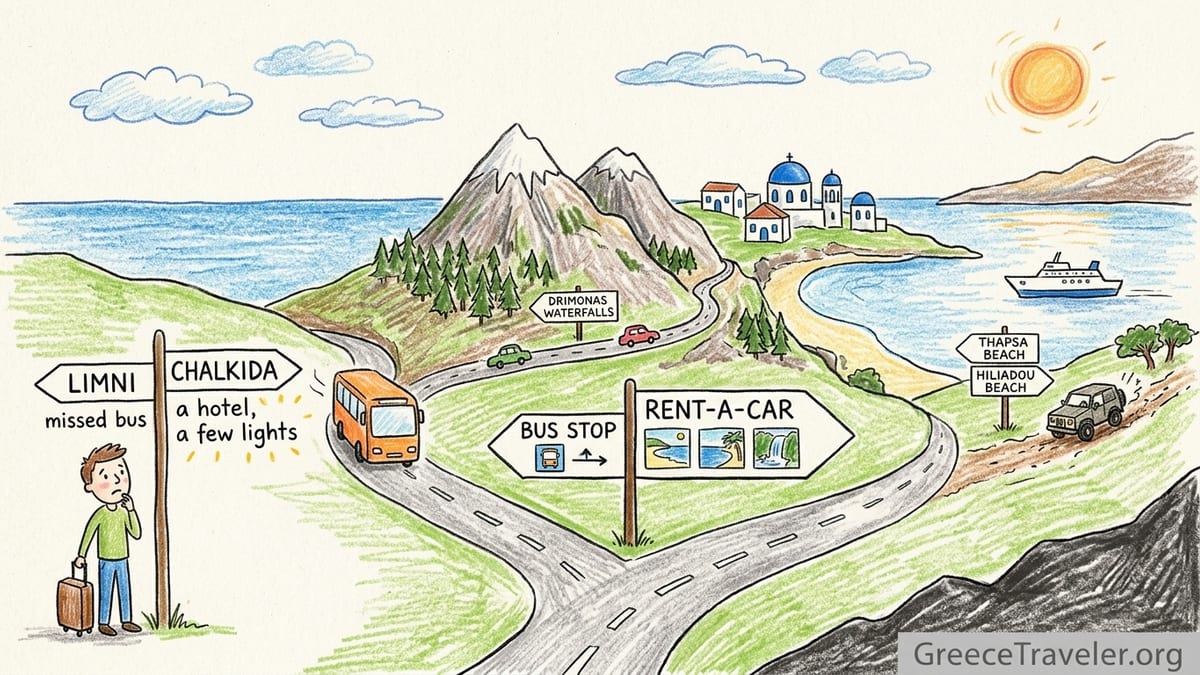
How One Missed Connection Derailed a Carefully Planned Evening
The trouble started the moment I decided to rely on the theoretical neatness of the timetable rather than the messy reality on the ground. My route looked straightforward on paper: an afternoon KTEL Evias bus from Athens Liosion station to Chalkida, an onward bus to Limni, then a short walk down to the waterfront. The Athens to Chalkida link is one of the most frequent intercity services in Greece, with departures roughly every hour on weekdays according to schedules published via the Old Evripos Bridge information site. That part worked. I left Athens on the 17:28 bus, paid around 8 euros, and arrived in Chalkida shortly after 19:00.
From there, I had planned to switch to the evening bus towards Limni, the historic town that now forms part of the Mantoudi–Limni–Agia Anna municipality on Evia’s northwestern coast. The official KTEL Evias timetable for that period showed an evening departure that, in theory, connected after the Athens bus. What the timetable did not say was that Friday traffic leaving Athens and crawling through Chalkida’s choke points often adds unplanned minutes. By the time our bus crossed the Evripos strait and pulled into the station, the Limni bus had already left.
The consequences were immediate and expensive. There was no next bus that evening. There was no station kiosk selling through-tickets that would protect connections. After half an hour of phone calls in the station café, I found exactly one local taxi willing to consider the 80-kilometre run to Limni, quoted at 90 to 100 euros for the night transfer. For a solo traveller who had just spent about 8 euros on the bus from Athens and 50 euros on a room, that wiped out any savings from “travelling the local way”. I declined and ended up paying for a Chalkida hotel instead, while my beach-view reservation in Limni stood empty.
That evening set the tone for the rest of the trip. On paper, Evia looks extremely connected: a major regional unit with a bridge to the mainland, intercity buses from Athens to almost every coastal town, and multiple short car-ferry routes. On the ground, it is a long, mountainous island where intercity lines thin out after the hubs, last-mile beach access depends heavily on taxis and private cars, and the margin for error when travelling without your own wheels can be uncomfortably slim.
Evia’s Geography: Long, Narrow and More Mountain Than Island Resort
Evia, or Euboea, is Greece’s second-largest island after Crete. The regional unit covers more than 4,000 square kilometres, stretching approximately 180 kilometres from north to south according to official regional data. The landmass is long and relatively narrow, threaded by a chain of mountains rather than lying flat like a typical sun-and-sand destination. Ranges such as Dirfys in central Evia rise over 1,700 metres and act as formidable barriers between the Aegean side and the calmer Gulf of Evia side.
This geography is crucial when you are planning to use public transport. On a map, Athens to Karystos at the southern tip looks like a simple hop, as does Chalkida to Agia Anna on the east coast. In reality, the roads zigzag inland through canyons, over high passes and along narrow coastal sections. Distances that appear short become 90-minute or two-hour drives in a private car. On a bus that must serve dozens of villages, those same routes slow down further, and the number of daily departures drops once you move away from the big axes.
Being connected by bridge at Chalkida also creates an illusion of urban convenience that does not hold for the rest of the island. Yes, you can be standing on Evia soil within an hour and a half of leaving central Athens, using a direct bus to Chalkida or a train plus local bus. However, that ease of access stops almost as soon as you leave Chalkida’s orbit. The farther north or south you go, the more tightly bus timetables are structured around local needs such as commuting and school runs rather than the whims of visiting beachgoers.
The mountains also shape where accommodation and beaches cluster. Many of Evia’s most remarkable spots are on the eastern Aegean-facing side, where the coast is raw, steep and wild. Beaches like Thapsa and Hiliadou, waterfalls such as Drimonas, and the Lichadonisia islets off the northwest are postcard beautiful, but they are hidden behind ridges that buses do not routinely cross. Bridge access does not change the fact that, on Evia, some of the best places are effectively off-grid unless you drive.
Big Towns vs Beaches: What KTEL Evias Actually Serves
To understand where public transport works on Evia, it helps to separate two levels of service: the intercity routes that connect Athens and Chalkida to the main towns, and the much weaker last-mile options from those towns to specific beaches or villages. KTEL Evias operates from Athens Liosion bus station and links to Chalkida, Eretria, Kymi, Karystos, Limni, Edipsos and other hubs. Athens Liosion is a major terminal for central Greece, and routes run year-round, with more frequent services in summer.
Athens to Chalkida is the backbone. Buses run many times a day and take around 75 to 90 minutes, with tickets typically under 10 euros. For travellers staying in Chalkida itself or in nearby resorts such as Drosia or Nea Artaki, this works well. You can even use Chalkida as a commuter base, combining it with regional trains where available. Between Athens and Eretria or Aliveri, services are somewhat less frequent but still workable for point-to-point travel to booked hotels on the Gulf side.
Beyond that inner ring, coverage starts to thin. Athens to Karystos at the southern extremity usually offers a few buses per day, often timed to suit arrivals in Athens or local residents who need to visit the capital. If your flight lands at Athens International Airport late in the day, you will almost certainly miss the last direct bus south and may need an overnight near Athens or a costly taxi to catch the morning departure. Athens to Kymi, the port for Skyros, also has scheduled buses, but the services are built around connecting to specific ferries rather than providing a flexible shuttle every hour.
Northwestern Evia is even more uneven. There are intercity lines from Athens and Chalkida to Limni, Rovies and Istiaia, and separate routes to Edipsos. These buses make it possible to reach spa towns and working ports without driving. However, if you inspect the official KTEL Evias timetables, which are often only partially available online and sometimes only posted locally at stations, you will see that many of these routes run just once or twice per day in each direction outside of peak August weekends. The bus system is designed first for residents commuting or going to hospital appointments, not for visitors hopping between beaches.
Where the Buses Stop: The Last-Mile Problem to Evia’s Best Beaches
The real pain point for car-free visitors arrives the moment you try to go beyond the town or port where the KTEL bus drops you. Here, the difference between established urban routes and beach access becomes stark. You may find yourself marooned at a harbour with your suitcase, staring at a minibus stop that only operates in July or that local hoteliers “think” is still running but no one can confirm. For several of Evia’s standout coastal spots, buses are absent, seasonal or simply not timed in a way that makes sense for a day at the sea.
Take Thapsa, often cited by Greeks as one of the island’s wildest and most magical beaches. It is reached from the east coast via rough unsurfaced tracks that descend for kilometres to a pebbly bay framed by cliffs. No scheduled KTEL Evias route runs all the way to Thapsa. At best, you can reach a larger settlement such as Steni or Zarakes by bus from Chalkida or Athens, and then negotiate a 4x4 transfer or taxi the rest of the way. In practice, drivers quoted prices in the region of 60 to 80 euros each way in summer 2024, partly due to the time and risk involved on the track and partly because the car must return empty.
Hiliadou on the Aegean side of central Evia is slightly easier but still not genuinely car-free friendly. It is a spectacular, partly nudist beach at the mouth of a gorge, directly exposed to the Aegean swell. To get there without a car, you would generally take a KTEL bus from Athens or Chalkida to Steni or another inland village on the Dirfys slopes and then hope to match a summer-only local bus or book a taxi. In August 2024, the limited local information pointed to a seasonal bus on certain days, but hotel owners warned that it was not reliable outside weekends. Taxi drivers in Steni mentioned round-trip fares between 70 and 100 euros, depending on waiting time.
On the northwestern side, Drimonas Waterfalls sit high above Rovies, in a forested, mountainous area that has suffered wildfire damage in recent years. There is no direct bus to the falls themselves. Travellers can take a KTEL line to Rovies or Limni, but the last leg requires a taxi on a winding uphill road. The waterfalls are about 20 to 30 minutes’ drive from the coast, and drivers often ask for a fixed price that covers both ascent and descent plus a waiting period, quoting figures around 40 to 60 euros from the seaside towns during peak season. Post-fire closure risks and temporary restrictions complicate matters further, because a bus timetable can tell you nothing about whether trailheads are actually open when you arrive.
Lichadonisia, a cluster of islets often dubbed the Greek Seychelles, is another example of how bus and beach do not neatly align. To join a boat tour to the islets, you typically need to reach the small port of Kavos on Evia’s northwest or the settlement of Kamena Vourla on the mainland. There is no dedicated KTEL line to Kavos. Visitors reach nearby towns such as Edipsos or Arkitsa by bus and then rely on taxis or private transfers to meet fixed-time boat departures. Miss the morning sailing, and you are left with a hot, dead period waiting at a roadside kiosk, spending money on coffees you did not plan to buy.
Ferries Around Evia: Useful but Rarely Synced with Buses
Evia’s network of short ferries is often marketed as a convenient alternative to the long road detours around the gulfs that separate the island from mainland central Greece. In practice, the ferries are extremely useful for drivers, but their schedules are not built around KTEL bus arrivals and departures. This matters if you plan to cross as a foot passenger and then count on public transport to continue your journey on either side.
The classic example is the Arkitsa to Edipsos route, a roughly 30 to 45 minute car ferry crossing that links northern Evia with the national highway north of Athens. Recent timetables published by the Arkitsa–Edipsos ferry operators show multiple daily departures in October 2026, with morning sailings at 07:00, 09:00 and 11:00 from Arkitsa and corresponding returns from Edipsos. These are excellent for drivers leaving Athens early, but they may or may not line up with KTEL buses from Athens or Lamia that stop near Arkitsa. There is no integrated ticketing and, crucially, no guarantee that a bus driver will drop or pick you right at the pier without prior arrangement.
The Glyfa to Agiokampos ferry across the northern Evian Gulf tells a similar story. Operators such as D Ferries and Glyfa Ferries run frequent short crossings in summer, with October 2026 timetables listing several sailings per day and journey times around 20 minutes. Ticket prices published by one major operator indicate about 4.60 euros for an adult passenger and roughly 18.50 euros for a private car. Those are excellent value when you drive, but as a foot passenger you still need some form of onward transport from Agiokampos on the Evia side. There is no high-frequency bus instantly waiting at every arrival, and luggage-friendly options are scarce.
On the eastern side, the Kymi to Skyros ferry adds another layer of complexity. KTEL Evias runs buses from Athens Liosion to Kymi that are timed to connect with particular ferry sailings to Skyros. Car fares on the Kymi–Skyros route typically add dozens of euros on top of the foot-passenger ticket, but they turn Skyros into a practical extension of an Evia road trip. If you arrive in Kymi by bus, you must mirror the ferry schedule almost exactly, otherwise you can find yourself stranded at the port, too late for the boat yet too early for a comfortable room check-in, with no obvious way to explore the coastline while you wait.
The pattern is consistent: ferries in and around Evia are scheduled as independent services that primarily make sense for people travelling with vehicles. While you can walk on as a passenger and sometimes catch a local bus or taxi at the other side, there is no contiguous, guaranteed chain of public transport across bus and boat. For a car-free beach holiday where you want freedom to chase the best weather or escape a crowded cove, that disconnect becomes a daily constraint.
What It Really Costs: Buses plus Taxis vs Renting a Car
At the planning stage, travelling Evia without a car can look economical. Bus fares from Athens to Chalkida or Eretria hover in the single digits per person, and even longer hauls to Karystos or Edipsos are often under 20 euros. It is tempting to think that, with a few smart bases and a willingness to use ferries as a foot passenger, you can outsmart both the roads and the rental market. My experience, and the numbers I collected across the island in summer 2024, tell a different story when you factor in taxis and lost time.
By contrast, small rental cars on Evia and in Athens airport in high season commonly start around 40 to 60 euros per day for a basic manual hatchback, booked directly or through national brokers. To that you add fuel, which in Greece has hovered around 1.90 to 2.10 euros per litre for petrol in recent summers, and motorway tolls between Athens and Chalkida that can add roughly 8 to 12 euros round-trip depending on the exact route. Many rental agencies require a deposit blocked on a credit card, often in the range of 500 to 900 euros, plus optional daily insurance supplements if you want to reduce your excess.
On the ferries, bringing a car is not free, but prices on the short routes around Evia are not prohibitive when shared between two or more travellers. On the Glyfa to Agiokampos crossing, for example, a private car ticket published by D Ferries is around 18.50 euros each way, with a 4.60 euro charge for an adult passenger. On the Arkitsa to Edipsos line, car fares are of a similar order of magnitude, while foot passengers pay significantly less. Over a three-day round-trip from the mainland to northern Evia, a couple might spend roughly 80 to 100 euros on vehicle ferry tickets, split between them.
What makes the car more compelling is the way taxi fares ramp up the moment you need anything beyond the core KTEL stops. For my Limni misadventure, the Chalkida to Limni taxi quote of up to 100 euros already exceeded the cost of three days of a cheap rental car. Drivers in Karystos quoted 20 to 25 euros each way for transfers to isolated southern beaches where no buses run. In central Evia, taxi prices to Hiliadou and Thapsa were substantially higher due to road conditions and waiting time. Once you take three or four such trips in a few days, your “cheap” bus-and-taxi itinerary can outstrip what you would have spent on a small car with generous use of the air conditioning.
There is also the cost of time and flexibility. A rental car allows you to leave Limni after a lazy coffee and still reach Drimonas Waterfalls before the midday heat, then detour to Rovies for a swim at sunset. Without a car, you are at the mercy of the once-a-day bus and the one taxi driver who may already be on an airport run. The financial numbers are not wildly different for a solo traveller, but for two people or a family of four, the scales tilt quickly in favour of renting, provided someone is confident behind the wheel.
Three-Day Reality Check: Solo Traveller, Couple and Family
To put these trade-offs into perspective, it helps to model a realistic three-day itinerary in northern and central Evia in two versions: one using buses and taxis only, the other with a rental car. These are not hypothetical constructs pulled from thin air, but composites based on real journeys I undertook or planned between August 2023 and September 2024, combined with published fares and firsthand taxi quotes.
Imagine a solo traveller starting in Athens on a Friday morning, aiming to spend three days around Limni and the northwest, with a day trip to Drimonas Waterfalls and a boat tour to Lichadonisia from Kavos. On the car-free version, they pay around 8 euros from Athens to Chalkida, then roughly 9 to 12 euros from Chalkida to Limni. To reach Drimonas, they hire a taxi for perhaps 50 euros round trip including waiting time. To make it to Kavos in time for a morning boat to Lichadonisia, they take a bus or taxi to Edipsos and then a taxi onward, spending another 50 to 70 euros. Add return legs and occasional short hops that become necessary when timetables disappoint, and they may easily spend 130 to 160 euros on ground transport over three days, plus the cost of the boat excursion itself.
On the same route with a small car rented in Athens for three days at 55 euros per day, the base cost is 165 euros plus perhaps 40 to 50 euros in fuel for the return to Athens and local touring, and modest tolls on the highway. Parking in small towns like Limni or Rovies is still free in many places, especially in shoulder season. That puts the total around 220 to 230 euros. For a solo traveller, that is slightly more than the bus-plus-taxi scenario, but it buys complete freedom to drive to Kavos, to stop at coves that are not in any guidebook, and to return from Drimonas on your own schedule if wildfire smoke or crowds make you uncomfortable.
For a couple, the balance changes further. Two people repeating the same car-free plan will effectively double the bus fares but not the taxi costs. Their three-day bus and taxi total can nudge towards 200 to 230 euros, while the rental car price, ferry vehicle tickets and fuel remain almost identical to the solo traveller’s scenario. Split between two, the per-person cost of the rental car option can undercut the per-person cost of frequent taxis, especially if they add in one more remote beach day such as Hiliadou or Thapsa.
For a family of four with two school-age children, the calculation becomes even starker. Child bus tickets are discounted, but taxis tend not to offer family pricing, and some parents will want to pay extra for pre-booked transfers or minivans on narrow roads. Over three days, a family heavily reliant on taxis to reach remote beaches could easily approach or surpass 300 euros in local transport, without any of the convenience of carrying beach gear, snacks, or a shaded space for naps that a private car provides. Even with higher-category rental cars and higher fuel consumption, self-driving often offers better value and far greater comfort for families on Evia.
The Downsides of Driving: Narrow Roads, Tracks and Fire
It would be irresponsible to present renting a car on Evia as a frictionless solution. The island’s geography that complicates bus service also makes driving challenging in places. Many routes between coasts involve narrow, twisty mountain roads with minimal guardrails, steep drop-offs and frequent hairpins. After heavy rain, there can be rockfalls and potholes. In summer, local drivers in pick-ups and scooters often take corners aggressively, and goats or sheep can appear without warning around bends.
Access to some of the most remote beaches, including stretches near Thapsa and certain coves around southern Evia, may involve unsurfaced tracks that standard rental contracts explicitly forbid. Companies vary in how strictly they enforce these clauses, but if you ignore them and damage the undercarriage, you risk losing your deposit. Navigation apps are not always reliable in the interior, sometimes directing you along gravel paths that locals use only with high-clearance vehicles. Planning routes ahead of time using satellite images and local advice is essential.
Summer traffic creates its own headaches. On August weekends, roads into Chalkida and across the Evripos bridge can back up badly, eating into the time advantage you would otherwise have over buses. Seaside towns like Karystos and Agia Anna see long lines of parked cars along their waterfronts and access roads, making it harder to find a legal space. In some villages, informal parking fills quickly in the evening, and frustration can build when tired drivers start improvising spots in places that block others.
Wildfire risk is another serious factor. Central and northern Evia suffered devastating fires in 2021, and each recent summer has brought new episodes in various parts of Greece. Roads into forested areas like Drimonas or the Dirfys slopes can be closed at short notice during high-risk days, and smoke can make driving uncomfortable or risky even if flames are distant. Fire-related closures disrupt both buses and private cars, but when you are driving, you must also be prepared to reroute yourself quickly, keep fuel topped up, and heed local police or civil protection alerts. Anyone who is anxious about mountainous driving or fast-changing conditions may still prefer to minimise time behind the wheel, even if they rent a car for selected days.
Where Evia Works Without a Car, and When I Would Still Rent
After my own experiments with buses, taxis and ferries, I have reached a nuanced conclusion. Evia is not categorically impossible without a car, but for a beach-focused holiday that aims to sample several coasts and inland sights in a short time, I would not rely on public transport alone again. Instead, I would divide the island into zones that work reasonably well for car-free travellers and those where a rental car is, in practice, the only way to make the most of limited days.
Chalkida is the clearest win for travellers without a car. With frequent buses and train connections to Athens, walkable waterfronts, and nearby beaches accessible by local bus or inexpensive short taxi rides, it suits weekend breaks or first-time visitors content with urban swimming spots and café life. Eretria, a resort town on the Gulf of Evia side, also works reasonably well thanks to regular KTEL connections and compact, flat streets. If you book accommodation near the beach and accept that you will not be chasing hidden coves, you can relax here happily via bus and occasional taxi.
Limni and Rovies on the northwest coast fall into a middle category. They are linked by KTEL buses from Athens and Chalkida, though not as frequently as Chalkida itself. Once there, you can swim right from the town beaches, stroll the promenades and enjoy tavernas without ever needing a car. Short taxi rides can carry you to a couple of nearby beaches or trailheads. However, the moment you try to fold Drimonas Waterfalls, Lichadonisia excursions or Aegean-side day trips into a short stay, the lack of reliable last-mile buses becomes frustrating and expensive.
Karystos and the deep south, the eastern Aegean coast around Hiliadou and Thapsa, and the interior mountainous villages are the zones where I would absolutely rent a car next time. Relying on buses means either confining yourself to the main town and its nearest organised beach, or spending so much on scattered taxis that any environmental or budget benefits disappear. For a couple or family keen on exploring wild beaches, lighthouses, monasteries and upland trails, a modest rental car, used with care and respect for the roads, unlocks an Evia that public transport only hints at from a distance.
If my trip taught me anything, it is that being bridge-connected to the mainland does not make Evia an extension of suburban Athens. It remains a large, mountainous island where local life and limited resources shape transport far more than visitor convenience. That is part of its charm, but unless your idea of a beach holiday is to stay put in one town and never gamble on a connection, your best bet is to budget for at least some days with your own wheels.
The Takeaway
Attempting to explore Evia without a car for a multi-base beach holiday turned out to be a revealing, often frustrating investigation into the limits of Greek island public transport. The island’s geography, long north–south spread and mountainous spine combine with modest local budgets to create a system that connects big nodes like Athens, Chalkida, Eretria, Edipsos, Limni, Kymi and Karystos reasonably well, but leaves many of the most compelling beaches and nature spots in a grey zone of irregular service and high taxi dependency.
Athens to Chalkida is as easy by bus as many suburban commutes, and using KTEL Evias to reach a single coastal town for a slow-paced week by the sea can be both economical and relaxing. Where expectations clash with reality is in the attempt to stitch together Drimonas Waterfalls, Hiliadou, Thapsa, Lichadonisia and remote southern coves into a single, nimble itinerary without renting a car. Ferry routes like Arkitsa–Edipsos, Glyfa–Agiokampos and Kymi–Skyros are invaluable links, but their schedules are not harmonised with bus timetables and offer no built-in onward connections for foot passengers dragging suitcases.
Cost comparisons show that a solo traveller determined to stay near one or two hubs can just about justify a car-free Evia in financial terms, accepting a certain amount of waiting, missed opportunities and the odd expensive taxi. For couples and families, the equation swings quickly towards renting, especially when sharing vehicle ferry charges and fuel. Driving on Evia brings its own difficulties, from narrow mountain roads to unsurfaced tracks and fire-season closures, but these risks can be managed with conservative route choices and attention to local advice.
In the end, my missed bus in Chalkida on that August evening was not just a minor travel mishap; it was an early warning about treating Evia as if it were an island-scale metro network. Next time, I would either commit to a single, well-served base like Chalkida or Eretria and drop any ambitions of chasing wild beaches by bus, or I would rent a small car for at least part of the trip and accept that on Evia, true freedom still tends to come with a steering wheel.
FAQ
Q1. Is it possible to visit Evia without renting a car at all?
Yes, it is possible if you choose one or two well-connected bases such as Chalkida or Eretria and are content to use nearby organised beaches and town amenities. However, reaching remote Aegean-side beaches, waterfalls and smaller villages without a car usually requires expensive taxis and careful timetable navigation.
Q2. Which parts of Evia are most practical for car-free travellers?
Chalkida is the most practical, thanks to frequent buses and some train connections with Athens, walkable streets and nearby beaches. Eretria and a couple of northwestern towns like Limni and Rovies can also work for car-free stays if you are satisfied with local beaches and occasional short taxi rides rather than extensive island-wide touring.
Q3. How reliable are the KTEL Evias bus timetables for planning beach trips?
Intercity timetables on main routes between Athens, Chalkida and larger towns are generally reliable, although summer traffic can still cause delays. The problem lies with last-mile routes to specific beaches, which may be seasonal, infrequent or not clearly published online. Travellers should verify times locally and allow large buffers for connections.
Q4. Can I use ferries like Arkitsa–Edipsos or Glyfa–Agiokampos as a foot passenger and then continue by bus?
You can certainly cross as a foot passenger, and ferry operators publish regular short crossings, especially in summer. However, there is usually no guaranteed onward bus waiting at the pier, and schedules are not synchronised. Most people who find these ferries convenient are driving; car-free travellers should be prepared to use taxis on the Evia side.
Q5. How expensive are taxis on Evia for reaching remote beaches and sights?
Taxi prices vary by distance and road quality, but real-world quotes in recent summers have ranged from around 20 to 25 euros for short transfers near Karystos to 50 to 100 euros for round trips to remote places like Hiliadou, Thapsa or Drimonas Waterfalls, especially when waiting time is included.
Q6. For a three-day stay, is a rental car really cheaper than buses and taxis?
For a solo traveller who stays close to one town and only uses buses plus one or two taxis, a car may cost slightly more overall. For couples and families, once you add several taxi rides to remote beaches or inland attractions, the per-person cost of a rental car often becomes equal or lower, while also providing much greater flexibility.
Q7. Are the roads on Evia dangerous for visitors who are not used to mountain driving?
Many roads are safe if driven carefully, but some routes are narrow, steep and winding, with limited barriers and occasional rockfalls or animals on the road. Drivers who are nervous about mountain driving should plan conservative routes, avoid night driving in the interior and consider limiting self-driving to coastal sections they feel comfortable with.
Q8. What about visiting natural attractions like Drimonas Waterfalls without a car?
You can reach nearby coastal towns such as Rovies or Limni by KTEL bus, but the final ascent to Drimonas requires a taxi or private transfer. This typically involves a 20 to 30 minute drive on a mountain road and a fixed fare that includes waiting time, making it relatively costly for solo travellers without a car.
Q9. Does wildfire risk affect transport on Evia in summer?
Yes, wildfire risk can lead to road closures, restricted access to forested areas and poor air quality. Authorities may close routes to places like Drimonas or high mountain passes on high-risk days. Both buses and private cars are affected, but drivers need to pay close attention to local warnings and be ready to change plans at short notice.
Q10. If I do not want to drive at all, what is the best way to structure an Evia beach holiday?
The most realistic approach is to pick one or two hubs with good public transport, such as Chalkida and Eretria, book accommodation near the water and accept that you will primarily enjoy nearby organised beaches. Consider supplementing this with one or two pre-arranged taxi excursions rather than trying to build a complex, multi-base itinerary by bus alone.