


Delphi is one of those rare places where the archaeological remains, dramatic landscape and museum collection all come together in a single, memorable visit. Perched on the southern slopes of Mount Parnassus, the ancient sanctuary of Apollo was once considered the “navel of the world” and home to the oracle that helped shape political and religious decisions across the Greek world. Today it is a UNESCO World Heritage site that rewards careful planning, especially if you want to see both the ruins and the Archaeological Museum without feeling rushed.
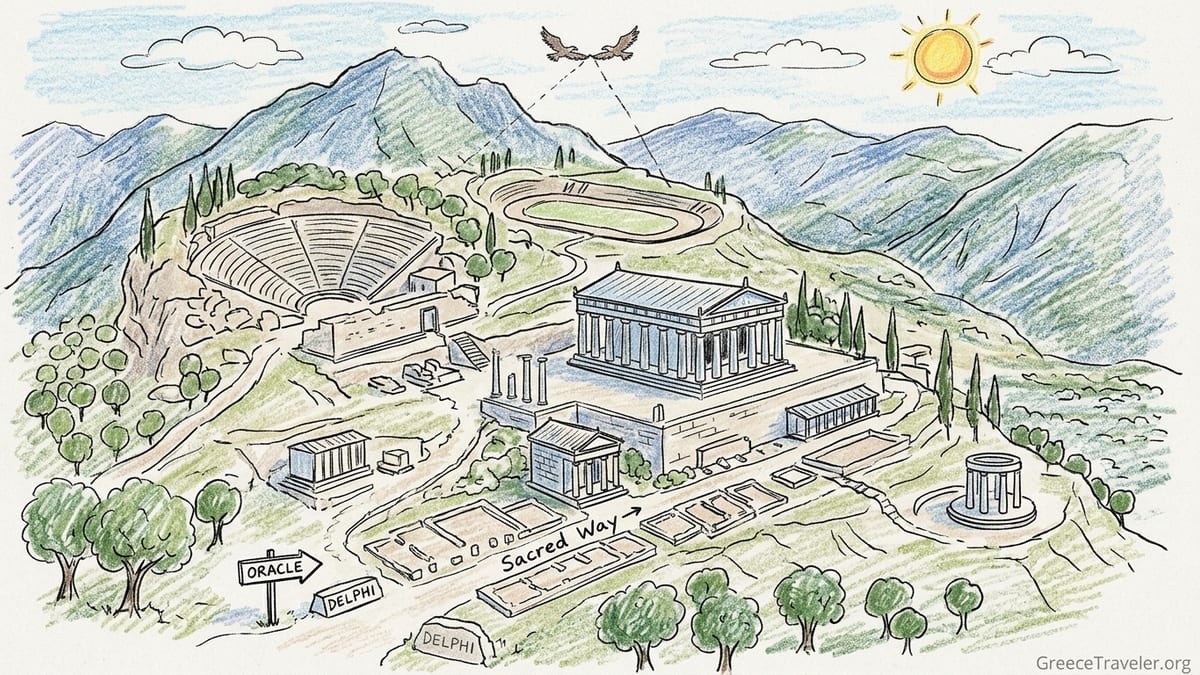
Why Delphi Matters: Sanctuary of Apollo and Oracle of the Ancient World
Delphi was the leading pan‑Hellenic sanctuary of Apollo, where city‑states and rulers came to consult the oracle and display their power. According to ancient tradition recorded by later authors and highlighted by UNESCO, Zeus released two eagles from opposite ends of the world and they met at Delphi, marking it as the omphalos, or “navel of the world.” The sanctuary developed from the 8th century BC and gained enormous religious and political influence by the 6th century BC, as Greek cities and foreign rulers alike sent dedications and consulted the Pythia, Apollo’s priestess, before taking major decisions.
In practical terms, this background explains why the site feels like a compact city of monuments rather than a single temple. Treasuries, stoas, statues and inscriptions line the Sacred Way as it climbs toward the Temple of Apollo. Above the temple sit the theatre and stadium, where crowds once gathered for the Pythian Games, a festival of athletics, music and drama. The ruins you walk through today are the physical traces of that world: foundations of buildings sponsored by specific city‑states, monumental bases that held bronze statues, and the remains of the temple where the oracle delivered prophecies.
Delphi is also important because of the way it illustrates the interaction between religion and politics. Inscriptions from the sanctuary record treaties, manumissions of slaves and diplomatic decisions that were symbolically anchored here to Apollo’s authority. When you pass the Athenian Treasury or the bases of statues from island cities such as Naxos, you are seeing real examples of how communities tried to win divine favour and broadcast their prestige in a shared, highly visible location.
For visitors in 2026, UNESCO listing and Greek state protection mean that Delphi is well presented and signposted, but it remains a genuine archaeological landscape. Paths are paved and roped, yet you still need to be ready for uneven ground, uphill sections and strong sun. Understanding in advance what each zone represents will make the climbing feel more purposeful and help you decide how much time and energy to devote to each part.
Tickets, Opening Hours and How Long to Allow
As of October 2026, the combined ticket for the Delphi Archaeological Site and the Archaeological Museum is set at 20 euros for full admission and 10 euros for those eligible for reduced admission. This combined ticket covers both the main sanctuary of Apollo and the museum immediately adjacent to the site entrance, and current Greek Ministry of Culture information confirms that site and museum are treated as a single ticketed unit. Reduced admission generally applies to specific categories such as EU students and seniors, while free admission days may apply on certain national dates. Because ticketing rules and prices can change, especially between winter and summer seasons, always confirm the latest rates and eligibility on official channels before your visit.
Opening hours vary seasonally, with extended hours in the main tourist months and shorter opening in winter. Recent Ministry of Culture announcements for 2026 indicate that many major sites operate roughly from early morning to late afternoon in the low season, and into the early evening in summer. For Delphi this usually means that a full‑day visit from mid‑morning to late afternoon is realistic in any season, but those travelling in winter should expect less daylight on site and a firmer closing time. Before you fix bus tickets or private transfers, check the currently published hours for the specific week you plan to visit, because they can shift slightly year to year.
In terms of time, a focused two‑hour visit allows you to see the core of the site plus a quick walk through the museum highlights, suitable for those on tight schedules or large coach tours. A half‑day of around four hours gives you time to walk the entire main sanctuary up to the stadium, detour to the Sanctuary of Athena Pronaia, and explore the museum without rushing. A full day, especially if you arrive early, makes it possible to break up the uphill sections, linger over key monuments, factor in a sit‑down lunch in modern Delphi village and perhaps add Hosios Loukas Monastery on the drive back.
If you are planning a self‑guided day trip from Athens by bus, a practical option in 2026 is to take a morning KTEL Fokidas departure from the Liosion bus station, such as the widely available 08:30 or 10:30 services, and return on the late‑afternoon or early‑evening bus. That schedule usually gives around five to six hours on the ground in Delphi, which is adequate for a complete site and museum visit with normal walking pace and breaks.
Layout of the Site: What Is Where and How Much Uphill
The main Delphi archaeological site occupies a steep, terraced slope directly above the modern village and the main road. The entrance and ticket office sit at the lower level, almost directly opposite the museum. From this lower gate you walk uphill along the Sacred Way to reach the Temple of Apollo and then further up again to the theatre and stadium. All of these elements Temple of Apollo, Sacred Way, Athenian Treasury, theatre and stadium lie within the principal archaeological enclosure covered by the combined ticket.
The Sacred Way is the backbone of the sanctuary, a winding path that climbs steadily from the entrance. Along its sides you pass foundations of treasuries and stoas, including the well‑preserved Athenian Treasury a small but striking building reconstructed using original marble blocks. The grade is moderate but continuous, similar to climbing several flights of stairs spread over a few hundred meters. There are occasional benches and low walls where you can pause, but older visitors or those with mobility concerns should be prepared for a sustained uphill walk rather than a flat loop.
The Temple of Apollo stands roughly halfway up the slope and forms the spiritual and visual focus of the sanctuary. Only the foundations and several columns remain, but from the temple terrace you look up to the theatre and down to the string of monuments along the Sacred Way. From here, paths continue further uphill to the theatre, which retains its cavea of stone seats and offers one of the classic views over the valley of the Pleistos River. The final climb to the stadium, set even higher in a natural hollow, is steeper and involves more uneven surfaces. Visitors who are short on time, sensitive to heat or not comfortable with steeper gradients may choose to stop at the temple or the theatre rather than tackle the full ascent to the stadium.
Outside the main enclosure sit two important related sites: the Castalian Spring and the Sanctuary of Athena Pronaia. Both are reached on foot from the main gate along the modern road and short paths, but each requires separate walking beyond what you do inside the primary site. The Castalian Spring lies slightly downhill toward the east and involves a modest but noticeable descent and return. The Sanctuary of Athena Pronaia, with its celebrated circular Tholos, is positioned a little further away and lower down the slope of the valley, so visiting it after a complete tour of the main sanctuary adds another stretch of walking and some elevation change, albeit on gentler gradients than the climb to the stadium.
Walking the Highlights: Temple, Treasuries, Theatre, Stadium and Springs
Most visitors begin by following the Sacred Way from the lower gate, passing the remains of early altars, bases of statues and smaller treasuries. The Athenian Treasury is the first monument that feels three‑dimensional rather than simply archaeological: its reconstructed Doric façade and compact chamber give a sense of how city‑states displayed their war spoils and valuable offerings. According to Greek Ministry of Culture interpretation, the Athenians dedicated this treasury after victories in the early 5th century BC, and its metopes once depicted labours of Herakles and Theseus, connecting the city’s achievements to heroic myth.
Continuing upwards, you reach the terrace of the Temple of Apollo, where the oracle operated. Here, signboards explain the layout of the temple and the role of the adyton, the inner area where the Pythia sat on a tripod over a chasm while delivering Apollo’s responses in an ecstatic state, later shaped into verses by priests. UNESCO notes that pilgrims came from across the Mediterranean to hear these oracles, and states sent lavish offerings to strengthen their standing with the god. Standing at the temple’s edge, it is worth pausing to picture processions of envoys, animals for sacrifice and interpreters of the oracle moving through this very space.
Above the temple, the stone seating of the theatre arcs around a stage that once hosted musical and dramatic competitions linked to the Pythian Games. From the upper rows you can look down on the temple and Sacred Way, with olive groves and the gorge beyond stretching toward the Corinthian Gulf. The path behind the theatre continues, more rugged now, to the stadium. This elongated space, with stone seating on one long side and an arched entrance in the Roman phase, was the setting for athletic contests. Reaching the stadium is particularly rewarding for photographers and visitors who want to experience the quieter upper areas of the sanctuary, but it does involve one of the steeper sections of the entire site.
Leaving the main enclosure, you can walk along the road to the Castalian Spring, where visitors to the oracle performed ritual washing before entering Apollo’s sanctuary. The surviving rock‑cut basins and channels are modest in scale but add another layer to understanding how an ancient pilgrim’s day at Delphi unfolded. Further along, the Sanctuary of Athena Pronaia occupies a terrace with several temple foundations and the iconic circular Tholos, partially reconstructed. Although smaller than the main sanctuary, this precinct gives a clearer view of individual buildings and is often less crowded, offering a useful contrast and a more contemplative atmosphere at the start or end of your visit.
The Archaeological Museum: Charioteer, Sphinx of Naxos and Other Essentials
The Archaeological Museum of Delphi, located just below the main site entrance, is integral to understanding what you see outdoors. Many of the most important dedications and sculptures from the sanctuary are preserved here, removed from the weather and displayed with explanatory texts. Entry is covered by the same combined ticket as the archaeological site, and the building is compact enough that you can see the principal highlights in about 60 to 90 minutes, or linger for several hours if you enjoy sculpture and epigraphy.
The single most famous object is the bronze Charioteer of Delphi, discovered in a sanctuary context and dated to the early 5th century BC. Greek Ministry of Culture interpretation highlights its exceptional preservation and the subtle rendering of the driver’s body beneath his long chiton. When you stand in front of it, pay attention to the inlaid eyes, the delicate detailing of the hair and the controlled posture that conveys self‑discipline rather than dramatic movement. It is a rare survival of a large bronze original rather than a Roman marble copy, and it gives a tangible sense of the quality of artworks that once filled the sanctuary.
Another key monument is the Sphinx of Naxos, a large sculpted sphinx originally set atop a high Ionic column near the Temple of Apollo. The museum presents it with part of its column, giving an impression of how it would have towered over worshippers on the ground. Dedicated by the island city of Naxos in the 6th century BC, it demonstrates how Greek cities used striking mythical figures to mark their presence at Delphi. Nearby, you will find fragments of the sculpted metopes and pediments from treasuries and temples, including reliefs associated with the Athenian Treasury and the temple itself, as well as smaller bronze and ivory offerings that speak to the variety of dedications.
UNESCO notes that the ensemble of artifacts and structures at Delphi illustrates a long history from the Archaic through the Roman periods, and the museum galleries are organised to reflect that chronology. Moving through them, you will see kouroi statues, later classical votive groups, Hellenistic architectural fragments and Roman imperial dedications. It is worth matching some of the large sculptures and inscriptions to their original locations on the site plans, so that when you walk the Sacred Way you can imagine not only the ruined bases, but the vivid statues, tripods and treasuries that once stood there.
Getting There, Parking, Accessibility and Practical Comfort
For independent travellers without a car, the most practical public transport option in 2026 is the KTEL Fokidas intercity bus from Athens. Buses depart from the Liosion bus station rather than the central Syntagma area. Recent consolidated timetable information shows several daily departures, with common options around 08:30 and 10:30 in the morning and returns in the late afternoon and early evening. The journey typically takes about 2.5 to 3 hours depending on traffic and intermediate stops, and standard one‑way fares are reported in the high‑teens in euros. You generally buy tickets at the station ticket office or via KTEL Fokidas’ own channels; third‑party sites and generic search engines are often unreliable for exact times, so always confirm close to your date of travel.
If you prefer to drive, Delphi is roughly a 2.5‑hour journey from Athens by motorway and mountain roads via Livadia and Arachova. The final stretch from Arachova to Delphi involves bends but is manageable in good weather. Several small parking areas line the main road near the museum and site entrance, and additional spaces can be found in the modern village slightly further along the road. In peak months you may need to be patient and walk a few extra minutes from where you park. Drivers combining Delphi with Hosios Loukas typically visit the monastery either on the way up from Athens or on the return journey, using secondary roads that connect via Distomo and the surrounding villages.
Accessibility at Delphi is limited by the hillside terrain. The lower parts of the site and the museum entrance are reachable with moderate assistance, and some paths near the entrance are surfaced. However, the Sacred Way, temple terrace, theatre and especially the stadium involve slopes and uneven stone surfaces that are challenging for visitors with serious mobility impairments or those who rely on wheelchairs. If accessibility is a significant concern, plan to spend more time in the museum, where exhibits are on largely level floors with clear circulation routes and seating, and treat any exploration of the outdoor site as a bonus rather than the core of the day.
Toilets are located at or near the museum and at designated points around the main entrance area, but facilities are sparse once you are inside the archaeological enclosure itself. It is wise to use the restrooms before you begin the uphill walk and again when you return for the museum. Shade is limited on the slopes, with only scattered trees and the occasional shadow from walls or treasuries, so bring a hat, sunscreen and water, especially from late spring through early autumn. Footwear should be sturdy with good grip; trainers or light hiking shoes are preferable to sandals with smooth soles, as polished ancient stone and gravel can be slippery even in dry weather.
Independent Visit, Licensed Guides, Audio Guides and Organized Excursions
How you structure your visit to Delphi will depend on your budget, confidence with logistics and desire for interpretation. An independent visit using public bus or rental car and exploring the site and museum on your own is the most flexible and often the most economical option. English‑language information panels at both the site and museum are fairly comprehensive, and many travellers bring a physical guidebook or offline map on their phone to supplement the official signage. This approach works especially well if you have at least half a day and are comfortable pacing yourself on the uphill sections.
Hiring a licensed local guide at Delphi adds considerable depth, especially for first‑time visitors who want to understand not just what the ruins are, but how the oracle functioned and how the sanctuary evolved. Licensed guides in Greece are regulated and must complete formal training; they can be booked in advance through agencies or sometimes engaged near the entrance, subject to availability and group size rules. A private guide is particularly valuable if you are travelling as a small group of friends or family and want tailored explanations, for example focusing on religion, architecture or political history.
Audio guides offer a middle path between full independence and a live guide. Some visitors download self‑guided audio tours produced by travel publishers or specialist companies, which use GPS or simple chapter cues to take you along the Sacred Way and through the museum. This solution suits solo travellers and couples who want structured commentary without being tied to a group schedule. When choosing an audio guide, make sure it is recent enough to match the current site layout and that it integrates both outdoor and museum sections, so you can keep a coherent narrative across your day.
Organized excursions from Athens, often sold through large tour operators or hotels, typically bundle coach transport, a licensed guide and sometimes lunch. They are convenient, especially for visitors with very limited time or those who prefer not to navigate bus stations and mountain driving. However, detailed reports from recent travellers suggest that many large‑group day tours offer only around 2 to 3 hours at the actual site and museum, with the rest of the day spent on the road and at tourist‑oriented stops. If you book an excursion, scrutinize the advertised “time on site” and whether the tour includes both the archaeological site and the museum interior, as well as any detours to nearby villages that may cut into your Delphi time.
Two‑Hour, Half‑Day and Full‑Day Itineraries, Plus Hosios Loukas
If you have only around two hours at Delphi, perhaps because you are on a tight coach schedule, prioritise the main slopes of the sanctuary and a rapid visit to the core museum pieces. Enter the site, walk purposefully up the Sacred Way past the Athenian Treasury, spend time at the Temple of Apollo terrace and continue at least partway up to the theatre for the classic view. On the return, head straight into the museum and visit the rooms with the Charioteer, the Sphinx of Naxos and the main Archaic and Classical sculpture. This compressed route sacrifices the stadium, Castalian Spring and Athena Pronaia, but preserves the key experience of the oracle’s setting and its finest artworks.
With a half‑day of approximately four hours, you can adopt a more measured pace. Begin with the main sanctuary in the cooler part of the day, walking the Sacred Way, exploring the Temple of Apollo, and climbing to the theatre and stadium if fitness allows. On the descent, pause at selected treasuries and viewpoints. After a short break for water or a snack, move into the museum for 60 to 90 minutes, following the chronological flow from early votive offerings to later sculptures. Time permitting, finish with a walk or short drive to the Sanctuary of Athena Pronaia and the Tholos, taking in the wider landscape and the role of Athena’s cult on the approach to Apollo’s domain.
A full day allows you to integrate Delphi into a wider central Greece experience without feeling rushed. One common pattern for travellers in a rental car is to leave Athens by mid‑morning, arrive at Hosios Loukas Monastery around late morning, spend an hour to 90 minutes there visiting the Byzantine churches and mosaics, then continue to Delphi for an afternoon and early‑evening visit, staying overnight in modern Delphi or nearby Arachova. Alternatively, day‑trippers focused primarily on Delphi might take the first KTEL bus, devote the late morning and early afternoon to the site and museum, enjoy a late lunch in the village with views over the valley and then walk to Athena Pronaia before catching the last bus back. Either way, combining Delphi with Hosios Loukas works best by car or private transfer, because coordinating two separate rural bus routes in one day is usually impractical.
Staying overnight in Delphi or in the nearby mountain town of Arachova transforms the experience. An evening arrival gives you time to settle, enjoy dinner with a view and begin early at the site the next morning before the largest tour groups arrive. In winter or shoulder seasons, staying locally also gives you flexibility in case of changeable weather, which can bring fog or rain to the slopes of Parnassus.
Recommended Walking Order and Nearby Accommodation
For most visitors, an efficient and comfortable walking order starts with the main sanctuary in the morning, when temperatures are lower and light is softer for photography. From the ticket gate, follow the Sacred Way at a steady pace, pausing briefly at major treasuries but saving in‑depth reading of panels for the main clusters such as the Athenian Treasury and the temple terrace. Continue up past the temple to the theatre, and if you still feel fresh, push on to the stadium, knowing you will descend the same route. This early push means you complete the most strenuous sections before midday heat sets in.
After you descend to the entrance, cross to the museum. Browsing the air‑conditioned galleries makes a pleasant contrast to the outdoor walk, and you can take breaks on benches as you move from room to room. When you leave the museum, assess your remaining energy. If you still feel keen to explore, walk or drive down to the Sanctuary of Athena Pronaia and, if time allows, the Castalian Spring, both of which round out the understanding of Delphi’s sacred topography. Finally, return to the modern village for a drink or meal before departure, using the panoramic views as a last look over the valley that framed the ancient sanctuary.
Modern Delphi offers a dense cluster of small and mid‑range hotels and guesthouses within walking distance of the site and museum, many of them on or just off the main street that runs parallel to the cliff edge. Rooms on the valley side often come with balconies looking out over the olive groves toward the sea, which makes even a one‑night stay feel special. In practical terms, staying in Delphi village means you can leave your car parked and walk to the site in 10 to 20 minutes, or descend from a KTEL bus stop straight to your accommodation without needing a taxi.
The town of Arachova, about a 15‑minute drive away, is another popular base, especially in winter when its alpine character and fireplace‑equipped guesthouses appeal to visitors heading to the nearby ski slopes as well as to Delphi. Choosing Arachova gives you a wider range of restaurants and evening ambiance, while still keeping you within a short drive of the ruins and museum. If you are travelling in peak summer or during weekend festivals, it is wise to book accommodation in either Delphi or Arachova in advance, as demand from domestic and international travellers can make the best‑located rooms scarce.
The Takeaway
Delphi rewards visitors who approach it as a complete landscape of sanctuary, museum and surrounding valley rather than a quick photostop at a single temple. Knowing that the Temple of Apollo, Sacred Way, Athenian Treasury, theatre and stadium all sit inside the main archaeological enclosure, while the Castalian Spring and the Sanctuary of Athena Pronaia with its Tholos require additional walking below the primary site, will help you plan your route and energy. The combined ticket of 20 euros full price and 10 euros reduced in October 2026 offers good value when you factor in the quality of the Archaeological Museum and its star exhibits, above all the Charioteer and the Sphinx of Naxos.
Whether you come independently by KTEL bus, rent a car and fold Delphi into a wider central Greece itinerary with Hosios Loukas, or join an organized excursion from Athens, be realistic about how much time you will actually spend at the sanctuary and museum. Use licensed guides or well‑produced audio tours if you want deeper interpretation, wear solid shoes, carry water and sun protection, and be prepared for significant uphill walking if you want to reach the theatre and stadium. Plan your day around the site’s current opening hours, always verified shortly before travel, and consider staying overnight in Delphi or Arachova if you value a quieter, more flexible experience. With thoughtful planning, your time at Delphi will feel less like a box ticked and more like a day spent in dialogue with one of the most resonant sacred landscapes of the ancient Mediterranean.
FAQ
Q1. How much does it cost to visit the Delphi archaeological site and museum in October 2026?
As of October 2026, the combined ticket for the archaeological site and the Archaeological Museum is 20 euros for full admission and 10 euros for eligible reduced admission. Because ticket prices and concessions can change, especially between winter and summer seasons, visitors should confirm the current rates with official Greek Ministry of Culture information before their trip.
Q2. What are the opening hours at Delphi and do they change by season?
Delphi’s opening hours follow the national pattern of longer days in the main tourist season and shorter ones in winter, typically opening in the morning and closing in the later afternoon or early evening depending on the time of year. Exact hours can vary from one year to the next and may be adjusted for public holidays, so travellers should consult the most recent Greek Ministry of Culture schedule shortly before their visit, rather than relying on older guidebooks or third‑party websites.
Q3. How difficult is the walking at Delphi, and is the site suitable for visitors with limited mobility?
The main archaeological site is built on a steep slope, and visiting the Temple of Apollo, theatre and stadium involves sustained uphill walking on uneven stone and gravel. While the lower areas near the entrance and the museum are more accessible, and some paths are surfaced, Delphi is challenging for wheelchair users and visitors with serious mobility limitations. Those with concerns may choose to focus on the museum and the lowest terraces of the sanctuary, treating any higher sections as optional depending on how they feel on the day.
Q4. Where exactly are the Temple of Apollo, Athenian Treasury and theatre located within the site?
All three monuments are inside the principal archaeological enclosure entered from the ticket gate above the main road. The Athenian Treasury stands along the Sacred Way a short distance uphill from the entrance, the Temple of Apollo occupies a terrace roughly midway up the slope, and the theatre rises directly above the temple, accessible by continuing further uphill on marked paths. The stadium lies even higher again, reached by a steeper extension of the same route.
Q5. How can I get to Delphi from Athens without a car in 2026?
The simplest car‑free option in 2026 is the KTEL Fokidas intercity bus from Athens’ Liosion bus station, with several departures each day and a journey time of about 2.5 to 3 hours. Tickets are usually bought at the station ticket counters or through the operator’s own sales channels, and recent timetable checks show popular morning departures around 08:30 and 10:30 and returns in the late afternoon or early evening. Because schedules can change, travellers should confirm exact departure times close to their travel date.
Q6. Is it better to visit Delphi independently or on an organized tour from Athens?
Independent visits using public bus or rental car provide more time on site and full control over your pace, which many travellers appreciate given Delphi’s uphill terrain. Organized coach excursions bundle transport and a licensed guide, removing logistical stress, but often allow only two to three hours at the site and museum once driving and lunch stops are accounted for. Travellers who value detailed interpretation but also want flexibility sometimes combine an independent arrival with a pre‑booked local licensed guide or a self‑guided audio tour.
Q7. Can I combine Delphi with Hosios Loukas Monastery in one day without rushing?
Yes, combining Delphi with Hosios Loukas in one day is realistic if you have a rental car or private transfer and plan your timings carefully. A common pattern is to visit Hosios Loukas first, spending around one to one and a half hours there, then continue to Delphi for an afternoon and early‑evening visit, or to stay overnight near Delphi. Doing both on the same day by public transport is usually impractical because the monastery and Delphi are served by different regional routes with limited connections.
Q8. What should I wear and bring for a comfortable visit to Delphi?
Visitors should wear sturdy, closed‑toe shoes with good grip, such as trainers or light hiking shoes, because the paths involve gravel, steps and ancient stone that can be slippery. A hat, sunglasses and sunscreen are strongly recommended from late spring through early autumn, as shade is limited on the slopes, and carrying a refillable water bottle is essential. Light layers are useful in shoulder seasons, when mornings can be cool but midday temperatures rise quickly on the exposed terraces.
Q9. How much time do I need to see both the archaeological site and the museum properly?
A minimum of about four hours makes it possible to explore the main sanctuary up to the theatre and stadium at a comfortable pace and then spend 60 to 90 minutes in the Archaeological Museum focusing on highlights such as the Charioteer and the Sphinx of Naxos. Those with only two hours will need to prioritise, concentrating on the Sacred Way, Temple of Apollo and a swift pass through the principal museum rooms. Travellers with a full day in the area can add the Sanctuary of Athena Pronaia and enjoy longer breaks without feeling hurried.
Q10. Where should I stay if I want to visit Delphi early or avoid crowds?
Staying overnight in modern Delphi village is the most convenient choice, placing you within walking distance of the archaeological site and museum and giving you the chance to enter soon after opening, before many coach tours arrive. Alternatively, the nearby mountain town of Arachova offers more accommodation and dining options and is about a 15‑minute drive from the ruins. Booking ahead is advisable in high season or around local holidays, when demand from both international visitors and Greek holidaymakers increases.