


On the first weekend of February 2026, I paid 210 euros for a standard double room in Arachova that should have cost half the price. The hotel was a stone-built boutique property a few steps above the main street, touted online as a romantic escape with mountain views, generous breakfast and easy access to the Parnassos ski resort. In reality, my partner and I dragged our bags up a steep, icy lane from a chaotic roadside parking spot, opened the door to a room overheated by a struggling radiator, stared at a view dominated by corrugated metal roofs, and listened all night to bar noise echoing through thin walls. By Sunday evening, stuck in a line of cars crawling back toward Athens in the dark, I started to question whether Greece’s most fashionable winter village has begun to believe its own “Greek Aspen” myth a little too much.
A Winter Weekend That Broke the Spell
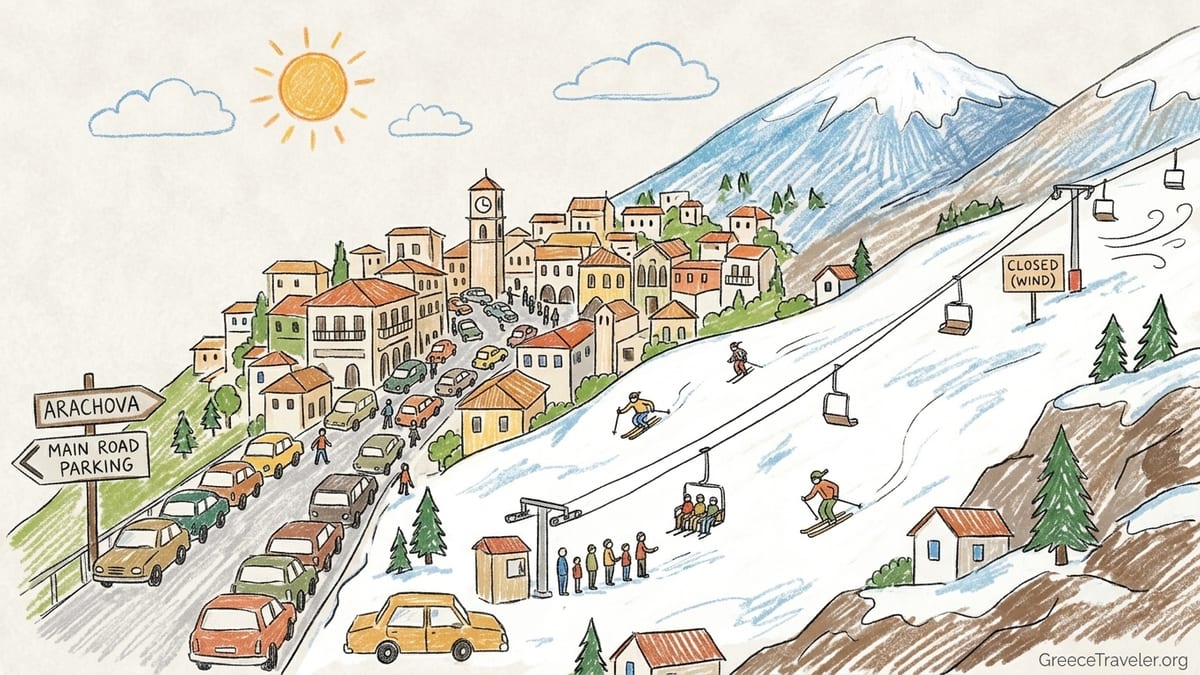
The facts of that weekend are simple. I booked two nights, Friday 7 to Sunday 9 February 2026, in a mid-range boutique hotel in central Arachova. The rate was 210 euros per night for a standard double, breakfast included, plus an informal request from reception to “please leave the car somewhere on the main road, we do not guarantee parking.” When we arrived from Athens after 9 pm, that translated into twenty minutes of circling in traffic before edging the car into an improvised space along the national road, hoping it would not be blocked in by the time we wanted to leave for the ski slopes at dawn.
Inside, the room was not terrible. It had a small balcony, a fireplace that cost extra to use, and a modern bathroom. But nothing about it matched the price point. The mattress sagged, the mini fridge rattled, the radiator took the room from chilly to stuffy without ever feeling properly insulated, and the much-advertised “view of the valley” required leaning over the balcony rail at an awkward angle between two buildings. Breakfast the next morning was a familiar Greek buffet of bread, eggs, yoghurt and a few pies, pleasant but far from luxurious.
What hit harder than the room itself was the feeling of being processed. Walking through the village that Saturday, the narrow main street was almost gridlocked with SUVs from Athens. It took us more than half an hour just to secure a coffee and cheese pie, and any hope of a long, quiet lunch disappeared when we heard the same phrase at three different tavernas: “Full until five, unless you reserved days ago.” At dinner, we finally squeezed into a table on the condition that we would vacate within ninety minutes for the next sitting. The entire village felt like a weekend production line designed around peak demand from the capital.
The ski day on Parnassos did not redeem the experience. The alarm sounded at 6.30 am, we were in the car by 7.15, yet road congestion to the Kellaria base area had already started by the Zemenos area. By the time we parked almost a kilometre from the lifts and queued for our passes, the snow on the lower slopes was thin and patchy, and strong winds had already closed at least one higher chairlift. With day passes listed around 30 to 35 euros for adults in the 2025 to 2026 season depending on day and category, two people quickly added more than 60 euros to an already expensive weekend, for a ski area that was only partially open.
How Athens Weekends Inflate Arachova’s Prices
Arachova sits roughly 150 kilometres from Athens, a two to two-and-a-half hour drive along the main highway toward Lamia and then up through Livadia. That geography is the foundation of its winter economy. It is close enough for Athenians to leave after work on Friday, ski on Saturday and Sunday, and be back in the city by Sunday night. It is also just far enough, high enough and pretty enough to feel like an escape. The combination has turned the village into one of mainland Greece’s sharpest examples of weekend surge pricing.
Recent accommodation surveys and booking engines show a stark pattern. Standard double rooms that sell for around 80 to 110 euros on midweek winter nights in Arachova can spike to 150 to 220 euros on peak Saturdays, with design-focused boutique suites and spa resorts easily topping 250 euros when conditions are good on the mountain. Guides for visitors now explicitly warn that from mid December to March, especially around Christmas, New Year and snowy weekends, Arachova fills almost completely, availability shrinks and prices climb steeply. Weekends do not just cost more than weekdays. They feel fundamentally different in rhythm and attitude.
This intense weekend demand affects everything. Rooms are sold first on location and perceived glamour, then on actual quality. Restaurants operate on strict sittings and reservations, especially for groups from Athens who book weeks ahead. Traffic along the main street can resemble a slow procession of luxury cars between 8 pm and midnight, with locals timing errands to avoid the peak. What might be a charming, slow-paced mountain village on a Tuesday in January becomes something closer to a compact winter strip on a Saturday night in February, without any additional space to absorb the flux.
If you arrive in Arachova expecting the flexibility of a typical Greek small town, this can be a shock. Walk-in tables vanish. Parking close to the centre becomes a matter of luck and patience. Hotel staff are professional but clearly stretched. With only a limited number of rooms within walking distance of the bars and tavernas, that pressure on central accommodation is exactly what allows a fairly ordinary room like mine to command 210 euros a night.
The “Greek Aspen” Image Versus On-the-Ground Reality
The phrase “Greek Aspen” appears often in lifestyle coverage of Arachova and Parnassos. The comparison is meant to evoke stylish ski outfits on the cobbled streets, après-ski bars with cocktails and wine lists, and a sense that this is where urban Greeks come to see and be seen in winter. There is some truth in that branding. On a peak Saturday, you will indeed see expensive down jackets, curated chalet-style interiors, and hotel lounges that lean heavily into stone, timber and designer lighting.
But Aspen is not only about luxury boutiques and buzzing bars. It is also a full-service mountain resort with an enormous ski domain and polished infrastructure. Parnassos, for all its improvements over the last decade, is still a medium-sized Greek ski centre. It offers roughly three dozen kilometres of pistes served by a mix of modern hybrid gondola-chairlifts and older surface lifts. When everything is open and snow is good, it is a fun and varied area for a day or two, especially for intermediate skiers. Yet it is not in the same category as major Alpine or Rocky Mountain resorts, and winter weather on this Mediterranean mountain is becoming more volatile.
Official reports and Greek climate coverage have started to highlight the shrinking snowfall on Greek mountains, including Parnassos. Local residents in Arachova speak of winters when snow used to reach village level for weeks, compared with recent seasons where reliable cover is usually found mainly on the higher slopes of the ski centre. The 2024 to 2026 winters, while still delivering good days, have seen more frequent rain events at mid altitude, high winds that force temporary lift closures, and thaw-freeze cycles that limit the number of open runs, particularly early and late in the season.
In this context, the Greek Aspen narrative can begin to feel like heavy marketing layered on top of a fragile product. What visitors reliably purchase every winter weekend are stylish rooms, stone-and-timber ambience and lively après-ski scenes. What they hope to purchase, but cannot be guaranteed even in January, is a fully open ski area beneath bright blue skies and packed powder. When a full-price lift pass buys access to only a fraction of the pistes because of wind or lack of snow, the discrepancy between image and reality becomes obvious.
What You Really Get For 200 Euros A Night
Stripping away the branding, it helps to compare the real contents of a typical high-season Arachova weekend with what you pay. In my case, the 210 euros per night bought a compact double room with a decent bed, central heating that struggled to maintain a stable temperature, a fireplace that required an extra fee for firewood, breakfast and no guaranteed parking. The bathroom was modern but small, and hot water pressure fluctuated when the hotel was full in the morning. The balcony view captured a slice of the Pleistos valley, but only if you ignored the rooftops and air-conditioning units between you and the mountains.
In quieter Greek mountain towns, a similar room might cost between 70 and 120 euros, often with included parking on site and a more relaxed breakfast experience. Even within the greater Parnassos area, the same winter weekend dates reveal sharp contrasts. Search engines and local guides suggest that standard doubles in nearby Delphi, fifteen to twenty minutes down the road, often sell from around 60 to 120 euros on winter weekends, with several hotels clustered along the main street offering views over the olive groves to the Gulf of Corinth. In Eptalofos, a village on the opposite side of Parnassos, and in Polydrosos, traditional guesthouses and small hotels frequently quote winter weekend rates in the 80 to 130 euro range for well-heated rooms, often with easy street parking directly outside.
Even within the Arachova region itself, the Livadi plateau above the village offers a different price and product point. Accommodation here is more spread out, often in chalet-style complexes with parking included and easier morning access to the ski centre. Recent listings for Livadi show stylish suites and family chalets starting from roughly 130 to 170 euros on winter weekends, rising higher for large houses or private hot tubs but generally undercutting the most fashionable central Arachova boutiques. The trade-off is that you drive down to the village for dinner or nightlife instead of walking.
When you factor in utilities and services that are critical in winter, the premium in the village is hard to justify. Heating in my central Arachova hotel never felt as solid as in cheaper, simpler guesthouses I have used in Eptalofos and Polydrosos, where thick stone walls and pellet stoves keep rooms properly warm without constant adjustment. Breakfast, while perfectly acceptable, offered nothing beyond what you might find at a three-star coastal hotel in summer. Parking, which matters enormously in icy conditions, was an afterthought. In effect, a sightseeing surcharge for being able to step directly into the evening promenade.
Counting the Full Cost: Arachova vs Cheaper Bases
For a clearer comparison, consider what a typical winter Saturday to Sunday for two people might cost in 2025 to 2026 based on publicly available price ranges. In Arachova, a centrally located boutique double at 180 to 220 euros per night is common on snowy Saturdays. Add a day pass for Parnassos at roughly 30 to 35 euros per adult in main season, so around 60 to 70 euros for two. Basic equipment rental at the ski base, combining skis, boots and poles, often starts from 20 to 30 euros per person per day, so around 40 to 60 euros for two. A group lesson for beginners, if booked through a local ski school, may add another 30 to 50 euros per person for a couple of hours.
By the time you include a simple après-ski stop for drinks and snacks, dinner at a popular taverna in Arachova where a meal for two with wine can easily reach 40 to 70 euros, fuel for the round trip from Athens at roughly 50 to 70 euros depending on your car and petrol prices, and incidental coffees and desserts, a single overnight weekend focused on one day of skiing can realistically reach 450 to 600 euros for two people, even without extravagant choices.
Now shift the base to Delphi for the same dates. Choose a well-reviewed mid-range hotel with sea views at around 90 to 120 euros for a double on a winter Saturday. The drive to Parnassos is longer, with at least 45 minutes to the ski base instead of 30 from Arachova, and you climb from sea-level conditions up into the mountain. Lift passes, rentals and lessons cost the same once you arrive. Dinner in Delphi, however, tends to be slightly cheaper, with plenty of tavernas competing along the main road. Overall, your weekend might come in closer to 350 to 500 euros for two, trading some driving time for a lower hotel bill and a calmer evening atmosphere.
In Eptalofos or Polydrosos, on the northern side of the mountain, winter weekend doubles in atmospheric guesthouses often sit around 80 to 130 euros. These bases offer faster access to the Fterolakas side of Parnassos and quieter evenings with just a handful of tavernas and cafes. Your total weekend cost can drop again, especially if you are content with simpler meals and accommodation. Livadia, a small city in the plains used by some locals as a practical base, may bring hotel costs down further into the 70 to 110 euro range for basic but warm rooms, but you accept a roughly fifty-minute mountain drive to the ski centre each morning.
None of these figures pretend to be precise for every date and every property, and they change year by year. What they illustrate is that the bulk of the price difference between Arachova and its neighbours sits in the accommodation and food bill, not in skiing itself. The lift pass on Parnassos costs roughly the same whether you sleep in an expensive suite in the village or a modest pension thirty kilometres away. The mountain does not reward you with extra vertical just because you paid boutique rates the night before.
Snow, Wind and the Risk of a Half-Open Mountain
All winter trips to low and mid-altitude ski areas carry snow risk, but Parnassos has some particular vulnerabilities that matter when you are paying a premium to be nearby. Official descriptions of the ski centre mention around nineteen marked runs and more than a dozen lifts across the Kellaria and Fterolakas sectors. On paper, it is one of the largest organised ski resorts in Greece. However, the number of lifts and pistes open on any given day depends heavily on snowfall, temperature, and especially wind.
Frequent visitors and local snow reports from recent seasons paint a consistent picture. Early season openings have been delayed on several occasions due to insufficient snow, with some Decembers operating only a small part of the terrain. Strong winds on the upper ridges are a regular issue, leading to temporary suspension of key chairlifts and gondolas. When that happens, even if there is adequate snow on the ground, skiers are squeezed onto a reduced network of lower lifts, creating longer queues and limiting variety.
Climate reporting on Greece has started to frame this as more than a one-off annoyance. Warmer, less predictable winters mean that snow at elevations that once felt safe is now less reliable. Parnassos, like other Greek resorts, compensates with snowmaking in some areas, but it cannot control rain events or prolonged thaws. For Arachova’s value proposition, this matters. Guests commit to high hotel prices, restaurant reservations and congested weekends in exchange for the promise of accessible skiing. If you arrive to find that only a handful of runs are open and upper lifts are closed for wind, the emotional gap between what you paid for and what you receive widens quickly.
There is also the visibility problem. Mediterranean weather can flip from bright sun to dense cloud within hours. On several midwinter visits, I have watched the upper slopes of Parnassos retreat into a grey soup by lunchtime, with skiers either abandoning the day or sticking to lower, less interesting runs. None of this is unique to Greece, but on a mountain that offers barely over thirty kilometres of piste in perfect conditions, even a partial closure or poor visibility day constrains your options sharply compared with larger European resorts. In such moments, the Greek Aspen slogan feels particularly out of place.
Why People Still Love Arachova
For all these criticisms, it would be dishonest to claim that Arachova’s appeal is purely artificial. On a cold, clear evening, the village is gorgeous. Stone houses climb the hillside, narrow alleys climb even steeper, and the illuminated clock tower watches over the main square. Traditional delis showcase local cheeses, sausages and pasta. Bakeries stay open late with trays of galaktoboureko and baklava. The air smells of woodsmoke and grilled meat, and bars hum with conversation until well after midnight.
The architecture helps. Unlike some purpose-built resorts, Arachova existed long before skiing arrived. Many newer hotels and guesthouses respect the local vernacular, using stone, timber and tiled roofs in proportion rather than overwhelming the hillside with glass and concrete. When you secure a room that genuinely looks over the valley toward Delphi, the view at sunrise or after snowfall can be extraordinary. Paired with a good taverna meal, perhaps a rich kokoretsi or slow-cooked goat with local wine, these are the moments that keep people returning despite the costs.
There is also the undeniable social element. For many Athenians, Arachova is less about skiing performance and more about winter theatre. The main street becomes a catwalk of expensive jackets and boots, as friends bump into each other outside bars and arrange impromptu group dinners. If your idea of a winter weekend is as much about being part of that scene as about carving perfect turns, then Arachova can deliver in a way that quieter bases never will. The village offers more choice of bars, more late-night energy and a stronger sense of occasion than Delphi, Eptalofos or Polydrosos.
My issue is not that Arachova has become fashionable, but that this fashion sometimes obscures uncomfortable questions about value. Stylish interiors and lively nights are not wrong. Yet when prices for quite ordinary rooms with thin walls and mediocre breakfast reach towards levels you could also spend in a Scandinavian or Alpine resort with deeper snow and more lifts, travellers deserve a clear-eyed view of what exactly they are buying.
The Takeaway
After several winters of watching Arachova’s profile and prices rise, including that overpriced February 2026 weekend, I have stopped recommending the village as a default base for first-time skiers or visitors to Delphi. The combination of inflated weekend rates, fierce competition for parking and restaurant tables, and the inherent snow and wind risks of Parnassos make it a high-variance bet. When everything aligns, you can enjoy stylish evenings, convenient access to the slopes and a sense of being at the heart of Greece’s winter scene. When conditions misfire, you are left wondering why you paid a capital city price for a mountain experience that feels partial and crowded.
Where, then, is the premium worthwhile? If your priority is nightlife, people-watching and being able to walk from your room to multiple bars and restaurants in five minutes, then paying more for a central Arachova hotel on a specific, well-chosen weekend can make sense. Aim for periods when fresh snow is forecast, avoid the absolute peak of Christmas and New Year, and accept that you are paying for atmosphere as much as for infrastructure. In those circumstances, look for properties that honestly disclose their parking situation, heating type and room size, not just their design flourishes.
For serious skiing on Parnassos, or for cost-conscious travellers, I now lean strongly toward bases like Livadi, Eptalofos and Polydrosos. Livadi gives you a head start on the morning drive to the slopes, usually with easier parking and more space, at prices that are high but often below Arachova’s top tier. Eptalofos and Polydrosos offer thick snow in the forest when the mountain is blessed, friendly guesthouses with hearty breakfasts and wood-burning stoves, and quieter evenings where you talk with owners over dinner instead of shouting over bar music. You lose some après-ski buzz, but you gain better value and less stress.
For Delphi, my advice is even clearer. Stay in Delphi itself or down on the coast in Itea or Galaxidi unless your trip falls in deep winter and you specifically want that mountain village feeling. The archaeological site and museum are best visited early in the morning, and waking up a short drive away matters more than having a trendy bar downstairs. Delphi hotels are often significantly cheaper than their Arachova counterparts for similar levels of comfort, and coastal towns offer a different, gentler kind of Greek winter charm.
The myth of Arachova as a Greek Aspen will probably endure. It serves the interests of local businesses, lifestyle magazines and weekend skiers who enjoy the glamour. My own conclusion, after paying high-season prices for limited benefits, is more tempered. Arachova is a beautiful mountain village with excellent food, handsome architecture and entertaining nights. It is also one of the most aggressively commercialised winter destinations in Greece, where value for money erodes quickly on busy weekends. Go once, perhaps, to see what the fuss is about, but go with clear eyes and a firm budget. Then, if you fall in love with Parnassos itself rather than the shop windows, consider staying elsewhere next time.
FAQ
Q1. Is Arachova worth it for a first ski weekend in Greece?
For a first ski weekend, Arachova is convenient and lively, but expensive. You pay a premium for atmosphere and proximity, not for an exceptional ski area, so consider whether nightlife and restaurant choice matter more to you than saving money by staying in nearby villages.
Q2. How far is Arachova from the Parnassos ski centre?
Arachova is roughly 27 kilometres by road from the main Kellaria base of Parnassos, usually around 30 to 40 minutes of driving in normal winter conditions. On busy or snowy weekends you should allow longer because traffic and chain checks can slow the ascent significantly.
Q3. How expensive are hotels in Arachova compared with nearby towns?
On winter Saturdays, central Arachova hotels commonly charge between about 150 and 220 euros for standard doubles, with higher prices for luxury suites. In contrast, similar dates in Delphi, Eptalofos, Polydrosos or Livadia often see doubles from around 70 to 130 euros, so your accommodation costs can easily be 30 to 50 percent lower outside Arachova.
Q4. What should I budget for a ski day for two on Parnassos?
As a broad guide for the 2025 to 2026 season, two adult day passes can cost around 60 to 70 euros in total, equipment rental about 40 to 60 euros, and a shared lesson perhaps another 60 to 100 euros, depending on duration and level. Add food, drinks and fuel, and a single ski day for two often lands somewhere between 180 and 250 euros before accommodation.
Q5. How reliable is the snow on Mount Parnassos?
Snow on Parnassos is increasingly variable. Good seasons still happen, but there have also been winters with delayed openings, rain at mid altitudes and more frequent high winds that close upper lifts. If skiing is your main reason to travel, it is wise to watch conditions and book flexibly rather than assuming January and February will always deliver plentiful snow.
Q6. Is driving and parking in Arachova difficult in winter?
Driving up from Athens is straightforward in dry conditions but can become stressful on snowy weekends, especially near the village and toward the ski centre. Parking in central Arachova is often the most frustrating part, with limited formal spaces, narrow streets and heavy demand at peak times, so choosing accommodation with guaranteed parking or staying in Livadi or another nearby base can make a big difference.
Q7. How does Arachova compare with Delphi as a base for visiting the ruins?
Arachova offers more nightlife, higher prices and a mountaintop atmosphere, while Delphi puts you closer to the archaeological site and is usually cheaper. If your main goal is to see the ruins early in the morning, Delphi is the more practical choice. Arachova makes more sense if you also plan to ski or want a classic Greek winter village experience.
Q8. Are Livadi, Eptalofos or Polydrosos good alternatives to Arachova?
Yes, all three work well as quieter and often cheaper bases for skiing on Parnassos. Livadi provides quick access to the ski centre with chalet-style accommodation, while Eptalofos and Polydrosos on the northern side offer traditional guesthouses, forest scenery and calmer evenings, though you will drive into Arachova if you want its restaurants or nightlife.
Q9. When is the best time to visit Arachova if I want fewer crowds?
Midweek visits between January and early March usually bring lower prices and thinner crowds than weekends, as long as snow conditions are decent. Late November, early December and late March can also be quieter, but snow cover is less certain, so these shoulder periods suit travellers who care more about the village and nearby hikes than guaranteed skiing.
Q10. If I have to choose one night only, should I stay in Arachova or elsewhere?
If you have only one night and want to experience the full winter scene of bars, shops and village lights, spending it in Arachova on a reasonably priced date can be worthwhile. If you care more about value, a good night’s sleep and easier logistics, you may be happier staying in Delphi, Livadi, Eptalofos or Polydrosos and visiting Arachova for a few hours instead of sleeping there.