


I wanted to love my Delphi day trip from Athens. Instead, somewhere between the third souvenir stop and a sprint past the Temple of Apollo, I realised the day was not designed for people who actually care about the site. It was built for headcounts, commissions and schedules. After retracing the journey independently, timing every transfer and queue, I am convinced that most standard Athens–Delphi day tours simply do not give visitors enough time to experience the sanctuary properly.
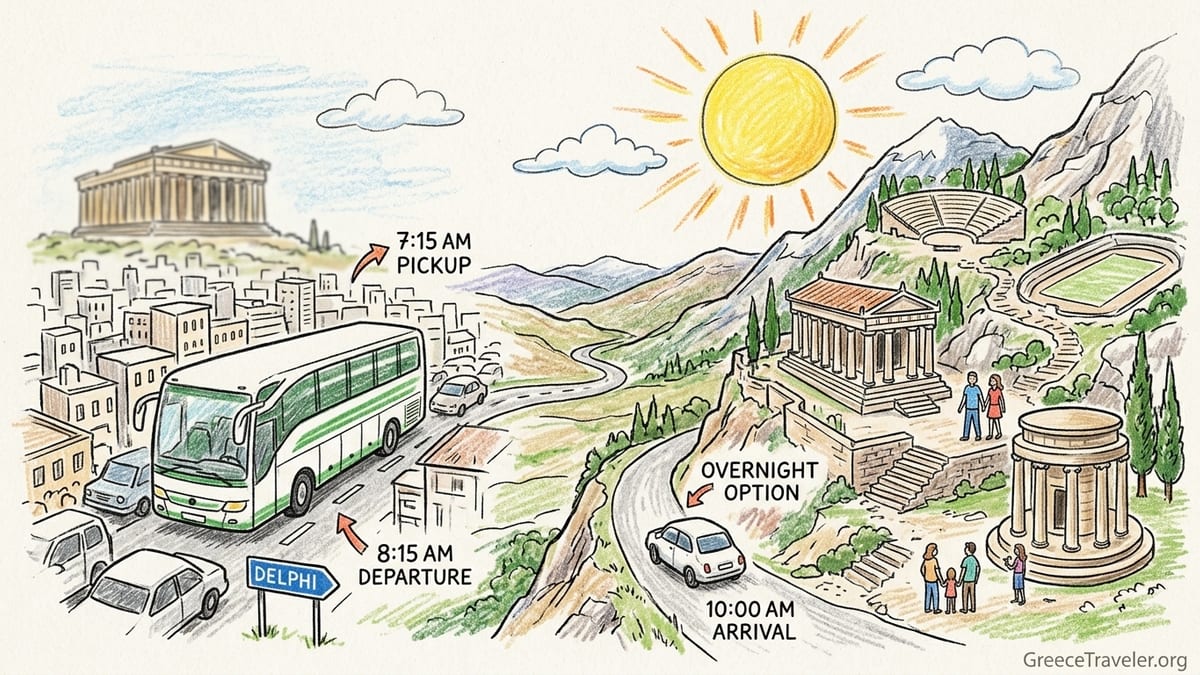
Reconstructing a “Classic” Delphi Day Trip From Athens
My first visit to Delphi followed the pattern most visitors are offered in Athens: a full-day coach excursion marketed as “10–11 hours” with pickup at central hotels, a guided tour of the archaeological site and museum, a taverna lunch, and a short pause in the mountain village of Arachova on the return. Several large operators sell near-identical itineraries, typically departing central Athens between 8:15 and 8:45 in the morning and promising to return around 18:30–19:30, depending on traffic and hotel drops.
Door to door, my day began at 7:20, when a minibus collected me from an Athens hotel near Syntagma. We spent the next 40 minutes crawling across the city, circling through Omonia and Metaxourgio to gather thirty-odd people from half a dozen pickup points, before finally consolidating onto the main coach near the National Archaeological Museum. Only at 8:15 did we actually leave Athens and join the highway toward Lamia and Mount Parnassus. By then, almost an hour of the “tour” had passed and we had not yet left the city.
The journey to Delphi itself is often described optimistically as “about 2.5 hours.” In practice, it is closer to three once you factor in departure delays, a coffee-and-toilet stop at a highway service station, and slower speeds on the final stretch into the mountains. On my tour, we left central Athens at 8:15, stopped for 20 minutes at 9:40, and finally rolled into the modern village of Delphi just after 11:15. At this point, four hours had elapsed since my hotel pickup, and I had not yet seen a single column of the sanctuary.
How Much Time Do You Really Get at Delphi?
The brochures for my coach tour promised a “guided visit to the archaeological site and museum of Delphi” along with “free time” to explore and take photos. That sounds generous. In reality, we were given roughly 1 hour and 20 minutes for the site and 40 minutes for the museum, including all walking and regrouping. Anyone who lagged behind risked missing the bus or sacrificing lunch.
When we arrived, the coach parked above the site and we walked down as a group to the ticket booth. The combined admission to the Delphi archaeological site and museum is officially 20 euros in October 2026, with reduced prices for eligible visitors. This ticket was not included in the advertised tour price, so the entire group had to queue and pay individually. Even with a cooperative guide, this added around 15 minutes before we could actually enter. Inside the gate, the guide moved us at a steady but unrelenting pace past the Roman agora, the Athenian Treasury and the Stoa of the Athenians toward the Temple of Apollo.
We paused at the temple for an excellent 15-minute explanation of the oracle and the history of the sanctuary. Then came a familiar compromise: the guide announced that there would not be enough time for everyone to continue up the Sacred Way to the theatre and stadium together and still make it to the museum before our lunch slot. The choice was stark. Either climb quickly on your own, skipping most commentary and several significant monuments such as the polygonal wall and various treasuries, or stay with the group and accept that you would see only a fraction of the upper sanctuary.
Most people tried to split the difference. I joined the subset who marched up to the theatre, snapped a few photos, and continued toward the stadium, only to turn back halfway when we realised the time. By the time I rejoined the guide near the exit, my shirt was soaked from the midday heat and I had spent more time watching my watch than reading inscriptions. Our “free time” on the site had been reduced to about 25 rushed minutes after the guided section, nowhere near enough to absorb the landscape or revisit anything that had caught my interest.
Can You See Sanctuary, Museum, Athena Pronaia, Theatre and Stadium?
Looking back at the map, the standard day-trip promise feels fundamentally unrealistic. Delphi is not just one compact ruin. There is the main Sanctuary of Apollo, the superb Archaeological Museum of Delphi, the Sanctuary of Athena Pronaia with its famous tholos, the theatre perched above the temple, and the stadium even higher up. In theory, all of this is included in the same entry ticket. In practice, during my coach tour there was simply no way to see it all without treating Delphi like an obstacle course.
After the site, we were herded onto the coach and driven a very short distance to the museum car park. The entrance here involved another short queue for bag checks and ticket scans. Inside, the guide focused on a small selection of highlights: the Sphinx of the Naxians, the Charioteer of Delphi, and the friezes from the Siphnian Treasury. This was well delivered, but it ate most of the available time. With just 40 minutes allotted, there was barely any opportunity to linger in front of the bronzes or double back to earlier rooms.
Most damning of all, the itinerary left zero time for Athena Pronaia, the circular tholos that appears in virtually every photograph of Delphi. The sanctuary is lower on the slope and not directly connected to the museum path. Visiting it would have required either walking an extra 15–20 minutes each way or moving the coach, which the schedule did not permit. When I asked, the guide admitted that the tour rarely manages to fit it in, especially in summer when queues, crowds and heat slow everyone down. We were told to take pictures from the bus as we drove past.
On paper, a 10–11 hour excursion might seem sufficient to cover everything. In reality, once you subtract 6 hours of driving, another 60–90 minutes of hotel pickups and drop-offs, at least 30 minutes of toilet and coffee stops, time to buy tickets, and a full sit-down group lunch, the actual “Delphi time” shrinks to roughly 2.5 hours. It is just enough to tick off the Sanctuary of Apollo and skim the museum. It is nowhere near enough for a thoughtful visit that includes Athena Pronaia, the climb to the stadium, and moments of quiet in the terraces between tour groups.
Heat, Hills, Queues and Crowds: The Hidden Time Sinks
The time pressure on standard tours is compounded by factors that brochure copy rarely advertises. Delphi clings to the slopes of Mount Parnassus, and the Sanctuary of Apollo is strung along a steep, stepped path. Moving a group of 40 people of mixed ages and fitness levels up and down that slope takes far longer than any spreadsheet suggests. Even those who are relatively fit need to slow down in the sun, especially from late spring to early autumn when temperatures on the exposed stone can climb quickly through the morning.
On my August visit, by the time our group entered the site it was approaching noon. The light was harsh, shade was scarce, and the stones radiated heat. Photography was difficult, but the real problem was the cumulative drag on the group’s pace. Older visitors, families with small children and anyone sensitive to the heat naturally fell behind. The guide tried to be considerate, pausing in the few scraps of shade available for explanations. Each pause was the right human decision and a further blow to the clock.
The museum brings its own friction. In high season, coach groups tend to converge between about 11:30 and 14:30. That means queues not only at the main entrance but often in front of the star exhibits. When my group arrived, we waited behind another large tour at the ticket control and just inside the first gallery. By the time we reached the Charioteer, our guide had tightroped his commentary between other multilingual groups doing the same circuit. All of this eroded the small window of unstructured time we might have used to revisit a room alone.
Then there is simple group logistics: counting people back on the coach, dealing with latecomers from restroom lines, loading and unloading at designated bus parking. None of these delays are dramatic on their own. Together, they quietly steal 5 minutes here, 10 minutes there, until an already narrow margin disappears. The result is an outing where the schedule, not the ruins, dictates almost every decision.
Following the Money: Tickets, Tour Prices and What You Actually Buy
In October 2026, the full combined ticket for the Delphi archaeological site and museum is 20 euros. This is set by the Hellenic Ministry of Culture and applies whether you arrive with a tour or independently. Many coach excursions from Athens quote prices in the region of 70 to 110 euros per person for a full day, depending on whether lunch is included and whether the group is advertised as “small” or standard. In almost all the offers I reviewed for this article, the entry ticket was explicitly excluded from the headline price, framed as “optional” or “payable on the spot.”
On my own tour, the base price covered transport by air-conditioned coach, an English-speaking guide, and a taverna lunch in the modern village of Delphi. Adding the 20-euro site ticket and a drink with lunch brought the true cost of the day close to 110 euros. That might feel acceptable if the bulk of the cost translated into meaningful time on site. Instead, I had effectively paid a premium for convenience, an inflexible lunch I did not need, a ten-minute wander through Arachova, and barely two and a half hours with the ruins and artefacts themselves.
Contrast this with the public KTEL Fokidas bus. Recent schedules show around four daily departures between Athens Liosion bus station and Delphi, with the journey taking approximately three hours. A one-way fare is around 17 euros, give or take small adjustments, which means a return trip costs in the mid-30s. Add the 20-euro site ticket and you are still under 60 euros before food. Even if you throw in a private licensed guide at Delphi for a couple of hours, the total often remains below or similar to what a bus tour charges for a more constrained experience.
Private car and driver options sit at the other end of the spectrum. Several Athens-based companies sell full-day private transfers to Delphi, sometimes with suggested stops at Hosios Loukas or Arachova. Prices vary with vehicle size, but a couple or family might pay in the region of 250 to 400 euros for the car alone, plus the 20-euro ticket per person and meals. That is a significant outlay, but the crucial difference is control over your schedule. You can leave Athens earlier, skip shopping stops, and allocate three or four unhurried hours to the sanctuary and museum without being tethered to a large group.
Are Extras Like Arachova and Hosios Loukas Worth the Time?
Many Athens–Delphi day tours trumpet a stop in Arachova or a visit to Hosios Loukas monastery as an added cultural bonus. Arachova, a mountain town about 8 kilometres east of Delphi, has reinvented itself as a weekend playground for Athenians, with boutiques, cafes and views across the Pleistos valley. Hosios Loukas, set further away in Boeotia, is one of Greece’s finest Byzantine monasteries, known for its 11th-century mosaics and stone architecture. Both are genuinely interesting places. The problem is not their quality, but their timing.
On my coach excursion, Arachova featured as a 20-minute “photo and shopping stop” on the way back to Athens. We arrived around 16:00, parked on the main road, and were encouraged to browse woollen rugs and local produce or grab a quick coffee. After a day of compressed sightseeing, most passengers drifted through a couple of shops in a daze. Whatever charm the village holds was mostly lost in the knowledge that every minute here was a minute not spent in front of the treasuries, the stadium or the Athena Pronaia sanctuary.
Private tours that include Hosios Loukas usually make a more serious visit, often allowing around an hour at the monastery, which is fair for the complex itself. Even then, adding Hosios Loukas into a single day that also has to cover Delphi from Athens is an aggressive choice. Travel between Athens, Hosios Loukas and Delphi adds cumulative minutes in the car. Those minutes have to come from somewhere, and they almost always come from Delphi. Operators sometimes frame this as “seeing more in one day.” In truth, you see more locations and have less time for the very place that should be the focus.
When I later planned my own independent return to Delphi, I made a simple rule: no extras on the Delphi day. If I ever visit Hosios Loukas or linger in Arachova, it will be on a separate trip or as part of a multi-day drive through central Greece. Compressed into a single outing from Athens, they are attractive distractions that quietly erode the heart of the experience.
Coach Tours vs Small Groups vs Doing It Yourself
After my first rushed visit, I wanted to understand whether my experience was bad luck or structurally baked into the format. So I compared large coach tours, small-group minivan excursions, private drivers, the KTEL bus and renting a car, timing each option against the opening hours and my own energy levels. What emerged was less a single “best” answer and more a clear pattern of trade-offs.
Standard coach tours promise simplicity. You are picked up, carried, instructed and fed with minimal decision-making. For travellers who dislike logistics or have limited mobility, that has value. Yet the very scale that makes these tours affordable also slows them down. Big buses cannot depart early from Athens without disrupting multiple pickups, and they have to herd dozens of people through toilets, ticket lines and lunch all at once. Time at Delphi suffers.
Small-group tours in minibuses improve some of these issues. With 8 to 16 people, it is easier to leave Athens promptly and keep bathroom breaks efficient. Some itineraries allocate closer to three hours on site, occasionally arriving slightly earlier in the day. However, nearly all of the options I examined still packaged in a group lunch and at least a short Arachova stop. The basic arithmetic of a same-day return from Athens did not change. You still have six hours of driving to fit into the day, and you cannot realistically leave very early or very late without alienating customers.
Public bus and self-drive options demand more initiative but reward you with time. Taking the early KTEL Fokidas bus from Athens Liosion, you can arrive in Delphi late morning, check into a hotel, and spend your first afternoon in the village and museum. Renting a car gives you even greater flexibility, allowing you to leave Athens at 7:00, arrive around 10:00, and head straight to the site. Both choices shift the ratio of transit to exploration in your favour. The drawback is that you either forgo a licensed guide or need to organize one separately upon arrival.
A Door-to-Door Timeline: Day Trip vs Overnight
To cut through the haze of “about” and “approximately,” I plotted two concrete scenarios. The first mirrors my original guided day trip. The second represents a simple overnight visit using a rental car, staying one night in Delphi or nearby Arachova. The difference in meaningful time on site is stark.
On the classic coach tour, the day looks roughly like this for a central Athens hotel guest. Pickup around 7:15–7:45. Consolidation at a central point and bus departure near 8:15. Highway stop around 9:40 for 20 minutes. Arrival at Delphi village around 11:15. Ticket queue and walk to site, entering about 11:30. Guided tour at the Sanctuary of Apollo until roughly 12:15, then 20–30 minutes of free time for independent climbing or photos. Back to the coach by 12:45–13:00. Short transfer to the museum, passing ticket control by about 13:10. Guided circuit until 13:40, followed by 10–15 minutes on your own. At 13:55 or 14:00, onto the coach again for a group lunch.
Lunch in the village takes about an hour including payment, bathrooms and the shuffle back onto the bus, so departure is around 15:00. Arachova stop arrives near 15:30 or 16:00, lasting 20 minutes. Then comes the long return to Athens, with or without a rest break. Arrival back in the city hovers between 18:30 and 19:30 depending on traffic, with hotel drops extending some passengers’ days to nearly 12 hours. Out of that entire window, it is generous to claim 2.5 hours as genuinely spent inside Delphi’s archaeological site and museum.
Now compare that to an overnight self-guided visit. Leave Athens by car at 7:00 after an early breakfast. Even allowing the full three hours for the drive and a short coffee break, you are in Delphi village around 10:00. Drop bags at your hotel, park, and walk down to the site. With tickets already purchased online or bought on arrival, you can be inside the sanctuary by 10:30 at the latest. Spend 2.5 to 3 hours exploring the terraces at your own pace, climbing all the way to the stadium, doubling back to the theatre and temple, and detouring to Athena Pronaia later. Break for lunch on your terms, then devote the mid-afternoon to the museum when most coach tours are already heading home.
Instead of sprinting back to Athens, you stroll up to your hotel, watch the light change on the mountains, and perhaps return to the site for a last look if opening hours permit. The next morning, you can either revisit a favourite part of the sanctuary at opening time, before the crowds arrive, or simply enjoy a slow breakfast before driving back to Athens by midday. In this timeline, your total time in or around Delphi’s ruins and museum easily doubles or triples what you get on the typical coach tour, with far less rushing and far more genuine engagement.
The Takeaway
My conclusion after living through both versions is unapologetically critical of the standard model. For travellers who genuinely care about Delphi as a historic and spiritual landscape, most one-day group excursions from Athens are a poor trade. Too many hotel pickups, coffee stops, compulsory lunches and side visits leave too little time for the sanctuary itself. The result is a box-ticking exercise where travellers can say they “did” Delphi without ever really standing still in it.
If I had to single out the format I would personally avoid, it would be the large coach tour that bundles transport, guiding, lunch and an Arachova stop into a single fixed-price package while excluding the 20-euro site ticket. It is the most rigid, the slowest to move, and the least likely to sacrifice commissions or convenience when the schedule tightens. A small-group tour that explicitly guarantees at least three unbroken hours at the site and museum, without a forced sit-down lunch, comes closer to viable, but such offers remain rare and often still pressurized.
The format that changed my relationship with Delphi was the simplest: travelling independently and staying overnight. Whether you arrive by early KTEL bus and sleep in Delphi village, or rent a car and base yourself in nearby Arachova, the key is to unshackle yourself from Athens for at least one night. That small act of generosity toward your own time transforms the experience. You can visit the sanctuary in the cooler hours, hear your footsteps instead of loudspeakers, and decide for yourself how long to stand in front of the Charioteer or sit on the theatre steps looking out across the valley.
Delphi rewards slowness. The real question is not whether you can mechanically fit it into a day trip from Athens. You can, and tens of thousands do. The question is whether you want your memory of one of Greece’s most evocative sites to be a blur of instructions, queues and bus windows, or a set of clear, unhurried hours among stones, terraces and mountain air. After timing it both ways, I know which version I would choose, and it does not come with a souvenir stop bolted to the end.
FAQ
Q1. Is a Delphi day trip from Athens technically possible?
Yes, it is physically possible, but most organized day trips give you only about 2 to 3 hours at the archaeological site and museum after accounting for driving, pickups, breaks and lunch.
Q2. How long is the drive from Athens to Delphi?
By coach or car, the journey usually takes close to three hours each way once you include getting out of Athens and a short rest stop on the route.
Q3. How much is the Delphi archaeological site and museum ticket in October 2026?
The official combined ticket for the archaeological site and the Archaeological Museum of Delphi is 20 euros per adult, with reduced tickets for eligible visitors.
Q4. Do standard tours include the entrance ticket in the price?
Many large coach tours from Athens do not include the entrance ticket and ask guests to pay the 20-euro fee on arrival, so always check what is and is not covered.
Q5. Can you see the Sanctuary of Apollo, museum, Athena Pronaia, theatre and stadium in one day trip?
You can technically visit all of them, but on most day tours it would mean rushing and probably skipping commentary or lingering time at several key areas.
Q6. Is it better to visit Delphi on your own with the KTEL bus?
Using the KTEL Fokidas bus is cheaper than a tour and can work well, especially if you stay overnight, but it requires navigating Liosion station and planning around fixed departure times.
Q7. Does adding Arachova or Hosios Loukas improve the Delphi day trip?
Although both are worthwhile places, on a single day trip from Athens they usually steal time from Delphi itself rather than adding real depth to your experience.
Q8. Are small-group or private tours less rushed than big coaches?
Small-group and private tours handle logistics more efficiently and can be less rushed, but the basic limitation of a same-day return from Athens still restricts time on site.
Q9. When is the best time of day to visit the Delphi site in summer?
The site is far more pleasant early in the morning or later in the afternoon, when temperatures are lower and coach groups are fewer, which is easier to achieve with an overnight stay.
Q10. What is the most rewarding way to visit Delphi if I value depth over convenience?
If you prioritize depth, the best approach is to travel independently, spend at least one night in Delphi or nearby Arachova, and give yourself a full unhurried day for the sanctuary and museum.