


Driving out of Athens opens up some of Greece’s most impressive mainland highlights, from the oracle at Delphi to the monasteries of Meteora and the coastal towns and ancient sites of the Peloponnese. With good highways, clear signage and plenty of places to break the journey, it is one of Europe’s most rewarding self-drive trips if you plan your routes and overnights carefully.
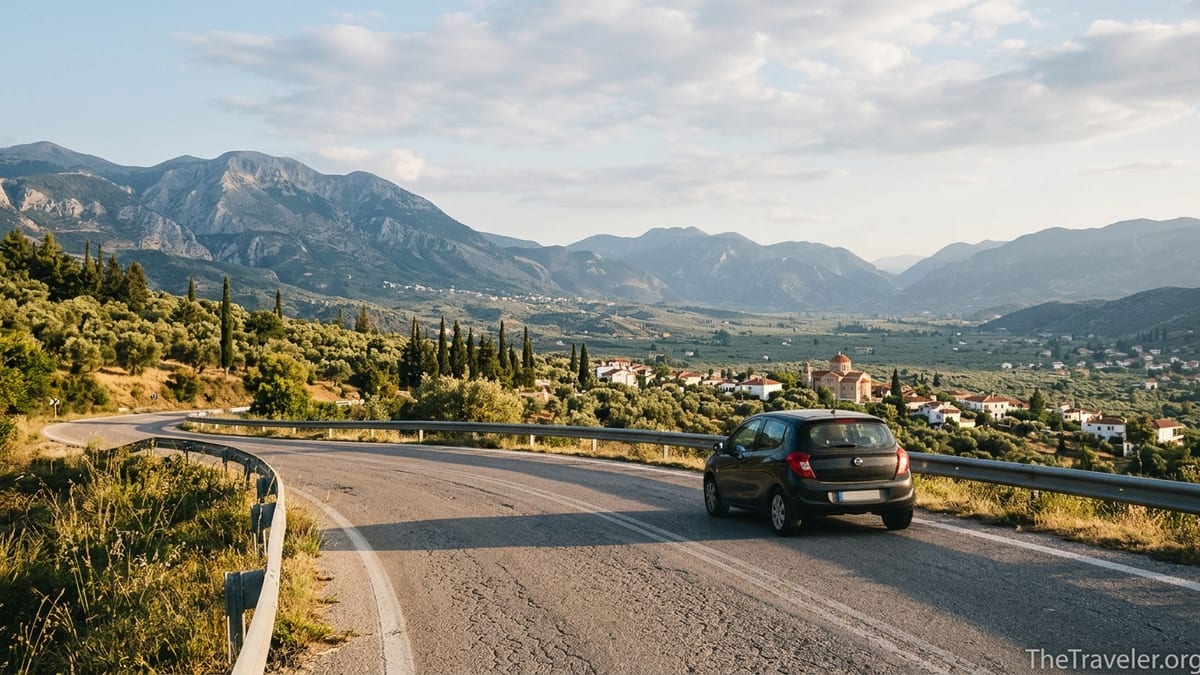
Key Route Overview: How Much Can You Realistically Cover
If you start and end in Athens, the classic loop that combines Delphi, Meteora and the eastern Peloponnese can be driven comfortably in 7 to 10 days. A typical anti-clockwise route is Athens – Delphi – Meteora – Olympia – Nafplio (for Mycenae and Epidaurus) – Monemvasia – Athens. That sequence keeps driving legs between roughly 2 and 4.5 hours and avoids too many backtracks.
Distances are manageable but add up. Athens to Delphi is roughly 180 to 190 kilometers by road and usually takes around 2.5 to 3 hours depending on traffic and how often you stop. From Delphi to the Meteora area (Kalambaka or Kastraki) you are looking at about 220 to 240 kilometers and a 3 to 3.5 hour drive on a mix of mountain roads and modern motorway. Returning directly from Meteora to Athens is longer at around 350 to 360 kilometers and about 4 to 4.5 hours, mostly on highway.
In the Peloponnese, Athens to Nafplio is about 140 to 150 kilometers and roughly 1.5 to 2 hours by the main highway via Corinth. From Nafplio, Mycenae is around 25 kilometers away and Epidaurus around 30 to 35 kilometers, so both work easily as half-day trips. To connect the mainland to the western Peloponnese, Nafplio to Olympia is a longer cross-country leg of about 230 to 260 kilometers and usually 3.5 to 4.5 hours depending on route. Olympia to Monemvasia, if you include it, is another long haul of 260 to 300 kilometers through the Peloponnese interior, so many drivers place Olympia between Meteora and Nafplio instead.
Most visitors underestimate how tiring Greek driving can be on consecutive days, especially when combined with walking ancient sites in the sun. For most travelers, no more than one long drive of 4 to 5 hours every second day works well. On other days, limiting yourself to 2-hour hops or just local excursions from your base town keeps the trip enjoyable rather than exhausting.
Athens to Delphi: First Leg into the Mountains
Leaving Athens for Delphi is often the first taste of Greek highway driving for visitors. The most straightforward route is to join the main E75 northbound and then follow the signs toward Livadia, Arachova and Delphi. Expect around 180 to 190 kilometers of driving and about 2.5 to 3 hours on the road, with one or two toll booths on the motorway section. As of mid-2026, typical tolls for a passenger car along this leg are in the low single-digit euro range per plaza, and fuel prices in Greece often hover around the higher end of the eurozone average, so a one-way trip might reasonably cost a couple of tens of euros in fuel and tolls combined depending on your car.
Delphi itself makes an excellent first overnight from Athens. Arriving by mid-afternoon gives you time to check into a guesthouse overlooking the olive groves of the Pleistos Valley and take a stroll in the village before the main crowds leave. Many travelers stay in the modern town of Delphi, where small hotels and family-run pensions sit right on the main street, or in nearby Arachova, a slightly livelier mountain village about 10 kilometers away with more restaurants and a ski-town atmosphere in winter.
Trying to do Delphi as a rushed day trip from Athens by car is technically possible but rarely satisfying. The site and museum together need at least three to four hours if you want more than a quick walk to the Temple of Apollo and back. In summer, queues at the ticket office and heat on the exposed slopes add to fatigue. A typical pattern that works well is to drive up from Athens in the late morning, visit the Delphi archaeological site in the late afternoon when it is a little cooler, spend the night nearby, then visit the museum and perhaps the Sanctuary of Athena Pronaia next morning before driving on toward Meteora.
On this first leg you will get used to Greek signage and driving etiquette. Signposts are generally in Greek and Latin script, but it pays to learn the Greek spelling of key towns such as Λιβαδειά (Livadia) and Δελφοί (Delphi). Outside Athens, highways are modern and well-maintained, but once you leave the motorway for the mountain road to Arachova and Delphi, expect more curves and slower traffic. Stop at a highway service area or a roadside café near Livadia for a quick Greek coffee or a souvlaki, and avoid driving this stretch in the dark if you are not used to mountain roads.
Delphi to Meteora: Linking Two Mainland Icons
The drive from Delphi to Meteora is one of the most scenic segments of a mainland Greece road trip, connecting two of the country’s biggest inland highlights. From Delphi you descend toward Amfissa and then work your way northwest onto the E65 motorway toward Trikala and Kalambaka. The distance falls roughly between 220 and 240 kilometers depending on your exact route choice, and you should allow 3 to 3.5 hours of driving in normal conditions, slightly more in winter or bad weather.
There are several route variations. One common approach is to drive from Delphi to Lamia via Amfissa and Bralos, then join the E65 toward Karditsa and Trikala before turning for Kalambaka, the gateway town for the Meteora monasteries. This option keeps more of the journey on modern motorway, with wide lanes and regular service areas. Another, smaller-road option loops through villages such as Gravia and Gardiki, attractive if you want more rural scenery and do not mind extra curves and slower progress. A realistic compromise is to stick to the recommended highway route in winter or if you are nervous about mountain driving, and save the smaller roads for a separate day trip.
Most travelers base themselves either in Kalambaka, a small town at the foot of Meteora’s rock pillars, or in Kastraki, an even smaller village slightly closer to many of the monasteries. Both have guesthouses, mid-range hotels and casual tavernas. Parking can be tight near the monasteries themselves, especially when tour buses arrive mid-morning, so staying two nights in the area works well. On a two-night stay you can arrive from Delphi in the afternoon, explore one or two monasteries and viewpoints the next day, and then depart the following morning refreshed for the next leg of your road trip.
Driving within Meteora involves a loop road that connects the monasteries along the ridge above Kalambaka and Kastraki. Surfaces are paved but narrow in places, and locals are used to tourist traffic. Start your monastery visits early in the morning so you can find parking without stress, then return to town for a late lunch. Be prepared for dress codes at the monasteries: long trousers for men, modest skirts or wraps for women, and shoulders covered. Many monasteries offer wraparound skirts at the entrance, but bringing your own lightweight scarf or sarong speeds things up.
From Meteora to Olympia and Nafplio: Crossing to the Peloponnese
Connecting Meteora to the Peloponnese gives you a satisfying sense of a grand tour across mainland Greece, but it requires some planning. A popular way to break up the journey is to drive south from Kalambaka toward Lamia and then continue across central Greece and over the Rio–Antirrio Bridge into the Peloponnese, overnighting in Olympia. The overall distance from Meteora to Olympia is roughly 360 to 400 kilometers depending on the route and can take 5 to 6 hours including fuel and snack stops, so building in a full travel day is wise.
Olympia makes sense geographically as a bridge between northern Greece and the eastern Peloponnese. The archaeological site where the Olympic Games began sits in a green valley and is easier to explore in the afternoon or morning when temperatures are slightly lower. A common real-world pattern is to leave Meteora after breakfast, reach Olympia by mid to late afternoon, check into a nearby hotel with a pool and visit the archaeological site either late that day or early the next morning. You then follow up with the Olympia museum before setting off for Nafplio or the wider Argolid area.
From Olympia to Nafplio you can choose between a faster interior route via Tripoli or a somewhat longer but more coastal-feeling route via Pyrgos and Patras. In either case you are looking at roughly 230 to 260 kilometers and 3.5 to 4.5 hours of driving. Arriving in Nafplio by early evening lets you stroll the pedestrianized old town waterfront and find dinner at one of the tavernas around Syntagma Square or in the streets below the Palamidi Fortress. Many drivers opt to return their rental car after the Peloponnese segment and continue on to the islands, but keeping the car for a few more days allows you to reach Monemvasia and some of the more remote beaches along the eastern coast.
If your time is shorter, you can skip Olympia and drive directly from Meteora or Delphi to the Peloponnese. Meteora to Nafplio in a single day is a long push of around 450 to 500 kilometers and can easily take 6 to 7 hours of driving, so it is only recommended for confident drivers who do not mind a full day on the road. Delphi to Nafplio via the Corinth Canal is more moderate at roughly 300 to 330 kilometers and around 4.5 to 5 hours, and has the added attraction of a possible coffee stop overlooking the canal near Isthmia.
Nafplio, Mycenae and Epidaurus: Efficient Day Trip Triangles
Nafplio is one of the best bases on the Peloponnese for drivers. About 140 to 150 kilometers from Athens, most of it on the main highway via Corinth, it feels far removed from the capital but is close to several key ancient sites. Plan around 1.5 to 2 hours for the drive from Athens, with motorway tolls and a final stretch on a regional road through Argos and into Nafplio. Many rental car companies near central Athens or the airport allow pick-up in the city and drop-off a few days later back in Athens after your Peloponnese loop.
From Nafplio, the Bronze Age citadel of Mycenae lies about 25 kilometers to the north. The drive typically takes around 30 minutes on a good regional road through orange groves and small villages. Arriving at Mycenae soon after opening time helps you avoid both the midday tour buses and the hottest part of the day. After exploring the Lion Gate, the royal tombs and the museum, you can return to Nafplio for a long lunch or continue on toward Nemea’s vineyard region if you are interested in wine tasting and do not need to drive large distances later in the day.
On another day from Nafplio, the Sanctuary of Asklepios at Epidaurus and its famous ancient theatre lie roughly 30 to 35 kilometers to the east. Allow about 40 minutes to an hour to reach the site depending on traffic and stops along the way. The road winds gently through olive groves and low hills and connects with the national road that runs across the Argolid peninsula. Many travelers visit Epidaurus in the late afternoon and stay into the evening if a performance is scheduled at the theatre during the summer festival period. In that case, factor in a night-time drive back to Nafplio and plan to take it slowly on the dark rural roads.
Nafplio itself deserves at least one full day without major driving. Climb the steps up to the Palamidi Fortress in the morning for wide views over the bay, then swim at nearby beaches such as Arvanitia or Karathona in the afternoon. With three nights in Nafplio you can typically manage one day focused on the town, one half-day at Mycenae combined with local wineries or Tiryns, and one half-day at Epidaurus, all with manageable daily drives of under 90 minutes in each direction.
Monemvasia and the Southern Peloponnese: Extending the Loop
Monemvasia is a dramatic medieval town perched on a rocky islet off the southeastern Peloponnese and rewards those who are willing to add some extra driving. From Nafplio, the distance to Monemvasia is roughly 210 to 230 kilometers and usually takes about 3.5 to 4 hours, mostly on regional roads across the interior via Tripoli and Sparta or via Leonidio and the coast if you prefer a more scenic but slower route. Travelers with a week or more on the mainland typically include either Monemvasia or the Mani Peninsula to get a taste of the wilder southern Peloponnese.
Driving into Monemvasia, you leave your car near the modern town on the mainland and then walk across the causeway to the walled medieval settlement. Inside the old town, lanes are cobbled and narrow, and most accommodation is in restored stone houses rather than big hotels. Staying at least one night allows you to experience the atmosphere after the day-trippers have left, and to enjoy dinner at a small taverna overlooking the sea without worrying about a late-night return drive.
From Monemvasia back to Athens, the fastest route typically heads northwest toward Sparta and Tripoli before joining the main highway back to Corinth and the capital. Expect a distance of roughly 320 to 360 kilometers and around 4.5 to 5 hours of driving, plus any breaks. Many drivers choose to break this leg with a coffee stop in a town like Tripoli or at a highway service area rather than powering through in one go. If you are returning a rental car and catching a flight the same day, it is safest to spend your last night near Athens or at the airport rather than driving in from Monemvasia on departure day.
If your schedule is tight, you may decide to skip Monemvasia and focus on the Athens–Delphi–Meteora–Olympia–Nafplio loop instead. The shorter loop already offers a strong mix of high mountains, classical sites and relaxed seaside towns without the longer interior drives of the southeastern Peloponnese. However, if you have 10 to 14 days on the mainland, adding two nights in Monemvasia can become a highlight of the trip, especially for travelers who enjoy atmospheric historic towns and quieter evenings.
Sample Itineraries: Combining Delphi, Meteora and the Peloponnese
For a focused one-week trip that includes all three regions, a realistic driving-based itinerary might look like this: Day 1 Athens to Delphi, overnight in Delphi or Arachova. Day 2 Delphi site and museum in the morning, then drive to Meteora and overnight in Kalambaka or Kastraki. Day 3 full day exploring Meteora, second night in the area. Day 4 drive to Olympia via the Rio–Antirrio Bridge, overnight near Olympia. Day 5 morning at the Olympia site and museum, then drive to Nafplio. Day 6 explore Nafplio and nearby Mycenae or Epidaurus. Day 7 return to Athens. This keeps drives per day generally under five hours and pairs each driving leg with either a half day or full day of sightseeing.
If you have 10 days, you can slow things down and add Monemvasia without feeling rushed. For example, after two nights in Meteora and one night in Olympia, spend three nights in Nafplio to cover both Mycenae and Epidaurus at a relaxed pace and to enjoy a non-driving beach or fortress day. Then continue with two nights in Monemvasia before returning to Athens on the final day. With this schedule, only three days involve longer drives, while others are devoted to either short regional excursions or staying put.
Travelers who are more interested in the Peloponnese than in Meteora can adjust the balance. Another pattern that works well is to limit Meteora to one overnight and redistribute the time to extra nights in Nafplio or Monemvasia. In practice, that might mean leaving Athens early, arriving in Delphi by late morning, visiting the site, then driving on to Meteora for a single night and a half day of monastery visits before heading south. This is a faster pace and better suited to those comfortable with consecutive long drives of 4 to 5 hours.
Whichever itinerary you choose, build in flexibility for weather and energy levels. Summer heat inland can be intense by midday, particularly at unshaded archaeological sites, so aim to do major walking before 11 a.m. or after 4 p.m. Driving sections in the early afternoon, when air conditioning can make the experience more comfortable, lets you arrive at your next base town in time for a late swim and a relaxed dinner. Avoid scheduling a long drive immediately after a late night in Athens or a full day of stair-climbing at Meteora or the Palamidi Fortress; your enjoyment and safety will benefit from a more measured pace.
The Takeaway
An Athens-based road trip that connects Delphi, Meteora and the Peloponnese works best when you think in terms of logical loops and realistic driving times rather than simply ticking off names on a map. Distances in kilometers can look small compared to North American or Australian road trips, but the combination of mountain curves, occasional slow trucks and frequent photo stops means that a 250-kilometer leg can still fill most of a day once rests and sightseeing are added.
Using Delphi as a first mountain stop, Meteora as the northern highlight and Nafplio as a comfortable Peloponnese base allows you to link major archaeological sites with characterful towns. Adding Olympia and Monemvasia further deepens the experience if you have the time and enjoy longer drives. For most travelers, seven to ten days is enough to follow the classic loop at a comfortable pace, while two weeks opens the door to side trips into wine country, smaller mountain villages or quiet coastal detours.
Above all, embrace the flexibility that self-drive offers. Stop for a late-morning coffee at a roadside café overlooking olive-covered hills, detour through a village that catches your eye from the highway, or linger longer in a town where a small guesthouse balcony becomes your favorite spot in Greece. With sensible planning around routes, overnights and combinations like Delphi with Meteora or Nafplio with Mycenae and Epidaurus, an Athens to mainland Greece road trip turns into a string of memorable days rather than a blur of kilometers.
FAQ
Q1. How many days do I need for an Athens–Delphi–Meteora–Peloponnese road trip?
Most travelers feel satisfied with 7 to 10 days, which allows one night near Delphi, two nights in Meteora, one night in Olympia and at least two or three nights in Nafplio without rushing.
Q2. Is driving from Athens to Delphi and Meteora safe for first-time visitors to Greece?
Yes, most of the route uses modern highways and well-maintained regional roads. The main challenges are some winding mountain sections and adapting to local driving habits, so driving in daylight and keeping speeds moderate is recommended.
Q3. Can I visit Delphi and Meteora as day trips from Athens instead of driving?
It is possible to join organized bus or small-group tours that run long day trips from Athens, but combining them as overnight stops on a self-drive trip is usually more relaxed and gives you quieter early-morning and late-afternoon visits.
Q4. Where is the best place to base myself for Mycenae and Epidaurus?
Nafplio is the most convenient and atmospheric base, with Mycenae about 25 kilometers away and Epidaurus around 30 to 35 kilometers. Many visitors stay three nights in Nafplio and visit each site on a separate half day.
Q5. Do I need an international driving permit to rent a car in Greece?
Travelers from the European Union typically do not, while visitors from countries like the United States, Canada and Australia are often advised to carry an international driving permit in addition to their home license. Check current requirements with your rental company before arrival.
Q6. How expensive are tolls and fuel on these routes?
Toll costs vary by segment, but for a compact car doing the full loop including Delphi, Meteora and the Peloponnese, you should budget for a combination of motorway tolls and relatively high fuel prices compared with some other European countries, often totaling several tens of euros over the trip.
Q7. Is parking easy near the main archaeological sites?
Most major sites such as Delphi, Mycenae, Epidaurus and Olympia have dedicated parking areas, though they can fill during peak hours. Arriving soon after opening time or later in the afternoon usually makes parking less stressful.
Q8. What is the best season for this mainland Greece road trip?
Late spring and early autumn, roughly May to early June and late September to October, offer pleasant driving conditions, milder temperatures at archaeological sites and fewer crowds than peak summer.
Q9. Can I drive straight from Meteora or Delphi to the islands?
There is no direct road link to the islands, so most travelers drive back toward Athens or major ports like Piraeus, Rafina or Patras, return their car, then continue by ferry or domestic flight to the islands.
Q10. Is it realistic to add Monemvasia to a one-week itinerary?
It is possible but will compress your schedule with several long drives. Monemvasia fits more comfortably into a 10 to 14 day itinerary, giving you time to enjoy the town rather than treating it as a quick detour.