


I came to Epirus for the kind of mainland Greece beach days that don’t require ferry schedules: wake up in a stone town, drink coffee by a small harbor, then drive ten to forty minutes to a new curve of coast. What surprised me was how quickly the Ionian “mood” changes here. One morning I was stepping off fine sand into gentle, shallow water in Parga, and the next I was wading across a shin-deep sandbar to an islet in Syvota while speedboats idled in the channel, waiting for swimmers to clear a path.
This is a highly observational, first-person guide based on beaches I genuinely visited around Parga, Syvota, Perdika, and Vrachos-Loutsa. I also include a few clearly labeled “researched only” options that are strongly recommended right now, especially the coves you reach more naturally by boat. For every beach I visited, I’ve noted what the shoreline actually felt like underfoot, how quickly the water got deep, what the waves did after lunch, where shade was real (trees) versus rented (umbrellas), and exactly where paying for organized facilities improved the day and where it didn’t.
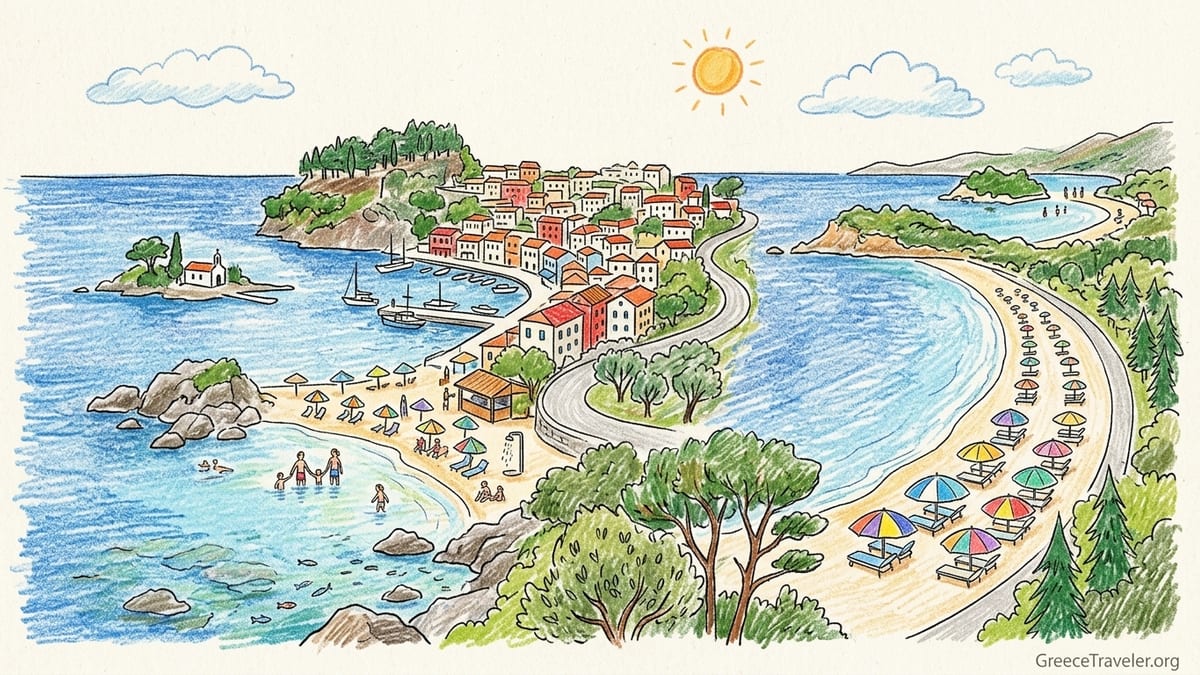
Parga: The Easy Beach Day (When You Want Town Comfort)
Parga is a beach town that behaves like a small amphitheater. You can be in the old lanes for a breakfast spanakopita, then ten minutes later you’re rinsing sand off your ankles at a shower by a beach bar. The coastline here is not “wild” in the sense of empty coves and no services. It is practical, walkable, and built for long swims followed by cold drinks and late lunches.
I started with Krioneri, the central town beach, because it’s the kind of place you can test the water without committing your whole day. Underfoot, it’s a soft sand feel where the wave laps, with the typical town-beach mix closer to the waterline: sandals, kids’ buckets, someone shaking out a towel. The entry is friendly and gradual for the first stretch, and the water clarity held up surprisingly well for how close everything is. The trade-off is noise and foot traffic. If you want a quiet read-and-nap beach day, this is not it. If you want to swim, dry off, and immediately be back in town for a freddo and a snack, it’s exactly right.
Shade here is mostly rented shade. I didn’t find the kind of dependable tree cover you can camp under for hours. On days when I stayed longer, paying for an organized setup made sense because it turned a short swim stop into a genuine half-day base: a stable umbrella, a place to leave a bag without anxiety, and the ability to order a bottle of water without walking back into town in wet clothes.
Logistics are what make Parga easy. You can arrive without a car, or park once and forget about it. The beach bars and tavernas are not an “extra,” they are basically the shoreline’s second layer. That is not a criticism. It’s the whole appeal when you want the simplest version of an Ionian beach day.
Valtos Beach, Parga: Where Paying For Sunbeds Actually Helps
Valtos is the big, classic Parga beach, and it feels like the town’s answer to anyone who says mainland beaches can’t do a full, all-day sprawl. The first thing you notice is scale: a broad arc of shoreline that can absorb crowds better than the smaller town beaches. The second thing you notice is how the beach texture changes as you walk. In some stretches I found nicer sand underfoot, while other parts leaned toward rougher, more rubble-like patches that made me choose my entry more carefully.
The water on my Valtos days was clear enough to see your feet as you waded in, with that Ionian blue-green shift as the depth increases. Depth here can come on quicker than you expect, depending on where you enter, so if you are traveling with small kids, it’s worth taking a minute to watch where families are choosing to set up. Waves were generally manageable, but Valtos is open enough that afternoon wind can put texture on the surface, and you will sometimes feel boat wash, especially when water sports are active.
This is one of those places where paying for an organized setup can improve the day, not because you “need” a sunbed to exist, but because Valtos is long and sunny and it’s easy to underestimate how punishing a midday stretch can be with no shade. Current, traveler-reported pricing commonly mentioned for Valtos is around 15 to 20 euros for a two-sunbed set with umbrella, with some reports noting cheaper and more expensive rows depending on position. In other words, it behaves like a real market beach: the sandier, nicer-feeling sections tend to cost more than the rougher sections.
What I liked about committing to the organized part of Valtos was the rhythm it enabled. You can swim a long line parallel to shore, come back to your umbrella, order something cold, then go again without thinking about your towel blowing into someone else’s space. Parking and access are straightforward by Parga standards, and once you’re settled, you’ll understand why this is the “default” beach day for many travelers. If you only have one full beach day in Parga, Valtos is the safest bet for facilities, food, and an all-ages swim.
Lichnos Beach (Near Parga): The Swim That Feels Like A Getaway
Lichnos was where Parga started to feel less like a town-beach story and more like a coastline story. The approach alone changes your mindset. You’re no longer stepping out of a harbor scene; you’re heading to a bay that’s set back and quieter, with a feeling of being “on holiday” rather than “in town.”
Underfoot, Lichnos gave me that satisfying beach texture where you can stand comfortably at the waterline without feeling like you’re balancing on loose stones. The entry felt easier on bare feet than the pebbly Syvota coves I visited later. The water clarity was the main event. It was clear enough that snorkeling was worthwhile close to shore, and I wasn’t snorkeling into a blank blue. I saw small silver fish schooling near rocks, and the usual quick flicks of tiny reef fish hugging the edges where stone meets sand. This is the type of place where even a cheap, basic mask makes sense because you can actually follow the shoreline and find life at the boundaries.
Waves were mild when I went, and the bay shape seemed to buffer it compared to more exposed stretches of coast. Depth increased at a sensible pace: you could wade, float, then swim without that sudden drop that makes some beaches feel less friendly for mixed groups. Natural shade was limited in the spots I used, so again, organized facilities mattered for comfort if you planned to stay into the afternoon.
For reaching Lichnos, it’s the kind of beach I recommend when you want Parga convenience but with a step toward calmer water and a more “destination” feel. I treated it as my reset beach: less spectacle, more swim.
Syvota: The Coves, The Islets, And The Beautiful Hassle
Syvota is where Epirus starts to feel like a puzzle you solve day by day. The coastline breaks into smaller coves, tiny bays, and swimming spots that are defined as much by access as by scenery. It is also where boat traffic becomes part of the landscape, especially around the iconic stops that show up in every official highlight reel.
Before you pick a beach, it helps to decide what kind of day you want. If you want effortless, choose a larger, organized bay and treat it like a standard beach day. If you want the “Syvota feeling” of wading to an islet or hopping into a sheltered lagoon from a boat, accept that you’ll trade comfort and simplicity for a story you’ll tell later.
The water here routinely looks unreal in the best way. It also behaves differently depending on where you are. Sheltered coves can be glassy, but you’ll feel the occasional boat wash, and in popular areas the presence of excursion boats changes the soundscape and the sense of solitude. Even when the sea is calm, it can feel busy because engines and anchors become the background noise.
For clarity, I’m separating what I personally did on foot from what is better done by boat. I visited Bella Vraka, Mikri Ammos, and Megali Ammos on my own time. I’m also including Pisina (Blue Lagoon) as “researched only,” because it is most naturally reached by boat and is currently marketed and sold that way through multiple excursion operators.
Bella Vraka (Syvota): Wading To The Islet, One Careful Step At A Time
Bella Vraka is famous for a reason that has nothing to do with beach bars: the experience of walking through the sea to reach an islet. When I arrived, the first “reality check” was parking and the approach. Parking in peak periods is often handled by private lots nearby, and the beach itself does not feel like a fully serviced setup. That’s part of the point. You come for a small adventure, not for an all-inclusive lounger day.
The walk across is exactly as awkward and fun as it sounds. The water is shallow enough to wade, but the bottom is not the soft, forgiving sand you might imagine from photos. I felt stones underfoot, and carrying anything that can’t get wet becomes an immediate problem to solve. I watched families do the same math: who carries the towels, who carries the baby, who sacrifices dry shorts. If you’re coming here, plan for the crossing like it’s part of the beach, not an afterthought.
Once you’re on the islet side, the water looks pristine, and clarity is the reward. The shallows glow and then drop into deeper blues farther out. Because this place is iconic, crowds can stack quickly, especially in July and August. On my visit, the sweet spot was earlier in the day, before the beach became a steady stream of people wading in lines, carefully holding bags above their heads.
Did I think organized facilities would have improved Bella Vraka? Not really. This is a bring-your-own day: your own water, your own shade plan, your own patience. Paying for comfort is not the point here. The best version of Bella Vraka is a short-to-medium stay, a swim with a sense of place, then a move to somewhere easier for lunch.
Mikri Ammos And Megali Ammos (Syvota): Choose Comfort Or Space
Mikri Ammos was my “I want comfort and a clean setup” Syvota beach. It’s close to the center, it’s organized in season, and it feels curated: sunbeds, service, and a clear sense of where to put yourself if you don’t want to improvise. The shoreline here is more pebbly than sandy, and I was happy I had water shoes in the bag, not because it’s painful, but because it makes the entry smoother and lets you focus on the swim rather than your footing.
The water was crystal clear, and the bay’s shape kept the surface calmer than I expected. Temperature felt on the cooler side compared with long, shallow sandy beaches, which matched the overall “pebble cove” character: clear water, quick depth, refreshing rather than bath-warm. When I snorkeled along the edges, I saw small schooling fish and tiny rock-dwellers darting between crevices. It’s not a dramatic reef, but it is a real, visible underwater scene, especially near the rocks that frame the cove.
This is a beach where paying for the organized setup made sense because the service is the product. Traveler reports in 2026 commonly put a sunbed set around 20 euros in peak periods. If you like an easy day with drinks brought to you and a proper meal close by, Mikri Ammos delivers. The downside is that it feels less “untouched,” and at busy times, the organized area can look dense.
Megali Ammos was the beach I used when I wanted room to breathe without giving up basics. It’s broader than the tiny coves, with a pale pebble and fine shingle feel that keeps the water clear. It is organized in season, but it also has enough space that you can often find a less crowded patch if you’re happy with a towel setup. Waves were usually minimal in the morning, with more movement later if wind picks up or boats pass. Access by road is straightforward, but the trade-off is summer traffic and the need to arrive earlier for easier parking.
If you’re deciding between them: Mikri Ammos is the “pay for comfort” choice, while Megali Ammos is the “bring less stress” choice because space is its luxury.
Perdika And Karavostasi: The Wider Bay That Feels Like A Real Swim Beach
Driving toward Perdika, the coast opens up into beaches that feel less like coves you slot into and more like long stretches where you can walk, choose your spot, and swim without feeling squeezed. Karavostasi is the headline beach here, and it reads differently from Syvota. It’s longer, more open, and the sea can show more mood if wind arrives from the west.
On my Karavostasi day, the first thing I noticed was how the beach texture changes from patch to patch: coarse sand mixed with fine pebbles and occasional larger stones. It’s not the uniformly powdery postcard sand, but it’s comfortable enough for a full day if you choose your entry carefully. The water is clear, but depth can come quickly, which makes the water color turn deeper sooner than you might expect. That quick deepening is great for confident swimmers who want to actually swim rather than just stand and chat in knee-deep water.
Waves are the variable here. When the bay is calm, it’s a straightforward, beautiful swim. When the afternoon wind builds, you feel the difference. If you’re traveling with kids or anyone who prefers completely sheltered water, the best move is to choose a supervised, organized section with clear flag rules and to swim earlier in the day.
Facilities exist but are not uniform across the whole beach. Some sections feel properly organized with sunbeds, umbrellas, and food close by, while other stretches are more open. This is where paying for organized facilities can be a strategic choice rather than a default: on a windy day, an organized section with a solid umbrella and nearby water and shade can turn a challenging beach into a comfortable one. On a calm shoulder-season day, I would happily take the quieter end with my own setup and treat Karavostasi as a long, open-air swim track.
Vrachos-Loutsa And The Wider Epirus Coast: The Classic Long-Sand Reset
After coves and islets, the long coastline around Vrachos-Loutsa felt like a reset. This is the kind of beach zone where you can drive up, see the sea immediately, and know you’ll find a spot. The beach itself runs long, and the scale changes the whole day: fewer micro-decisions about which cove, more simple choices like “Do we want to be closer to a taverna or farther away?”
On my swim day here, the shoreline felt sandier than the pebbly Syvota coves, and the entry was more gradual. That gradual entry changes who the beach is for. You see more families setting up for hours, more people walking along the waterline, more swimmers who want to wade and float without immediately being out of their depth. The water clarity was good, though not always the glassy, aquarium-like clarity of a small pebble bay. That’s the trade: long sandy beaches can feel slightly more “alive” in the water column, especially when wind and waves stir it up.
Waves are more of a factor on open beaches like this. Even small swells can make the waterline busy, and in the afternoon the surface can go from mirror to textured quickly. If you’re looking for snorkeling with precise visibility and rock habitats, this is not your best Epirus pick. If you want long walks, easy entry, and the simple pleasure of a big horizon, it shines.
Organized facilities are common across long beaches on the Epirus coast, but it’s not the kind of place where you must pay. This is where a quieter patch can genuinely be better. If you have your own umbrella and a cooler bag, the “free” space gives you a calmer experience, and you can still walk to a taverna when you’re hungry. I found that paying for a front-row setup only mattered when the sun was intense and I wanted a guaranteed umbrella that wouldn’t shift in wind.
Researched Only: Pisina (Blue Lagoon), Zeri, And Boat-Reached Coves Around Syvota
This section is researched only, not personally visited by me on this trip, and I’m labeling it clearly because the experience depends heavily on the boat you take and the time slot you end up with. Pisina, widely marketed as the Blue Lagoon, is consistently highlighted in official and commercial materials for the Syvota area and is commonly sold as a boat-only swim stop. The key detail travelers should understand before building a “perfect” day around it is that popularity brings boat traffic.
Multiple current excursion listings for 2026 advertise Blue Lagoon day cruises from Syvota and also from Corfu-area departure points, with common advertised prices in the rough 30 to 45 euro range per person depending on duration and inclusions. It’s typically framed as a swim-and-snorkel stop with dramatic color and visibility. Because it’s approached by anchoring boats, the experience you get can be less “quiet cove” and more “beautiful water with a floating crowd,” especially mid-summer and mid-day.
Zeri is frequently mentioned as part of the Syvota beach set in current guides, along with Bella Vraka, Mikri Ammos, and Megali Ammos. What I can responsibly say without visiting is that it’s treated as another cove option, and like many of these smaller Syvota spots, the biggest differentiators will be access (parking and approach) and how much boat movement you tolerate in peak season.
If your dream Epirus day is “coves reached naturally by boat,” consider planning one day as a boat day and one day as a land-based beach day. The boat day is for the color, the caves, the sense of moving along the coast. The land day is for quiet, predictable logistics, and the kind of swim you can repeat without checking a return time.
The Takeaway
Epirus is a coastline of contrasts, and the best beach here depends on what you want to feel. If you want a straightforward, comfortable beach day with services and an easy rhythm, Parga’s Valtos is the dependable answer, with Lichnos as the calmer alternative when you want clearer water and a getaway feel. If you want the “postcard moment,” Syvota delivers it, but it asks you to accept crowds, parking friction, and boat noise as part of the deal, especially at Bella Vraka and around the Blue Lagoon circuit.
My strongest advice is to treat organized facilities as a tool, not a rule. Pay for sunbeds when you need reliable shade and you’re committing to an all-day stay, especially on long, exposed stretches like Valtos or broad bays like Karavostasi. Skip the paid setup when the beach itself is the story and you’re only staying for a few hours, like Bella Vraka, where the crossing is the experience and comfort is never going to be the main feature.
If you’re building a week, mix beach types on purpose. Do one “big beach” day where you can fully relax. Do one cove day where you accept a little hassle for extraordinary water. And if you can, reserve one day for the boat-only highlights, with realistic expectations about crowds, anchor lines, and the fact that even paradise has an engine sound in high season.
FAQ
Q1. Which Epirus beach is best for an all-day, easy setup?
Valtos Beach in Parga is the most reliable all-day choice for space, services, and a full beach-day rhythm.
Q2. Where did paying for sunbeds feel most worth it?
At Valtos and Mikri Ammos, paying for an organized setup improved comfort because shade and service let me stay longer without hassle.
Q3. Where was it better to skip organized facilities and go simple?
At Bella Vraka, the main experience is wading to the islet, so I found it better as a bring-your-own, shorter visit.
Q4. Which beach felt best for swimming rather than just lounging?
Karavostasi near Perdika felt like a true swim beach because the bay is wide and the water deepens quickly for proper swimming.
Q5. Which beaches around Syvota are easiest to reach by car?
Mikri Ammos and Megali Ammos are among the most straightforward Syvota-area choices for road access and practical beach days.
Q6. Is Bella Vraka sandy, and is the crossing easy?
Parts are sandy, but the crossing involves wading over a stony bottom while carrying your things, so it can be awkward without water shoes.
Q7. Where did you see marine life while snorkeling?
I saw small schooling silver fish and tiny rock-dwelling fish near rocky edges at clearer coves like Lichnos and Mikri Ammos.
Q8. Is the Blue Lagoon (Pisina) something you can do without a boat?
Researched only: it is commonly sold and described as a boat-access swim stop, so most travelers experience it via cruise or rental boat.
Q9. Which area is better for families who want a gradual sandy entry?
Longer sandy stretches like Vrachos-Loutsa generally feel more gradual and family-friendly than the pebbly Syvota coves.
Q10. How should I split a 3-day beach itinerary in Epirus?
Do one Parga day (Valtos or Lichnos), one Syvota cove day (Bella Vraka plus a more comfortable bay), and one wider-bay day like Karavostasi or Vrachos-Loutsa.