


Planning a family holiday in the Cyclades is often a balancing act. You want sandy beaches with shallow water, short and simple transfers from Athens, plenty of family hotels and apartments, and enough tavernas and activities to keep everyone happy, without the late-night party scene. Naxos, Paros, Syros and Andros are the stand-out choices, with a few smaller islands also worth considering for second or third stops.
How to choose the right Cycladic island for your family
For families, the most important decision is usually not the most glamorous island, but the one that keeps daily life easy. In practice, that means choosing islands with direct ferries from Athens’ ports, relatively short sea crossings, and beaches that are sandy, shallow and at least partly sheltered from the Meltemi winds that blow across the Aegean in July and August. Naxos, Paros, Syros and Andros all meet these criteria in different ways and work well for both first-time and repeat visitors.
Before you book, think about your children’s ages and your own travel style. Families with toddlers generally do best staying near a calm town beach, so you can walk to both the sea and restaurants. With older kids and teens, you might prefer a quieter bay with space to explore, try paddleboards or take a half-day boat trip. On Naxos, for example, staying around Agios Georgios beach lets you push a buggy straight onto the sand, while on Andros a base in Batsi gives you a sheltered bay with watersports and easy access to inland hiking trails.
Budget is another factor that differs by island. You can still find simple family studios near the beach on Naxos and Andros in the 90 to 150 euro per night range in June and September, rising in July and August. On Paros and Syros, especially in sought-after spots like Naoussa or the seafront in Kini, equivalent family rooms can run noticeably higher. Booking several months in advance, especially for peak school-holiday weeks, gives you the best choice of rooms with kitchenettes and separate sleeping areas.
Finally, consider whether you want to stay on one island for a week or combine two relatively close islands. Naxos and Paros are linked by frequent ferries and can work as a two-centre holiday. Andros and Syros also combine well with a city break in Athens because ferries are shorter and often run year-round, which is helpful for Easter or autumn trips when sea temperatures are still pleasant but resorts are quieter.
Naxos: the Cyclades classic for long sandy beaches
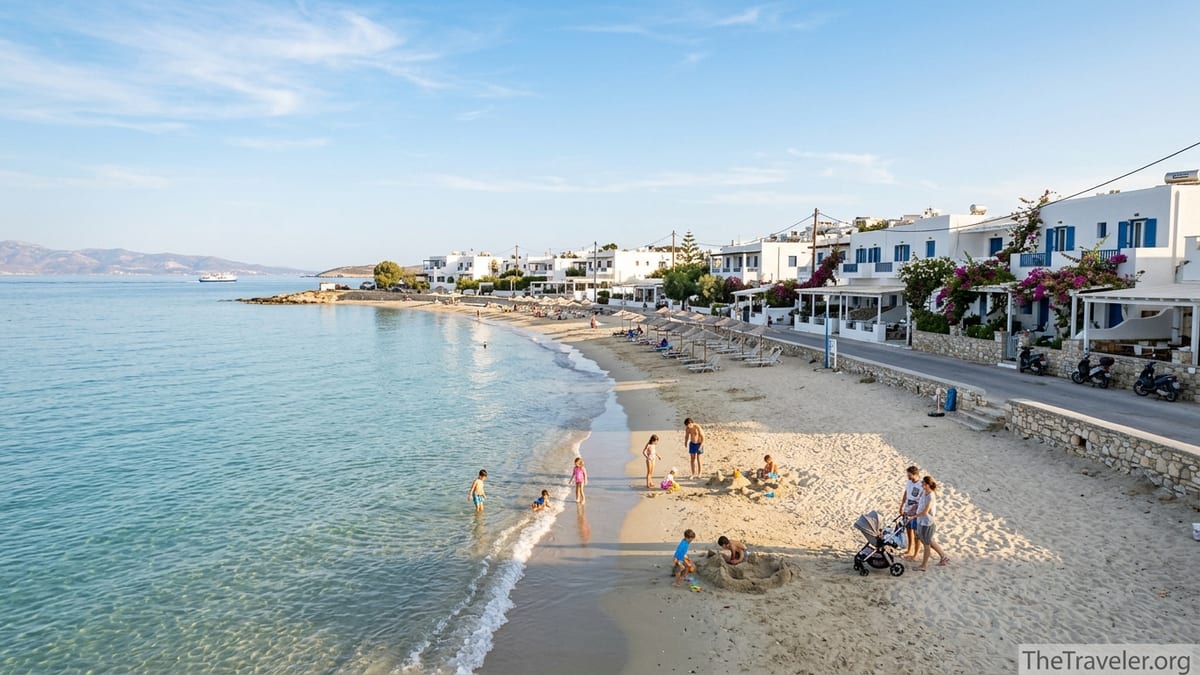
Naxos has become a byword for family-friendly Greek islands, and the main reason is its string of wide, gently shelving beaches on the sheltered west coast. Around Naxos Town, Agios Georgios beach is especially popular with families because the water stays shallow for a long way, there is fine sand underfoot and the bay is partly protected from waves. Parents regularly report that young children can sit and splash near the shoreline for hours while adults relax at one of the low-key beach cafes a few steps back from the water.
South from town, a series of beaches including Agios Prokopios, Agia Anna and Plaka offer more space and a slightly wilder feel while still being practical for families. These are classic Cycladic scenes with golden sand, turquoise water and a backdrop of low dunes or tamarisk trees rather than big hotel blocks. In several sections you can rent a pair of sunbeds and an umbrella but also find free areas where children can play with buckets and spades without weaving between rows of loungers. The south-west corner of the island, around beaches like Alyko and Mikri Vigla, adds more sheltered coves and shallow water that suits confident but still-learning swimmers.
Accommodation around Naxos Town and the west coast is heavily geared towards families. You will find small apartment complexes and studios with kitchenettes within a few minutes’ walk of the sand, as well as mid-range hotels with pools. Typical examples include family-run properties set one or two streets back from Agios Georgios, offering one-bedroom apartments with sofa beds, air conditioning and simple kitchen facilities, often including breakfast, for a moderate nightly rate outside the very peak weeks. Car rental is widely available and useful for day trips into the island’s interior villages such as Halki and Apiranthos, which break up beach time with shaded squares, casual tavernas and short walks.
Reaching Naxos is straightforward but involves a sea crossing. High-speed ferries from Piraeus or Rafina generally take between 3.5 and 4.5 hours, while slower conventional ferries can take about 5 to 6 hours, usually at a lower cost. In summer, there are also domestic flights from Athens that take around 40 minutes. Once you arrive, many hotels around Agios Georgios or Naxos Town are within a 10 to 15 minute taxi ride from the port or airport, which keeps the final leg manageable even after an early-morning flight into Greece.
Paros: easy logistics and polished family resorts
Paros sits close to Naxos and offers a slightly more polished and fashionable take on family holidays while still providing very good practicalities. It benefits from its own small airport with domestic flights from Athens, as well as frequent ferries, which keeps transfer times relatively short. For a first visit, many families choose to stay in Parikia, the main port town, or Naoussa in the north, both of which have sandy beaches within walking distance and a full set of services such as pharmacies, supermarkets and bakeries nearby.
Paros is known for its golden-sand beaches, several of which are very suitable for children. The town beach in Parikia offers a shallow, sandy bay a few minutes from the ferry dock, which works well for families who want to avoid extra transfers on arrival day. Further south, beaches such as Chrissi Akti, also known as Golden Beach, and New Golden Beach have soft sand and clear water, with sections offering watersports like windsurfing for older children and teenagers. Between Drios village and Golden Beach, a quieter cove such as Boudari has a leeward, sheltered feel and a small cluster of family-oriented hotels and suites just behind the sand.
Accommodation on Paros covers everything from basic studios to full-service resorts. Families who value pool time alongside the sea might look at mid-range hotels near Golden Beach or in the countryside a short drive from Naoussa, where you can get family rooms or small villas with access to a shared pool. In and around Naoussa, there are more boutique hotels, some of which are adults-only, so check age policies carefully before booking. Parikia, by contrast, maintains a more mixed atmosphere and a range of price points, including older self-catering apartments that suit larger or multigenerational groups.
Paros also works well if you want to add short excursions. From Naoussa, small boats run in season to beaches on the opposite side of the bay, which can feel like an adventure for school-age children. There are straightforward bus connections across the island, meaning you could, for instance, spend a morning in the narrow streets of Naoussa and an afternoon at a calmer beach near Piso Livadi without hiring a car. For many families, a week on Paros with one or two boat trips and perhaps a half-day visit to the smaller neighbouring island of Antiparos strikes a good balance between relaxation and variety.
Syros: short transfers and calm bays near a real town
Syros is the administrative capital of the Cyclades and has a different feel from more purely touristic islands. Its main town, Ermoupoli, is a handsome port with neoclassical architecture, real year-round life and services such as a hospital and larger supermarkets, which some families find reassuring. Ferries from Piraeus can be as short as about 2.5 hours on faster boats in summer, making it one of the more convenient islands to reach for a week’s holiday with younger children.
While Ermoupoli’s rocky swimming platforms mainly attract older kids and adults, Syros has several sandy, family-focused beaches a short drive or bus ride away. Galissas is one of the best-known, a broad, sandy arc with shallow, usually calm water that has made it a favourite for families. Behind the sand sits a small resort settlement with simple hotels, rooms to let and a choice of tavernas. Vari, on the south coast, is another reliably sheltered bay with a sandy bottom and a handful of low-rise hotels. Kini, on the west coast, combines a traditional seaside village atmosphere with a long beach and a selection of beachfront tavernas, and is especially popular with families who like sunset swims and dinners by the water.
Syros’ accommodation stock reflects its dual role as a working island and a tourist destination. You will find traditional guesthouses converted from old mansions in Ermoupoli, serviced apartments above the seafront in Kini and mid-sized hotels in Galissas, many of which offer family rooms or interconnecting options. Prices are often slightly lower than on more famous resort islands, especially outside late July and early August. Because Syros is relatively compact, you can base yourself in one beach village and still make easy day trips to others, or head into Ermoupoli for an evening stroll and ice cream along the quayside.
Activities for families on Syros lean towards simple pleasures rather than large-scale attractions. Snorkelling along the rocks at the edges of bays such as Kini and Galissas, hiring a pedalo where available, walking up to small chapels that overlook the sea and visiting the twin hilltop quarters of Ano Syros and Vaporia in Ermoupoli all make for memorable half-day outings. For families with older children interested in culture, the Apollo Theatre in Ermoupoli hosts events in summer, and the island’s working-shipyard harbour can be fascinating to watch from a waterside cafe.
Andros: green landscapes, short ferry and low-key villages
Andros is the northernmost of the main Cyclades and one of the greenest, with natural springs and terraced hillsides. It lies closest to the mainland, and for families the big advantage is the short ferry crossing from Rafina, the smaller port east of Athens airport. Conventional ferries typically take around two hours to reach the port of Gavrio, which is very manageable with children after a flight. From there, a bus or short taxi ride leads to the island’s main resort villages and beaches.
For a beach-based stay, Batsi is the stand-out choice. This small coastal village, around 8 kilometres from Gavrio, sits in a protected bay with a broad, sandy beach where the water is usually calm and shallow near the shore. It is one of the most organised and family-friendly beaches on the island, with sunbeds and umbrellas available in some sections, casual tavernas set just above the sand and a relaxed promenade that is easy to navigate with pushchairs. Nearby beaches such as Chrissi Ammos and Agios Petros, between Batsi and Gavrio, add more sandy options with relatively easy access and clear, shallow water.
Accommodation in Batsi and along the west coast includes small hotels with pools, simple studios and family rooms right by the sea. Some properties offer two-bedroom apartments or maisonettes suited to families of four or five, often with kitchen facilities and balconies looking over the bay. Mid-range family-friendly hotels near Batsi or on beaches like Kypri typically provide breakfast buffets, on-site parking and the option to add extra beds or baby cots. In Andros Town, also known as Chora, you will find more boutique-style guesthouses and apartments, which work well if you want to mix beach days with cultural visits to the town’s museums and galleries.
Andros particularly appeals to families who enjoy walking, as the island has an extensive network of marked trails, some short and suitable for children used to hiking. A typical day might combine a morning on the beach at Batsi with a late-afternoon walk up to a nearby viewpoint, followed by dinner at a taverna on the waterfront. Because Andros sees fewer package tourists than some other Cyclades, restaurants tend to cater to a mix of locals and visitors. Menus usually highlight grilled meats, simple pasta dishes and fresh fish, with children’s favourites such as souvlaki, fries and local cheeses widely available at moderate prices.
Other islands to consider: Tinos, Antiparos and the Small Cyclades
Beyond the four headline choices, a few other Cycladic islands suit families looking for sandy beaches and a quieter pace. Tinos, just across the water from Andros and close to Mykonos, has been gaining attention for its blend of traditional villages and uncrowded beaches. The island’s road system and bus network link the main town to bays with sandy stretches and simple beachside tavernas. While wind can be a factor on some days, you can often find more sheltered corners by choosing leeward beaches on the south coast.
Antiparos, a small island off the coast of Paros, works well as a second stop after a few nights on a larger island. Reached by a short car ferry from Paros, it offers a low-rise village, sandy beaches within a short walk or bike ride and a very relaxed feel. Families often base themselves near the main village beach or at a small bay slightly further out, where a handful of pensions and apartments sit close to the water. Evenings tend to revolve around strolling the pedestrian lane through the village, picking a taverna with tables under the trees and perhaps stopping at a small playground or gelato shop on the way back.
The so-called Small Cyclades, a group of tiny islands south of Naxos that includes Koufonisia, Schinoussa and Iraklia, have become known for their exceptionally clear water and laid-back atmosphere. They are reached by ferries from Naxos and, in some cases, by small local boats. Families who value quiet beaches, limited traffic and simple accommodation often head for Koufonisia, whose main beach near the harbour is a large sandy bay with shallow water, and whose coastal path links to a string of coves. The trade-off is that facilities such as medical services and large supermarkets are limited, so these islands are best for families who are comfortable planning ahead and do not require extensive infrastructure.
When combining islands, try to keep transfers simple. For example, you might spend five or six nights on Naxos or Paros, then add three nights on Antiparos or in the Small Cyclades before returning via the larger island. This keeps ferry journeys shorter on any given day and avoids multiple connections with tired children and luggage in tow.
Family-friendly logistics: transfers, dining and daily life
For most visitors, the international gateway is Athens. From there, you can either fly directly to some islands or continue by ferry from Piraeus or Rafina. Families with younger children often prefer to break the journey with an overnight stay near the airport or in the city, then take a morning ferry when everyone is rested. For Naxos and Paros, high-speed ferries are efficient but can feel more enclosed and are sometimes bumpier in windy conditions, while slower conventional ferries provide more space to move around on deck, which some families find easier even if the crossing takes longer.
On arrival, local transfers are usually straightforward. Public buses run from the ports of Naxos, Paros, Syros and Andros to the main beach areas in season, with extra services timed to ferries on busy days. However, many families choose to pre-book a taxi or private transfer, particularly after a long flight. On Naxos and Paros, car rental is widely available and useful if you want to explore multiple beaches or inland villages. On Andros and Syros, you can manage without a car if you stay in a well-connected village such as Batsi, Galissas or Kini, but hiring one for a couple of days adds flexibility.
Eating out with children in the Cyclades is generally uncomplicated. Most tavernas are family-run and happy to adapt portions or prepare simple off-menu plates like plain grilled chicken with rice or pasta with tomato sauce. In beach areas on Naxos and Paros, you will find casual places serving gyros, salads and local dishes at prices that remain accessible for families, especially if you share larger plates. In more polished settings such as central Naoussa or parts of Paros’ south coast, some restaurants cater to a higher-end crowd, so checking menus and prices before sitting down is sensible.
Daily life on these islands still follows a Mediterranean rhythm. In the peak of summer, families with younger children often head to the beach early, retreat to their room or hotel pool for a rest during the hottest hours, then go out again in the late afternoon. Supermarkets and bakeries in resort areas make it easy to stock up on picnic supplies and snacks, while pharmacies are used to advising visitors on basic sun care and minor ailments. The presence of medical centers or hospitals in Naxos Town, Parikia, Ermoupoli and Andros Town offers additional reassurance.
The Takeaway
Choosing the best Cyclades island for your family comes down to matching the character of each place with your own priorities. Naxos is hard to beat if you want wide sandy beaches with shallow water, a broad choice of family-run lodgings and an easygoing atmosphere. Paros offers similarly good beaches but with a slightly more polished feel and the option to pair your stay with Antiparos. Syros stands out for its short ferry from Athens and its combination of real-town life in Ermoupoli with calm bays in Galissas, Vari and Kini. Andros adds greener landscapes, short sea crossings from Rafina and low-key villages centred on safe, sandy beaches like Batsi.
Whichever island you choose, focusing on sheltered west or south-facing beaches, accommodation within walking distance of the sea and straightforward transfers will make the biggest difference to how relaxing your holiday feels. For many families, the Cyclades provide exactly what they hope for from Greece: warm, clear water, unpretentious food, hospitable hosts and the chance for children to spend long, unhurried days on the sand. With a little planning around ferries and locations, your own version of that classic Aegean beach holiday is very achievable.
FAQ
Q1. Which Cyclades island is best for a first family trip?
Naxos is often the top choice for a first family trip thanks to its long sandy beaches with shallow water, plentiful mid-range family accommodation and a relaxed, village-style atmosphere around Naxos Town and Agios Georgios beach.
Q2. Is Paros or Naxos better with younger children?
Both work well, but Naxos has more very shallow, gently shelving beaches right by accommodation, which tends to suit toddlers and early swimmers, while Paros adds more variety of towns and slightly more polished resorts that some parents prefer with older children.
Q3. How rough are the ferry crossings to these islands?
Conditions vary with wind, but in summer most ferries run smoothly. Fast ferries shorten the trip but can feel bumpy in strong winds, while slower conventional ferries are more stable and spacious, which some families find more comfortable even if the journey takes an extra hour or two.
Q4. Do we need a car on Naxos, Paros, Syros or Andros?
You can manage without a car if you stay near a main beach with good bus connections, such as Agios Georgios on Naxos or Batsi on Andros, but hiring a car for at least a couple of days is useful for exploring inland villages and quieter beaches on all four islands.
Q5. Are there all-inclusive family resorts in the Cyclades?
Classic all-inclusive resorts are rare. The region is dominated by small hotels, studios and apartments where you eat at local tavernas. A few larger properties offer half-board or full-board options, but most families enjoy the flexibility of eating in different places.
Q6. When is the best time to visit with children?
Late May, June and September usually offer warm weather and sea temperatures suitable for swimming with fewer crowds and slightly lower prices. July and August bring the strongest sun, busiest beaches and occasional windy days but are still very workable with good sun protection and beach timing.
Q7. Which islands have the shortest transfers from Athens?
Syros and Andros have some of the shortest ferry crossings, often around two hours or a little over from Piraeus or Rafina, while Paros and Naxos take longer by sea but can also be reached via short domestic flights from Athens in summer.
Q8. Are the beaches sandy or pebbly on these islands?
All four highlighted islands have multiple sandy beaches suitable for children. Naxos and Paros are particularly known for long sandy stretches, while Syros and Andros offer a mix of sandy family bays such as Galissas, Vari and Batsi alongside some pebbly or rockier coves.
Q9. How family-friendly are restaurants and evening life?
Restaurants are generally very welcoming to children, staying open late and offering simple dishes that suit younger palates. Evening life in these islands centres more on tavernas, promenades and small bars than loud nightclubs, especially in beach villages, which keeps the overall atmosphere family-friendly.
Q10. Can we easily combine two Cyclades islands in one trip?
Yes, island-hopping is common. Naxos and Paros link well by frequent ferries, and Paros connects easily to Antiparos. Many families choose one main base for a week and add a shorter stay on a nearby smaller island to keep transfers manageable.