


The Cyclades are made for island hopping, and ferries are how the whole region connects. With multiple Athens departure ports, dozens of ferry companies and hundreds of weekly sailings in summer, planning can feel overwhelming. This guide focuses on practical, real-world details to help you choose routes, compare ports, understand ticket options and build a smooth itinerary between Athens and the Cyclades in 2026.
Understanding Athens Ferry Ports: Piraeus, Rafina and Lavrio
Athens has three main gateways to the Cyclades: Piraeus, Rafina and Lavrio. Most travelers default to Piraeus because it is the largest port in Greece and offers the widest range of departures to major islands such as Santorini, Mykonos, Paros and Naxos. From Piraeus in summer 2026 you can typically find at least one daily sailing to almost every major Cycladic island, and several services per day to hubs like Paros and Naxos. For example, published 2026 timetables show daily Piraeus departures to Santorini from around 46 to 50 euros in economy, with the fastest trips about 4 hours 50 minutes on high speed vessels and up to around 11 hours on slower overnight ferries.
Rafina, northeast of central Athens and closer to the international airport, is often more convenient if you are heading to northern Cyclades such as Andros, Tinos and Mykonos. Typical 2026 fares from Rafina to Mykonos start around 38 euros in economy, with fast boats taking roughly 2 hours and conventional ferries closer to 4. Travelers arriving on an afternoon flight into Athens often choose Rafina to avoid crossing the city to Piraeus, especially when catching evening services to Andros or Tinos.
Lavrio, southeast of Athens, is smaller but increasingly important for less visited Cyclades and shorter crossings. It is the main gateway to Kea and Kythnos, with published fares such as around 15 euros from Lavrio to Kythnos and just under 12 euros from Lavrio to Kea, and seasonal sailings further out to islands like Serifos, Sifnos and Milos. If you are planning a quieter island-hopping route that includes Kea or Kythnos, starting in Lavrio can significantly cut travel time and avoid backtracking via Piraeus.
When choosing a departure port, weigh up your accommodation location, flight times and onward island. A traveler staying near central Syntagma with a morning departure to Naxos will generally find Piraeus easiest, using the metro or a pre-booked taxi. Someone landing at Athens Airport at 15:00 and heading directly to Andros, however, might save an hour or more by taking a bus or taxi to Rafina for an early evening sailing instead of crossing to Piraeus.
Main Routes from Athens to the Cyclades
The busiest Cyclades routes from Athens are to Santorini, Mykonos, Paros and Naxos, followed by Milos, Syros, Ios and smaller hubs. On the Piraeus to Santorini route in 2026, operators publish economy fares starting around 46.50 euros with journey times ranging roughly from 4 hours 50 minutes on fast catamarans to over 10 hours on larger conventional vessels. A typical scenario in July might be a morning high speed departure at around 07:00 taking about 5 hours and an evening conventional boat with deck and cabin options arriving in Santorini close to midnight.
Piraeus to Mykonos is another classic route, with daily departures year round and multiple sailings in high season. Recent guides report high speed catamarans covering this route in as little as around 2 hours 40 minutes, while conventional ferries can take up to roughly 5 or 6 hours depending on stops at islands like Syros or Tinos. Economy tickets often start in the mid to high 30 euro range if you book early in shoulder season, rising to 50 euros or more on peak August weekends for the fastest boats.
Paros and Naxos serve as central hubs. Piraeus to Paros and Piraeus to Naxos ferries run daily, with sample 2026 fares from about 35 euros and fastest times of approximately 3 hours 30 minutes to Paros and 3 hours 45 minutes to Naxos on high speed vessels. Conventional ferries are usually cheaper but take 5 hours or more, often calling at other islands along the way. For Milos, Piraeus offers at least two daily departures in high season with indicative economy fares from about 38 euros and fastest journeys just over 4 hours.
Rafina also has direct links to Paros, Naxos, Mykonos and occasionally to Santorini in summer. Published examples include Rafina to Naxos starting around 43 euros with fastest sailings near 3 hours, and Rafina to Paros from roughly 39 euros with journey times around 3 hours 15 minutes on high speed ferries. If you are building an itinerary that visits Mykonos first and you fly into Athens, choosing Rafina instead of Piraeus can shave 30 to 60 minutes off your transfer and potentially let you catch an earlier ferry.
Inter-Island Connections and Key Island Hubs
Once you reach the Cyclades, many travelers continue by ferry between islands instead of returning to Athens. Paros, Naxos, Mykonos and Santorini are the primary hubs, with dense networks of short hops. For instance, schedules for summer 2026 show Paros to Naxos ferries running multiple times per day, with some routes operating 8 to 12 daily crossings in peak months, taking as little as about 20 to 25 minutes on fast boats. Economy fares on this short stretch typically start around 5 to 10 euros, making it easy to base yourself on one island and explore another as a day trip.
Naxos is also a gateway to the Small Cyclades and eastern islands. There are frequent summer services from Naxos to Koufonisia, with published fares starting a little above 7 euros and crossing times around 2 hours. The famous local ferry Express Skopelitis links Naxos to smaller islands like Iraklia, Schinoussa and Donousa, with journeys ranging roughly from just under 2 hours to almost 4 hours depending on the day and combination of stops. This little local boat is an example of how inter-island ferries can be both a transport link and a cultural experience, with villagers boarding for short hops and goods being loaded by hand.
Mykonos offers fast catamarans to Santorini, Paros, Naxos and Milos during the season. For example, Mykonos to Naxos crossings can be as short as around 35 minutes on the quickest catamarans, with economy fares starting near 20 to 25 euros if you book ahead. Mykonos to Santorini typically takes around 2 hours on fast boats, with sample fares often starting near 50 to 80 euros depending on the operator and date. These routes are popular, so in July and August it is common to see afternoon sailings fully booked a few days in advance.
Santorini has strong links to Ios, Naxos, Paros and Milos, facilitating loop itineraries such as Santorini – Ios – Naxos – Paros – Athens. As an example, Santorini to Ios can take as little as about 20 to 35 minutes on high speed ferries with published fares starting around 6.50 euros, while Santorini to Naxos crossings often take around 1 hour 30 minutes with economy fares from approximately 30 euros. Planning with these hubs in mind lets you build efficient routes, like flying into Santorini, hopping north through the islands and then returning to Athens from Paros or Mykonos.
Fast vs Conventional Ferries: What You Really Get
On most Cyclades routes you will see a mix of high speed catamarans and conventional car ferries. High speed ferries, operated by companies such as SeaJets or Golden Star Ferries, are the fastest but also among the most expensive. On a route like Piraeus to Mykonos, a high speed catamaran can cut travel time down to around 2 hours 30 to 2 hours 40 minutes compared with 4 to 5 hours on a conventional ship. Similarly, Piraeus to Santorini may take about 4 hours 50 minutes on the quickest vessels versus up to 10 or 11 hours overnight on slower ferries.
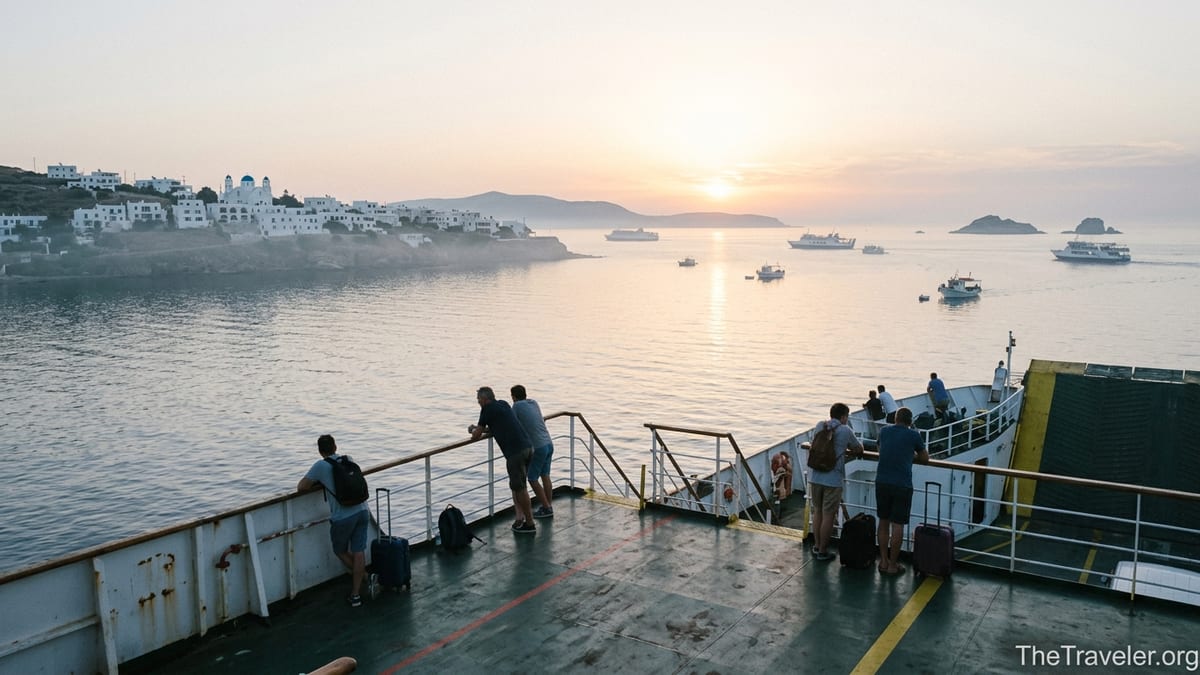
Conventional ferries, often operated by companies like Blue Star Ferries, are generally larger, more stable and cheaper. Interior lounges feel more like a simple cruise ship, with wide outdoor decks, cafes and often proper cabins on longer routes. For example, on the Piraeus to Naxos route you might see a Blue Star economy seat around 35 euros taking about 5 hours, while a high speed option is closer to 60 euros but cuts the trip to under 4 hours. For many travelers who are not in a rush, the slower boat offers better value and a more relaxed experience on deck.
High speed catamarans have advantages and trade-offs beyond time. They can be more prone to motion in rough seas, and outside deck space is often limited or non-existent. Cabins are rare, and luggage storage may be more constrained. Conventional ferries can handle rough weather better and are less likely to be canceled on windy Meltemi days, although delays are still possible. A realistic strategy in July and August is to use conventional ferries on longer legs, such as Piraeus to Santorini or Piraeus to Naxos, and high speed ferries for short hops between islands where the extra cost is smaller and the time savings feel significant.
When comparing options on booking platforms, pay close attention to vessel type, not just departure time. Two ferries departing Piraeus for Paros within 30 minutes of each other may differ dramatically: one a high speed catamaran arriving 3.5 hours later with a 60 euro ticket, the other a conventional ship taking 5 hours with tickets around 35 to 40 euros. Decide whether you value comfort, deck views and lower price more than arriving 90 minutes earlier.
Tickets, Seating, Cabins, Luggage and Vehicles
Economy class is the standard ticket type for Cyclades ferries, with prices varying by route, date and vessel. On shorter inter-island legs you will sometimes see ultra-low fares such as 5 to 10 euros between neighboring islands, while mainline routes from Athens to major islands usually start around 30 to 50 euros in economy in 2026. Many ferries also offer reserved airline-style seats, business or VIP lounges and, on larger conventional ships, private cabins for 2 to 4 people. For instance, on a night sailing from Piraeus to Santorini, a cabin supplement can turn an 11 hour crossing into a full night’s sleep and effectively replace a hotel night.
Luggage policies are generally generous. Most companies allow at least one large suitcase per passenger plus smaller bags without extra fees, as long as you can carry them yourself. At boarding, you usually leave big suitcases on specific luggage racks near the vehicle deck or at designated spots marked with your destination, then take smaller hand luggage with you to your seat. On busy August sailings from Piraeus to Paros or Naxos the luggage racks can look chaotic, so it helps to label your bag clearly with a name and island and attach a colored strap or ribbon to spot it quickly on disembarkation.
If you are traveling with a car or motorbike, you pay an additional vehicle fare that can easily exceed the passenger ticket. As a very rough example, on a typical Piraeus to Naxos route a small car might add 80 to 120 euros each way in high season, depending on the company and vessel. Spaces for vehicles are limited and should be booked weeks in advance for July and August. At the port, you will usually be directed to queue in a separate lane, board via the vehicle ramp and then be guided by staff into a parking spot. Plan to arrive at least 60 to 90 minutes before departure with a vehicle, especially in Piraeus.
Boarding and seat use are fairly relaxed, particularly on conventional ferries. Even if you have a specific seat number, many travelers sit on deck or at cafe tables once underway. On shorter inter-island runs such as Paros to Naxos or Mykonos to Paros, it is common to stand outside for the views and return inside only briefly. For overnight or long daytime sailings, reserved seats or cabins are worth the extra cost if you prefer guaranteed personal space and quiet.
Booking Strategy, Timing and Realistic Prices
The key to stress-free ferry planning in the Cyclades is to book major legs early while keeping some flexibility for short inter-island hops. For 2026, most summer schedules for June to September start appearing online from late winter, with more additions in March and April. Popular fast ferries from Piraeus or Rafina to Mykonos, Paros and Naxos on Fridays and Sundays in July or August can sell out several days or even weeks ahead. If you know you must be on a specific island for a fixed hotel booking, book those ferries as soon as the timetable is published.
On the main Athens to Cyclades routes, sample prices for 2026 show economy tickets such as 35 euros Piraeus to Paros, 35 euros Piraeus to Naxos, 38 euros Piraeus to Mykonos and about 46.50 euros Piraeus to Santorini for the cheapest seats on slower or shoulder-season departures. Fast catamarans are usually 30 to 70 percent more expensive. Inter-island routes remain relatively affordable: for example, Paros to Naxos from around 10 euros, Naxos to Koufonisia from just above 7 euros and Santorini to Ios from around 6.50 euros. Treat these figures as indicative examples, as final prices vary by date, demand and how early you book.
A practical booking sequence for a 10 day trip in July might look like this. First, once flights are confirmed, reserve key ferries from Piraeus or Rafina to your first island and from your final island back to Athens. Second, book any long inter-island legs that have limited weekly frequency, such as Milos to Amorgos or Sifnos to Santorini, where missing a ferry might force a full day’s detour. Third, leave short, frequent routes such as Paros to Naxos or Santorini to Ios until closer to departure, especially in June or September when demand is lower.
Allow buffer time around ferries. On arrival day in Athens, avoid tight connections between flights and ferries. For example, landing at 11:30 and expecting to catch a 13:00 departure from Piraeus leaves almost no margin for immigration, baggage and traffic. More realistic is to aim for a mid or late afternoon ferry, or spend the first night in Athens and sail the next morning. Similarly, when returning to Athens for an international flight, plan to arrive in the city at least one night before departure, rather than relying on the last ferry of the day from an island.
Planning Sample Itineraries Through the Cyclades
Thinking in terms of routes can help turn individual ferry legs into a coherent journey. One classic first-time itinerary is Piraeus – Paros – Naxos – Santorini – Athens. In practical terms, this might mean a morning high speed or mid-morning conventional ferry from Piraeus to Paros (from around 35 euros), a short 25 minute Paros to Naxos crossing (roughly 10 euros), a 1 hour 30 minute Naxos to Santorini hop (from about 30 euros) and then a fast or overnight sailing back to Piraeus. This loop offers beaches, traditional villages and caldera views with minimal backtracking and mostly short ferry journeys between islands.
A more adventurous route could use Naxos as a gateway to the Small Cyclades. For example, you could travel Piraeus to Naxos, then board the local Express Skopelitis to Iraklia, Schinoussa or Donousa, continuing on to Amorgos. Published fares for some of these short legs start as low as around 5 to 7 euros, with travel times ranging from about 1 hour to nearly 4 hours depending on stops. From Amorgos, you might continue to Santorini or Naxos on a faster conventional ferry and then return to Athens. This style of itinerary suits travelers who prioritize quiet beaches and local life over nightlife and shopping.
Another practical plan focuses on western Cyclades, starting from Piraeus or Lavrio and visiting Serifos, Sifnos and Milos. In 2026, indicative fares show Piraeus to Serifos starting from about 30 euros with roughly 2 hours 30 minutes on fast ferries, and Piraeus to Sifnos from around 40.50 euros with journey times similar. Inter-island links like Sifnos to Milos can be under an hour on some sailings with modest fares. You could finish by sailing from Milos back to Piraeus, or, for a quieter return, route via Lavrio on one of the seasonal connections.
When piecing these routes together, map out not just the islands but the likely ferry times. For example, if you plan to leave Santorini for Naxos at midday, check whether that arrival time in Naxos aligns with same-day departures of Express Skopelitis or other local boats if you intend to reach Koufonisia or Amorgos before nightfall. Realistic planning means accepting that some days will be partly “ferry days” and structuring your sightseeing or beach time around early morning or late afternoon sailings rather than trying to squeeze too much into a single day.
The Takeaway
Traveling by ferry around the Cyclades is one of the great pleasures of a trip to Greece, but the mix of ports, companies and vessel types means it pays to plan ahead. Start by choosing the Athens departure port that best fits your flights and first island, then decide whether fast or conventional ferries match your comfort level and budget. Use hub islands like Paros, Naxos, Mykonos and Santorini to structure inter-island hops, and pay attention to sample prices and journey times so you understand what you are getting for each ticket.
Book key long legs early, especially in July and August, while leaving some flexibility for short local crossings that are easier to adjust as you go. Label your luggage, arrive at the port in good time and treat the ferry trips as part of the experience rather than an obstacle. With realistic expectations and a clear strategy, Cyclades ferries can turn your route between Athens and the islands into a highlight of your journey rather than a logistical headache.
FAQ
Q1. How far in advance should I book Cyclades ferry tickets in summer?
For July and August, aim to book main routes from Athens and key inter-island legs at least 3 to 6 weeks in advance, especially for high speed ferries and Friday to Sunday departures. Short, frequent crossings such as Paros to Naxos can often be booked closer to travel, but even those can sell out on peak holiday weekends.
Q2. Is it better to sail from Piraeus or Rafina?
Piraeus has the most routes and is best if you are staying in central Athens or heading to southern Cyclades like Santorini, Milos or Ios. Rafina is often more convenient from the airport and works well for northern Cyclades such as Andros, Tinos and Mykonos. Choose based on your arrival time, hotel location and first island rather than assuming one port is always better.
Q3. Do I need printed tickets or are mobile boarding passes accepted?
Most major ferry companies serving the Cyclades now support electronic tickets and mobile boarding passes, so you can check in online and show a QR code on your phone at boarding. However, a few routes and smaller operators still require printed tickets, so always check the instructions on your booking confirmation and allow time at the port ticket office if a physical ticket is necessary.
Q4. What happens if my ferry is canceled due to strong winds?
During Meltemi wind episodes, some high speed ferries may be canceled or delayed, while large conventional ferries are more likely to operate. If your sailing is canceled, you are generally entitled to a refund or to be rebooked on the next available departure. In practice, rebooking can mean significant delays, so it helps to build a buffer day into your itinerary if you are traveling in late July or August when winds are strongest.
Q5. Are cabins worth it on overnight Athens to Cyclades routes?
Cabins add a noticeable cost but can be worthwhile on long overnight journeys such as slow Piraeus to Santorini or Piraeus to more distant islands. They effectively replace a hotel night, offer privacy and make it easier to arrive rested early in the morning. On day crossings under 6 or 7 hours, cabins are less necessary unless you particularly value quiet space.
Q6. Can I island-hop the Cyclades without returning to Athens between stops?
Yes. In fact, most travelers build itineraries that move from island to island before finally returning to Athens. Hubs like Paros, Naxos, Mykonos and Santorini have dense networks of connections so you can create loops such as Paros – Naxos – Ios – Santorini or Mykonos – Paros – Naxos – Amorgos without going back to the mainland.
Q7. How early should I arrive at the port before departure?
For foot passengers, arriving 45 to 60 minutes before departure is usually sufficient, though in Piraeus during peak season it is sensible to aim for the earlier end of that range. If you are boarding with a car or motorbike, arrive at least 60 to 90 minutes early to allow for check-in, vehicle queueing and loading.
Q8. Are Cyclades ferries suitable for travelers prone to seasickness?
Conventional ferries are generally more stable and comfortable in rough seas than small high speed catamarans, so they are the better choice if you are prone to motion sickness. Sitting on an outside deck with a view of the horizon and avoiding heavy meals or alcohol before departure can help. If you know you are sensitive, carry motion sickness tablets recommended by a medical professional.
Q9. Can I take my rental car on the ferry between islands?
Technically you can, but most rental car contracts prohibit taking vehicles on ferries without explicit permission. Even when allowed, adding a car to multiple ferry legs can quickly become expensive. In many cases it is simpler and cheaper to rent separate cars on each island and travel as a foot passenger, especially on routes with frequent service and short distances.
Q10. Is it possible to visit the Cyclades on a tight budget using ferries?
Yes. By choosing conventional ferries, traveling outside peak August, booking in advance and focusing on shorter inter-island hops, you can keep transport costs relatively low. For example, combining an economy ticket from Piraeus to Paros with a few short routes such as Paros to Naxos or Naxos to Koufonisia can let you visit multiple islands without spending heavily on high speed ferries.