


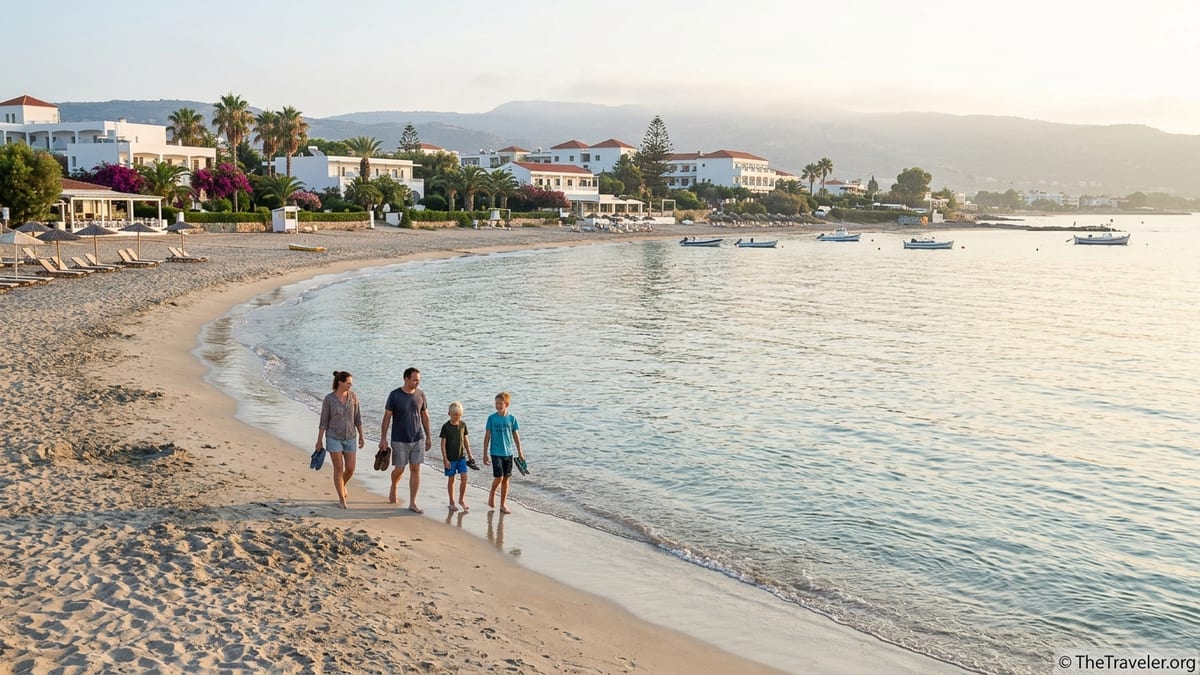
The Dodecanese island group in the south eastern Aegean is one of Greece’s most reliable choices for a family beach holiday. Direct summer flights from many European cities, well developed resorts and an island hopping network that lets you add quieter side trips all help parents keep logistics under control. Within the group, Rhodes and Kos stand out as the easiest bases for families, but smaller islands like Symi, Tilos and Kalymnos are increasingly popular for a second, slower week. This guide compares Rhodes, Kos and a few practical alternatives with a focus on sandy beaches, short transfers, family friendly resorts, things to do and the day to day details that matter when you are travelling with children.
Rhodes vs Kos: How They Compare for Family Holidays
Rhodes and Kos are the two largest and best connected Dodecanese islands, both served by international flights in summer and daily ferries for those arriving via Athens. Rhodes is bigger and more varied, with a medieval old town, long resort strips on both coasts and easy boat links to several smaller islands. Kos feels smaller and flatter, with long open beaches, a compact main town and shorter driving distances. In practice, families choosing between them are deciding between Rhodes’ wider choice of resorts and day trips and Kos’s slightly simpler layout.
For sandy beaches and all inclusive hotels, both islands work well. On Rhodes, family favourites such as Faliraki, Kolymbia and Kiotari offer wide sandy or sand and shingle bays, large pool complexes and kids’ clubs. A family of four can often find an all inclusive week in mid season in a mid range hotel from roughly 900 to 1,200 euros per person including flights, depending on departure airport and board basis. On Kos, Tigaki, Marmari and Kardamena play a similar role, with long shallow beaches and a dense cluster of resorts at different price points.
Another practical difference is scale and transfer times. From Rhodes airport, resort areas such as Ixia and Ialyssos on the west coast are only about 15 to 20 minutes by taxi, Faliraki around 20 to 25 minutes and Kolymbia about 30 minutes. Lindos, further south, can take 50 to 60 minutes by road and Kiotari about 65 to 70 minutes. From Kos airport, by contrast, Tigaki is around 20 minutes away, Marmari about the same, Kardamena roughly 15 minutes and Kos Town around 30 minutes. If your children are small and you want the shortest transfer possible, the cluster of resorts close to Kos airport gives Kos a slight edge.
In terms of atmosphere, Rhodes has more distinct zones: an historic UNESCO listed old town, busy family resorts, quieter coves and a windier west coast popular with windsurfers. Kos is flatter and breezier, with long straight stretches of beach and a more uniform resort feel. Both have busy but walkable main towns with pedestrian streets, ice cream shops, casual tavernas and small playgrounds where children can blow off steam in the evening.
Best Family Bases on Rhodes: Short Transfers and Sandy Beaches
If you choose Rhodes as your base, the key decision is whether you want to be close to Rhodes Town for easy sightseeing or further down the east coast for calmer beaches. For most families, the most practical compromise is the stretch from Kallithea and Faliraki down to Kolymbia. These areas combine wide, sandy or soft sand and pebble beaches with big resort hotels, waterparks and straightforward bus or taxi links into Rhodes Town and to Lindos for day trips.
Faliraki in particular has reinvented itself as a family resort. While it still has nightlife, the centre of gravity has shifted toward beach clubs with playgrounds, casual tavernas and mid range all inclusive hotels. The main beach is long and sandy with shallow water, and there are sheltered coves like Anthony Quinn Bay and Ladiko a short taxi ride away. Families regularly choose hotels such as Apollo Blue or Apollo Beach, mid range seaside properties with large pools and direct beach access, where a taxi from the airport typically costs in the region of 35 to 45 euros and takes around 20 to 25 minutes in normal traffic.
Kolymbia, about 30 to 35 minutes from the airport, is another strong option if you prefer a slightly quieter feel. It sits roughly halfway between Rhodes Town and Lindos, which keeps day trip times manageable. The long main beach is a mix of sand and fine shingle, with shallow entry and plenty of space even in high season. Families who like hotel based holidays often look at resorts such as Port Royal or larger family focused properties with kids’ clubs and splash pools. Bus services run along the main road behind the resort, so older children can experience local buses to Rhodes Town or down the coast without long journeys.
For families who want more character and do not mind a longer transfer, Lindos remains one of Rhodes’ most atmospheric villages. The beaches of Lindos and nearby Pefki are sandy and good for children, and the whitewashed village with its hilltop acropolis is a highlight of the island. However, the one hour transfer from the airport and higher in resort prices mean Lindos often works best for families with older children or for a second week after a few nights closer to the airport.
Family Friendly Areas on Kos: Compact Distances and Easy Logistics
Kos is particularly easy for families who want short transfers and simple bus routes. The airport sits roughly in the middle of the southern coast, which means main resorts are rarely more than half an hour away. Kardamena, only about 7 kilometres from the airport, is one of the closest resort towns. It has a sandy beach, a lively waterfront and a mix of all inclusive hotels, self catering apartments and small family run properties. A pre booked taxi from the airport to Kardamena typically costs less than a similar journey on Rhodes, reflecting the shorter distances involved.
On the north coast, Tigaki and Marmari are favourites for families seeking long, shallow beaches and a traditional package holiday feel. Both resorts are around 20 minutes from the airport and 15 to 20 minutes by bus or taxi from Kos Town. The beaches here are among the sandiest in the Dodecanese, with gently shelving water and sections where you can still find space even in August. Large family hotels and all inclusive resorts sit just behind the sand, meaning you can walk straight from the pool to the beach without crossing busy roads.
Kos Town itself can also work as a base for independent minded families who prefer apartments to big resorts. The town has a compact harbour, archaeological sites scattered around the centre and a good choice of restaurants that stay open later into the shoulder seasons. From the port you can book daily boat trips to nearby islets and to the Turkish coast. However, beaches near town are narrower and in some cases more pebbly, so many families who stay in town plan to take the local bus to Tigaki or Psalidi for full beach days.
Day to day logistics on Kos are straightforward. A network of local buses links the main resorts to Kos Town, and services are usually frequent in July and August. Car hire for a day trip to the island’s interior, including the mountain village of Zia or the archaeological site of Asklepion, can often be arranged for roughly 40 to 60 euros per day for a small car outside peak weeks, with higher prices in August. Roads are generally quiet by European standards, which is reassuring for parents who do not drive often at home.
Smaller Dodecanese Islands as Easy Side Trips
One of the advantages of staying on Rhodes or Kos is the access they provide to smaller Dodecanese islands that are harder to reach directly. Fast catamarans and conventional ferries connect Rhodes and Kos to islands such as Symi, Tilos, Chalki, Kalymnos, Nisyros and Patmos. Many families use this network to split a two week trip into a week in a full service resort followed by a slower week somewhere quieter, without adding complex international flights.
From Rhodes, one of the most popular day trips is to Symi, known for its colorful neoclassical harbour and clear water bays. In high season, excursion boats leave Rhodes Town most days in the morning and return late afternoon, often including a swimming stop at a bay like St George. This gives families a taste of a smaller island without changing hotels. For a longer break, Tilos and Chalki offer low key beaches, simple tavernas and very little traffic, which can be appealing if you want children to have more freedom to explore.
From Kos, Kalymnos and Nisyros are the most practical side trips. Kalymnos is famous for rock climbing and sponge diving heritage, but for families the main appeal is a more authentic Greek island atmosphere and smaller, quieter beaches in villages like Vathy or Massouri. Nisyros, a small volcanic island, offers a very different landscape, with a crater that can be visited on organised excursions. Both islands are generally reached by day tours or scheduled ferries that take around one to two hours, depending on route and vessel.
When planning side trips, bear in mind that ferry timetables in the Dodecanese can change with the season and may be reduced in April, May and October. Booking flexible accommodation on the main island and leaving enough buffer days at the end of your trip to get back to Rhodes or Kos before your flight home can reduce stress if sea conditions affect schedules.
Choosing the Right Beach and Resort Style
For many families the beach is the deciding factor. On Rhodes, the east coast between Kallithea and Lindos has the most family friendly beaches, with a mixture of soft sand and fine shingle and generally calmer seas. Faliraki offers a wide sandy bay, while Tsambika and Agia Agathi further south are known for particularly soft sand and shallow water, although they lack large hotels directly on the beach. The west coast near Ixia and Ialyssos can be windy and the beaches are more pebbly, which suits older children interested in windsurfing or kitesurfing but may be less comfortable for toddlers.
On Kos, the north and south coasts are lined with long, sandy beaches that feel more open and exposed to wind than many Rhodes coves. Tigaki and Marmari have shallow water and large stretches of sand with basic facilities like sunbeds, cafes and small playground equipment near some beachfront tavernas. Kardamena combines sandy beaches with a compact town, but some parts of the waterfront are more developed and busy, so it is worth checking the exact location of your hotel relative to quieter sections of the shore if you have very young children.
Resort style also varies. Rhodes has a wide range of all inclusive and half board hotels with kids’ clubs, water slides and evening entertainment, especially around Faliraki, Kolymbia and Kiotari. Properties often include multiple pools, buffet restaurants and supervised activities, which can be helpful if parents want some downtime. Kos has similar resorts along the Tigaki and Kardamena coasts, but also a healthy supply of small, family run apartment complexes where self catering is easier and staff often remember guests from year to year.
If you value having restaurants, supermarkets and playgrounds within a short walk, look carefully at maps and recent photos of each resort area. In Faliraki or Kardamena, for example, you can usually walk from your hotel to several family friendly tavernas and mini markets in less than ten minutes. In more spread out areas like Kiotari or some stretches of the north coast of Kos, you may rely more on hotel facilities or need a short taxi ride to reach a wider choice of places to eat.
Getting Around: Transfers, Buses, Taxis and Car Hire
Both Rhodes and Kos have straightforward airport transfer options and family friendly transport once you are in resort. On Rhodes, official taxis queue outside the terminal, and fixed price tables indicate typical fares to popular resorts. As a rough guide, a standard taxi from Rhodes airport to Ixia or Ialyssos usually takes about 15 to 20 minutes, to Faliraki around 20 to 25 minutes and to Lindos around 50 to 60 minutes in normal traffic. Pre booked private transfers and shared shuttle buses are widely available, often bundled through tour operators, with shuttle times sometimes longer due to multiple hotel stops.
On Kos, the shorter distances mean taxi fares are generally lower and journey times shorter. Kardamena is close enough to the airport that you can often be at your hotel pool within 30 minutes of landing, even allowing for luggage collection. Public buses connect the airport with Kos Town and major resorts in high season, although families with younger children and luggage usually prefer the predictability of a taxi or pre arranged transfer. For budget conscious travellers, checking in advance whether your hotel can arrange a transfer at a fixed rate can help avoid surprises.
Local buses on both islands are adequate for simple day trips but may not match urban timetables at home. On Rhodes, services from the town bus station run along the east coast to Faliraki, Kolymbia and Lindos, with extra departures in July and August. Buses can be busy at peak times, particularly in the morning and late afternoon, so travelling slightly earlier or later can make journeys more comfortable with children. On Kos, buses run from Kos Town to Tigaki, Marmari and Kardamena, and from Kardamena to Kefalos at the west end of the island.
Car hire can be a good investment if you want to explore beaches beyond your immediate resort. Rates fluctuate with demand, but outside August you can often find a small hatchback from local agencies for roughly 40 to 60 euros per day on a short rental, with lower daily rates for longer bookings. Child seats are widely available but may need to be reserved in advance. Roads are mostly single carriageway and well signposted, although parking near Rhodes Old Town in high season can be challenging, which makes staying in nearby Ixia or Faliraki and using a taxi into town a practical compromise.
Food, Activities and Everyday Practicalities
Families tend to praise Rhodes and Kos for being straightforward places to feed children who may not be adventurous eaters. Menus in resort areas almost always include simple pasta, grilled chicken, burgers and fries alongside Greek staples like souvlaki and moussaka. Seafront tavernas in Faliraki, Kolymbia, Tigaki and Kardamena routinely offer high chairs, children’s portions and informal service that is forgiving of noise and dropped cutlery. Prices vary with location, but a casual family meal for four with mains and soft drinks commonly costs something in the range of 40 to 70 euros in mid range resorts, with Rhodes Old Town and Lindos often at the higher end.
Beyond the beach and hotel pools, there are plenty of family activities. On Rhodes, the large waterpark near Faliraki is a major draw for children and teenagers, with shuttle buses from some nearby resorts, while the Valley of the Butterflies in the island’s interior is a popular half day trip in late spring and summer. Mini golf courses, small fun parks and boat trips with swimming stops run out of many east coast resorts. On Kos, families often combine beach days with visits to the Asklepion archaeological site, a bike ride along the seafront path in Kos Town or a boat trip that includes dolphin spotting or snorkelling stops.
Everyday practicalities such as supermarkets, pharmacies and medical care are reasonably well covered on both islands. Larger resorts have at least one supermarket selling nappies, baby food and beach toys, as well as several smaller mini markets. Pharmacies in resort towns usually keep standard medicines and basic first aid supplies and can advise on minor ailments. Both Rhodes and Kos have hospitals in their main towns, and there are private clinics in popular resorts, which provides reassurance in case a child needs to see a doctor.
Seasonality is another factor to consider. July and August are hot, with midday temperatures regularly above 30 degrees Celsius, which can be tiring for toddlers. Many families now choose late May, June or September, when the sea is warm enough to swim but temperatures are milder and crowds smaller. Outside the main season, some resort facilities, including kids’ clubs and full entertainment programmes, may run a reduced schedule, so checking with your hotel in advance can help you avoid disappointment.
The Takeaway
For families looking at the Dodecanese, Rhodes and Kos are the most practical and versatile choices. Rhodes offers more variety, from the medieval old town to sandy family resorts like Faliraki and Kolymbia and atmospheric villages such as Lindos, alongside excellent ferry connections for side trips to islands like Symi and Tilos. Transfers to many east coast resorts are manageable, and there is a wide range of hotel styles and price points.
Kos, by contrast, wins on compactness and simplicity. Almost every major resort is within 30 minutes of the airport, beaches in places like Tigaki and Marmari are wide and sandy, and bus routes are easy to grasp even for visitors who do not usually use public transport. For a first Greek island holiday with very young children, the shorter distances and flat terrain can be reassuring.
Smaller Dodecanese islands add depth for families willing to move around, but for most travellers it makes sense to treat them as second bases or day trips rather than the main hub. Whichever island you choose, focusing on short transfers, walkable access to the beach, nearby everyday services and a resort or town with a good spread of family friendly restaurants will do more for your holiday experience than chasing the most dramatic scenery. In that respect, both Rhodes and Kos deliver reliable, repeatable family holidays that are easy to recommend.
FAQ
Q1. Which island is better for a first family trip, Rhodes or Kos?
For a first visit with younger children, Kos often feels easier because transfers are shorter and distances are compact, but Rhodes offers more variety and day trip options.
Q2. Are the beaches on Rhodes or Kos sandier for small children?
Kos has longer stretches of soft sand in areas like Tigaki and Marmari, while Rhodes has a mix of sandy and sand and shingle beaches, especially along the east coast near Faliraki and Kolymbia.
Q3. How long are airport transfers to the main resorts?
On Rhodes, expect roughly 20 to 25 minutes to Faliraki and around 50 to 60 minutes to Lindos. On Kos, most major resorts such as Kardamena and Tigaki are about 15 to 25 minutes from the airport.
Q4. Do we need a car on Rhodes or Kos with kids?
Not necessarily. Many families rely on airport transfers and local buses or taxis for short hops. Hiring a car for one or two days can be useful for exploring beaches and villages beyond your immediate resort.
Q5. Are there good all inclusive resorts for families?
Yes. Both islands have many all inclusive and half board hotels with pools and kids’ clubs, particularly around Faliraki, Kolymbia and Kiotari on Rhodes and around Tigaki, Marmari and Kardamena on Kos.
Q6. Is it easy to find family friendly food?
Very. Menus in resort areas almost always include simple pasta, grilled meat, salads and snacks alongside Greek dishes, and tavernas are generally welcoming to noisy or restless children.
Q7. Can we visit smaller Dodecanese islands as day trips?
Yes. From Rhodes, popular day trips include Symi and sometimes Chalki, while from Kos you can reach Kalymnos and Nisyros. In peak season there are usually daily excursions sold in resort towns.
Q8. When is the best time to visit with children?
Late May, June and September usually offer warm seas with slightly cooler air temperatures and fewer crowds than July and August, which many parents find more comfortable for younger children.
Q9. Are the towns and resorts stroller friendly?
Most resort promenades and main streets are reasonably stroller friendly, though older village centres and parts of Rhodes Old Town have cobblestones and steps that can be harder to navigate.
Q10. How far in advance should we book for school holiday dates?
For July and August, it is sensible to book flights and family rooms several months ahead, especially if you want a specific hotel with family suites or need adjoining rooms.