

The Ionian Islands line Greece’s west coast with a run of beaches that feel almost unreal: white cliffs, turquoise water and coves that seem to glow from within. Yet on the ground these shores are far from identical. Some are dramatic, deep-water bays best for strong swimmers and photographers. Others are mellow family beaches with soft sand, shallow shelves and rows of sunbeds attached to low-key beach bars. This guide compares the headline Ionian beaches island by island, focusing on what most travelers care about in practice: sand versus pebbles, cliffs versus easy swimming, the presence of beach clubs and tavernas, nearby accommodation, parking and whether you will be arriving by car or by boat.
Lefkada’s West Coast Icons: Porto Katsiki vs Kathisma
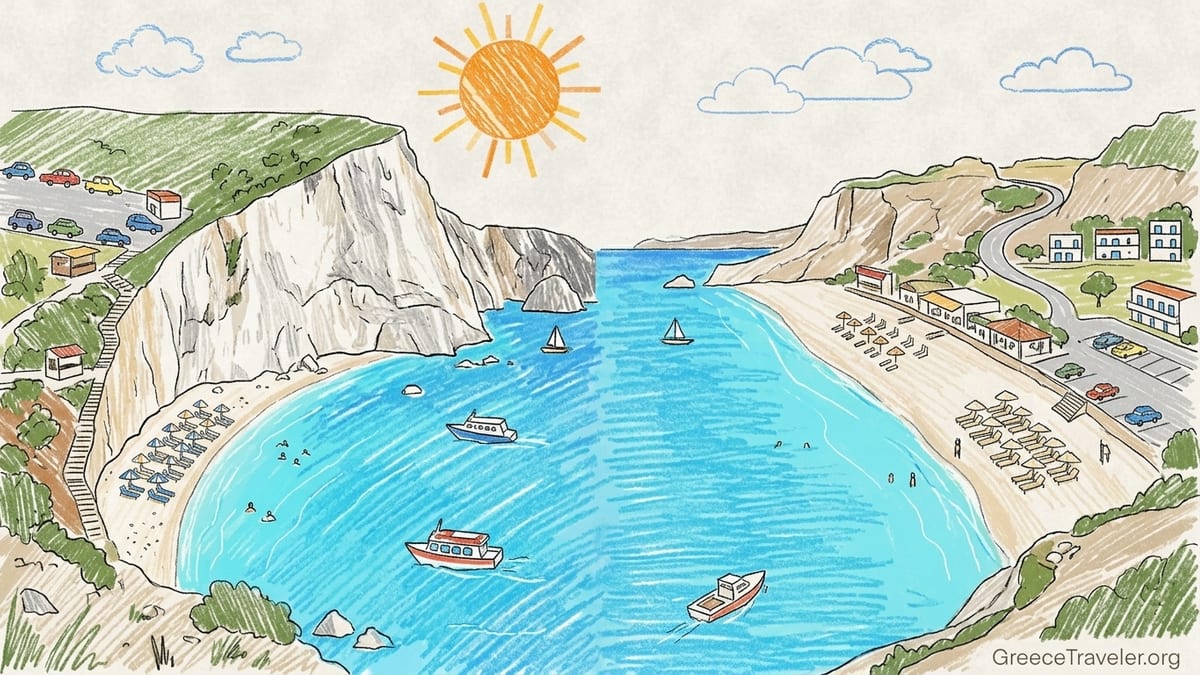
On Lefkada, Porto Katsiki is the beach that fills the postcards. Set below a sheer white cliff on the island’s southwest tip, it is a compact arc of bright coarse sand and fine white pebbles that drops quickly into deep, cold water. The cliff behind it means there is no natural shade until late afternoon, and when westerly swells roll in the surf can be powerful, which makes this a better choice for confident swimmers than for toddlers. Access is part of the experience: from the clifftop parking area you descend around a hundred concrete and metal steps, and in high summer the canteen and simple snack kiosks at the top do brisk trade in cold coffees and sandwiches as people pause before the climb back up.
Porto Katsiki has only a modest row of organized sunbeds and umbrellas on one side of the beach, and no built-up village at sea level. Most visitors stay elsewhere on Lefkada, in resorts like Nidri or the small harbour of Vasiliki, and reach the beach on day trips by car or by shared excursion boats that call in along the coast. If you arrive early in the day in June or September you may find a parking space close to the steps and plenty of room to spread a towel on the pebbles. By late morning in July and August the car parks above are usually full, and cars line the approach road, so it pays to time your visit for early morning or later afternoon when the cliffs start to cast shade.
Kathisma Beach, farther north on the same west coast, shares Porto Katsiki’s mixture of sand and pebbles and the same luminous blue water, but the atmosphere is quite different. Here the cliffs retreat slightly and the beach is longer and wider, with enough flat land behind the shore to support a small strip of development. Instead of a staircase, a paved road winds almost all the way down to sea level, ending at a ribbon of beach bars, casual restaurants and small hotels or studio complexes built into the slope. Parking lots back the sand, and while they can still get busy in high season, the practicalities are easier for families or anyone with mobility concerns.
Kathisma’s beach clubs range from simple lounger-and-umbrella setups rented by the day to more polished operations with cocktails, light menus and music that gets louder toward sunset. The sand is generally softer and more continuous than at Porto Katsiki, though you still find pebbly patches near the waterline. The sea becomes deep quickly here too, but the broader bay and easier access create a more relaxed, all-day-beach vibe. For travelers weighing the two, Porto Katsiki is the dramatic, camera-ready cliff amphitheatre, while Kathisma is the practical choice if you want to roll out of a seafront room, rent a sunbed and have lunch and a shower within a few steps of where you swim.
Kefalonia Contrasts: Myrtos vs Xi
Kefalonia’s most famous beach, Myrtos, occupies a sweeping, horseshoe-shaped bay framed by towering limestone slopes on the northwest coast. The shore is made up of white to pale grey pebbles rather than sand, which glow in the sun and give the water its electric turquoise colour. Underfoot that means a firm, slightly uneven surface where water shoes can help, and the sea deepens sharply just a few steps out, creating fast-changing shades of blue but little in the way of a shallow paddling zone. Myrtos can experience strong waves when weather systems push into the Ionian, so it suits confident swimmers, sunset watchers and photographers more than families with very young children.
Practical facilities at Myrtos are limited. There is a small parking area close to the beach at the end of the steep access road, along with seasonal snack kiosks and basic toilets. Above, at the top of the hairpin descent, the village of Divarata has simple tavernas where many people stop before or after their swim rather than planning a full beach day. Accommodation is not clustered right on the bay; visitors generally stay in nearby villages like Assos or in the larger town of Argostoli, then drive out to Myrtos for a few hours. The real reward is the sense of scale: stand back from the waterline and you feel dwarfed by the high slopes and the bare sweep of pebble shore.
Across the island on the Paliki peninsula, Xi Beach offers almost the opposite experience. Here the sand is a striking rust-red colour, soft underfoot and shelving gently into relatively shallow, usually calm water that is well suited to children and less confident swimmers. The backdrop is formed by low, pale clay cliffs rather than rugged limestone, and the whole scene feels more horizontal and approachable. Rows of sunbeds and umbrellas stretch along the bay, attached to beach bars and tavernas that serve everything from simple souvlaki plates to seafood and cold beer. Showers and changing cabins make it convenient to freshen up before heading back to a hotel.
Xi is one of Kefalonia’s most developed family beaches, with a choice of small hotels, apartments and villa complexes within walking distance or a short drive. Parking is straightforward along the access road and in informal lots behind the bars, and you never have to contend with the kind of hairpin descent that characterizes the approach to Myrtos. Day-trip boat excursions from Lixouri sometimes include Xi as a stop, but most visitors simply drive. If Myrtos is Kefalonia’s poster image, ideal for a dramatic swim and a sunset visit, Xi is where families can comfortably spend the entire day rotating between the sunbed, the shallow sea and the taverna.
Zakynthos: Gerakas and the Navagio Area
Zakynthos offers two very different coastal stories. In the island’s far south, Gerakas Beach forms part of the National Marine Park, created to protect nesting loggerhead turtles. The beach is a long, curving stretch of soft sand with shallow, usually calm water that makes it one of the easiest family-friendly entries into the Ionian Sea. Sunbeds and umbrellas occupy designated zones, set back from the most sensitive nesting areas, and there are information boards and wardens reminding visitors where they can and cannot place umbrellas or dig in the sand. Motorized watersports are restricted here, so the soundscape tends more toward waves and conversations than jet-ski engines.
Gerakas has a small cluster of parking areas a short walk from the sand, and in the nearby low-rise resort of Vasilikos you will find guesthouses, small hotels and apartments that cater to visitors who want to be close to the marine park beaches. Beach bars and tavernas sit behind the dunes or along the approach road rather than right on the sand, reflecting the environmental regulations. For travelers this means that cold drinks, snacks and sit-down meals are still readily available, but the beach itself retains a relatively natural, low-key profile compared with the livelier resort strips elsewhere on the island.
On Zakynthos’s northwest coast, the Navagio area centres on the world-famous Shipwreck Beach, a tiny cove ringed by high limestone cliffs with the rusting hull of the Panagiotis shipwreck stranded on its pebble shore. The sands here are in fact mostly bright pebbles and grit, and the water deepens almost immediately offshore, making it a place for quick dips rather than lengthy wades. However, for safety reasons due to rockfall risk, Greek authorities have repeatedly closed direct access to the beach itself, and in 2026 boats are not permitted to land people on the sand. Instead, excursion boats from ports like Porto Vromi and Agios Nikolaos now circle in the outer part of the bay when conditions allow, letting passengers swim in deep water at a safe distance or simply view the wreck from the deck.
The second way to experience Navagio today is from above, at the cliff-top viewpoint accessible by road from the island’s interior. Here a fenced platform and informal rocky vantage points give a vertical, birds-eye view down into the cove. There is basic parking, seasonal kiosks and a rotation of food trucks that sell cold drinks and quick snacks, but there is no beach infrastructure in the immediate area because the cliffs drop directly to the sea. Accommodation is found in inland villages and on the more developed northeast and southeast coasts, so most visitors see Navagio as a half-day excursion combined with other stops such as the Blue Caves or nearby coves with pebble beaches where swimming from the boat is still possible.
Corfu Beaches: Variety Over Icons
Corfu does not have a single beach that dominates postcards in the way that Porto Katsiki or Navagio do, but it offers a wide range of shorelines, many of them easier to reach and more varied in terms of sand, pebbles and nearby amenities. On the west coast, bays such as Paleokastritsa and Glyfada are typical. Paleokastritsa wraps around several small coves with mostly pebbly or coarse sand shores and very clear, cool water that deepens quickly, framed by cliffs and olive-covered hills. Small beaches here are backed by tavernas, family-run hotels and boat rental outfits that send visitors to neighbouring grottoes and pocket coves. Parking is fragmented along the coastal road and can feel tight in August, but regular bus services from Corfu Town help.
Glyfada, farther south on the same coast, offers a long sweep of soft golden sand with a shallower entry that appeals to families. It has a row of modern beach bars and hotels immediately behind the sand, with organized loungers, showers and beach service that can feel resort-like in peak season. Here, unlike the cliff-backed beaches of Lefkada, you can walk straight from a seafront hotel or apartment onto the beach without tackling steep staircases. Prices for a pair of sunbeds and an umbrella are typically comparable to other Ionian resorts, with modest surcharges in July and August at the trendiest spots.
On Corfu’s northeast coast, beaches like Barbati and Kalami switch the balance back toward pebbles, with clear, calm water and impressive views across to the Albanian mountains. These shores tend to have a narrow band of white pebbles underfoot, which quickly give way to deep, boat-friendly water. Many visitors here split their days between swimming and renting small motorboats to explore nearby coves. Tavernas and low-rise apartments are set just back from the water, and the main coastal road keeps Corfu Town within an hour’s drive. Together, Corfu’s beaches demonstrate that the Ionian is not only about cliff amphitheatres, but also about string-of-pearls bays where you can combine easy access, village life and relaxed swimming.
Ithaca’s Gidaki: A Quiet Pebble Classic
Ithaca is quieter and less developed than its neighbours, and Gidaki Beach captures that mood perfectly. Located on the island’s east side, Gidaki is a long, gently curving shore of small white pebbles backed by low hills rather than vertical cliffs. The water is almost impossibly clear and turquoise, deepening steadily but not as abruptly as at Myrtos or Porto Katsiki. There are no concrete promenades here, no dense rows of beach clubs. Instead, you typically find a simple arrangement of sunbeds and umbrellas in high season, serviced by a laid-back beach bar or taverna that focuses on salads, grilled fish and cold drinks.
Access shapes the experience. Many visitors reach Gidaki by small taxi boat from Vathy, Ithaca’s main harbour, boarding in the morning and returning mid-afternoon. The crossing is short, usually around twenty minutes, and the boat ticket effectively becomes your transport both ways for the day. Alternatively, there is a hiking path that traverses the low hills above the coast, taking around an hour from the end of the road and rewarding walkers with high views over the channel between Ithaca and the mainland. Because vehicles do not come directly to the beach, parking concerns are shifted back to Vathy or to the trailhead, and the shore itself remains considerably more tranquil than many of the better-known beaches in the region.
Gidaki’s lack of heavy development also affects who it suits best. Families with older children, couples and independent travelers who enjoy a combination of swimming and reading in relative quiet tend to appreciate it most. The absence of loud music, organized watersports and a dense backdrop of hotels means that the main activities here are swimming, snorkelling along the rocky edges of the bay and lingering over lunch at the simple taverna. If Kathisma and Xi represent the convenient, drive-up Ionian beach with every facility at hand, Gidaki is the counterpart for visitors willing to trade a little effort and planning for space, calm and star-filled skies if they linger into the evening.
Antipaxos and Voutoumi: The Lagoon Effect
South of Corfu and just a short distance from Paxos, the tiny island of Antipaxos has become known almost entirely for its beaches, with Voutoumi often singled out as one of the most beautiful in Greece. Voutoumi sits in a protected bay with a wide, pale shore of sand mixed with fine shingle that feels softer underfoot than the pebble-dominated classics of Lefkada and Kefalonia. The water here is shallow for quite some distance and takes on a milky, Caribbean-like turquoise, which makes it ideal for relaxed floating and for families with children who want to play at the edge of the sea without being knocked over by waves. On calm days the surface becomes glassy, and boats anchor just offshore in a scene that can feel more like a lagoon than an open-sea beach.
As Antipaxos has no airport and only a handful of accommodation options, almost everyone arrives at Voutoumi by boat. Regular excursion boats shuttle back and forth from Gaios on Paxos, and in summer there are often small water taxis that allow you to choose your own return time. A typical excursion might cost a modest amount per person for the round trip, with departures in the morning and returns mid to late afternoon. On arrival, passengers disembark directly onto the sand or a small jetty, and a short walk brings them to simple beachfront tavernas where fresh grilled fish, Greek salads and local wine are the norm.
Antipaxos’s limited development means that while Voutoumi does have sunbeds, umbrellas and one or two eateries, it retains a laid-back atmosphere. There are no large hotels on the beach itself; instead, a few villas and guesthouses are scattered over the hills, often booked well in advance for those who want the island almost to themselves in the evenings. Travelers who do not stay on Antipaxos typically base themselves on Paxos or even Corfu, combining Voutoumi with other stops such as the sandy Vrika Beach or the blue caves along Paxos’s west coast. For visitors building an island-hopping itinerary, Voutoumi represents the soft-sand, shallow-water extreme of the Ionian spectrum.
Sand vs Pebbles, Cliffs vs Family Bays: How to Choose
Looked at side by side, the Ionian’s headline beaches offer a clear set of trade-offs. If you prioritize soft sand and easy, shallow entries for children, options like Xi on Kefalonia, Gerakas on Zakynthos, Glyfada on Corfu and Voutoumi on Antipaxos stand out. These are places where you can walk barefoot without water shoes, let children play at the water’s edge and spend long stretches in the sea without suddenly losing footing. Beach bars and tavernas are never far away, and nearby accommodation ranges from simple apartments to small hotels, so you can realistically structure entire days around the shore without any logistical strain.
If, instead, you are chasing dramatic landscapes and iconic photos, you will gravitate toward the pebble and mixed shores backed by high cliffs: Porto Katsiki and Kathisma on Lefkada, Myrtos on Kefalonia and the Navagio area on Zakynthos. These beaches deliver theatrical settings where white pebbles and sheer rock walls contrast with unusually vivid water, but they come with steeper access roads, staircases or boat-only approaches. Waves can be stronger, depth changes more abrupt and natural shade scarce. For many travelers, the best strategy is to treat these beaches as highlight stops for a few hours at a time while basing yourself in a more forgiving bay nearby.
Boat access is another key factor. Voutoumi and Gidaki are classic examples of beaches that feel special precisely because you reach them by sea. Day trips from Paxos or taxi boats from Ithaca’s Vathy turn the journey into part of the experience, often combining swim stops in other coves. The downside is that you are tied to boat schedules and weather conditions; if the wind picks up, departures can be delayed or cancelled. By contrast, drive-up beaches like Kathisma, Xi and many of Corfu’s west-coast bays offer the flexibility to come and go as you please in a rental car or by bus, even if the setting is less secluded.
When it comes to beach bars and the wider atmosphere, Kathisma, Xi, parts of Corfu and, to a lesser extent, Gerakas offer structured rows of sunbeds, music and food service that create a social, resort-like scene. Myrtos and Porto Katsiki, despite their fame, remain relatively simple at beach level, with a few organized sectors but little in the way of full-service clubs. Gidaki and Voutoumi fall somewhere in between: each has at least one taverna and organized loungers, but the absence of heavy construction or large hotels keeps the overall feel more low-key. Choosing between these settings is largely a matter of deciding whether you want your Ionian stay to centre on quiet swims and long naps or on social afternoons with a soundtrack and a cocktail in hand.
The Takeaway
Planning a trip through the Ionian Islands becomes much simpler once you understand how their headline beaches differ on basic, practical terms. Pebble and cliff classics such as Porto Katsiki and Myrtos are best treated as spectacular outings for strong swimmers and photographers rather than as everyday family beaches. Softer, shallower shores like Xi, Gerakas, Glyfada and Voutoumi are where young children, multigenerational groups and less confident swimmers tend to feel most comfortable, with tavernas and beach bars close enough to make a full day by the sea easy and enjoyable.
On top of that basic split, logistics and access will shape your choices. Boat-based beaches like Gidaki and Voutoumi reward those who are willing to plan around ferry timetables or taxi-boat schedules. Drive-up classics like Kathisma, Xi and many of Corfu’s bays are more forgiving if you want the freedom to come and go, especially in peak summer heat. By mixing a few of each type into your itinerary, you can experience the full breadth of the Ionian coastline, from empty morning swims under high white cliffs to sunset cocktails on soft sand in front of a beach bar.
Whether you base yourself on a single island and explore from there or link several islands together by ferry, understanding the character of each shoreline will help you match beaches to your own style. If you do that, the famous names on the map stop being interchangeable blue pins on a screen and become what they truly are in reality: a spectrum of very different coasts, each with its own balance of drama, comfort and sense of escape.
FAQ
Q1. Which Ionian beach is best for families with small children?
Gerakas on Zakynthos, Xi on Kefalonia, Glyfada on Corfu and Voutoumi on Antipaxos all offer soft sand or fine shingle, relatively shallow water and nearby tavernas, making them strong options for families who value easy entry and on-site facilities.
Q2. Is Navagio Beach open for swimming or landing in 2026?
Due to ongoing rockfall risk, authorities have restricted access so that boats no longer land visitors on the sand, and swimming is generally limited to controlled distances outside the most dangerous part of the cove, meaning Navagio is now a sight to view from boats and the cliff-top viewpoint rather than a conventional beach day.
Q3. Do I need a car to reach the best beaches on Lefkada and Kefalonia?
A car makes visiting places like Porto Katsiki, Kathisma and Myrtos much easier, as public buses are limited and summer taxis get busy; many travelers rent a car for at least a few days to give themselves flexibility on weather and timing, especially if they want to arrive early to secure parking close to the sand.
Q4. Are the famous pebble beaches uncomfortable without water shoes?
Beaches such as Porto Katsiki, Myrtos, Gidaki and many Corfu coves have pebbles that can feel hard or slippery underfoot, so lightweight water shoes or sturdy sandals make getting in and out of the sea easier, particularly for children or anyone with sensitive feet.
Q5. Can I find quiet beaches in high season on these islands?
In July and August, headline spots get very busy, but arriving early in the morning or later in the afternoon helps, and quieter experiences can be found by taking taxi boats to places like Gidaki or by exploring smaller coves on Corfu’s northeast coast or Kefalonia’s less-developed stretches.
Q6. How expensive are sunbeds and umbrellas on Ionian beaches?
Prices vary by island and popularity, but on major beaches you can typically expect to pay a modest daily fee for a pair of sunbeds and an umbrella, with premium beach clubs at spots like Kathisma or Glyfada charging somewhat more, especially in peak months.
Q7. Is it better to stay near a beach or in a main town and travel out?
Staying near a beach such as Xi, Kathisma or Glyfada gives easy everyday access to the sea, while basing yourself in towns like Argostoli, Lefkada Town or Corfu Town provides more dining and cultural options; many visitors combine a few nights in each setting during a longer trip.
Q8. Are there strong currents or waves I should worry about?
Cliff-backed beaches open to the Ionian, including Porto Katsiki, Myrtos and the Navagio area, can experience strong waves and sudden depth changes, so they are best for confident swimmers, while family-oriented bays like Gerakas, Xi and Voutoumi are usually much calmer but still require normal care around the water.
Q9. Do Ionian beaches offer shade or should I bring my own?
Natural shade is limited on most major beaches, especially those under high cliffs where the sun does not drop behind the rock until later in the day, so booking sunbeds with umbrellas or bringing a small beach tent or parasol is wise during the hotter months.
Q10. How early should I book accommodation near the most popular beaches?
For July and August stays near in-demand beaches like Kathisma, Xi, Vasilikos for Gerakas or Corfu’s west coast, it is sensible to book several months ahead, particularly if you want specific room types, sea views or family apartments within walking distance of the shore.