


The Ionian Islands scatter down Greece’s west coast in a chain of green mountains, Venetian towns and turquoise bays. What they share in scenery they completely differ in mood. Corfu, Kefalonia, Zakynthos, Lefkada, Paxos and Ithaca all suit very different trips, and the single most important decision you will make is not which hotel to book, but which island and which town or resort to call home. This guide compares the main islands and then zooms in on their strongest bases, so you can match Corfu Town or Kassiopi, Argostoli or Skala, Tsilivi or Vasilikos, Nidri or Lefkada Town and the small harbours of Paxos and Ithaca to the way you actually like to travel.
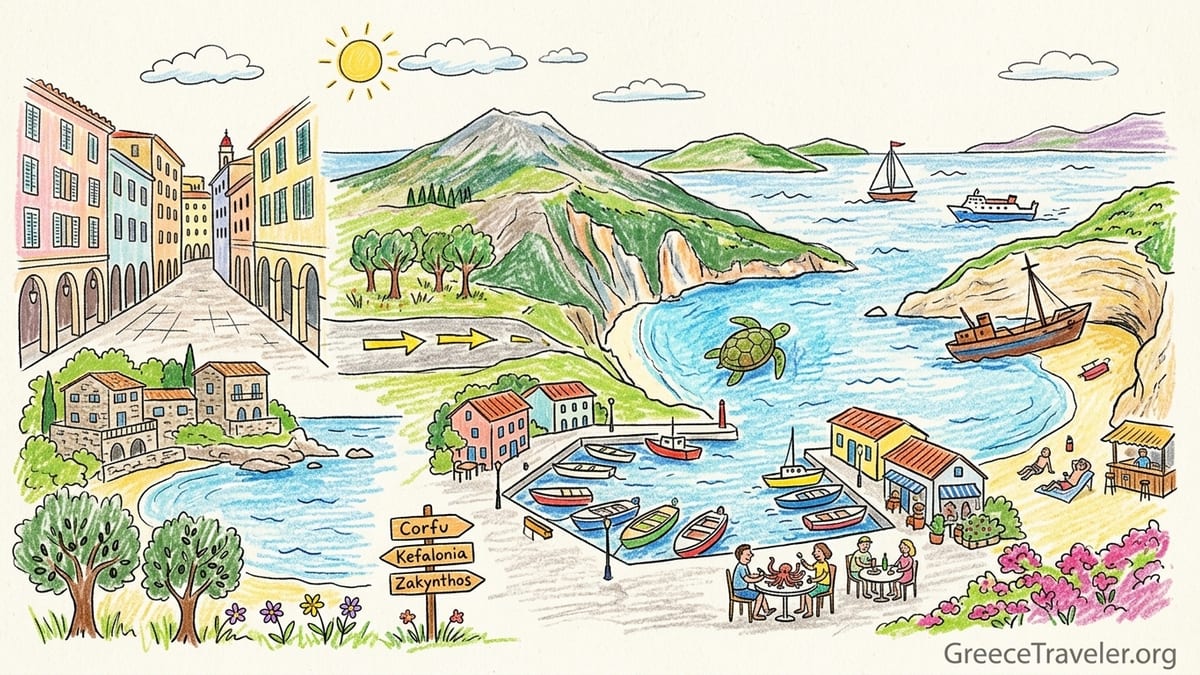
Choosing Your Ionian Island: How They Really Compare
Corfu is the obvious choice if you want culture, variety and an easy first-time introduction to the Ionians. Corfu Town delivers Unesco-listed alleys, pastel Venetian facades and proper year-round life, while coastal resorts range from small coves lined with stone villas near Kassiopi to big all-inclusive complexes on the south coast. In practice, this means you could spend a morning browsing old bookshops under the arcades of the Liston and be back by the pool for lunch without feeling you have sacrificed beach time.
Kefalonia appeals if you picture your holiday framed by mountains, dramatic headlands and quieter towns. Driving the spine of the island, you see Mount Ainos rising inland and cliffs dropping to the blue of Myrtos Bay. Bases like Argostoli, Fiskardo and Skala feel more low-key than the busier spots on Corfu or Zakynthos. Even in August, you can find evenings that are animated rather than rowdy, with tavernas focusing on fresh fish and local robola wine instead of two-for-one cocktail jugs.
Zakynthos, or Zante, has built a reputation on beaches and nightlife. This is where you come for the iconic shipwreck view at Navagio, long sandy strands that stay shallow for metres and full-on bar streets in places such as Laganas. Yet not every corner of the island is a party. Areas like Tsilivi and Vasilikos balance beach comfort and family-friendly or couple-friendly evenings. A realistic week here might mean a boat trip to the Blue Caves one day, sunset drinks in a beach club the next and one or two late nights out rather than a full week of clubbing.
Lefkada, Paxos and Ithaca lean more into slow travel. Lefkada is the only one attached to the mainland by a causeway and small bridge, so it is ideal if you want to arrive by car or plan a road trip that strings it together with Parga or the Peloponnese. Nidri has become a hub for sailing and flotilla holidays, with quaysides full of yachts and day-cruise boats in July and August. Paxos and Ithaca sit at the opposite end of the scale from high-rise resorts: you stay in small harbours, in villas with private pools and in a handful of boutique hotels. Nights are more about lingering over grilled octopus in a harbourfront taverna than finding the next club.
Corfu: Culture-Rich Corfu Town, Scenic Paleokastritsa or Relaxed Kassiopi
Corfu Town is the strongest base if you care about history, restaurants and doing at least part of your trip without a car. The old town’s tight lanes hold everything from small guesthouses above family bakeries to polished boutique hotels in restored mansions. Typical midrange doubles in high season run at roughly mid three-figure sums per night, with breakfast terraces looking onto tiled rooftops or the sea. From here, you can use frequent buses or taxis to reach nearby beaches such as Glyfada or Benitses, join boat trips to Vidos islet or simply stay in town and treat it almost like a small Italian city break with a side of sea air.
Paleokastritsa, on the west coast, is the resort that most often appears in Corfu brochures, and with good reason. Sheer cliffs drop to a string of blue-green coves, and small hire boats line up each morning ready to shuttle visitors along the coast to quieter swimming spots. Accommodation ranges from simple studios behind the main road to midrange hotels stacked into the hillside with wide sea views. If you book a place with a pool and parking, you can spend days alternating between beach-hopping by boat, drives up to the hill village of Lakones for views and evenings of low-key bars and tavernas rather than loud nightlife.
Kassiopi, on the north-east corner, suits travellers who like a small harbour feel, easy boat rentals and the flexibility of villas. The waterfront is ringed with tavernas, a few low-key cocktail bars and shops selling sailing gear and beachwear. Many visitors rent a self-catering villa on the surrounding slopes, often with private pools and views across to the Albanian mountains. A common pattern is to walk or drive down to the harbour in the evening, eat grilled fish or souvlaki by the water, then return to a quiet terrace. Kassiopi is also an efficient base for exploring the line of coves that run down the north-east coast, from Avlaki to Nissaki.
If you are torn between these three, use your evenings as the deciding factor. Choose Corfu Town if you want buzzy piazzas, a choice of wine bars and the occasional cultural event in the old fort. Opt for Paleokastritsa if sea views and daytime excursions matter more than nightlife. Pick Kassiopi if you prefer a village-sized base with a working harbour and the feel of a small boating community.
Kefalonia: Argostoli, Fiskardo and Skala for Different Kinds of Quiet
Argostoli, Kefalonia’s capital, works best as a practical all-round base. The town has a waterfront promenade where locals stroll in the evening, a pedestrian shopping street, several bakeries and plenty of tavernas. In summer, visitors often gather on the harbour wall in the morning hoping to spot loggerhead turtles that feed around the fishing boats. Many hotels here are modern, midrange properties with comfortable rooms rather than destination resorts, which keeps prices more reasonable than in boutique-heavy Fiskardo. You are a short drive from the sandy beaches of Lassi and within day-trip reach of Myrtos, Assos and the Melissani and Drogarati caves.
Fiskardo in the far north is the island’s prettiest harbour, fronted by pastel houses that survived the 1953 earthquake and lined with yachts in high season. Staying here feels different from the rest of the island. Waterfront rooms and design-led boutique hotels come at a premium, particularly in late July and August, and it is common to see restaurant tables filled with yacht crews and well-heeled families. You might pay noticeably more for a seafront room here than for a larger hotel room in Argostoli, but in exchange you get a walkable village where you can swim off small pebbly coves in the morning and wander to dinner without ever using your car.
Skala, in the south, combines a long Blue Flag sandy beach with a proper village main street. The accommodation spread runs from simple studios just behind the sand to low-rise beachfront hotels and hilltop spa properties with wide sea views. Visitors who choose Skala often do so because they want a resort where they can spend most evenings on foot, choosing between tavernas, low-key cocktail bars and ice-cream shops along the pedestrianised stretches. At the same time, Skala is a practical base for driving to the rest of the island, with roughly similar distances to the north, centre and west coast.
When deciding between these three, think about what you want outside beach hours. Argostoli makes most sense if you value supermarkets, pharmacies and a choice of cafes all within a few blocks. Fiskardo suits those willing to pay for a postcard harbour setting and who plan to spend many evenings in the same few streets. Skala is ideal if long days on an accessible beach and relaxed, walkable nights are your priorities.
Zakynthos: Tsilivi, Vasilikos and Laganas for Beaches and Nightlife
Zakynthos has some of the most photogenic water in Greece, but the feel of each resort is very different. Tsilivi, on the north-east coast, is one of the most balanced choices. It has a gently shelving sandy beach, a spread of midrange hotels, apartment complexes and villas, and a main strip where you can find everything from Greek tavernas to pizzerias and cocktail bars. Families like that they can walk to mini-golf, small waterparks and beach bars without needing to drive, while couples appreciate that there are quieter side streets a few hundred metres back from the front.
Vasilikos, on the south-east peninsula, is greener and more spread out. Here you are choosing between beach hotels and villas near long sandy bays such as Gerakas, Dafni and Banana Beach rather than one concentrated resort. Tavernas tend to sit just above the sand, sometimes with free sunbeds if you order meals or drinks. It is a good choice if your ideal day is simply walking from your room to the sea, reading under a parasol and then having an unhurried dinner on a terrace as the sun goes down. Nightlife exists in the form of beach bars and a few relaxed venues, but you will not find rows of clubs.
Laganas, by contrast, is the party centre of Zakynthos. The resort’s long sandy beach is lined with bars, ticket sellers for boat trips and loud venues that stay open until the small hours in peak season. Prices for basic rooms off the main strip can be lower than in quieter family-oriented resorts, which attracts groups of friends in their twenties. If you do decide to stay in Laganas, it makes sense to book accommodation a few streets back from the centre for sleep and then walk in for nightlife. Travellers who want to visit the Laganas Bay area for a day but not stay there often base themselves in Kalamaki or even Tsilivi and take taxis for a single big night out.
In practice, Zakynthos rewards clarity about your tolerance for noise. Pick Tsilivi if you want a middle ground of activity and comfort, Vasilikos if you value beaches and still evenings above all else, and Laganas only if nightlife is central to your plan and you are prepared for busy streets and loud music during high summer.
Lefkada: Road-Trip Friendly Lefkada Town and Sailing Hub Nidri
Lefkada is the easiest of the Ionian islands to reach without a ferry, thanks to its road link to the mainland. This shapes the feel of its main bases. Lefkada Town, at the north end, has a local, year-round character. The grid of streets behind the waterfront holds pastel metal-clad houses, small squares and a mix of boutiques, bakeries and cafes. Accommodation includes simple rooms above cafes, small hotels set one or two streets back from the lagoon and a clutch of smarter properties on the outskirts. Staying here suits travellers who want to combine beach days with evenings in a lived-in Greek town, perhaps calling in at the main market to pick up local honey or olive oil.
Nidri on the east coast is the island’s sailing and excursion hub. The main seaside road is lined with tavernas, cafes and bars on the water side and small hotels, apartments and travel agencies opposite. In high season, the harbour fills with flotilla yachts and day-cruise boats that depart for nearby islets such as Skorpios or down the coast to Porto Katsiki and Egremni. Accommodation here is usually midrange and functional rather than ultra-luxury, with many properties offering simple rooms with balconies and a small pool area. For many visitors, the appeal lies in being able to walk to boat departures, restaurants and rental offices without needing a car every day.
If you will have your own vehicle, you might base in Lefkada Town and treat Nidri as a day-trip stop for cruises and water sports. If you do not plan to drive, Nidri offers a more self-contained setup where beaches, tavernas and organised activities sit close together. In both cases, the island’s more dramatic west-coast beaches, including Porto Katsiki, Kathisma and Egremni, are better visited as day trips by car or organised tour rather than as bases in their own right.
Because Lefkada combines road access with good sailing conditions, it is also popular as a starting point for multi-island itineraries. Some travellers pick a simple hotel in Lefkada Town for their first and last nights, then spend a week on a chartered yacht from Nidri, exploring nearby Meganisi and the smaller offshore islets.
Paxos and Ithaca: Intimate Harbours and Quiet Villas
Paxos is one of the most upmarket and intimate of the Ionian Islands. There are no big resorts or high-rise hotels. Instead you find three small settlements, each with a different mood. Gaios, the main port, has the liveliest atmosphere, with a waterfront lined by tavernas, cafes and small hotels. Rooms above the harbourfront can be surprisingly affordable outside peak season, and you can step straight off a hydrofoil from Corfu into the middle of town. This appeals to travellers who want a village that feels awake even in June or September.
Lakka, at the north of the island, curves around a near-circular bay of shallow turquoise water where yachts and small motorboats anchor. Accommodation here leans towards boutique hotels and stylish villas, often set among olive groves above the water. In a typical setup, a couple might rent a one-bedroom villa with a small private pool, use a hire car or scooter to explore beaches during the day and then walk down to Lakka’s handful of tavernas each evening. Loggos, a smaller harbour on the east coast, feels sleepier still, with a compact waterfront of tavernas and a few apartments and villas scattered in the hillside groves behind.
Ithaca, legendary home of Odysseus, remains one of the quietest inhabited islands in the Ionian group. Vathy, the main town, sits on a deep horseshoe bay, with low buildings edging the water and a small square where locals gather. You will find a cluster of modest hotels and family-run guesthouses here, plus car and boat rental agencies. From Vathy it is straightforward to drive out to small pebble beaches on either side of the bay, then return in the evening for dinner on the waterfront.
On the east coast of Ithaca, the smaller harbours of Kioni and Frikes offer an even more tranquil experience. Kioni is a picture-book village of stone houses stepping down to the water, with a handful of tavernas and cafes on the waterfront. Villas and apartments sit among the olive groves behind, many with terraces looking over the bay where yachts moor overnight. Frikes is tiny, essentially a quay with a couple of tavernas, a bar, rooms and a few guesthouses, ideal if you want to wake to the sound of fishing boats and little else. Both villages work best for travellers who plan to swim off small coves, read on their terrace and spend evenings in the same few favourite tavernas rather than seeking variety.
How to Choose Your Ideal Base: Practical Decision Guide
If Corfu and Zakynthos are your shortlist, ask yourself how much nightlife you truly want. For a mix of culture, beaches and a broad range of evening options that includes everything from traditional tavernas to wine bars, Corfu Town plus a few nights in Paleokastritsa or Kassiopi often beats a full week in a single resort. On Zakynthos, decide whether you prefer a broad, activity-rich resort such as Tsilivi, a quieter beach peninsula like Vasilikos or full-on nightlife in Laganas. Think in terms of how far you are willing to walk at night, whether you want to hear music from your balcony and whether you will rent a car for daytime escapes.
Between Kefalonia and Lefkada, the choice often comes down to how confident you feel driving. Kefalonia’s best experiences involve exploring by car, from switchback roads that descend to Myrtos Beach to hilltop villages that look over the Paliki peninsula. Bases like Argostoli and Skala make that easy, with straightforward parking and clear roads out of town. Lefkada also rewards independent exploration, but its mainland bridge makes it more suitable if you are planning a longer driving itinerary or want to avoid ferry timetables. Staying in Lefkada Town or Nidri can be part of a wider road trip through Epirus and western Greece.
If you are choosing between Paxos and Ithaca for a peaceful week, consider how much you care about sea connections. Paxos is usually accessed by hydrofoil from Corfu, and many visitors twin the two, spending two or three nights in Corfu Town and then transferring to Gaios or Lakka for the rest of their stay. Ithaca is typically reached via Kefalonia or the mainland port of Astakos, so it often features as a second step on a holiday that starts in Argostoli or Sami. Villas on both islands tend to book early for July and August, so if you are set on a particular hamlet or bay it is worth planning several months ahead.
In all cases, picture a typical day on your holiday and work backwards. If you see yourself walking to breakfast at a cafe, swimming off a nearby beach and then strolling to dinner without ever touching a car, you need a compact base like Corfu Town, Fiskardo, Skala, Tsilivi, Nidri, Gaios, Lakka, Vathy or Kioni. If your dream day involves driving to a different remote cove each morning and climbing to viewpoints in the afternoon, you will be happier basing somewhere that makes getting in and out with a car simple, such as Argostoli, Skala or Lefkada Town.
The Takeaway
The Ionian Islands offer an unusually clear menu of travel moods. Corfu gives you culture and resort variety, Kefalonia trades in mountain-backed scenery and quieter towns, Zakynthos majors on beaches and nightlife, Lefkada excels in road access and sailing, and little Paxos and Ithaca provide intimate upscale stays and deep tranquillity. The key is not to chase every island at once, but to match a single main base to the way you prefer to spend your days and nights.
Once you have chosen your island, narrowing down to the right town or resort becomes a practical exercise. Corfu Town versus Paleokastritsa versus Kassiopi, Argostoli versus Fiskardo versus Skala, Tsilivi versus Vasilikos versus Laganas and Lefkada Town versus Nidri all reflect real trade-offs between atmosphere, convenience and cost. Think about walking distances, driving confidence, your tolerance for noise and how much you truly plan to move around. Then pick the island and base that match that picture, and let the landscapes, harbours and tavernas of the Ionian Sea do the rest.
FAQ
Q1. Which Ionian island is best for a first-time visitor?
Corfu is usually the best starting point thanks to frequent flights, a wide choice of accommodation, Corfu Town’s historic centre and easy day trips to beaches and nearby islands.
Q2. If I want dramatic scenery but quieter evenings, where should I stay?
Kefalonia is the strongest fit. Bases such as Argostoli, Fiskardo and Skala give access to mountain and cliff scenery with evenings focused on tavernas rather than loud nightlife.
Q3. Where should I stay in Zakynthos if I want good beaches but not heavy partying?
Look at Tsilivi or Vasilikos. Both offer sandy beaches and plenty of tavernas, with a livelier but still moderate atmosphere compared with the club-focused resort of Laganas.
Q4. Is Lefkada a good option if I am driving from mainland Greece?
Yes. Lefkada is linked to the mainland by a causeway and small bridge, so you can drive straight to Lefkada Town or Nidri without using a ferry, ideal for road trips.
Q5. Which island is best for sailing and boat-based holidays?
Lefkada and Paxos both work well. Nidri on Lefkada is a major sailing hub, while Paxos offers small harbours like Gaios and Lakka that are popular with yacht crews and boat rentals.
Q6. Where can I find the quietest, most tranquil base among these islands?
Paxos and Ithaca are the most tranquil overall. Villages such as Kioni, Frikes, Lakka and Loggos are especially peaceful, with limited traffic and low-key evenings.
Q7. Do I need a car on Corfu, Kefalonia or Zakynthos?
A car is very helpful on Kefalonia and Zakynthos for reaching beaches and viewpoints. On Corfu you can manage without if you base in Corfu Town, but a car widens your options.
Q8. Which bases are best if I want to walk to dinner every night?
Compact hubs such as Corfu Town, Paleokastritsa, Kassiopi, Argostoli, Fiskardo, Skala, Tsilivi, Nidri, Gaios, Lakka, Vathy and Kioni all allow easy evening walks to tavernas.
Q9. How far in advance should I book accommodation on Paxos and Ithaca?
For peak months like July and August it is wise to book several months ahead, especially for villas with pools or harbourfront rooms in small villages.
Q10. Can I combine more than one Ionian island in a single trip?
Yes. Popular pairings include Corfu with Paxos, Kefalonia with Ithaca and Lefkada with nearby smaller islands, but factor in ferry schedules and minimum stay requirements.