


The Ionian Islands look close together on the map, but traveling between Corfu, Paxos, Lefkada, Kefalonia, Ithaca and Zakynthos is not as simple as jumping on the next boat. Routes are fragmented, many ferries are seasonal, and in several cases the fastest “connection” involves going via the mainland or even flying. This guide focuses on how services actually work in 2026 so you can build a realistic, transaction-focused plan instead of a fantasy itinerary that depends on non-existent direct routes.
Understanding the Two Practical Island Clusters
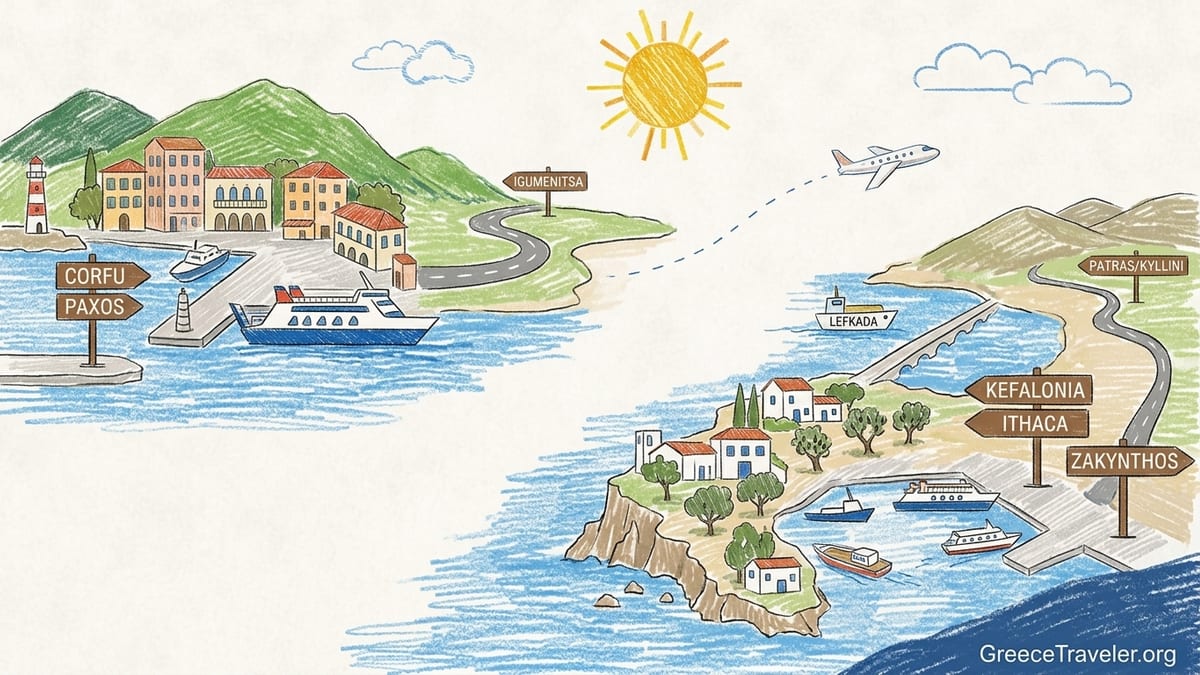
For planning purposes, the Ionian effectively splits into two workable clusters. In the north you have Corfu and Paxos, connected by frequent ferries and hydrofoils in season, with onward routes mainly via the mainland port of Igoumenitsa. In the south you have Lefkada, Kefalonia, Ithaca and Zakynthos, which share a web of year-round and summer-only ferries focused on short inter-island hops and links to Patras, Kyllini and Astakos on the west coast of Greece.
Corfu sits furthest north and is one of Greece’s major ferry gateways, with daily connections to Igoumenitsa and seasonal links to Italy, plus regular boats to Paxos from Corfu Town. Paxos, in turn, is effectively a spoke of Corfu: it has no car-ferry link to the southern Ionian islands, so most travelers wanting to continue south must backtrack to Corfu or cross via the mainland. By contrast, the southern cluster feels more interconnected thanks to regular ferries among Kefalonia, Ithaca and Lefkada, plus seasonal routes between Kefalonia and Zakynthos.
This structure means that a straight north–south island-hopping chain from Corfu to Zakynthos is rarely efficient. A more practical approach is to focus on either the Corfu–Paxos cluster combined with Epirus and mainland ports, or the Lefkada–Kefalonia–Ithaca–Zakynthos cluster combined with Patras, Kyllini and Astakos. If you truly want to bridge the two clusters in a single trip, you should expect at least one mainland transfer or a domestic flight.
Northern Cluster: Corfu, Paxos and the Mainland Links
Corfu is one of the busiest ferry hubs in western Greece. From Igoumenitsa on the mainland, large car ferries and smaller passenger boats run multiple times daily year-round to Corfu Town and, less frequently, to Lefkimmi in the island’s south. In high summer you can usually find departures every couple of hours on this short crossing, which takes from 60 to 90 minutes depending on the vessel type. Because of this frequency, travelers often treat Igoumenitsa–Corfu as a shuttle and book tickets only a few days or even hours in advance, especially outside peak August dates.
From Corfu to Paxos, services are more distinctly seasonal. In a typical July or August week, several small ferry and high-speed operators run daily or near-daily routes from Corfu Town to Gaios, the main port on Paxos, with crossing times from around one hour on a fast boat to about two hours on slower ferries. Outside the core season, especially from late October to April, departures reduce significantly and may operate just a few times per week, which can turn a simple hop into a date-dependent puzzle. Ticket prices on this leg are usually higher per mile than the main Igoumenitsa route due to the smaller, faster vessels commonly used.
What you cannot realistically do from Corfu or Paxos in 2026 is sail directly to Lefkada, Kefalonia or Zakynthos on a conventional scheduled ferry. Although some seaplane and small-ship cruise products advertise Corfu–Lefkada or Corfu–Kefalonia legs, these are specialised services, not the backbone public ferries most travelers rely upon. To move from the northern to the southern Ionian on public transport, you almost always route back through the mainland, commonly via Igoumenitsa, then overland to Preveza or Astakos, or via a domestic flight from Corfu to an airport like Aktio (for Lefkada) or Kefalonia.
Southern Cluster: Lefkada, Kefalonia, Ithaca and Zakynthos
The southern Ionian cluster is far more conducive to classic island hopping because several short ferry lines connect nearby ports. Lefkada, although technically joined to the mainland by a causeway and swing bridge near Aktion airport, also has summer ferries that link its southern port of Vasiliki with northern Kefalonia and Ithaca. Kefalonia itself is a major node, with ports at Sami on the east coast and Poros further south both seeing traffic to Ithaca and the mainland, and additional routes connecting to Zakynthos in season.
Ithaca, a small island east of Kefalonia, is unusually well connected relative to its size. In 2026 there are daily ferries between Sami on Kefalonia and Pisaetos on Ithaca run by Ionian-focused operators, with crossing times of around 30 to 50 minutes depending on the vessel. This makes Kefalonia–Ithaca an extremely practical hop to build into almost any southern Ionian itinerary. In addition, many of these ferries continue or connect to Astakos on the mainland and sometimes to Lefkada’s Vasiliki port during the busier months, which lets you chain islands and mainland in a single day’s travel if timetables align.
Zakynthos, also known as Zante, anchors the southern end of the archipelago. Its main port connects year-round to Kyllini in the Peloponnese, and in summer additional services operate between Zakynthos and Kefalonia. In some recent seasons this has meant car ferries running from the port of Pessada in southern Kefalonia to Zakynthos town, often once or twice daily from late spring through early autumn. Because this is a popular route for both tourists and local traffic, securing a place for vehicles in August usually requires advance booking, while foot passengers can sometimes book closer to departure.
Year-Round vs Seasonal Services and What That Means for You
For trip planning, the key distinction is between routes that are genuinely year-round and those that exist only for a summer window. Year-round in the Ionian generally means at least a few weekly departures in winter, not necessarily daily service. The most reliable year-round links serving these six islands are the mainline ferries connecting Corfu with Igoumenitsa, Zakynthos with Kyllini, Kefalonia (particularly Sami and Poros) with Kyllini and Patras, and the daily Kefalonia–Ithaca crossings between Sami and Pisaetos. These routes underpin local transport and freight, so operators have a strong incentive to keep them running outside the holiday season.
Seasonal services, by contrast, respond directly to tourism demand and are far more vulnerable to change. The ferry from Lefkada’s Vasiliki to Kefalonia’s Fiskardo and Ithaca’s Frikes or Pisaetos, for instance, usually appears from roughly late June to early September, sometimes with additional shoulder-season sailings in May or late September. Within that window, there can be near-daily departures on busy days, but exact start and end dates vary by operator and year. Similarly, Kefalonia–Zakynthos services typically run from late spring into early autumn, but both ports used and weekly frequency can shift. Treat published timetables as indicative until tickets go on sale for your travel dates.
The practical implication is that if you plan to travel in April, October or later, you should assume that only the core, lifeline-style routes will be available. For example, an October trip from Lefkada to Ithaca that relies on a direct Vasiliki–Ithaca ferry is risky; you may instead need to travel overland to Astakos and take a mainland–Ithaca ferry via Kefalonia. By contrast, an August itinerary that strings together Vasiliki–Fiskardo, Sami–Pisaetos and Pessada–Zakynthos can be both efficient and enjoyable, as long as you confirm up-to-date schedules and build in buffer time.
Key Ports, Airports and Typical Transit Combinations
Several mainland and island ports effectively act as hubs for Ionian island hopping. On the mainland, Igoumenitsa is the principal jumping-off point for Corfu and, indirectly, Paxos, while Astakos and Patras act as gateways to Kefalonia and Ithaca. Kyllini in the western Peloponnese is the workhorse port for Zakynthos and also serves Kefalonia. In practice, many travelers arriving in Athens combine long-distance buses with these ports, such as a bus-and-ferry ticket from Athens to Zakynthos via Kyllini or from Athens to Sami via Patras.
On the islands, Sami on Kefalonia is a star player, with ferries linking it to Ithaca, Patras and sometimes Astakos, while Poros sees frequent boats to Kyllini. Fiskardo, in northern Kefalonia, is the natural partner for Lefkada’s Vasiliki on summer inter-island routes, while Pisaetos and occasionally Frikes on Ithaca handle inter-island and mainland routes. Zakynthos town is the main port on that island, handling almost all scheduled ferries, while smaller harbours such as Agios Nikolaos in the north are used more for day cruises than inter-island transport.
Airports also play a role in linking the two clusters. Corfu, Kefalonia and Zakynthos all have international airports with seasonal flights from across Europe. Aktion Airport near Preveza serves Lefkada and is connected by short road transfers over the causeway. In practice, travelers who want to visit both Corfu–Paxos and the southern Ionian often fly into Corfu, explore that cluster, then use a domestic flight or overland transfer via Preveza and Astakos to reach Lefkada or Kefalonia. For example, one realistic route is to fly into Corfu, ferry to Paxos and back, fly from Corfu to Athens or Preveza, then continue by bus to Lefkada and on to Vasiliki to pick up the southern ferry network.
Building Realistic North–South Routes Between Clusters
If your goal is to travel from Corfu or Paxos in the north to Zakynthos or Kefalonia in the south without resorting to charter boats, it is essential to accept at least one mainland or air segment. A practical example for 2026 might be Corfu Town to Igoumenitsa by morning ferry, a bus south to Preveza or Lefkada, then on to Vasiliki for an onward ferry to Kefalonia in season. Alternatively, from Corfu or Paxos you could return to Igoumenitsa, travel by bus to Patras, then catch an evening ferry to Sami or Poros on Kefalonia.
Another option is to fly part of the way. Some travelers finish a Corfu–Paxos stay, return to Corfu airport and take a short flight to Kefalonia or Zakynthos when schedules allow, then continue island hopping by ferry within the southern cluster. While this can add ticket cost, it often saves a full day of overland transit via Igoumenitsa and Patras. When evaluating this, compare not just ticket prices but the value of a full “lost” vacation day spent on buses and in waiting rooms.
What is rarely feasible as a same-day public-transport journey is a straight Corfu–Paxos–Lefkada–Kefalonia chain relying only on ferries. Even in August, timetables seldom line up cleanly enough to allow multiple inter-island transfers in one day, and you are at the mercy of sea conditions. Treat each leg as its own travel day or pair one ferry with a shorter road transfer instead of stacking crossings back to back. This approach both reduces stress and gives you realistic margins if a sailing is delayed or cancelled.
Example Itineraries Based on Real 2026 Connections
To illustrate how all of this fits together, consider a one-week southern Ionian itinerary in July. You might fly into Aktion Airport near Preveza, transfer by road to Lefkada and spend two nights in Nidri. On day three, you travel by bus or taxi to Vasiliki and take a seasonal ferry to Fiskardo in northern Kefalonia. After two nights around Fiskardo, you continue by bus to Sami and board a daily ferry to Pisaetos on Ithaca, spending your final two nights in Vathy. To return, you either backtrack to Sami and catch a ferry to Patras or Astakos for onward buses to Athens, or you sail from Ithaca back to Lefkada via Vasiliki if schedules permit.
A more ambitious ten- to fourteen-day route in peak season could combine Zakynthos, Kefalonia and Ithaca. For instance, arrive in Zakynthos via Kyllini, spend several days there, then take a seasonal ferry from Zakynthos town to Pessada or another Kefalonian port. After exploring Kefalonia, move from Sami to Ithaca on one of the daily crossings to Pisaetos, perhaps timing your travel so that you can continue later to Astakos on the mainland. You then return to Athens by bus from Astakos, avoiding the need to loop back through Zakynthos or Kyllini.
Travelers with more time who want to link both clusters might design a route such as: fly into Corfu, stay several nights and take a day trip or short stay on Paxos; return to Corfu and fly or travel overland via Igoumenitsa and Patras to Kefalonia; then spend the remainder of the trip moving between Kefalonia, Ithaca, Lefkada and Zakynthos using the southern ferry web. The key is to accept that the “join” between the two clusters is not a simple boat ride and to budget either a day of surface transit or the cost of a domestic flight.
Ticketing, Booking Strategy and On-the-Ground Practicalities
For most Ionian routes, especially outside of August and major holiday periods, you do not need to book ferries months in advance as a foot passenger. However, when your itinerary depends on relatively infrequent seasonal connections such as Vasiliki–Fiskardo–Ithaca or Kefalonia–Zakynthos, it is wise to secure tickets as soon as schedules open for your dates, particularly if you are traveling with a car. For example, travelers planning a late July Saturday crossing from Kefalonia to Zakynthos with a rental vehicle often find that prime-time sailings sell out first.
Fares within the cluster are broadly comparable to similar-length Greek island routes elsewhere. A short hop such as Sami–Pisaetos might cost roughly what you would pay for a brief Aegean inter-island crossing of around 30 to 60 minutes, while longer legs to Patras or Kyllini are priced more like regional mainline ferries. Many operators offer online booking in English, but in smaller ports like Frikes or Fiskardo it is still common to purchase tickets from local agencies or kiosks near the quay a day or two before departure, especially for shoulder-season travel.
On the day of travel, plan to arrive at the port earlier than you might expect, particularly when embarking with a car. Check-in cut-off times for vehicles can be 45 to 60 minutes before departure, and port traffic in places like Zakynthos town and Poros can be dense in August. Foot passengers should aim for at least 30 minutes, allowing time to collect tickets if necessary. It is also prudent to monitor operator announcements on the morning of departure during periods of strong wind or rough seas, when the coast guard may impose restrictions that delay or cancel smaller vessels.
The Takeaway
Island hopping in the Ionian can be richly rewarding, but it only works smoothly when you build your plans around the routes that actually exist. The islands naturally fall into a northern Corfu–Paxos cluster and a southern Lefkada–Kefalonia–Ithaca–Zakynthos cluster, with practical ferry networks mostly contained within each group. Daily Kefalonia–Ithaca crossings, robust year-round links to Kyllini, Patras and Igoumenitsa, and a lattice of seasonal inter-island ferries between Vasiliki, Fiskardo, Ithaca and Zakynthos give you many options, but they require careful timetable checking and a willingness to route via the mainland or by air when connecting the two clusters.
Approach your planning as a series of point-to-point transactions rather than a romantic continuous sea journey. Confirm whether your key segments operate in your travel month, decide where you are comfortable inserting buses or flights, and avoid assuming that every line on a map represents a direct ferry. With that mindset and realistic expectations about seasonal variability, you can craft an itinerary that uses Corfu and Paxos as one island world, Lefkada, Kefalonia, Ithaca and Zakynthos as another, and enjoys the best of both without your holiday being at the mercy of a single, fragile connection.
FAQ
Q1. Can I travel directly by ferry from Corfu to Kefalonia or Zakynthos?
In 2026 there are no regular public ferries directly linking Corfu with Kefalonia or Zakynthos. You normally route via the mainland, such as Igoumenitsa to Patras or Kyllini, or consider a domestic flight.
Q2. How often do ferries run between Kefalonia and Ithaca?
In 2026 there are daily ferries between Sami on Kefalonia and Pisaetos on Ithaca for most of the year, with increased frequency in summer. Exact sailing times vary by season and operator.
Q3. Is there a direct ferry between Lefkada and Kefalonia?
Yes, but it is seasonal. Typically in summer there are ferries from Vasiliki on Lefkada to Fiskardo on Kefalonia, sometimes extending to Ithaca. Outside the main season this route may not operate.
Q4. How can I get from Paxos to Lefkada using public transport?
There is no direct ferry. The usual route is Paxos to Corfu, then Corfu to Igoumenitsa, followed by a bus south towards Preveza and Lefkada. This often takes most of a travel day.
Q5. Are there ferries between Kefalonia and Zakynthos in 2026?
Yes, there are seasonal ferries between the two islands, often linking Zakynthos town with a port in southern Kefalonia such as Pessada. Services usually run from late spring to early autumn.
Q6. Do I need to book Ionian ferries in advance?
For year-round routes and foot passengers outside peak August dates, last-minute booking is often possible. For seasonal routes and for any crossing with a car in July and August, advance booking is strongly recommended.
Q7. What is the best port to use for Zakynthos from the mainland?
Kyllini in the western Peloponnese is the main year-round gateway to Zakynthos, with frequent ferries most of the year. Buses from Athens typically connect directly with these sailings.
Q8. Is Lefkada really an island if it has a road bridge?
Lefkada remains geographically an island but is linked to the mainland by a short causeway and swing bridge near Aktion Airport. For travelers it behaves like an island with both road and ferry access.
Q9. Can I rely on ferry timetables published many months ahead?
You can use early timetables as a planning guide, but seasonal services often change. Always recheck schedules and ticket availability a few weeks before travel and again close to your departure date.
Q10. What happens if my Ionian ferry is cancelled due to bad weather?
If a sailing is cancelled, operators usually move passengers to the next available departure or offer a refund. In peak season it may take time to find space, so having flexible plans and travel insurance is sensible.