


The Ionian Islands look compact on the map, but once you land at Corfu, Kefalonia, Zakynthos or nearby Aktion Airport for Lefkada, distances and steep coastal roads quickly make themselves felt. Whether you actually need a rental car, and where to pick it up, can shape everything from beach days to ferry connections. This guide walks through the main Ionian gateways with practical, on-the-ground examples so you can decide when a car is essential, when it is a nice-to-have, and when it simply gets in the way.
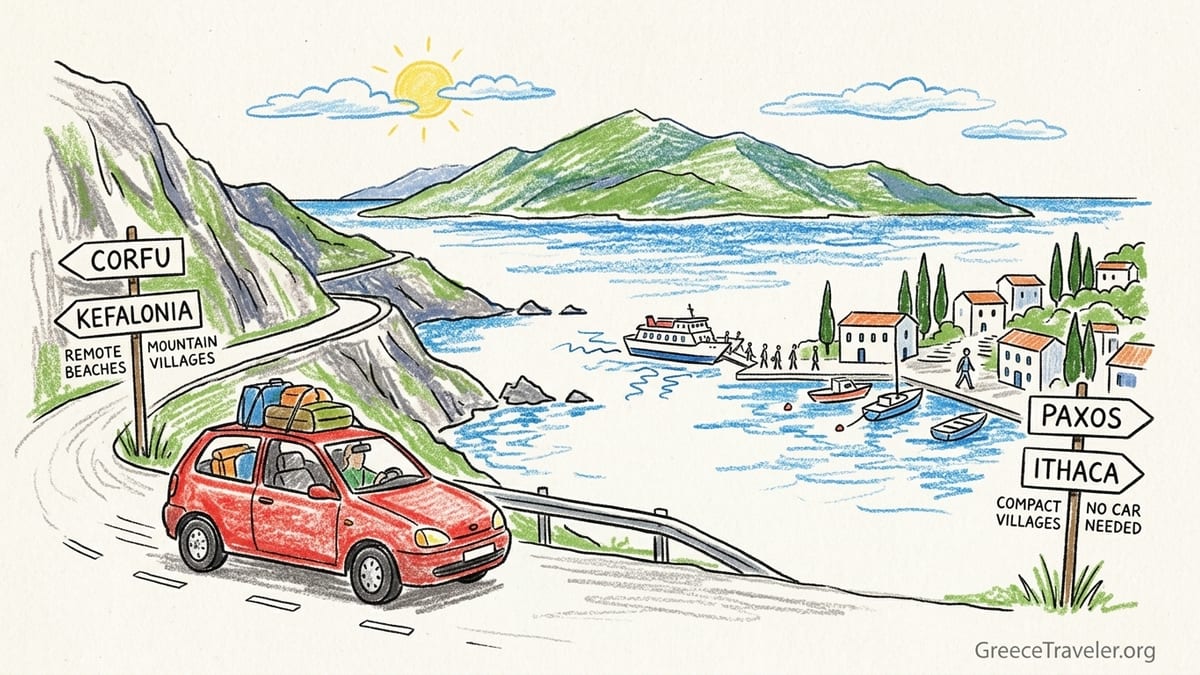
Do You Need a Car on Each Ionian Island?
Size, terrain and public transport frequency vary widely across the Ionian, so the value of a rental car is very different on each island. On larger islands such as Corfu, Kefalonia, Zakynthos and road-linked Lefkada, a car unlocks remote beaches, hill villages and flexible ferry timings. On tiny Paxos or during a short stay on Ithaca, narrow lanes and compact villages often mean a car spends more time parked than moving.
Corfu, roughly 65 kilometres long, has scattered resorts from Kassiopi in the north to Paleokastritsa on the west and Kavos in the far south. Buses radiate from Corfu Town but are infrequent once you get away from the main spine. Visitors staying in a hillside villa above Nissaki, for example, quickly find that a rental car is the only realistic way to reach supermarkets or late-night tavernas without long walks on unlit roads.
Kefalonia is similar in scale but even more rugged. Driving from the airport near Argostoli to Fiskardo in the north can take two hours on winding mountain roads, and public buses might only run a couple of times a day. If you want to combine Myrtos Beach, Assos, the caves near Sami and a sunset at Petani in three days, a car is effectively essential.
Zakynthos and Lefkada are slightly smaller yet still large enough that beach-hopping by bus is frustrating. On Zakynthos, there is no practical public way to combine Navagio (Shipwreck) viewpoint, Porto Limnionas and the south-coast turtle beaches in one day. Lefkada’s dramatic west coast, from Kathisma to Porto Katsiki, is poorly served by buses; many beaches sit at the bottom of steep, twisting access roads where taxis are scarce after sunset. By contrast, tiny Paxos and the main village strip on Ithaca can be covered on foot or with short taxi rides, so a scooter or occasional transfer may be enough for a three-night stay.
Airport Pickups: Corfu, Kefalonia, Zakynthos and Aktion for Lefkada
For most visitors, renting at the airport is the simplest way to start a trip. At Corfu’s Ioannis Kapodistrias Airport, major brands such as Hertz, Avis, Europcar and Sixt sit alongside local outfits clustered just outside arrivals. The airport is about 3 kilometres from Corfu Town, so a taxi into town can easily cost as much as a day’s small-car rental in shoulder season. Many travelers flying in on morning charters collect a car at the airport, drive to their resort and return it at Corfu Port before catching a ferry or hydrofoil as foot passengers.
Kefalonia’s airport, south of Argostoli, operates in a similar way. In July and August, morning arrivals from northern Europe can see lines at the international brands, while local firms with meet-and-greet service often hand over keys more quickly in the parking lot opposite the terminal. A realistic example for summer 2026 is a manual compact from a local agency for around 40 to 60 euros per day including basic insurance, compared with higher headline rates at multinational desks once you add the same coverage at the counter.
Zakynthos International Airport has a dense cluster of rental counters in the small arrivals hall and offers free delivery from several local firms to both the airport and Zakynthos Port. Some local companies prominently advertise that payment is taken on delivery and no advance deposit or credit card is required, appealing to visitors who do not want large holds on their cards. Others, especially international chains, will pre-authorize a significant deposit even for a short three-day rental in August.
For Lefkada, most visitors land at Aktion National Airport near Preveza on the mainland. The terminal is about 20 kilometres from Lefkada Town, usually a 25-minute drive via the floating bridge that makes the island effectively a peninsula for driving purposes. Airport rental companies here range from large multinationals to local brands that specialise in Lefkada and Parga, often arranging pick-up at the terminal exit and drop-off back at Aktion or in Lefkada Town by prior agreement.
Car Types, Automatics and Driving the Roads
On all four major islands, the most popular rentals are small manual hatchbacks such as a Fiat Panda, Peugeot 208 or similar. These cars are narrow enough for village streets, easy to park in tight beach lots, and generally more affordable than SUVs. On Kefalonia’s roads between Argostoli, Sami and Fiskardo, the combination of hairpin bends and occasional rough edges makes a light, nimble hatchback more practical than a large sedan.
Automatics are available but scarcer and often significantly more expensive. In peak summer, it is common to see automatic small crossovers such as a Hyundai Bayon or Nissan Juke priced 30 to 70 percent higher than a similar manual. An American couple arriving late at night in Corfu in August, for instance, may find only a handful of automatics left at the airport and pay 90 to 120 euros per day compared with 50 to 70 euros for a manual booked months earlier.
The roads themselves inform the choice. Corfu and Lefkada have narrow, balcony-lined village streets where wing mirrors skim past parked scooters. Kefalonia and Zakynthos mix fast coastal stretches with sudden, unsignposted hairpins down to beaches like Myrtos or Porto Katsiki. Steep gradients, loose gravel on the shoulders and tight parking spaces at small coves all argue strongly for the smallest car that comfortably fits your party and luggage rather than a prestige SUV.
Drivers unused to manual transmissions should think carefully before choosing one solely to save money. Clutch-heavy hill starts out of Argostoli’s back streets or on the incline leaving Vasiliki’s ferry dock can be stressful with traffic behind you. If you rarely drive stick at home, paying the premium for an automatic is often worth it for peace of mind, provided you book well ahead for July and August.
Insurance, Deposits and Realistic Costs
Insurance structures and deposits vary sharply between local and international providers. Many airport desks from major brands in Greece still work on a model where a basic collision damage waiver leaves a substantial excess, often in the range of several hundred to over a thousand euros. At Aktion Airport, for example, some large agencies routinely pre-authorise between roughly 1,200 and 1,800 euros on a credit card and release the hold 5 to 10 days after return. Budget-oriented brands and smaller regional companies may hold even more and take up to four weeks to release funds during peak season.
To reduce or eliminate that excess, you will usually be offered extra insurance at the counter. This might be labeled Super CDW, Full Cover or similar and can easily add 10 to 25 euros per day. For a week-long family stay in Kefalonia in August, a compact car that appears online at 300 euros might increase to 430 or more once you accept the recommended full coverage at the desk. Some local Zakynthos agencies instead bundle full damage waiver with zero excess into the base rate and proudly advertise no deposit and payment on arrival, shifting the cost into a higher upfront daily rate but sparing you the large card hold.
If you rely on a credit card’s own rental coverage, read the small print carefully. Card insurance often covers collision damage but not administrative fees or loss-of-use charges, and some issuers explicitly exclude damage that occurs while a vehicle is on a ferry. On islands where taking cars on ferries requires special permission, having a card policy that does not match the rental contract can leave you exposed. For example, if you decline the rental company’s ferry surcharge in Corfu or Lefkada because your card “covers ferries,” but the rental contract forbids boats without written authorisation, any incident on a crossing may void all coverage.
Third-party brokers and comparison sites often sell stand-alone excess insurance that reimburses you if the local supplier charges for damage. This can be good value but does not change the rental company’s own rules, nor does it reduce the deposit they hold at pick-up. In practical terms, arriving in Zakynthos with only a debit card, expecting a small hold and discovering a 1,500-euro pre-authorisation requirement is an avoidable holiday shock; checking deposit policies for your specific supplier and location in advance is essential.
Steep Roads, Village Streets and Parking Realities
Driving in the Ionian is less about highway cruising and more about negotiating steep, narrow, occasionally chaotic local roads. In Corfu’s Old Town, on-street parking is extremely limited in summer and multi-level car parks near the harbour fill by mid-morning when cruise ships are in. Visitors staying in Kanoni or Benitses who plan to explore by day often leave the car in suburban lots and walk into the historic centre in the evening to avoid tight parallel parking on blue-zoned streets.
On Kefalonia and Lefkada, parking pressure shifts to beaches and small harbours. At Myrtos Beach, the official lot can fill by late morning in August, leaving latecomers to inch along the access road searching for gaps on the verge. In Assos and Fiskardo, restaurant-lined waterfronts offer only a handful of formal spaces, and drivers end up backing into improvised slots between olive trees or on terraces above the harbour. Similar scenes unfold in Lefkada’s Kathisma and Porto Katsiki beach lots, where attendants might wave you into steep, gravelled overflows that feel better suited to 4x4s than compact hatchbacks.
Zakynthos adds its own quirks around Navagio viewpoint, where informal parking areas have grown up along the cliffs, and at Laganas, where beachfront lanes can be clogged with quad bikes and scooters. Many visitors choose to park slightly away from the busiest strips and walk the last few minutes. In all of these places, a small car with good ground clearance and parking sensors or a rear camera is more practical than a long sedan. Drivers should also budget extra time for each journey; a 30-kilometre drive that might take 30 minutes on a mainland highway can easily stretch to an hour once you add slow trucks on mountain climbs and the inevitable photo stops.
Night driving deserves particular caution. On Zakynthos and Kefalonia, some rural roads lack lighting and have minimal guardrails. Goats and stray dogs are not uncommon after dark, and local drivers who know the roads may take bends faster than visitors expect. Limiting long drives to daylight hours and allowing at least 50 percent more time than your mapping app suggests is a sensible safety margin.
Can You Take Rental Cars on Ferries Between Islands?
One of the biggest practical questions for an Ionian itinerary is whether you can take a rental car on inter-island ferries. There is no single answer, because policies differ sharply between companies and locations. Some local firms in Zakynthos, for example, explicitly restrict cars to the island and state that vehicles may only be driven within Zakynthos’s boundaries. Others in the same market allow ferry use to the mainland or nearby islands but only with written permission and the purchase of extra ferry insurance at the counter.
In Corfu, several airport-based agencies state that cars are not allowed on ferries at all without written approval. A number of local companies around Corfu Port are outright categorical that their vehicles must not board boats; they expect customers to leave the car on Corfu and cross to Igoumenitsa, Paxos or Albania as foot passengers. This is especially important for travelers planning to hop from Corfu to Paxos, where some passenger ferries do not carry vehicles and most Corfu rental contracts do not permit the crossing even on those that do.
Lefkada is a special case. Because the island connects to the mainland by a short floating bridge near Aktion, many rental contracts treat it as part of the mainland road network and do not require any ferry authorisation to drive there. You can, for example, rent a car at Aktion Airport, drive over the bridge to Lefkada and return the car in Lefkada Town without ever boarding a boat. However, onward ferries from Vasiliki or Nydri to Kefalonia, Ithaca or Meganisi are another matter. Sailing with a rental car from Lefkada to Fiskardo or Frikes typically requires both a vehicle ticket on the ferry and written approval from your rental supplier, sometimes with a per-day surcharge.
On Kefalonia itself, experiences vary. Some long-established local agencies in places like Argostoli and Lassi quietly allow cars to travel on ferries to neighbouring islands as long as you inform them and accept that any damage during the crossing is your responsibility. Larger national chains are more rigid and either prohibit ferries entirely or require you to pay a set ferry fee and note the crossing on the contract. Similar patterns appear in Zakynthos, where international brands often charge an extra fee at pick-up to record that the car will travel on a ferry, and warn that insurance is limited while on board.
Because ferry rules combine company policy, insurance limitations and individual staff discretion, the safest practical approach is to decide your route before booking and then confirm in writing with the exact supplier at the specific location. If your plan is Corfu to Lefkada to Kefalonia to Zakynthos by sea, for example, you might be better off renting separate local cars on each island and travelling as a foot passenger between them, rather than trying to find a single contract that allows every crossing.
When a Car Is Worth It: Corfu, Kefalonia, Zakynthos and Lefkada
On the four main islands, a car usually pays for itself in flexibility. In Corfu, drivers staying near Paleokastritsa can combine a morning at the main beach with an afternoon exploring La Grotta, Liapades or the hilltop village of Lakones without worrying about bus timetables. Families in the northeast can stock up at large supermarkets outside Corfu Town, then spend evenings at quieter coves between Barbati and Kassiopi that are awkward to reach by public transport after dark.
In Kefalonia, having a car transforms what is otherwise a list of scattered day trips into a coherent loop. A realistic three-day drive could include Argostoli and Lassi on day one, Myrtos and Assos on day two, and Sami, Melissani Cave and Antisamos on day three, finishing with a sunset drink near Lourdata. Doing the same with buses would mean backtracking via Argostoli almost every time and losing hours waiting at roadside stops in the heat. For villa stays in the hills above Skala or near Lourdas, taxis are limited, and a car is almost a necessity to avoid feeling marooned.
On Zakynthos, a car lets you time your visits around cruise-ship crowds. You can drive to Porto Limnionas or the west-coast cliffs in the late afternoon when day-trip boats are gone, then drop down to the south in the morning for a turtle-spotting cruise from Laganas or Kalamaki. Likewise, on Lefkada a rental car opens up west-coast beaches such as Egremni, Kathisma and Porto Katsiki, plus inland villages like Karya, which are hard to reach and even harder to leave after dinner without your own wheels. Visitors staying in remote villas around Sivota or Athani often regard the cost of a week’s rental as part of the accommodation budget.
By contrast, on compact Paxos many visitors happily rely on walking, water taxis and the occasional scooter. Gaios, Lakka and Loggos are strung along a short coastline, and distances rarely exceed a 10-minute drive. Parking is limited in the small harbours, and village streets can be clogged with pedestrians in July and August. On Ithaca, a brief stay centred in Vathy or Kioni may not need a car more than for a single day, and hiring a car locally just for that day can be easier than paying for an island-hopping contract from Kefalonia.
FAQ
Q1. Do I really need a rental car on Corfu?
For most stays outside Corfu Town, a car is highly recommended. Buses radiate from town but services thin out to resorts such as Paleokastritsa or the northeast in the evening, and many villas sit up steep access roads where taxis are scarce at busy times.
Q2. Is a car essential on Kefalonia?
For travellers who want to see more than one area, a car is very close to essential. Key sights such as Myrtos Beach, Assos, Sami and Fiskardo sit far apart on winding mountain roads, and public buses are too infrequent to link them efficiently in a few days.
Q3. Can I manage without a car on Zakynthos?
It is possible if you stay in a busy resort like Laganas or Tsilivi and are content with local beaches and organised tours, but a car is strongly recommended if you want to combine Navagio viewpoint, quiet west-coast coves and south-coast turtle beaches on your own schedule.
Q4. How do I reach Lefkada from Aktion Airport without a car?
You can use the regional bus that runs between Preveza and Lefkada, or take a taxi from outside the terminal. The journey over the floating bridge to Lefkada Town takes around 25 minutes, and from there you can connect to local buses or pre-booked transfers.
Q5. Are automatics widely available on the Ionian Islands?
Automatics exist at all the main airports but in smaller numbers than manuals and at higher prices, especially in July and August. If you are not comfortable with a manual gearbox, it is wise to reserve an automatic several months in advance.
Q6. How big are typical rental deposits in the region?
International brands at airports often hold well over a thousand euros on a credit card for a standard compact, releasing it several days after return. Some local firms, particularly in Zakynthos, advertise zero deposit and payment on arrival but build more insurance into the daily rate.
Q7. Can I take a rental car on a ferry between the Ionian Islands?
Sometimes, but never assume it is allowed. Many companies forbid ferries entirely or require written permission and an extra fee. You must check the exact policy for your chosen supplier and location before booking if your route involves ferries.
Q8. Is a car useful on small islands like Paxos or Ithaca?
On Paxos, many visitors manage happily on foot, by taxi and with occasional scooters or day boat rentals. On Ithaca, a short stay focused on one village may only justify hiring a car for a single day rather than for the whole trip.
Q9. What type of car is best for Ionian island roads?
A small to mid-size hatchback with good ground clearance and air conditioning is ideal. Large SUVs can be awkward in village streets and tight beach parking areas, while very low sports models may struggle on steep, rough access tracks.
Q10. Do I need an International Driving Permit for the Ionian Islands?
Requirements depend on your home country and the Greek authorities’ rules at the time of travel. Some rental companies accept licences from non-EU countries, but police may still require an International Driving Permit, so it is prudent to carry one if you are eligible.