


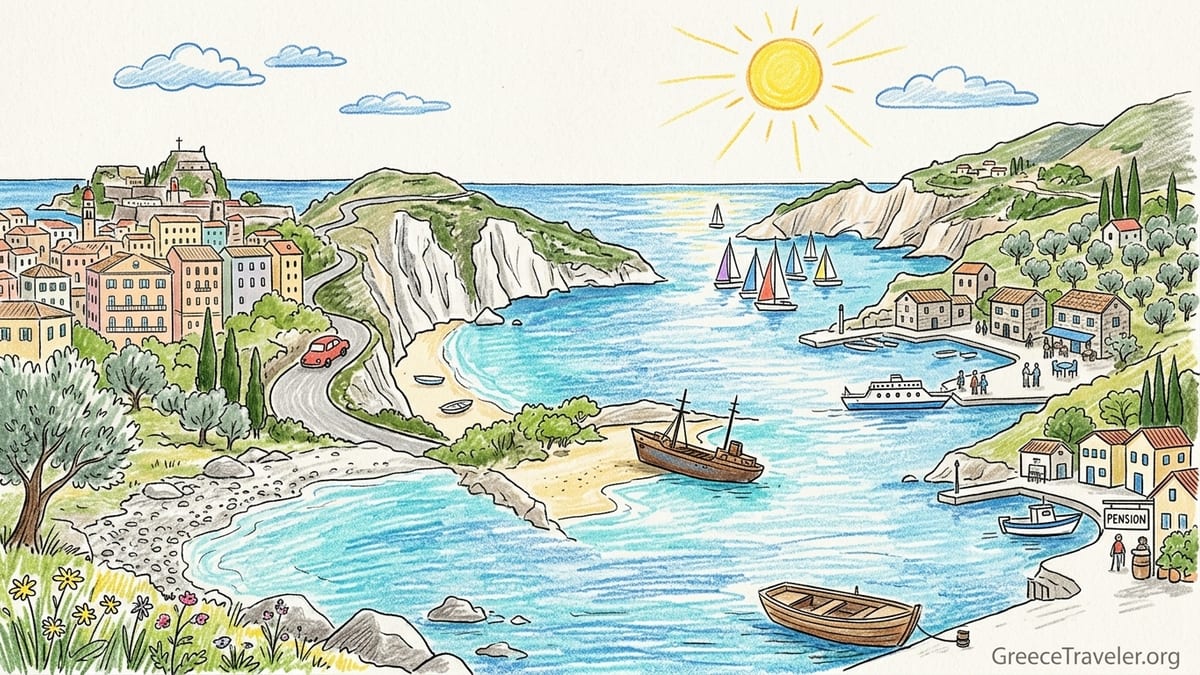
The Ionian Islands are Greece at its most cinematic: turquoise coves, cypress hills, pastel harbours and a laid-back, west-coast rhythm. Yet when you have to pick just one island, things get complicated fast. Corfu, Kefalonia, Zakynthos, Lefkada, Paxos and Ithaca all promise beaches and blue water, but they deliver very different kinds of trips. This guide compares the six main Ionian choices on what really matters in 2026: beaches, scenery, old towns, nightlife, driving, boat trips, villas, luxury, airport access and overall cost.
At a Glance: Which Ionian Island Suits Which Traveller
If you want the broadest mix of culture, beaches and classic holiday resorts, Corfu is still the most versatile Ionian island. You get an atmospheric UNESCO-listed old town, family-friendly east coast strips like Dassia and Ipsos, scenic coves at Paleokastritsa and affordable package resorts in the south, all tied together by an international airport with frequent flights in season.
Kefalonia is the choice for dramatic scenery and road trips. Iconic Myrtos Beach, perched beneath sheer white cliffs, winding mountain roads through fir forests and colourful harbours like Assos and Fiskardo reward travellers who are happy to drive 1 to 2 hours between sights and treat the island as a slow coastal road journey rather than a single base.
Zakynthos is best for famous beaches and nightlife. Shipwreck Beach, or Navagio, remains one of the most photographed coves in Greece, reached by boat excursions that still run even as the beach itself is subject to safety controls. South-coast resorts such as Laganas, Tsilivi and Kalamaki combine long sandy beaches with clubs and bars that target a younger, party-oriented crowd.
Lefkada is about beaches and sailing. It has some of the most striking shorelines in the Ionian, including Porto Katsiki and Egremni on the west coast, and it is connected to the mainland by a causeway so you often fly into nearby Preveza rather than onto the island itself. Sailing flotillas cluster in Nidri and Vasiliki, making this one of the best islands if you want to combine beach days with a week on a yacht.
Paxos is the pick for small-scale upscale relaxation. Reached by hydrofoil or ferry from Corfu, the island is tiny, covered in silver-green olive groves and dotted with stone houses that have been carefully converted into boutique hotels and villas. There are no large resorts or big nightclubs, and many visitors arrive on private boats, so the overall tone is quiet, grown-up and relatively expensive.
Ithaca is ideal for quiet, traditional island travel. With no airport, few large hotels and a landscape of terraced hillsides dropping to glassy coves, it is a place to settle into a pension or villa near Vathy or Kioni, explore a handful of beaches by car or taxi boat, and spend long evenings in harbourside tavernas. It suits couples and repeat Greece visitors who value authenticity over amenities.
Beaches, Scenery and Old Towns
All six islands have good beaches, but the character of the coastline changes significantly. Corfu’s shores are a patchwork: pebble-and-sand bays on the east coast facing Albania, wide sandy beaches on the west and north, and tiny rocky inlets around Paleokastritsa that are perfect for snorkelling. Resorts like Glyfada and Agios Gordios offer classic long, sandy strands, while Canal d’Amour near Sidari is known for its sculpted sandstone formations and narrow channels.
Kefalonia’s coastline feels wilder. Myrtos Beach, guarded by steep white cliffs and accessed via a zigzag road, has repeatedly featured in “best beaches in Greece” round-ups. Driving times between star spots such as Myrtos, the Melissani Cave near Sami and the harbour village of Fiskardo can easily stretch to 40 to 60 minutes each, but the reward is a sense of space and drama you rarely get elsewhere in the Ionian.
Zakynthos combines long, shallow beaches in the south with more rugged coves in the west and north. Laganas Bay and Kalamaki are wide, sandy and gently shelving, popular with families by day even though Laganas evolves into the island’s nightlife hub after dark. Navagio, on the northwest coast, sits in a horseshoe of high cliffs with an old shipwreck on the sand below and is reached only by boat, usually on half-day trips from ports such as Porto Vromi or Agios Nikolaos.
Lefkada is most famous for its west-coast arc of towering cliffs and luminous water. Porto Katsiki and Egremni back their ribbons of white pebbles with vertical limestone walls, often reached by a combination of winding roads and staircases cut into the hillside. On the east, by contrast, Nidri and its neighbours have gentler, greener bays with views to islets and frequent day-cruise departures.
Paxos does not have the postcard-spectacle of Myrtos or Navagio, but its small-scale coves are highly appealing. Around Gaios, Lakka and Loggos you find pebble beaches shaded by olive trees that stretch almost to the water, and many visitors take a taxi boat across to Anti-Paxos for sandy Vrika and Voutoumi beaches, where the sea is a shade of turquoise that rivals the Caribbean on bright days.
Ithaca’s beaches are understated yet often unforgettable. Dexa and Filiatro near Vathy, and Afales or Aspros Gialos in the north, are mostly pebble or shingle with clear water and simple facilities such as a seasonal beach bar or sunbed rental. The scenery is more about soft, terraced hills and old stone paths than dramatic cliffs, which suits travellers seeking calm rather than spectacle.
In terms of old towns, Corfu is the clear winner. Corfu Town’s twin fortresses, pastel Venetian facades and arcaded Liston square make it one of the most atmospheric historic centres in the Greek islands, with year-round life and serious museums. Zakynthos Town and Argostoli on Kefalonia are pleasant harbours with long promenades and a cluster of cafes, but they lack the architectural impact of Corfu’s capital. Lefkada Town has a low-rise, corrugated-metal and stone aesthetic born of earthquake rebuilding, while Vathy on Ithaca and Gaios on Paxos are charming, small-scale harbours rather than “sights” in their own right.
Nightlife, Atmosphere and Who Each Island Suits
For nightlife, Zakynthos has the loudest reputation, centred on Laganas where club strips stay busy with British and northern European visitors well into the small hours in high summer. Tsilivi and Argassi offer a slightly more moderate mix of cocktail bars and live music, so you can still have a late night without committing to full club holidays.
Corfu provides the widest range of evening scenes. Kavos in the far south is the classic bar-and-club strip for young party-goers, while Sidari and Roda mix karaoke bars, casual pubs and seafront tavernas. In contrast, Corfu Town’s lanes fill with locals and visitors enjoying wine bars and contemporary restaurants, and north-coast villages like Kassiopi blend relaxed harbourfront drinks with a handful of late venues.
Lefkada and Kefalonia have lower-key nightlife. On Kefalonia you might end your day with a drink on Argostoli’s seafront square, or in a waterfront bar in Fiskardo, but all-night clubs are rare and most places wind down around midnight or 1 a.m. Nidri on Lefkada has a busy strip of tavernas, gelato shops and bars that stay lively in July and August, yet the focus remains on dining and strolling rather than clubbing.
Paxos and Ithaca are firmly in the quiet camp. You might find a cocktail bar with a DJ in Gaios in August, or a small late-opening bar in Vathy, but the prevailing rhythm is taverna dinners, harbourfront walks and an early night. Many visitors are couples or multi-generational families staying in villas, and the social hub is often a long table on a terrace rather than a strip of bars.
For families, Corfu, Zakynthos, Kefalonia and Lefkada all work well, but with different trade-offs. Corfu’s east coast around Dassia, Ipsos and Barbati offers shallow, relatively calm water and easy access by bus or car to Corfu Town. Zakynthos provides long, sandy beaches with gentle entry to the sea at Kalamaki, Tsilivi and Alykes, but Laganas in peak season can feel overwhelming for families who prefer quieter evenings. Kefalonia’s family appeal lies in relaxed resort towns such as Skala and Lassi, where you have broad beaches and a good choice of mid-range hotels and apartments, plus manageable day trips by car.
Couples and honeymooners often gravitate towards Corfu’s romantic north-east bays, Kefalonia’s Assos and Fiskardo, Lefkada’s west-coast view hotels, or the intimate harbours of Paxos and Ithaca. A week in a stone house above Loggos, with a small motorboat rental to beach-hop by day and dinners in the village each night, is a classic Paxos combination for special occasions. On Ithaca, staying in a small hotel above Kioni’s horseshoe harbour and walking down to the waterfront each evening offers a similarly low-key, romantic routine.
Getting Around, Driving and Boat Trips
How comfortable you are with driving should strongly influence your choice. Corfu’s road network is busy but relatively forgiving: main routes between the airport, Corfu Town and east-coast resorts are well-used by buses, taxis and transfer coaches, and many visitors manage with just a couple of short local drives to reach west-coast beaches like Paleokastritsa or Glyfada. The challenge comes when you head into the central hills or remote northwest, where roads narrow and become more winding.
Kefalonia is the archetypal driving island. The distances between popular bases such as Skala in the south-east, Lassi near Argostoli, Sami on the east and Fiskardo in the far north can easily run to 60 to 90 minutes along curving mountain roads. Drivers are rewarded with viewpoints above Myrtos, detours to hillside villages and access to quieter beaches, but those who dislike long drives or hairpin bends may find the logistics tiring, especially on short stays.
Lefkada also benefits from a car, particularly if you want to explore both the west-coast beaches and inland villages. From Lefkada Town or Nidri, reaching Porto Katsiki or Egremni involves a series of winding roads and, typically, a final stretch on narrower lanes. The island is, however, straightforward to enter: you usually land at Preveza Airport on the mainland and cross to Lefkada by causeway in 20 to 30 minutes by car or transfer bus, avoiding ferries entirely.
Zakynthos sits somewhere in between. Resorts along the south and east coasts are mostly connected by decent roads, and drives from the airport near Zakynthos Town to Tsilivi, Kalamaki or Laganas are short, often 15 to 25 minutes. To reach the wilder west coast or northern viewpoints over Navagio you will still need to navigate some narrower routes, but overall the island is manageable for less confident drivers.
Paxos and Ithaca are smaller and much gentler to drive, with only a handful of main routes. On Paxos you can drive from Gaios in the south to Lakka in the north in roughly 20 minutes, though parking in harbour villages can be tight in peak season. Ithaca’s central spine road knits Vathy to the north-coast villages with frequent sea views and occasional sharp bends, but the overall scale is compact enough that you can explore most accessible beaches in a few days with a rental car or taxi.
Boat trips are a highlight across the Ionian. From Corfu, popular options include full-day cruises from Corfu Town to Paxos and Anti-Paxos, or shorter hop-on boats from Paleokastritsa to nearby coves and sea caves. On Zakynthos almost every resort sells half-day boat tours to Navagio and the Blue Caves, with prices typically starting from a modest per-person rate for a group excursion in high season. Kefalonia offers trips from Sami or Agia Efimia to Ithaca, or coastal cruises from Skala and Lixouri to remote beaches, while Lefkada’s Nidri is a hub for day trips to Meganisi, Skorpios and southern Ionian islets.
Paxos and Ithaca themselves are excellent for small-boat rentals. On Paxos it is common for visitors to hire a 30 horsepower motorboat for a day, with simple handling and no previous licence needed under Greek rules for smaller craft, then work slowly along the indented coastline. Around Ithaca, taxi boats ferry travellers to beaches such as Gidaki and Filiatro, and some accommodations can arrange private boat hire for multi-day explorations of hidden coves.
Accommodation, Villas and Costs
Corfu and Zakynthos generally offer the widest spread of accommodation categories and price points. Corfu’s long tourism history means you can find everything from budget studios in Sidari or Benitses to five-star beach resorts in Kommeno or near Glyfada, along with boutique hotels in restored mansions in Corfu Town. Zakynthos has a similarly broad range, though more of its stock is in mid-range beach hotels and self-catering apartments in Laganas, Tsilivi and Kalamaki.
Kefalonia and Lefkada stand out for villas and small family-run hotels rather than large all-inclusive complexes. Around Kefalonia’s Assos and north-coast hills you will see designer villas with infinity pools overlooking Myrtos or the open Ionian, rented weekly, often with car hire arranged as part of the package. On Lefkada, hillside villas above Sivota or between Porto Katsiki and Vasiliki are popular among groups and extended families looking for privacy and multi-bedroom layouts.
Paxos and Ithaca sit at the premium end of the Ionian price spectrum. Both islands have limited hotel capacity and a strong villa culture, particularly for British and Italian visitors who return year after year. As a result, nightly rates for harbour-view apartments in Gaios or Vathy in peak season can easily outpace equivalent properties on larger islands. Many houses are beautifully renovated stone buildings with private pools and sea views, and on Paxos it is common for villa prices to assume a week-long stay rather than short breaks.
In terms of overall cost, Corfu and Zakynthos can be the most budget friendly if you tap into package deals or stay in simple studios a short walk back from the seafront. Eating out can also be slightly cheaper in busy resort strips where competition between tavernas keeps prices moderate. Kefalonia and Lefkada can feel a notch more expensive due to car hire being more or less essential and the popularity of view-heavy accommodation, while Paxos and Ithaca usually command the highest per-night spend but reward it with peace, space and a slower pace.
Villas are available on all six islands, but they play a different role in each. On Corfu, a hillside villa with a pool above Nissaki or Kassiopi suits families wanting privacy but easy access to tavernas and small pebble bays. On Zakynthos, villas often sit inland from the coast among olive groves, offering good value for groups as long as you are comfortable with a short drive to the beach. Kefalonia and Lefkada have arguably the strongest concentration of design-led villas, where the view is the main selling point and interiors tend to follow a clean, contemporary Mediterranean aesthetic.
Airport and Ferry Access
Four of the six islands in this comparison have their own airports with seasonal international flights: Corfu, Kefalonia, Zakynthos and Lefkada via nearby Preveza. Corfu Airport sits right on the edge of Corfu Town, so transfer times to central hotels are often under 15 minutes and most major resorts on the east or west coast are within an hour’s drive. This makes it a practical choice for short breaks and shoulder-season trips when you do not want lengthy onward journeys.
Kefalonia Airport, located south of Argostoli, serves direct flights from many European cities in summer. Transfer times to nearby Lassi can be as short as 15 minutes, but getting to Fiskardo in the far north, or to Skala in the south-east, typically involves 60 to 90 minutes on the road. Zakynthos Airport lies a short distance from Zakynthos Town and the southern resorts; stays in Laganas and Kalamaki involve some of the shortest transfer times in the Ionian, often around 10 to 20 minutes, which can be appealing for families with young children or for quick getaway weekends.
Lefkada is unusual in that it does not have its own island airport but instead relies on the Aktion Airport near Preveza on the mainland. From there, it is usually a straightforward 25 to 40 minute drive or transfer to Lefkada Town, slightly longer if you are continuing down the east coast to Nidri or further to Vasiliki. The advantage is that you avoid ferry schedules; the causeway between the mainland and Lefkada keeps journeys relatively predictable.
Paxos and Ithaca, by contrast, remain ferry-only islands. To reach Paxos you typically fly into Corfu, transfer to Corfu Town’s port and then take a hydrofoil or ferry to Gaios, with total travel time from plane to harbour commonly running to 3 to 5 hours depending on connections. Ithaca is usually approached via Kefalonia or the mainland port of Astakos, with regular ferries arriving at Pisaetos on Ithaca before onward travel by car or taxi to Vathy or northern villages.
The lack of airports on Paxos and Ithaca contributes strongly to their atmosphere. The extra steps in the journey limit casual weekend visitors and large tour groups, which helps preserve a quieter, more local feel. It also means, however, that travellers should build generous buffers into their itineraries in case of weather-related ferry delays, especially in shoulder seasons.
Choosing the Best Ionian Island for Your Trip
If you want one island that does almost everything well, Corfu is the safest all-round recommendation. It blends beaches for all tastes with one of Greece’s best old towns, a range of resorts from budget to five-star, easy airport access and enough inland villages and hiking routes to keep active travellers occupied. A typical first-time itinerary might combine three nights in or near Corfu Town with four nights on the west or north-east coast, using local buses or a rental car for day trips.
For travellers who prioritise scenery and exploring by car, Kefalonia is hard to beat. You could base yourself in Lassi or Skala and take day trips to Myrtos, Assos, Fiskardo, Melissani Cave and Xi Beach over the course of a week, accepting 60 to 90 minutes of driving on several days in exchange for wild views and an ever-changing coastline. This suits couples, groups of friends and families with older children who are comfortable with longish journeys.
If bucket-list beaches and nights out are key, Zakynthos delivers both. A balanced approach might be to stay in a quieter part of Kalamaki or in Tsilivi, where you still have beach life and a choice of bars, then take a taxi or short drive to Laganas for one or two late nights. During the day, book a small-group boat tour to Navagio and the Blue Caves, and perhaps a separate trip into the interior villages for a change of pace.
Lefkada is the Ionian answer for beach connoisseurs and sailors. You can pair a week in a hillside hotel or villa above the west coast, with daily drives down to Porto Katsiki, Egremni and Kathisma, with a separate week on a sailing yacht from Nidri or Vasiliki exploring Meganisi and nearby islets. The island works particularly well for active couples and groups who are happy to rent a car and do not mind a little logistics in exchange for superlative sea and cliff scenery.
Paxos rewards travellers who want understated luxury and a sense of retreat. A common pattern is to spend one or two nights in Corfu Town at the start or end of the trip, then a week in a villa or small hotel in Gaios, Loggos or Lakka. Days revolve around slow motorboat explorations of the coastline, swims in clear coves and long, late dinners at harbourside tavernas. It is not the place for big resort pools or flashy bars, but it excels at quiet indulgence.
Ithaca is best for those who measure a good holiday by how relaxed they feel rather than how much they tick off. You will likely stay in or near Vathy or Kioni, hire a small car or use taxi boats to reach beaches such as Filiatro, Gidaki or Afales, and perhaps walk parts of the island’s network of old donkey paths between villages. Even in high season it tends to feel slower and more traditional than its larger neighbours.
Ultimately there is no single “best” Ionian island, only the one that suits your priorities. In brief: choose Corfu for the broadest mix of culture and resorts; Kefalonia for dramatic scenery and road trips; Zakynthos for famous beaches and nightlife; Lefkada for standout beaches and sailing; Paxos for small-scale upscale relaxation; and Ithaca for quiet, traditional island travel.
The Takeaway
When you look beyond the turquoise water that all six islands share, the differences between them become clear. Corfu is the flexible generalist, combining a remarkable old town with beaches and resorts for every budget and travel style. Kefalonia is the road-tripper’s dream, trading short transfers for sweeping views and a constant sense of discovery. Zakynthos is the crowd-pleaser for those who want a headline-grabbing beach and long summer nights.
Lefkada is the choice for travellers who will happily drive a little further if it means parking above one of the most spectacular bays in the Ionian, or casting off on a yacht to explore neighbouring islets. Paxos is the refuge for those who would rather spend on a stone villa and a small boat than on club entry and cocktails. Ithaca is the slow-burn island, ideal for readers, walkers and second-or-third-time Greece visitors who want to tap into a quieter, more traditional rhythm.
Whichever island you choose, building a trip around your priorities will matter more than chasing an abstract “best.” Decide first whether you care more about nightlife or quiet, driving or staying put, old towns or small harbours, and then let those answers guide you. The Ionian has a match for almost every kind of traveller; the art lies in choosing the one that feels most like your version of Greece.
FAQ
Q1. Which Ionian island is best for a first-time visitor to Greece?
For a first trip, Corfu is usually the most practical choice. It combines an impressive old town, a range of beaches, varied nightlife, frequent flights and plenty of organised excursions, so you can get a broad introduction to Greek island life without complex logistics.
Q2. Which island has the best beaches overall?
Lefkada often takes the top spot among beach enthusiasts thanks to west-coast stars like Porto Katsiki and Egremni, but Kefalonia’s Myrtos, Zakynthos’s Navagio and the coves of Paxos and Ithaca are all strong contenders. The “best” will depend on whether you prefer dramatic cliffs, long sandy bays or quiet pebble coves.
Q3. Where should I go in the Ionian for nightlife?
Zakynthos is the prime nightlife island, especially Laganas, which has the densest club and bar scene. Corfu runs a close second, with Kavos for full-on clubbing and places like Sidari and Corfu Town for a more mixed, moderate evening scene.
Q4. Which island is most suitable for families with young children?
Corfu, Zakynthos and Kefalonia are all very family friendly. Look at Corfu’s east coast resorts such as Dassia or Barbati, Zakynthos’s Kalamaki and Tsilivi, or Kefalonia’s Skala and Lassi for shallow water, plenty of accommodation options and easy access to restaurants and basic services.
Q5. Is it worth visiting Paxos or Ithaca if they do not have airports?
Yes, if you value peace and character and do not mind an extra ferry leg. Both islands feel more intimate and less developed than the larger Ionian islands, with strong local communities and a slower pace that many repeat visitors consider the main reason to go.
Q6. Do I need a car on these islands, or can I rely on buses and taxis?
On Corfu and Zakynthos you can manage with public buses and taxis in the main resorts, though a car still helps for exploring more remote beaches. Kefalonia and Lefkada are much more rewarding with a rental car because key sights are spread out. Paxos and Ithaca are small enough that a combination of short car hires, taxis and boat taxis can work well.
Q7. Which Ionian island is best for a sailing holiday?
Lefkada is the main base for sailing in the Ionian, with large marinas and many charter companies operating out of Lefkada Town, Nidri and Vasiliki. From there you can easily explore nearby islands such as Meganisi, Kefalonia and Ithaca on a one or two week itinerary.
Q8. How do prices compare between the Ionian islands?
Corfu and Zakynthos can be the most budget friendly thanks to large numbers of beds and competitive package deals. Kefalonia and Lefkada tend to be slightly pricier once you factor in car hire and view-focused stays. Paxos and Ithaca are usually the most expensive per night, with an emphasis on villas and smaller, characterful properties.
Q9. Can I realistically visit more than one Ionian island on the same trip?
Yes, but it works best to pair islands that connect conveniently, such as Corfu and Paxos, or Lefkada with Kefalonia and possibly Ithaca via local ferries. Trying to include all six major islands in a single short holiday often leads to more time in transit than on the beach.
Q10. Which Ionian island is best for quiet, traditional villages and low-key evenings?
Ithaca is the strongest match if your priority is quiet, traditional island life, closely followed by Paxos. Both offer small harbour villages, limited nightlife, family-run tavernas and a rhythm that remains closer to local life than to resort tourism.