


The Ionian Islands have quietly become one of Europe’s strongest villa destinations, with more than six thousand pool villas spread across Corfu, Lefkada, Kefalonia, Zakynthos and tiny Paxos. For many travelers, a private villa with a pool now beats booking two or three hotel rooms, especially for families, multigenerational groups and couples looking for more privacy. The challenge is not finding a villa, but choosing the right island, the right area and the right style of property for the way you actually travel.
How to Choose the Right Ionian Island for a Villa Holiday
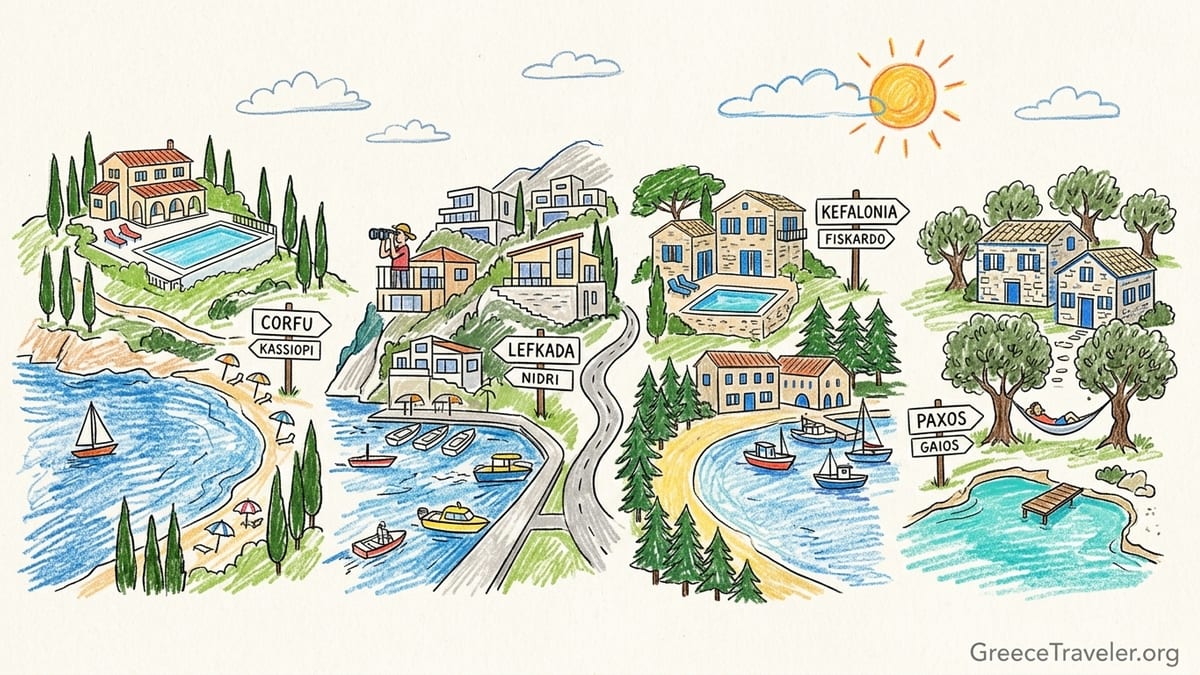
Although the Ionian Islands lie within a short flight of most European hubs, they offer very different villa experiences. Corfu’s northeast coastline around Kassiopi is known for established luxury homes with dramatic sea views and old-school resort ambience. Lefkada and its Nidri and Perigiali area have dense villa inventory at various price points, much of it modern, with sweeping views across the Onassis islands and easy access to boat trips. Kefalonia’s north around Fiskardo and the south around Argostoli combine yachting glamour and low-key beach towns with villas ranging from rustic charm to contemporary estates. Zakynthos, particularly the peninsulas of Vasilikos and the resort area of Tsilivi, blends family-friendly sandy beaches with clusters of pool villas hidden in the olive groves. Paxos, clustered around Gaios, has fewer properties but a high concentration of characterful stone houses with serious privacy.
For most visitors in 2026, the practical question is not only which island looks prettiest, but how you want to balance walkability against seclusion, and how much you value hotel-style services such as daily housekeeping, on-site breakfast or a spa. A couple who picture strolling from their villa to a taverna-lined harbour every night will be frustrated if they end up on a remote hillside half an hour’s drive away. A family with young children might value a gated terrace, a shallow step-entry pool and a supermarket within five minutes’ drive more than a stark architectural showpiece perched above a cliff.
The good news is that the current villa market is broad enough that you can usually match your wish list to a specific area. Below, we look at the five key islands and their most popular villa zones, using real examples and typical pricing to show how a Corfu headland differs from a hillside above Nidri or an olive grove outside Tsilivi. We also highlight when a villa is better value than multiple hotel rooms, what minimum stays to expect, and when you can rely on your feet instead of a rental car.
Corfu’s Northeast Coast and Kassiopi: Classic Villa Territory
The northeast coast of Corfu has long been one of Greece’s most established villa regions, curving from Nissaki up to Kassiopi. The terrain is steep and green, with cypress trees and silvery olive groves tumbling toward pebble coves and clear water, and villas here have evolved around that landscape. Many properties perch on terraces above the sea, with infinity pools angled toward the Albanian mountains across the straits. A contemporary example is Villa Valora, a four-bedroom luxury villa built in 2025 just outside Kassiopi, where the design leans heavily on glass walls and expansive terraces so that every room frames the bay and the private infinity pool acts as a foreground to the open water beyond.
Walkability in Kassiopi itself can be excellent. Villa Trousas, set right in the village, has a private pool and upper-floor sea glimpses, yet is only about a six-minute walk from Kalamionas Beach and a short stroll from Kassiopi’s tavernas, small supermarkets and waterfront bars. In that kind of location, you can comfortably skip a rental car and rely on buses, water taxis and occasional taxis. By contrast, hillside villas such as Villa Melanthi, located on the slopes above Kassiopi, trade a bit of walking convenience for more panoramic views and privacy. Guests there often choose to rent a car, even though the walk into town is reported at around 20 minutes, because the return hike is uphill and late-night taxis are far less frequent than in a large resort.
Corfu’s villa stock on this coast caters especially well to families and groups three generations deep. You will find many four and five bedroom homes sleeping 8 to 10 guests, often with separate guest houses, shallow-entry pools, shaded dining terraces and outdoor kitchens. Weekly rates in high season typically start from the equivalent of a mid-range hotel room per person per night once you divide by occupancy, which is why a villa can represent strong value for a family who might otherwise book three double rooms. Housekeeping on the northeast coast ranges from twice-weekly cleans to six-day service in top-tier properties, sometimes with optional cooks or provisioning. Minimum stays in July and August usually run at seven nights, although shoulder-season flexibility is improving as owners try to fill gaps.
Lefkada and Nidri: Hillside Infinity Pools and Easy Boat Trips
Lefkada is unusual in the Ionian chain because it connects to the mainland via a causeway and bridge rather than requiring a ferry, which helps explain why villa inventory has grown so quickly. The cluster around Nidri, Perigiali and the surrounding hills has become one of the biggest concentrations of pool villas in the islands. Many properties are etched into the slopes above Vlicho Bay or facing the Skorpios and Meganisi islands, pairing dramatic elevations with wide terraces and classic blue-tiled pools that seem to merge into the sea. Villas such as De La Luna in Perigiali are typical of the current style, with a private infinity pool, floor-to-ceiling glass and family-friendly layouts aimed at four to six guests; some even headline themselves as ideal family villa holidays in their marketing and guest feedback.
Nidri also offers a spectrum of real-world options for larger groups. One listing, Liana’s House above Vlicho Bay, sleeps up to 17 guests across seven bedrooms and features a private pool and generous outdoor space, a format that has become more common as owners combine a main villa with annexes or lower-level apartments. At the other end of the scale, secluded houses such as a private villa in the Nidri hinterland with a large pool and quiet setting appeal to couples or small families looking for tranquillity within a ten-minute drive of the harbour. Nightly rates around Nidri for a three-bedroom villa with pool in high season can often start in the mid to high 400 euro range and extend well beyond that for larger or more design-forward properties.
Walkability varies sharply. Villas embedded within Nidri’s coastal strip or a short walk uphill might allow you to stroll to the harbourfront in the evening for souvlaki and gelato, but many of the best-view properties sit higher in the hills or in villages like Fterno, where a car is vital for shopping and beach-hopping. Lefkada’s appeal for active travelers is strong, because from Nidri you can join day trips to waterfalls, charter small boats to explore coves and sail across to Meganisi. For families or mixed-age groups, the ability to combine pool days with straightforward boat outings means a Nidri villa can feel like a complete resort, especially when you factor in housekeeping that is often weekly or twice weekly as standard, with linen changes mid-stay for bookings over a week.
Kefalonia: From Fiskardo Views to Argostoli Convenience
Kefalonia is the largest of the Ionian Islands and feels the most diverse. The north, especially around Fiskardo, has evolved into a sophisticated yachting hub where luxury villas sit above a Venetian harbour, while the southern region around Argostoli and Lassi offers easier access to long sandy beaches and more traditional resort amenities. Fiskardo itself, a historic harbour village that survived the devastating 1953 earthquake that destroyed many other parts of the island, is surrounded by hills dotted with villas designed specifically for the boat-and-beach crowd. Complexes such as 5 Elements near Fiskardo feature multiple villas, each with large private pools of around 20 meters in length, furnished terraces and expansive sea views, pitched at guests arriving by yacht or rental car who want high comfort in a quiet rural setting.
Nearby, stone-built properties like Vigli Villas sit a short drive from Fiskardo and combine classic Ionian architecture with modern pool decks looking toward Ithaca and the mainland. Smaller boutique clusters such as Il Borgo’s Casa di Clò and Casa di Giò, located on a promontory sheltering Fiskardo, each have private pools and wide sea views but remain within a few minutes’ drive of the harbour’s tavernas. Here, walkability to the village is marginal; some very fit guests might walk one way, but most rely on cars or taxis, especially at night. In these northern pockets, minimum stays of seven nights still dominate in peak months, though May, June and late September can bring shorter gaps where owners accept four or five night bookings to fill calendars.
Around Argostoli, Kefalonia’s rebuilt capital and main hub, villas are more spread out but often provide easier access to supermarkets, bakeries and the airport, which lies roughly 10 kilometres to the south. While the area around Lassi and the southern coast hosts a rising number of villa hotels and luxury villa-style resorts such as Eliamos Villas Hotel & Spa, many independent villas sit in low-key suburbs or across the bay toward Lixouri. This zone suits travelers who prefer to drive a little farther for the island’s famous sights, like Myrtos Beach or Melissani Cave, then retreat to a quiet pool house in the evening. For families considering a two-week stay, basing in the south and driving to Fiskardo for a day or overnight side trip can be more convenient than committing to the more remote northern tip.
Zakynthos: Villa Life Around Vasilikos and Tsilivi
Zakynthos, also known as Zante, is best known for its shipwreck bay and loggerhead turtles, but for villa travelers the focus narrows to quieter pockets such as the Vasilikos peninsula and the resort area of Tsilivi. Vasilikos, on the southeast of the island, is a green limb of pine woods, olive groves and sandy coves. The cluster of Periyali Villas near Gerakas Beach on this peninsula offers a good snapshot of what has developed here: a handful of detached villas, each with a private pool and barbecue, set a short drive or walk from one of the island’s most family-friendly beaches while remaining sheltered from the loudest nightlife. This makes Vasilikos particularly attractive for families with younger children and for couples who want a beach-focused trip without compromising on privacy.
Tsilivi, on the northeast coast, mixes a broad sandy beach and a full spread of restaurants and mini-markets with a surrounding hinterland of villas. A property marketed simply as Villa Tsilivi, for example, sits just inland from the resort, with a private pool that reviewers highlight as large enough for laps and a location about one and a half kilometres from the sea. That distance makes it walkable for some guests, but in summer heat many still prefer a rental car or occasional taxi, especially when returning with groceries. For groups of friends or extended families, villas around Tsilivi offer a good compromise between access to watersports and tavernas and a quieter residential setting once you close the garden gate.
Prices on Zakynthos remain competitive compared with some of the more established Ionian islands, which can make the island a smart choice if you are balancing a tighter budget with a desire for a private pool. Many three-bedroom villas with pools in the Tsilivi or Vasilikos area are still achievable for a similar nightly rate to two standard rooms at a mid-range hotel in high season, especially if you book shoulder months like June or late September. Minimum stays tend to be seven nights in July and August, tapering to five or even three nights earlier in the season, which can work well for travelers combining Zante with another Greek island.
Paxos and Gaios: Boutique Villas for Couples and Slow Travelers
Paxos is a different proposition entirely. One of the smallest inhabited Ionian Islands, it is reached via hydrofoil or sea taxi from Corfu’s port, and that extra step keeps mass tourism and very large developments at bay. Most visitors base themselves around the harbour town of Gaios, with its waterfront tavernas, pastel houses and bobbing fishing boats, then branch out to Lakka or Loggos. The villa inventory here is lower in volume but rich in atmosphere: traditional stone houses with thick walls and blue shutters converted into holiday homes, and low-rise contemporary villas carefully slotted into the landscape among olive terraces.
A typical Gaios-area example is Vasiliki Villa, a three-bedroom house with a private pool set within reach of waterfront tavernas, shops and the famous harbour but still a short drive or long walk from the main square. Properties like this often pair pool terraces with simple, classic interiors and views toward the tiny islets that dot Gaios Bay. Access to Paxos usually involves flying into Corfu, then taking a hydrofoil or private sea taxi that covers the route to Gaios in about an hour, which means that arrival and departure days require more planning but also lend the trip a sense of occasion and seclusion.
Paxos villas are especially suited to couples and small groups who value quiet and authenticity over nightlife. Car rental is strongly recommended, as many of the most charming houses are tucked in olive groves above the sea, with nearest mini markets often more than a kilometre away, but distances on Paxos are short enough that drives rarely exceed 20 minutes. Services tend to be simple but efficient: weekly stays usually include a midweek clean and linen change, with owners or local managers arranging extra housekeeping or private cooks on request. Because inventory is smaller, Paxos books out earlier for peak August dates than some bigger islands; travelers seeking shoulder-season value often look to May, June or late September.
When a Villa Beats Multiple Hotel Rooms
For families, groups and many couples, the tipping point at which a villa becomes better value than multiple hotel rooms arrives sooner than you might expect. Consider a typical family of five heading to Corfu’s northeast coast during school holidays. Booking two interconnected rooms in a four-star hotel with a shared pool might easily approach mid three figures per night when all fees are included. By contrast, a four-bedroom villa with a private pool above Kassiopi, sleeping up to eight, may be advertised in a similar overall nightly range in July, but that cost divided by a larger group can bring the effective per-person price dramatically down. Similar arithmetic applies in Lefkada’s Nidri area, where a three-bedroom infinity-pool villa marketed as family-friendly can run for a nightly rate comparable to two or three hotel rooms, yet includes a kitchen, laundry and extensive outdoor space.
For groups of friends, the advantage is often even clearer. A seven-bedroom villa like Liana’s House near Nidri, which can accommodate up to 17 guests around a shared pool, allows large parties to gather under one roof rather than spread across a hotel’s corridors. The same pattern appears in Kefalonia, where five-bedroom villas with pools near Fiskardo or in the hills above Argostoli are explicitly pitched at groups of 10 people, with pricing structured so that once full, the nightly per-person cost is significantly below that of individual hotel rooms of comparable standard. The tradeoff is that you take responsibility for cooking breakfast, organizing activities and possibly renting cars, rather than leaning on hotel reception and restaurants.
The main circumstances where hotels still win are very short stays, city-style breaks and trips where travelers value spa facilities, kids’ clubs or on-site entertainment. Minimum stays at many Ionian villas run from five to seven nights in high season, and cleaning schedules may be every few days rather than daily, particularly in more affordable properties. Villa hotels or villa resorts, like the villas-with-hotel-services concept that has developed on Kefalonia’s southern coast, can bridge the gap by offering private pools attached to suites or small houses within a serviced complex, but they typically price higher than independent villas while retaining some minimum-stay rules in busy months.
Practicalities: Pools, Services, Cars and Minimum Stays
Across the Ionian villa market, private pools are now a near-standard expectation rather than a rare perk. Even mid-range villas in Nidri, Tsilivi or just outside Gaios usually feature a dedicated pool for the property, sometimes modest in size but often large enough for casual laps. At the higher end, especially around Kassiopi, Fiskardo and selected parts of Lefkada, infinity pools that visually blend with the sea are common, and some newer builds add features such as integrated shallow platforms for young children, whirlpool corners or heated options in shoulder season. As always, parents should note that most villas specify that pool use is at guests’ own risk and that children must be supervised, a point that managers of Paxos and Zakynthos houses frequently underline in their welcome notes.
Housekeeping is typically less intensive than in full-service hotels but is improving as competition grows. A widely used pattern is a thorough clean before arrival, a midweek light clean and linen and towel change for stays of seven nights, and more frequent service by arrangement at extra cost. High-end villas near Kassiopi and Fiskardo often include six-day-per-week housekeeping and may offer add-ons such as breakfast preparation, shopping services and on-call maintenance that approaches hotel standards. In more remote parts of Lefkada’s hills or Zakynthos’ countryside, service may be simpler, but owners usually live on island or have dedicated local managers who handle pool maintenance and respond quickly to issues such as air-conditioning failures or appliance problems.
Car rental is one of the biggest differentiators among Ionian villas. Guests staying in central Kassiopi, within a few minutes’ walk of the harbour and beaches, can feasibly skip a car for much of their stay, combining walking with occasional taxis and boat trips. Similarly, travelers who book villas just behind the main strip in Nidri or close to Tsilivi’s centre may find they only need a car for day trips. In contrast, many of the most atmospheric properties in Lefkada’s hills, Kefalonia’s rural north, Zakynthos’ interior and Paxos’ olive groves are a steep walk or long distance from shops and tavernas, making a car near-essential. Roads are generally well maintained but can be narrow and winding; if members of your group are nervous drivers, prioritising walkability may be worth a trade-off in views.
FAQ
Q1. Which Ionian island is best for a first-time villa holiday with children?
For first-timers with children, Corfu’s northeast around Kassiopi and Lefkada near Nidri work especially well, as both offer plenty of villas with private pools, good access to family-friendly beaches and relatively easy walks or short drives to tavernas and mini markets.
Q2. Do I really need a rental car if I book a villa in the Ionian Islands?
It depends heavily on location. Villas inside or just above villages like Kassiopi, Nidri, Tsilivi or Gaios can be manageable without a car, but hillside or countryside properties in Lefkada, Kefalonia, Zakynthos and Paxos almost always benefit from having at least one rental car for shopping, beaches and evening outings.
Q3. How far in advance should I book a popular villa in August?
For peak August weeks, especially on smaller islands like Paxos and in sought-after areas such as Kassiopi or Fiskardo, it is sensible to book nine to twelve months ahead. Some of the most requested houses see repeat guests reserving their same dates a year in advance.
Q4. What is a typical minimum stay for pool villas in the Ionian Islands?
In July and August, seven-night minimums are standard across most islands, including Corfu, Lefkada, Kefalonia, Zakynthos and Paxos. In May, June, September and October, many owners are more flexible, accepting five or even three nights to fill calendar gaps.
Q5. Are private pools usually heated?
Most mid-range Ionian villas do not offer heated pools, and water can feel cool in May or late October. Higher-end properties, particularly newer builds around Kassiopi, Nidri and parts of Kefalonia, are starting to add optional pool heating at an extra daily fee, but it is not yet universal.
Q6. How does villa housekeeping compare with hotels?
Villa housekeeping is typically lighter than in a hotel, with a full clean before arrival and one or two cleans during a week-long stay. Luxury villas sometimes provide near-daily service, while simpler houses on Lefkada, Zakynthos or Paxos may include only a midweek clean unless additional visits are requested and paid for.
Q7. Is it easy to walk from villas to beaches and tavernas?
Some villas are an easy walk from beaches and tavernas, such as centrally located houses in Kassiopi, Tsilivi or close to Nidri’s waterfront, but many of the best-view properties are on hillsides where the walk back is steep or unlit. When booking, check the stated walking times and gradients and assume that anything above ten to fifteen minutes uphill will feel demanding in summer heat.
Q8. Are Ionian villas a good option for couples, or are they mainly for families and groups?
They work very well for couples, particularly on quieter islands like Paxos or in peaceful areas of Zakynthos and Lefkada. Many one or two bedroom villas with private pools are designed specifically for honeymooners or long-stay couples who prefer space and privacy over hotel-style facilities.
Q9. How do I decide between staying near Fiskardo or Argostoli on Kefalonia?
Choose Fiskardo if you want a postcard harbour, boat life and a concentration of luxury villas with big sea views, and do not mind a slightly more remote northern location. Pick Argostoli or nearby Lassi if you want easier access to long beaches, more shops and restaurants, and a shorter transfer to the airport.
Q10. When is the best time of year for a villa with a private pool in the Ionian Islands?
Late May to early October is the main villa season. June and September often offer the best balance of warm pool-friendly weather, lower prices and fewer crowds, while July and August deliver the hottest temperatures and fullest island buzz but also the highest villa rates and strictest minimum stays.