


Crete is not one island so much as several different trips sharing the same landmass. First timers usually hear the same names on repeat Chania, Knossos, Samaria Gorge, Elafonisi then stare at the map wondering where to stay and how much to move. The good news is that you do not need to see everything to have a brilliant week or two in Crete. You do, however, need to choose your bases carefully. This guide compares Crete’s key regions and towns as places to stay, not just things to tick off, so you can match beaches, history, food, nightlife, hiking and quiet corners to the kind of holiday you actually want.
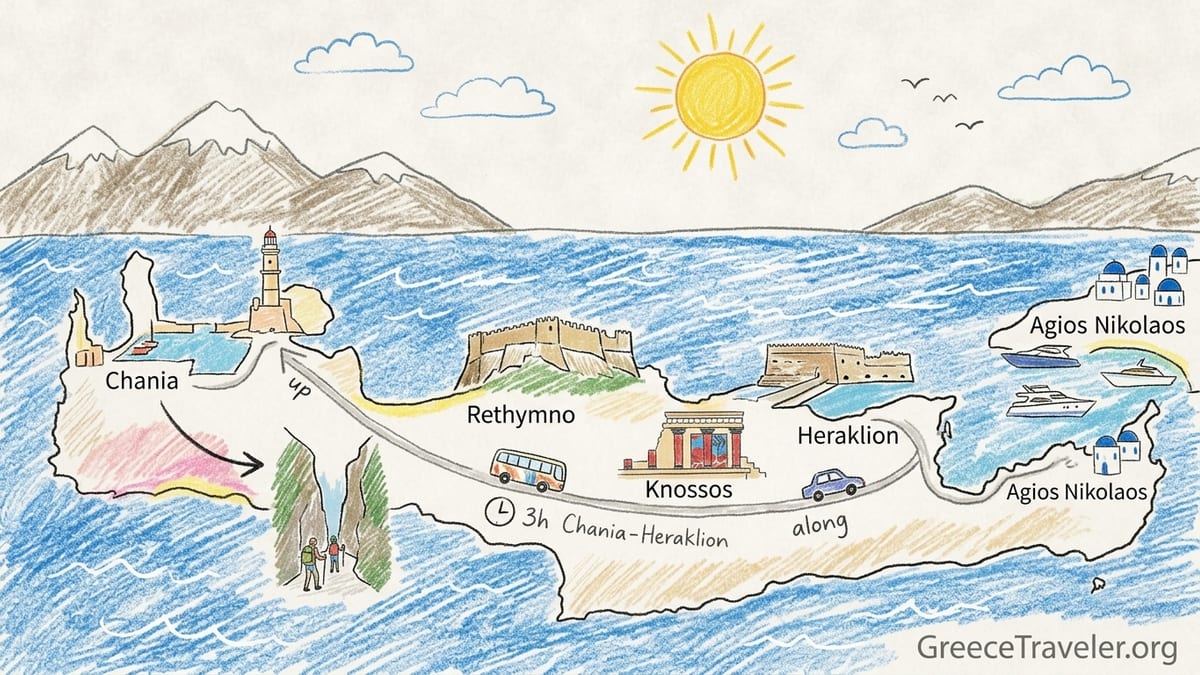
How to Think About Crete: Bases, Day Trips and Driving Times
Crete is roughly 260 kilometers long, with three main hubs on the north coast Chania in the west, Rethymno in the middle and Heraklion near the east. Distances look close on the map but road speeds are modest, and in summer traffic, a bus ride from Chania to Heraklion can take around three hours. It is usually better to choose one or two bases and explore on day trips than to change hotels every night and spend your holiday repacking. A classic first visit combines a western base near Chania for beaches and the Samaria Gorge with a night or two in or near Heraklion for Knossos and the Archaeological Museum.
Public buses link all the north coast towns, and there are frequent services in season between Chania, Rethymno and Heraklion. Once you head south to Paleochora, Plakias or Chora Sfakion for Loutro, services thin out and timing day trips becomes trickier. Hiring a car for at least a few days opens up quieter beaches, mountain villages and natural attractions like the Imbros Gorge or the plateau above Elounda. Even then, you do not want to spend half your trip in the driver’s seat, so the key is picking a base that naturally fits most of what you care about.
Think in terms of themes. For Venetian harbors, nightlife and easy access to famous beaches, base in or near Chania. For a blend of history and a long town beach, Rethymno works well. For Minoan archaeology, Heraklion and Knossos are unavoidable. For calmer luxury stays with views of Mirabello Bay, Agios Nikolaos and Elounda take the lead. If your priority is hiking and wild swimming, look to Paleochora, Plakias, Loutro and the wider southwest coast. You can layer these together, but trying to “do” all of Crete in 7 to 10 days usually leaves people exhausted.
Prices vary by region and season but you will typically find double rooms in small, family run guesthouses in the 60 to 120 euro range in June and September, with Chania old town and Elounda’s waterfront on the higher side in July and August. Budget travelers often compromise by staying just behind the waterfront or in neighboring villages, then using buses or short taxi rides to reach the prettiest parts in the evening.
Chania: The All Rounder for Charm, Food and Iconic Day Trips
Chania is the place that converts “not really a Greece person” into someone planning their next trip before they leave. Its Venetian harbor, lighthouse and alleys full of 19th century houses set the tone, and for many visitors it is the obvious first base. You can spend the day wandering the covered market area, then walk ten minutes to Koum Kapi or Nea Chora for a swim before dinner. The old town lanes are packed with small hotels and restored townhouses. A typical midrange double in high season in a renovated building near the harbor might run to 130 to 180 euros, while simple rooms just outside the walls can be significantly cheaper.
If you are chasing the postcard beaches that dominate Crete’s social media feeds, Chania is logistically the best base. Most organized excursions to Balos Lagoon and Gramvousa island leave from Kissamos, which you can reach by bus or tour coach from Chania. Trips to Elafonisi and Kedrodasos run from the same side of the island. For Samaria Gorge, early morning buses and tour pickups from Chania get you to the Xyloskalo trailhead in the White Mountains, then ferry you by boat and bus back again. Staying in Chania means you can wake up early for those trips without already facing a two hour drive.
For food and nightlife, Chania is hard to beat on Crete. You can eat well at every price point, from souvlaki at simple grill houses near the Agora to wine bars and creative Cretan menus along the backstreets of Splantzia. In summer, the waterfront fills with couples and groups stopping for a drink at bars in the old harbor or in the Koum Kapi district, which is lined with cafes and bars that stay busy long after midnight. For a slightly more resort like vibe with beach clubs and late night music, many people base in nearby Agia Marina or Platanias and pop into Chania by bus or taxi in the evenings.
Chania also works for families, though you will want to stay near a beach such as Nea Chora or in the suburban resort strips west of town so that children can play in the sand without heavy traffic nearby. Nea Chora offers shallow water, a small harbor and plenty of tavernas directly on the sand where a family of four can comfortably share grilled fish, salads and local dishes for well under 80 euros. That practicality, combined with the romantic evening atmosphere of the harbor and easy access to big name excursions, makes Chania the single most versatile base on the island.
Rethymno: Balancing Old Town Atmosphere with a Walkable Beach
Rethymno sits roughly halfway along Crete’s north coast, and it quietly wins over visitors who might have expected more from the bigger names. The historic quarter is a compact tangle of Venetian and Ottoman architecture, crowned by the Fortezza fortress and the small marina. Directly east of the old town runs a long, sandy town beach that stretches for around 12 kilometers toward Scaleta, with a promenade lined by hotels, tavernas and beach bars. Being able to walk from a morning coffee in a 16th century lane to a sunbed with full service in ten minutes is one of Rethymno’s biggest selling points.
If you are traveling without a car but want to combine beach time with some genuine sense of place, Rethymno makes logistics easy. Many hotels along the seafront are in the three to four star bracket, with double rooms in shoulder season often around 80 to 130 euros, including breakfast and umbrellas on the beach across the road. Families appreciate that in the late afternoon a stretch of the seafront road frequently closes to traffic, which turns the promenade into a safe strip for evening walks with ice cream and children’s scooters. It is not the quietest place on Crete, but the convenience is hard to beat.
Rethymno is also a good base for people who do not want to commit entirely to the wild southwest but would like to sample it. Regular buses and day tours connect the town with south coast beaches such as Plakias and Preveli, and countryside excursions visit villages in the Psiloritis mountains, which have UNESCO Global Geopark status. You can base in Rethymno for a week, take two or three day trips south for wilder beaches and gorges, then still return each evening to the comfort of a familiar town and a reliable choice of tavernas.
Compared with Chania, nightlife in Rethymno has a more student and local feel during the university term, with bars and clubs strung along the waterfront and tucked behind the harbor. Couples and older travelers tend to gravitate to quieter wine bars inside the old town. For romantic stays, small boutique hotels in restored townhouses offer inward facing courtyards, rooftop terraces and just a handful of rooms, which can feel more intimate than the busy harbor hotels of Chania while still keeping you within walking distance of everything.
Heraklion and Knossos: Essential for History, Optional for Sleeping
Heraklion is the capital of Crete and the gateway to Knossos, the most famous Minoan palace on the island and part of a wider UNESCO listing for Minoan palatial centers. For travelers interested in Bronze Age history, a visit to both Knossos and the Archaeological Museum in Heraklion is non negotiable. Knossos lies about 5 kilometers south of the city, reachable in roughly 20 minutes by local bus or taxi. In recent seasons the site has introduced timed entry slots and manages daily visitor flows during peak months, so it is wise to check the latest ticketing details and aim for an early morning or late afternoon slot to avoid the worst of the heat.
The Archaeological Museum in Heraklion, which holds most of the original frescoes and artifacts from Knossos and other Minoan sites, is in the city center and pairs naturally with a half day at the palace. Many travelers find that combining the two in one long day, with a break for lunch in between, gives them enough of a sense of Minoan culture without feeling overwhelmed. If you are arriving on a midday flight, you might plan to check into a central hotel, take a stroll through the pedestrian shopping streets and the Venetian harbor, then dedicate the following morning to Knossos before moving on.
Whether Heraklion deserves to be a base or just a necessary stop depends on your priorities. The city itself is busy, modern and more functional than charming, although its waterfront and the restored Koules fortress have appeal. Food lovers will find a growing scene of contemporary Cretan restaurants and wine bars that use local ingredients in inventive ways, and prices in casual places can be slightly lower than the tourist heavy harbors further west. However, if your image of a Greek holiday leans hard toward old town alleys and sunset harbor views, you might prefer to spend only one or two nights here.
From a practical standpoint, Heraklion works well as a last night base if you are flying home early in the morning or catching a ferry to other islands. It also opens up day trips eastward to places like Agios Nikolaos or the archaeological site of Phaistos to the south, although combining those in a short stay requires careful planning. For many itineraries, the cleanest solution is to book one overnight here in the middle or at the end of your trip to cover Knossos and the museum, while keeping your main base in Chania, Rethymno or on the quieter east coast.
Agios Nikolaos and Elounda: Calm Bays, Upscale Resorts and Easygoing Beaches
East of Heraklion, the coastline softens into the sheltered Mirabello Bay, with the small town of Agios Nikolaos and the resort village of Elounda as its main hubs. Agios Nikolaos centres on a photogenic lake, a harbor and a compact grid of streets with cafes, tavernas and boutiques. It feels more low key than Chania and less student driven than Rethymno, which suits couples and older travelers looking for easy evening strolls, reliable restaurants and simple city beaches without intense nightlife. Small hotels in and around the center offer sea view rooms from around 90 to 150 euros in peak season, with better value either side of August.
Elounda, a short drive or bus ride north of Agios Nikolaos, has grown into one of Crete’s main luxury clusters. Several high end resorts with private coves, infinity pools and spa facilities line the coast, often marketed to honeymooners and families who prefer to stay largely within their hotel complex. Nightly rates in these properties can climb well beyond 300 euros in summer, but the setting is undeniably beautiful: calm blue water, views to the island of Spinalonga and a backdrop of hills that glow at sunset. Budget travelers, on the other hand, can still find rooms in the older part of the village and use the public beach and boat excursions without paying resort prices.
This corner of Crete works best for travelers who value calm seas and boat trips over dramatic hiking. You can take regular small boats from Elounda or nearby Plaka to Spinalonga, the former Venetian fortress and later leper colony that now draws visitors for its history and views. Several beaches along the bay are gently shelving and organized with sunbeds and umbrellas, which suits families with younger children. The trade off is that you are a long way from marquee attractions in the west: a day trip from Agios Nikolaos to Chania or Elafonisi is essentially a full day in a vehicle.
As a base, Agios Nikolaos is more rounded than Elounda. It has enough year round population to feel like a functioning town, shops for practical errands, and a range of bars that stay open later in high season without the intense club strip energy found in party resorts like Malia. Elounda is best chosen when you know you want a resort style escape with polished service, spa time and easy dips in flat, clear water, perhaps breaking up your stay with one or two day trips back toward Heraklion for Knossos and other archaeological sites.
Paleochora, Plakias, Matala and Loutro: Crete’s Laid Back South Coast
Crete’s south coast faces the Libyan Sea and feels, in many places, like a different island. The weather is often a notch drier and sunnier, the sea deeper blue, and the pace slower. Paleochora, on the southwest corner, is a favorite among repeat visitors who want a small town with multiple beaches, good tavernas and a friendly, low rise feel. There is a sandy beach on one side of the peninsula, a pebbly one on the other, and enough small hotels and apartments that you can usually secure a simple double from around 60 to 100 euros in shoulder season. At night the main street turns largely pedestrian, and locals, long stay visitors and families drift between cafes and ouzeri until late.
Further east along the south coast, Plakias sits in a wide bay backed by mountains, with a long beach that catches the prevailing winds. It has a slightly more developed resort strip feel than Paleochora but still nothing like the package resorts of the north. Plakias is handy for exploring nearby gorges and smaller beaches such as Damnoni and Ammoudi, which you can reach by car or on foot. Hikers appreciate that several E4 long distance trail sections pass nearby, allowing for coastal walks with frequent swimming stops. For families, the sea can feel rougher on windy days, but many accommodations provide sheltered pools and playgrounds that keep children happy when the waves pick up.
Matala, on the south central coast, is famous for the caves in its cliffs and its 1960s and 70s hippie past. Today it is more of a compact, slightly bohemian beach town than a pure counterculture enclave, but the atmosphere remains relaxed. The main beach is organized with umbrellas and music from the surrounding cafes, and prices for snacks and sunbeds are a touch higher than in less known spots but still manageable. Many travelers treat Matala as a one or two night stop rather than a full week base, combining it with a visit to the nearby archaeological site of Phaistos and smaller beaches along the Messara Gulf.
Loutro, reached only by boat or by hiking from Chora Sfakion, is the least practical but perhaps most romantic of the south coast villages. The tiny whitewashed settlement curls around a small bay, with all buildings facing the water and no cars in sight. Accommodation fills early for July and August, and prices are higher than in more accessible villages because supply is limited. Once there, your days fall into an easy rhythm of walking along the coast, swimming from small pebble beaches and taking taxi boats to neighboring coves. Loutro is not a great base if you want to cover a lot of the island, but for couples seeking three or four days of quiet, sea focused time with minimal logistics, it can be the highlight of a trip.
Beaches, Hiking, Food, Nightlife and Families: Matching Places to Priorities
Seen side by side, Crete’s regions each have clear strengths. For beaches, the Chania region and the southwest coast stand out. From Chania, you can easily day trip to Balos, Elafonisi and Falassarna, which offer shallow turquoise water and white or pink tinged sand in season, albeit with crowds and queues for parking. Paleochora and Plakias give you a base directly on the Libyan Sea, with a choice of town beaches and more secluded coves that rarely feel as busy as the headline north coast names. Agios Nikolaos and Elounda, in contrast, excel at calm, sheltered swimming rather than dramatic scenery, which suits young children and less confident swimmers.
For hiking, the southwest is unmatched. The Samaria Gorge, officially around 16 kilometers from the trailhead at Xyloskalo to the coastal village of Agia Roumeli, is the default “big hike” and features towering walls, shaded sections through forest and a finale at the Libyan Sea. Imbros Gorge offers a shorter option that families and less experienced hikers can tackle comfortably in half a day. Paleochora and Loutro work especially well as bases for walkers, since you can stitch together coastal and gorge walks without needing to drive every day. Remember that in the hottest months, setting off early and carrying plenty of water is more important than squeezing one more activity into the afternoon.
When it comes to food, no major town on Crete will leave you hungry, but their personalities differ. Chania has the broadest scene, from tiny meze places to modern spots that play with local recipes and wine lists. Rethymno leans toward classic tavernas and grills, with enough student and local custom to keep prices sensible in backstreet venues. Heraklion has an emerging contemporary food culture that rewards travelers who stay at least one night and explore beyond the main pedestrian strip. On the south coast, food is simpler but often deeply satisfying: grilled fish, dakos, snails in rosemary and village salads eaten with bare feet in the sand and bills that feel gentle compared with more famous Greek islands.
Nightlife is most concentrated in and around Chania, Rethymno and certain resort strips. Chania’s old town and waterfront offer bar hopping and late night music without tipping fully into club resort territory unless you head to western suburbs like Platanias. Rethymno has a more distinct club strip near the marina that attracts students and younger travelers in high season. Heraklion has bars and clubs too, but they are more scattered and local focused. Malia and Hersonissos, east of Heraklion, are the obvious choices for people who want a full on party base, although they are not ideal for quieter travelers. In contrast, Paleochora, Plakias, Matala and Loutro lean into long dinners and glasses of raki by the sea rather than dance floors.
Families usually do best in Rethymno, the Chania suburbs and the calmer east coast towns. Rethymno’s long sandy town beach makes daytime logistics effortless with children, since you can duck back to the hotel for naps or forgotten toys. West of Chania, resorts in Agia Marina, Stalos and Platanias combine shallow beaches, pools and playgrounds with bus access to the old town in the evenings. On the east coast, Agios Nikolaos and Elounda offer stroller friendly promenades and small, safe beaches where parents can easily keep an eye on kids. For romantic and quieter stays, old town boutiques in Chania or Rethymno in shoulder season, inland guesthouses in the foothills of Psiloritis, and car free Loutro or village rooms around Paleochora all provide atmosphere without relentless noise.
The Takeaway
Choosing where to stay in Crete is less about chasing every famous place and more about understanding what you want your days to feel like. If it is your first visit and you want a bit of everything, basing in or near Chania for five or six nights and adding one or two nights in Heraklion for Knossos makes a strong, simple plan. You will see the headline beaches, stroll a beautiful old town, eat well and leave with a sense of Crete’s history.
Travelers who value a walkable town beach and day trips south might choose Rethymno as their main base, with an overnight or two in Paleochora, Plakias or Matala for a taste of the Libyan Sea. Those drawn to quieter waters, resort comfort and easygoing evenings will be happy in Agios Nikolaos or Elounda, especially outside August when the island is at its busiest. Hikers and people who already know they prefer low key nights will get more from basing themselves on the south coast and treating Chania and Knossos as day trips at the start or end of the journey.
Crete rewards repeat visits, and there is no single correct way to divide your time. The key is to be honest about how much moving you actually enjoy, book no more than two or three bases for a ten day trip, and accept that you will not see every gorge, beach and village. Instead, allow yourself the luxury of slow mornings, long lunches and unplanned swims. The island’s landscapes and hospitality will take care of the rest.
FAQ
Q1. Is it better to base in Chania or Rethymno for a first trip to Crete
For a first trip, Chania is usually better if you want big name beaches and a strong restaurant and nightlife scene, while Rethymno works well if you prefer a calmer atmosphere and a long walkable town beach.
Q2. Do I need a car to explore Crete properly
You can visit the main towns, Knossos and a few beaches using buses and organized tours, but renting a car for at least a few days gives you far more flexibility, especially for the south coast and smaller villages.
Q3. How many nights should I spend in Heraklion and Knossos
Most travelers find that one or two nights in Heraklion is enough, allowing a full day to combine Knossos and the Archaeological Museum without rushing and still having time for a stroll around the harbor.
Q4. Which part of Crete is best for hiking
The southwest, around Chania, Paleochora and Chora Sfakion, offers the best hiking, including the Samaria and Imbros gorges and sections of the E4 trail along the Libyan Sea.
Q5. Where should families with young children stay in Crete
Families tend to be happiest in Rethymno, the resort strip west of Chania such as Agia Marina or Platanias, or the calmer east coast towns of Agios Nikolaos and Elounda with their sheltered beaches.
Q6. Is Loutro worth staying in overnight or just for a day trip
Loutro is worth at least one or two nights if you value quiet, car free surroundings and simple days of walking and swimming, but it is not practical as a base for exploring the wider island.
Q7. When is the best time to visit Crete for fewer crowds and good weather
Late May to mid June and September to early October usually offer warm sea temperatures, long days and fewer crowds than the peak of July and August, along with slightly lower prices.
Q8. Which area of Crete is best for nightlife
Chania and Rethymno have the most appealing mix of bars and late opening venues for many visitors, while resorts like Malia and Hersonissos near Heraklion cater to those seeking a full on club strip atmosphere.
Q9. Are the famous beaches like Balos and Elafonisi suitable for children
Yes, both have shallow areas and soft sand, but they can be crowded and hot in high season, so visiting early in the day, carrying shade and plenty of water is important with children.
Q10. How many bases should I plan for a 10 day trip to Crete
Two bases are usually ideal for 10 days, such as Chania plus Heraklion, or Rethymno plus a south coast village, with three bases only if you enjoy moving and pack very light.