


Crete is Greece’s largest island, roughly 260 kilometers long from west to east, and it feels even bigger when you try to see it all in a week. For first-time visitors, the key decision is not only where to stay, but how many regions to combine without turning your holiday into a long-distance commute. This guide walks you through Crete’s four main regions – Chania, Rethymno, Heraklion and Lasithi – and shows why you should treat the island as a small country rather than a single resort.
Understanding Crete’s Four Regions
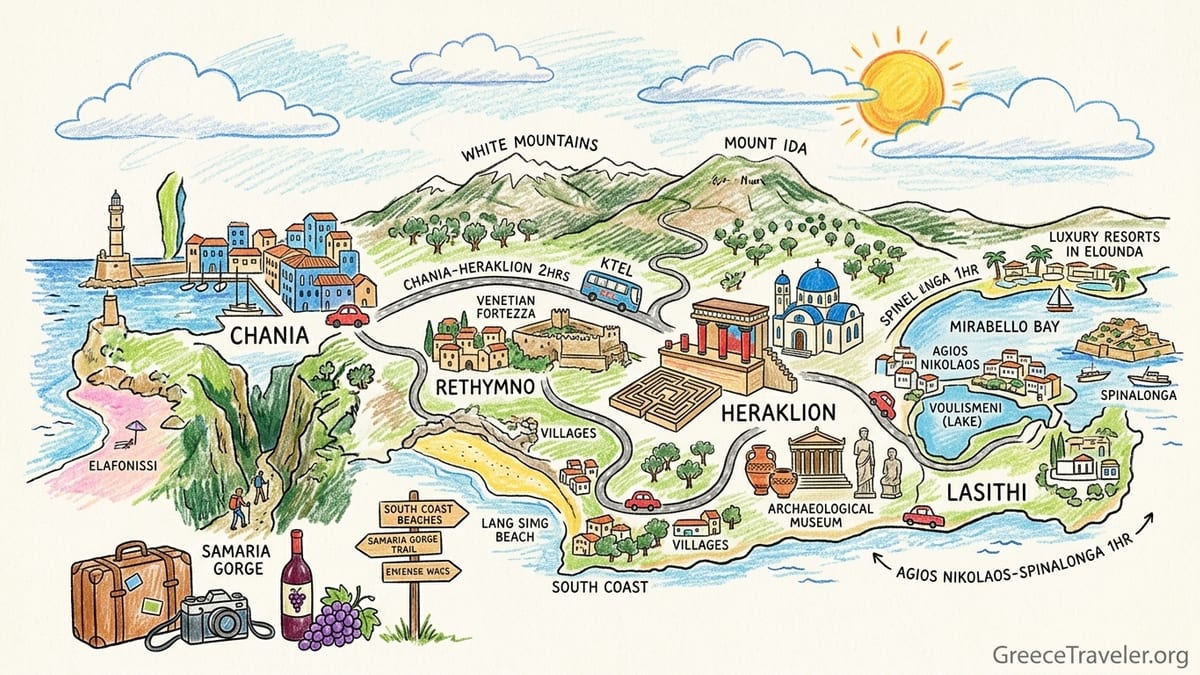
Crete is divided into four regional units that roughly run west to east along the north coast: Chania, Rethymno, Heraklion and Lasithi. Each has its own character and signature sights. Chania blends a romantic Venetian harbor with wild beaches and mountain gorges. Rethymno offers an atmospheric Old Town and easier access to the south coast. Heraklion is the capital and transport hub, home to Knossos and major museums. Lasithi in the east is more low-key, centered on the bays around Agios Nikolaos and Elounda and the quieter, less developed south and far east.
Distances between these regions are longer than they look on a map. The main northern highway connects Chania, Rethymno, Heraklion and Agios Nikolaos, but even on this road the drive from Chania to Heraklion typically takes around two hours, and from Chania to Agios Nikolaos about three hours under normal conditions. Local buses cover the same route in roughly similar times. That means a day trip from Chania to Knossos near Heraklion would involve four to six hours of travel, not counting visiting time.
For a first trip of 5 to 7 days, most travelers will enjoy focusing on one base, or at most two neighboring regions. For example, you might split a week between Chania and Rethymno, or Heraklion and Agios Nikolaos, instead of trying to see Balos, Samaria Gorge, Knossos, Elafonissi and Spinalonga as day trips from a single hotel. With 10 to 14 days you can reasonably link three regions, for instance Chania, Rethymno and Heraklion, or Chania, Heraklion and Lasithi.
A helpful way to plan is to think in “clusters” rather than individual sights. Chania is your base for Balos, Elafonissi and Samaria Gorge. Rethymno is ideal for the central north and some south coast villages. Heraklion combines Knossos with Matala and other south coast beaches. Lasithi is the best base for Agios Nikolaos, Elounda, Spinalonga and more laid-back stretches of shoreline.
Chania: Old Town Charm, Balos, Elafonissi and Samaria Gorge
Chania in the west is often the first choice for first-time visitors because of its postcard-perfect Old Town. The Venetian harbor, with its lighthouse and pastel facades, is compact enough to wander in an afternoon yet full of detail: Ottoman-era houses, a covered market, and alleyways lined with small family tavernas. Many visitors stay in restored townhouses inside the Old Town walls or in modern hotels in the nearby districts of Nea Chora and Koum Kapi, which put you within walking distance of the harbor while avoiding the busiest lanes.
From Chania, some of Crete’s most photographed beaches are within reach, but they still require commitment. Balos Lagoon and Gramvousa are typically visited on a boat trip from the small port of Kissamos, which is about a 45 to 60 minute drive west of Chania. Many rental car companies either discourage or forbid driving the rough track to Balos beach itself, so first-timers usually opt for an organized boat excursion that includes the lagoon and the fortress island of Gramvousa. Expect a full-day outing, with an early departure from Chania and late afternoon return.
Elafonissi Beach on Crete’s southwest coast is famous for its pale sand with pink tinges and shallow turquoise water. By car, it is usually a two-hour drive each way from Chania along winding mountain roads. In summer there are also daily buses and numerous coach excursions that bundle hotel pick-up, beach time and return. On a typical group tour, you might be collected from a beachfront hotel in Agia Marina around 8:00 a.m., reach Elafonissi late morning, and return to Chania in the early evening. While it is a stunning beach, it is not a casual half-day trip; most of the day is spent out of town.
The Samaria Gorge, in the White Mountains south of Chania, is one of Europe’s classic day hikes and another full-day commitment. Most visitors follow the one-way route from the Omalos plateau down to Agia Roumeli on the Libyan Sea. The hike itself usually takes 5 to 7 hours depending on fitness and photo stops. After reaching the sea, you take a ferry to either Sougia or Chora Sfakion, then a bus back to Chania. Organized tours package all of this into a long but straightforward day that might start before 6:00 a.m. and finish back in Chania around 8:00 or 9:00 p.m. It is a highlight of a Chania-based stay, but it is intense enough that you will likely want a slower beach or harbor day before and after.
Rethymno: Between North and South Coasts
Rethymno sits roughly between Chania and Heraklion and often serves as a bridge between the two. Its Old Town and Venetian Fortezza are smaller than Chania’s but still atmospheric, with a mix of student bars, cafes and family-run tavernas. A long sandy beach stretches east from the town, lined with low to mid-rise hotels and apartments that put you within walking or short taxi distance of the center. Rethymno attracts visitors who want a relaxed base that still has nightlife, but without the scale of Heraklion.
Rethymno’s big advantage is how quickly you can reach both the north and south coasts. It is around a 30 to 45 minute drive west to Chania and a similar time east to Heraklion on the main highway, though summer traffic can add delays. More importantly, roads heading south take you to the Libyan Sea in about 45 minutes. That makes day trips to places like Plakias, Damnoni and the villages around Agia Galini realistic without very long hours in the car.
For first-time visitors, Rethymno can work well as a single base for a week if you are willing to choose a handful of key excursions. For example, you might spend two or three days exploring the Old Town and nearby beaches, set aside one day for a trip to Preveli or Plakias on the south coast, and another for a guided day tour to Knossos and Heraklion. However, it is still ambitious to try to cover Chania’s Balos or Elafonissi as well as eastern highlights like Elounda and Spinalonga from a single Rethymno stay. Each of those would require at least three to four hours of driving in one day.
Prices in Rethymno are generally a little lower than in Chania and some of the more upscale resorts, particularly when it comes to mid-range hotels and dining. Many tavernas in the Old Town offer generous plates of grilled meat or fresh fish, salads and house wine at prices that first-time visitors from northern Europe or North America often find good value compared with home. Expect to pay less in the inland villages south of town, where hospitality is usually warm and menus often feature local lamb, horta (wild greens) and cheeses from nearby shepherds.
Heraklion & Knossos: Crete’s Cultural and Transport Hub
Heraklion is Crete’s largest city and the main transport hub, with the island’s busiest airport and main ferry port. Many visitors arriving on flights from Athens or European cities pick up a rental car at the airport and then drive straight out to Chania or the resort towns, spending little or no time in Heraklion itself. That is understandable if you have limited days, but if you are interested in archaeology and urban life it is worth at least a night or two in the city.
The star attraction near Heraklion is the archaeological site of Knossos, often described as the palace of King Minos and a center of Minoan civilization. Knossos lies only a short drive south of the city, and local buses run frequently from the central bus station during the main season. First-time visitors should plan to arrive early in the morning, particularly in June, July and August, to avoid the hottest hours and the largest tour groups. Official sources list a full-price ticket in the range of tens of euros, with reduced rates for certain categories and free days at specific times of the year, but ticket structures and combined offers change, so it is best to check the latest price shortly before you travel or through your hotel or guide.
In Heraklion itself, the Archaeological Museum houses many of the finest finds from Knossos and other Minoan sites around Crete. Many travelers do Knossos and the museum on the same day, either independently or on a guided city and palace tour that includes transport. A typical day might involve a morning visit to Knossos with a licensed guide, a break for lunch in a central square back in Heraklion, then an afternoon at the museum. With this schedule, you will likely not have much energy left for a long drive back to Chania, which underlines why treating Knossos as a simple day trip from the far west is not ideal.
Heraklion is also a jumping-off point for the south coast village of Matala, known for its crescent bay backed by cliffs that once housed hippie-era caves. By car, the drive from Heraklion to Matala usually takes around 1.5 hours each way, mostly on inland roads. Many visitors combine Matala with nearby beaches such as Kommos or red-sand Kalamaki, spending the full day on the south coast before returning to their north-coast base. Again, this illustrates why Heraklion or a nearby resort is a more practical base for discovering Matala than Chania or Agios Nikolaos, unless you are comfortable with very long days behind the wheel.
Lasithi, Agios Nikolaos, Elounda and Spinalonga
Lasithi is Crete’s easternmost region and feels more self-contained than the rest of the island. The town of Agios Nikolaos sits on a pretty bay with a small inner lake, a compact harbor and a mix of family-run guesthouses and modern seafront hotels. It is about a 50 minute drive from Heraklion Airport under typical conditions, while the drive from Chania can easily take three hours. That distance keeps Agios Nikolaos quieter than some west-coast resorts for short-stay visitors, but it rewards those who make the effort with a relaxed, walkable town and easy access to a string of beaches along the Mirabello Bay.
North of Agios Nikolaos, Elounda has developed into one of Crete’s most upscale resort areas, with a line of luxury hotels and villas spread along the coast. Even if you are staying elsewhere, it is realistic to visit Elounda and nearby Plaka as a day trip from Agios Nikolaos or from a resort between the two. The sea here is generally calm and clear, and the views across to the rocky island of Spinalonga are a constant backdrop from seafront tavernas serving local fish, grilled octopus and simple meze plates.
Spinalonga itself is a small former fortress and leper colony that has become one of Crete’s most visited historic sites, helped in part by popular novels and television dramas set there. Boats depart regularly in season from both Elounda and the village of Plaka, usually making the crossing in less than 20 minutes. Typical visits involve one to two hours on the island to wander through the abandoned houses and fortifications, followed by a swim and lunch back on the mainland. For first-time visitors staying in eastern Crete, Spinalonga is an essential half-day that mixes gentle history, scenery and sea time without the effort of a long hike.
The further east and south you travel in Lasithi, the quieter Crete becomes. The south coast villages beyond Ierapetra and the far east near Sitia and Xerokambos attract a fraction of the visitors seen in Chania or Elounda. Roads can be winding and travel times add up, so these areas are best suited to travelers with at least 10 to 14 days who enjoy slower road trips and are comfortable driving. For a first short visit, basing in Agios Nikolaos or Elounda and exploring Spinalonga, nearby beaches and perhaps one or two south coast excursions is usually enough.
Beaches, Hiking and the Quieter South Coast
Most visitors see Crete first through its beaches. On the north coast, resorts such as Agia Marina and Platanias near Chania, Bali near Rethymno, and Hersonissos and Malia near Heraklion offer long sandy stretches with sunbeds, beach bars and water sports. These are easy to access from nearby towns and suit travelers who want facilities close at hand. Room-only apartments and mid-range hotels line the main roads, often no more than a few minutes’ walk from the sand.
The south coast feels very different. Reached by winding mountain roads from each regional center, it opens onto the Libyan Sea with smaller villages, coves and a more laid-back atmosphere. Places like Paleochora, Sougia and Chora Sfakion in the Chania region, Plakias and Agia Galini from Rethymno, and Matala and Lentas from Heraklion attract hikers and independent travelers who prefer simple pensions and waterfront tavernas to large resorts. Expect fewer organized activities, more pebble or mixed-sand beaches, and darker, deeper water compared with the shallow lagoons of Balos or Elafonissi.
Crete is one of Greece’s best islands for hiking, and not just in Samaria Gorge. Many south coast villages are linked by coastal paths, and inland there are shorter gorges and plateaus for those who do not want a full-day trek. However, even shorter walks should be treated with respect in summer. Heat, lack of shade and rocky terrain can catch out first-time visitors who are used to easier marked trails at home. Practical preparation means starting early, carrying water, wearing closed shoes, and checking local advice on trail conditions and ferry times before committing to a gorge hike that ends on the south coast.
For those who want to mix beaches and hiking, it often makes sense to spend at least a night or two on the south coast rather than relying entirely on day trips from Chania, Rethymno or Heraklion. For example, instead of doing Samaria Gorge as a single long excursion from Chania with bus and ferry in one day, some travelers choose to overnight in Chora Sfakion or Sougia, walk shorter sections of the coastal path, and return to the north coast the following day. This slower approach reduces pressure to chase every highlight and makes the island feel more manageable.
Food, Practical Transport and Driving Reality
Cretan food is one of the pleasures of any trip and is an area where you do not need to chase specific regions to eat well. Fresh vegetables, olive oil, local cheeses, lamb, goat and seafood appear on menus across the island. In Chania’s Old Town you might sit down to dakos barley rusks topped with tomatoes and mizithra cheese, grilled sardines and local wine in a courtyard that has been serving visitors for decades. In inland villages near Rethymno you are more likely to see slow-cooked goat or lamb in lemon sauce and plates of foraged greens. Around Agios Nikolaos and Elounda, simple seafront tavernas specialize in grilled fish priced by weight, alongside classic Greek salads and fried courgette or aubergine.
Transport is straightforward but takes time. Crete’s main highway along the north coast has no tolls and connects all four major regional centers. Intercity buses, operated by regional KTEL companies, run regularly between Chania, Rethymno, Heraklion and Agios Nikolaos, with express services on the busiest routes. A bus from Heraklion to Chania typically takes close to three hours including intermediate stops. Within each region, local buses connect towns with nearby beaches, airports and in some cases trailheads such as Omalos for Samaria Gorge, though services are more frequent in peak season and limited on Sundays and in the shoulder months.
Driving is the most flexible way to explore, but first-time visitors should be realistic about speeds and conditions. Distances may seem short, yet local drivers, variable road quality, and frequent bends in the mountains slow progress. A simple rule of thumb is to expect average speeds of 50 to 60 kilometers per hour on highways and less on smaller roads. Many travelers pick up rental cars directly at Heraklion or Chania airports for convenience, but it is worth reading the rental conditions closely. Some companies do not allow driving on rough tracks, which affects independent trips to places like Balos. Parking inside old towns can also be challenging, so it is often easier to choose accommodation with parking just outside the historic centers and walk in.
For a first-time visitor on a one-week stay, a practical compromise is to rely on buses and occasional organized excursions for the longest days, and rent a car for two or three days to explore within your region. For instance, if you are based in Chania, you might take a coach excursion to Samaria Gorge, use public buses or taxis for Chania Old Town evenings, and then rent a car for a couple of days to drive to Falassarna Beach or smaller villages in the Apokoronas area. This spreads costs and reduces the stress of driving when you are tired after a long hike or late dinner.
How Many Regions to Combine on Your First Trip
The central planning question for a first visit is how ambitious to be. Because Crete’s main sights are widely shared online, it is easy to draw up a wish list that includes Chania Old Town, Balos, Elafonissi, Samaria Gorge, Rethymno, Knossos, Heraklion, Matala, Agios Nikolaos, Elounda, Spinalonga and the south coast. On paper this looks like a logical route along the island, but in reality trying to see all of these in 7 days will mean constant packing, unpacking and long hours in transit.
As a rough guide, if you have 5 to 7 days, choose one base and possibly a short second stay. For example, spend all 7 nights in Chania and accept that you will not realistically visit Knossos or Spinalonga this time. You can still experience Chania Old Town, Balos or Elafonissi by organized trip, and Samaria Gorge if you like hiking, plus a local beach day or two. Alternatively, split a week between Heraklion and Agios Nikolaos, focusing on Knossos, Heraklion’s museum, Matala and the eastern highlights of Elounda and Spinalonga.
With 10 to 14 days, you can reasonably experience three regions without rushing. A popular option is to fly into Chania, spend four or five nights there for the harbor, Balos and Samaria Gorge, then move to Rethymno or Heraklion for three or four nights to see Knossos and the city, and finish with three or four nights in Agios Nikolaos or Elounda for Spinalonga and quieter beach time. Even on a two-week trip, it is wise to schedule at least two nights per base, and ideally three or more, to avoid feeling as if you are on a permanent road trip.
The key mindset shift is to accept that Crete is too large to treat as a single resort zone from which every famous attraction is an easy day trip. A hotel in Chania is not a convenient base for Knossos and Matala in the same way that a central hotel in a small island might be for multiple beaches. Each of the island’s four regions can support a full week of varied experiences on its own. Choosing fewer areas and going deeper will usually leave you with better memories than chasing every name you have seen online.
The Takeaway
Crete rewards travelers who slow down and treat it as a set of distinct regions rather than a checklist. Chania offers a classic introduction with its harbor, nearby beaches and mountain hikes. Rethymno balances Old Town ambiance with easy access to both coasts. Heraklion anchors the island’s cultural story at Knossos and the Archaeological Museum, and serves as a base for Matala and surrounding villages. Lasithi, with Agios Nikolaos, Elounda and Spinalonga, provides a gentler eastern chapter and a gateway to quieter corners.
For a first-time visitor, the most important decision is how many of these chapters to include. With a week, choose one or two neighboring regions and let go of the rest for a future trip. With longer, you can add a third base and a taste of the south coast. In every case, remember that travel times are real, hikes are demanding in summer, and local food and hospitality are as memorable as any lagoon or ruin. Plan conservatively, allow days to simply sit by the harbor or on a village terrace, and Crete will feel like a place you have lived in for a while rather than rushed through.
FAQ
Q1. Is Crete too big to see in one week?
For most first-time visitors, yes. In a week you can comfortably explore one region such as Chania or a combination of two neighboring regions, but trying to cover all four will mean long driving days and little time to relax.
Q2. Can I visit Balos, Elafonissi and Samaria Gorge from Chania without a car?
Yes, but you will rely on a mix of organized excursions and regional buses. Many agencies in Chania sell day trips to Balos and Elafonissi by coach and boat, and to Samaria Gorge with bus and ferry connections included.
Q3. Is Knossos a realistic day trip from Chania?
It is technically possible but not ideal. The drive or bus journey between Chania and Heraklion is around two to three hours one way, so a Knossos day trip from Chania often involves over five hours of travel plus time at the site and museum.
Q4. Where should I stay if I want both beaches and archaeology?
Heraklion and its surroundings are a good compromise. You can reach Knossos and the Archaeological Museum easily, while nearby north coast resorts provide sandy beaches, and Matala on the south coast is about 1.5 hours’ drive away.
Q5. Do I need a car to enjoy Crete?
No, but a car adds flexibility, especially outside the main towns. Buses connect the big centers and some beaches, and excursions cover major sights, but if you want to explore small villages or quieter south coast areas, a rental car is very helpful.
Q6. Which region is best for a quieter, less developed feel?
The south coast in general, and parts of Lasithi and far western Crete in particular, feel quieter. Villages like Sougia, Chora Sfakion, Plakias and the smaller settlements east of Ierapetra appeal to travelers seeking a slower pace.
Q7. How long does it take to hike Samaria Gorge?
Most people take between 5 and 7 hours to walk from the Omalos plateau down to Agia Roumeli. Including bus transfers to the start, the ferry to the exit village and the return bus, it becomes a full-day excursion from Chania.
Q8. Is it better to fly into Chania or Heraklion?
Choose the airport closest to where you plan to base yourself. Chania Airport works best if you are staying in the west, while Heraklion Airport is more convenient for Heraklion, Rethymno and eastern bases such as Agios Nikolaos and Elounda.
Q9. Can I combine Agios Nikolaos, Elounda and Spinalonga in one day?
Yes. Many visitors stay in Agios Nikolaos or Elounda, take a morning boat to Spinalonga from Elounda or Plaka, explore the island for an hour or two, then return for lunch and an afternoon swim at nearby beaches.
Q10. What is a sensible two-region itinerary for a first trip?
A popular choice is to spend three to four nights in Chania for the harbor, Balos or Elafonissi, and three to four nights in Heraklion for Knossos, the museum and possibly a day trip to Matala or nearby beaches.