


Crete looks compact on a map, but its size and mountains surprise first-time visitors. The island stretches roughly 260 kilometres from west to east, and the roads that cross its interior climb through serious hills, deep gorges and slow village stretches. That creates a real planning problem: most people only have a week, search for a “7-day Crete road trip” and end up with ambitious itineraries that zigzag across the whole island. In practice, trying to race from Chania to Elafonissi one day, then Heraklion, Knossos and the south coast the next can turn your holiday into a sequence of dawn starts and sunset parking hunts. This guide shows how to turn Crete’s size into an advantage, using a realistic west-to-east structure from Chania to Agios Nikolaos, with optional south coast detours and clear advice on when a 10 to 14 day trip makes far more sense.
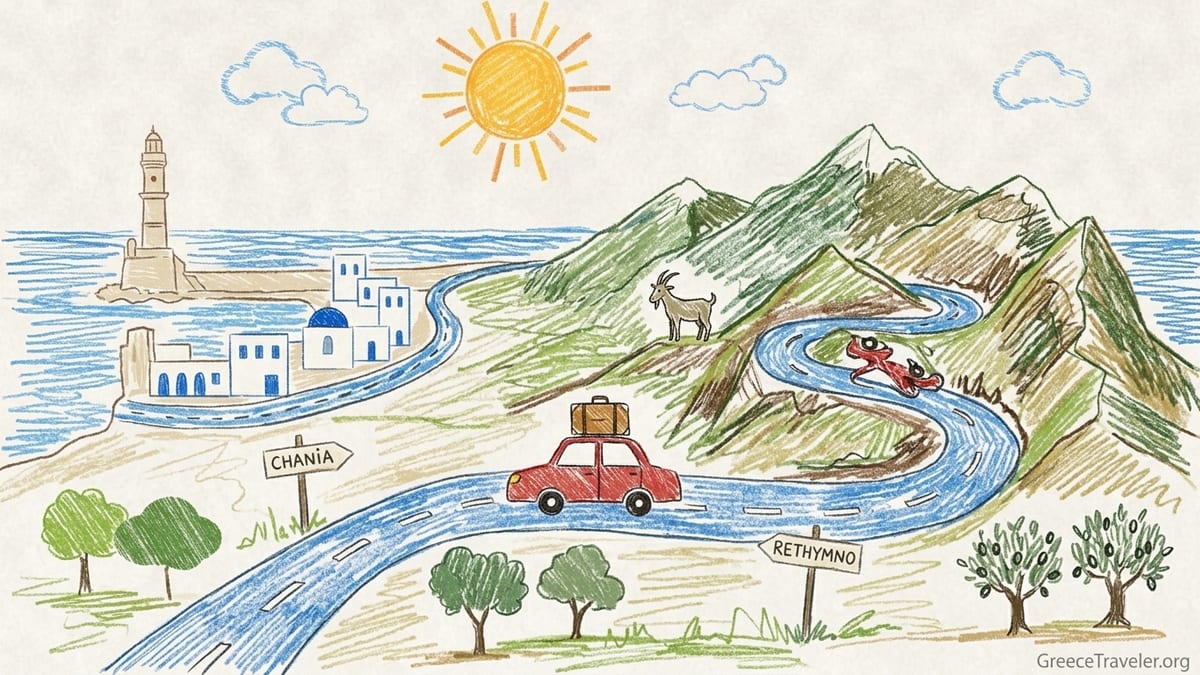
Understanding Crete’s Scale and Driving Reality
On paper, Crete is “just” Greece’s largest island. In real driving terms, the distances are longer than visitors expect. The main north coast highway, often referred to locally as VOAK, runs from Kissamos near Chania through Rethymno and Heraklion to Agios Nikolaos and beyond. On good sections it feels like a modern dual carriageway, yet there are still single-lane stretches, junctions that appear suddenly and slower traffic that can cut average speeds down to 60 to 80 kilometres per hour. A route that looks like an easy 90 minutes on your phone can, in high season, stretch closer to two hours once you factor in roadworks, trucks and coastal city traffic.
The bigger surprise is how quickly the character of the roads changes when you turn south. Within an hour of leaving the north coast you can be climbing more than 1,000 metres through tight hairpins, passing goats at the roadside and edging along gorges where there are few or no guardrails. For example, the drive from Chania to Chora Sfakion on the south coast is only about 70 kilometres, yet rental agencies routinely estimate around 90 minutes of careful driving. Similar timings apply when you cross from Rethymno to the south via Spili, or from Heraklion to the Libyan Sea near Matala. North to south often means one to two hours of concentrated mountain driving, even if the distance does not look dramatic.
Because of this, a true west to east crossing that bounces between both coasts in seven days is technically possible but rarely pleasant. Travellers who attempt it often report that they spent more time in the car than on beaches or in villages. A more realistic strategy is to accept that with one week you will cover either the west and centre, or the centre and east, while a full north coast arc from Chania to Agios Nikolaos with meaningful south coast detours belongs in the 10 to 14 day category.
This guide follows a practical west-to-east flow that matches most international flight patterns: starting in Chania, moving through Rethymno and Heraklion, and finishing in Agios Nikolaos or Elounda. At each step you will see where south coast side trips make sense and where it is smarter to stay focused on one region instead of criss-crossing mountains just to tick boxes.
One-way Car Rental, Hotel Changes and Trip Length
A key decision that shapes your Crete road trip is whether to book a one-way car rental. Many visitors now arrive in Chania Airport and depart from Heraklion, or vice versa, specifically to avoid backtracking across the island. Local firms based in Chania and Heraklion frequently offer one-way rentals where you collect the car at one airport or city office and drop it at another. The typical surcharge is often a modest flat fee on top of the daily rate rather than a huge penalty, which makes sense once you calculate the fuel, toll-free but time-consuming drive and extra day you would spend returning to your starting point.
For example, a couple planning to start with three nights in Chania’s Old Town, then drive east, visit Knossos and finish with two or three nights near Elounda will benefit from a one-way rental that begins in Chania and ends at Heraklion Airport. They can drop the car after visiting Knossos or Heraklion city, then use a taxi or hotel transfer for the final short hop if they prefer to relax without parking worries. Conversely, if your flights are in and out of the same airport and you are focusing on just the western or central part of the island, a standard return rental is usually cheaper and simpler.
The second structural decision is how often you change hotels. On a seven-day trip, switching beds every night quickly becomes exhausting, especially if you are parking inside old town zones with one-way alleys. A realistic approach is to choose a maximum of three bases. For a west-centre itinerary, that might mean three nights in Chania, two in Rethymno and two in or near Heraklion. If you are determined to include Agios Nikolaos or Elounda in a single week, you will be down to two nights in Chania, two in Heraklion and two on the far east, with one night absorbed by travel or a city stop.
As soon as you add serious south coast driving into the equation, ten days starts to feel more natural and 14 days becomes comfortable. With 10 to 14 days, you can keep the same west-to-east flow, but add extra nights in either Chania or Rethymno to allow for a Balos or Elafonissi day, and an additional base somewhere on the Libyan Sea coast, such as Plakias, Agia Galini or Matala. Instead of sprinting, you are building layovers that turn drives into day trips, which is exactly how Crete rewards patient travellers.
Chania Region: West Crete Base and Balos Realities
Chania city is the natural starting point for a western Crete road trip. The Venetian harbour, lighthouse and tight lanes of the Old Town provide the sort of atmosphere that makes many travellers glad they booked at least three nights. Crucially, Chania works as a base for exploring both the inland villages and some of the island’s most famous beaches without changing hotels. Popular choices include staying in the Old Town itself in a heritage townhouse or boutique hotel, or basing yourself in nearby Nea Chora or Kalamaki where modern seafront hotels offer simpler parking.
From Chania, the main north coast highway runs west toward Kissamos and the peninsula that hides Balos Lagoon. Balos is one of the most photographed beaches in Greece, but it now comes with restrictions and logistics that first-timers often underestimate. The famous dirt road from Kaliviani to the Balos parking area remains a rough track, with potholes, loose stones and exposed edges. Many local car rental contracts explicitly exclude damage on unpaved roads, and some firms tell customers that their insurance is void if they drive that stretch. In practical terms, visitors who do take rental cars along the track report slow progress, around 45 minutes for the final few kilometres, plus a small parking fee when the site is staffed in summer.
In recent seasons, environmental pressure from overcrowding has led to tighter controls, including limits on how close excursion boats may land and talk of further restrictions during peak months. A realistic planning assumption is that you should avoid counting on doorstep vehicle access or unlimited boat capacity at Balos in July and August. Instead, think of Balos as a full-day outing where you either book an organised boat trip from Kissamos or drive as far as the official car park if permitted, then hike down and back on a rocky path. Either option requires an early start from Chania, particularly if you are travelling with children or visiting in intense heat.
Chania also serves as a hub for easier days, from wine tasting in the hills around Vamos to relaxed beach time at Falassarna or Marathi. These trips still involve 45 to 90 minutes of driving in each direction, especially in high season, but they do not demand the same risk calculations as Balos. For nervous drivers or anyone renting a small city car, steering clear of the Balos dirt road altogether and choosing Falassarna’s wide sandy bay or Elafonissi’s lagoon instead can be a wise trade-off.
Rethymno as a Central Pivot and South Coast Gateway
Rethymno sits roughly halfway between Chania and Heraklion on the north coast highway and works beautifully as a two or three night pivot in a west-to-east itinerary. The compact Old Town has its own Venetian harbour and fortress, with a more low-key feel than Chania but enough tavernas and cafes to fill a couple of evenings. Many travellers choose to stay within walking distance of the harbour and accept that parking may involve a five to ten minute walk, using municipal lots on the edge of the centre. Others pick seafront hotels along the long town beach where on-site parking is more common.
Driving times between the three northern cities are shorter than people expect but still deserve buffer. Chania to Rethymno is usually quoted at about an hour on the main highway, while Rethymno to Heraklion typically takes 75 to 90 minutes, again depending on traffic and roadworks. These are not punishing drives, yet adding a fuel stop, a coffee at a roadside cafe and a quick supermarket run easily turns a simple transfer day into a relaxed half-day movement.
From a road trip perspective, Rethymno’s real strength is its access to the south coast. The drive from Rethymno to Plakias via the Kourtaliotiko Gorge is around 35 kilometres and often takes 45 minutes to an hour. The route passes through a dramatic gorge where the road clings to the side of the rock and viewpoints tempt you to pull over. Travellers often break the journey with a short walk to the river in the gorge before continuing to Plakias, which has a long, curving beach, a compact waterfront and easy parking in shoulder seasons. Nearby Preveli Beach, with its palm grove and river, is another popular outing; the final stretch involves smaller roads and, depending on your choice of car park, a hike down to the beach.
This is where the seven-day planning issue becomes clear. If, in a single week, you insist on three nights in Chania, two in Rethymno and two in Heraklion, then try to squeeze in Balos, Elafonissi and a full south coast day from Rethymno, you will spend multiple days driving two to three hours round-trip on top of sightseeing. A more realistic seven-day version would keep Chania and Rethymno as bases, include one major signature beach day and one south coast excursion, and leave the full eastern leg for another visit or for a longer 10 to 14 day crossing.
Heraklion, Knossos and When to Push On to Agios Nikolaos
Heraklion divides opinion as a city, but for a road trip it is essential. The port and airport make it a primary entry or exit point, and the archaeological site of Knossos is one of the island’s headline attractions. Many visitors who approach by car from Rethymno underestimate how busy both the city ring roads and Knossos can be in high season. A safe plan is to allow at least 90 minutes to drive from Rethymno to the outskirts of Heraklion, then another half hour to navigate local traffic and reach either your hotel or the Knossos parking area, especially in July and August.
Most travellers either stay one or two nights in central Heraklion or sleep just outside the city in beach suburbs like Amoudara, where larger hotels often provide on-site parking and easier access to the highway. If you plan to visit Knossos independently, an early start from your hotel, aiming to arrive when the site opens, can avoid the heaviest crowds and the midday heat. Some visitors choose to leave their car at a hotel and join a small-group tour that includes transfers, which removes parking stress and allows everyone in the group to sample wine or raki at lunch without worrying about the drive back.
The key decision at this stage of a west-to-east road trip is whether to end your journey near Heraklion or to continue to Agios Nikolaos or Elounda. The drive from Heraklion to Agios Nikolaos on the improved north coast highway is around 70 kilometres and usually takes about an hour. While the scenery becomes more rugged and dramatic east of Heraklion, the road itself is a main artery and less demanding than the mountain routes to the south coast. If you have at least ten days in total, pushing on to spend two or three nights in Agios Nikolaos or Elounda can be deeply rewarding, giving you time to explore the Mirabello Gulf, the former leper island of Spinalonga by boat and the quieter eastern beaches.
In a tight seven-day itinerary, extending to Agios Nikolaos only really makes sense if you trim nights elsewhere and accept that you will not explore the western south coast in the same trip. For instance, two nights in Chania, one in Rethymno, two in Heraklion and two in Agios Nikolaos is technically workable but leaves you with little unstructured time in each place. If your main interests are history and relaxed seaside evenings rather than ticking off every famous beach, this can still be a smart choice, especially if you are using a one-way rental and flying home from Heraklion after dropping the car in Agios Nikolaos or at the airport.
South Coast Detours: Libyan Sea, Mountain Roads and Parking
The south coast of Crete, looking over the Libyan Sea, feels like a different island. Places such as Chora Sfakion, Loutro, Plakias, Agia Galini and Matala are less developed than the big northern resorts and require more effort to reach. The pay-off is a sense of remoteness and wild scenery that many travellers remember long after the trip. The price is the driving. Routes such as Chania to Chora Sfakion, Rethymno to Plakias, or Heraklion to Matala involve sustained climbs, descents through hairpins and the real possibility of meeting oncoming buses or trucks on narrow sections.
These roads are not inherently dangerous if you drive within your comfort zone, but they are tiring and can be intimidating for nervous drivers. It is common to average 40 to 50 kilometres per hour or even less on the steeper stretches. Rental companies and local guides often advise simple techniques: use low gears for descents, avoid riding the brakes continuously, pull over in safe lay-bys to allow faster traffic to pass and never trust every instruction from navigation apps if they suggest tiny mountain shortcuts. If a sat nav tries to divert you off the main signposted road onto what looks like a narrow concrete lane climbing between olive terraces, ignoring it is usually the right call.
Parking logistics also change on the south coast. In compact places such as Chora Sfakion, the village waterfront has limited on-street spaces and a couple of pay-and-display lots that fill quickly when ferries arrive or depart. In Plakias and Agia Galini, visitors often park on the edge of the village and walk in, particularly in August when narrow waterfront streets are busy with pedestrians. At popular beaches such as Preveli or the coves near Agios Pavlos, the final approach may be an unpaved spur road where your rental contract does not cover damage. Many experienced drivers simply stop where the surfaced road ends, park considerately, and walk the final stretch rather than risk a puncture or scraped undercarriage.
This is where trip length matters again. With only seven days on Crete, diverting to the south coast from both the Chania area and the Rethymno or Heraklion region will leave you with very long driving days. A more balanced plan is to choose one south coast focus per trip. For western itineraries, that might mean using Chania as a base and dedicating a day or overnight to the Chora Sfakion and Loutro area, or combining Rethymno with a couple of nights in Plakias. For central itineraries, Matala and the surrounding coast can be the target. With 10 to 14 days you can weave two or even three south coast bases into a gentle loop, but you will still need to respect driving times and keep days flexible for weather, especially when wind and swell affect small-boat services.
Making 7 Days Work vs Planning a 10–14 Day Crossing
With all these variables, how do you turn abstract advice into a realistic plan? For a first visit of seven days, the most satisfying road trips tend to concentrate on either the west and centre, or the centre and east, without trying to cover everything. A west-centre example could be three nights in Chania, two in Rethymno and two in or near Heraklion. From Chania you might choose one major excursion day to either Balos by boat from Kissamos or to Elafonissi by road, plus a gentler day exploring nearby beaches and villages. From Rethymno you could dip into the south via Plakias or Preveli, then move on to Heraklion for Knossos and a museum visit before flying home.
A centre-east seven-day plan might skip Chania entirely and begin in Heraklion. You could stay three nights between Heraklion and nearby beach suburbs to see Knossos and explore the wine country south of the city, then drive east for four nights in Agios Nikolaos or Elounda. From there, day trips might include a boat tour to Spinalonga, a drive to the hill village of Kritsa and a beach day on the quieter eastern coast. In both versions, you are accepting that Balos, Elafonissi and the wilder south-west will wait for another trip, but you gain slower mornings, long lunches and evenings where you are not constantly packing or hunting for parking.
Once you extend your stay to 10 days, a full west-to-east arc becomes genuinely attractive. One workable pattern is three nights in Chania, two in Rethymno, two in Heraklion and three in Agios Nikolaos or Elounda, using a one-way car rental that you pick up in Chania and drop at Heraklion or Agios Nikolaos. This gives you enough slack to schedule one demanding beach day from Chania, one south coast day from Rethymno and still arrive in the east with time to relax. At 14 days, you gain the freedom to add a standalone south coast base such as Plakias or Matala for two or three nights, or to spend more time in the mountains around Anogeia or the Lassithi Plateau.
However long you stay, the most important shift is mental. Instead of viewing Crete as a checklist of famous spots that must all be squeezed into one trip, treat it as a place you might return to. When you plan that way, the island’s size stops being a problem and becomes what it really is: a reason to slow down. A carefully chosen sequence of three or four bases, linked by realistic drives and supported by a one-way rental where it makes sense, will leave you with the kind of memories that no Instagram highlight reel can capture.
The Takeaway
Crete is not a quick coastal spin. It is a long, mountainous island where a line on the map from Chania to Agios Nikolaos represents a full day’s travel once you add stops and slow sections, and where jumping from the north to the south coast eats another hour or two each time. That does not mean you should avoid a road trip. It means you should design it with the island’s true scale in mind.
For a seven-day holiday, the most rewarding approach is to choose either the west and centre or the centre and east, limit yourself to two or three hotel bases and accept that some postcard beaches will wait for next time. One-way rentals can save you from backtracking when your flights allow, but they are not essential if you keep your radius modest. When you have 10 to 14 days, a full west-to-east arc with south coast detours becomes realistic, provided you still build in rest days and avoid chasing every famous name.
If you remember nothing else, remember this: on Crete, time spent lingering in a mountain taverna or a half-empty cove is never wasted, but time spent racing the sunset along a gorge because you over-planned your day often is. Let the island’s size slow you down, and your road trip will feel less like a race and more like the Cretan welcome that so many travellers fall in love with.
FAQ
Q1. Is a seven-day Crete road trip enough to drive from Chania to Agios Nikolaos?
Seven days is technically enough to drive from Chania to Agios Nikolaos, but it leaves very little time to explore. In most cases it is wiser to focus on either the west and centre, or the centre and east, and save a full island crossing with south coast detours for a 10 to 14 day trip.
Q2. Do I really need a one-way car rental for a west-to-east Crete itinerary?
No, but a one-way rental can be practical. If you are arriving in Chania and flying out of Heraklion, for example, picking up the car in Chania and dropping it near Heraklion saves a full day of backtracking and the extra fuel. If your flights are in and out of the same airport and your route is compact, a standard round-trip rental is usually fine.
Q3. How difficult are the mountain roads on the way to the south coast?
The main south coast routes are well-paved but steep and winding, with hairpin bends, occasional narrow sections and sometimes no guardrails. They are manageable for most drivers who take their time, use lower gears on descents and pull over safely to let faster traffic pass. Nervous drivers should avoid very tight schedules and aim to drive these roads in daylight and good weather.
Q4. What is the safest way to visit Balos Lagoon from Chania?
The safest option for most travellers is to drive to the port of Kissamos on surfaced roads, park in town and take an organised boat excursion to Balos if services are running. Driving the rough dirt track from Kaliviani to the Balos parking area may be discouraged or excluded by some rental contracts, and conditions can change, so it is important to read your rental terms carefully and avoid the track if damage on unpaved roads is not covered.
Q5. How many hotel bases should I plan for a one-week trip?
For a seven-day trip, two or three bases is usually ideal. For example, you might split time between Chania and Rethymno, or between Heraklion and Agios Nikolaos. Changing hotels every night often leads to fatigue and reduces the time you spend actually experiencing each place.
Q6. What are realistic driving times between Chania, Rethymno, Heraklion and Agios Nikolaos?
On the main north coast highway, Chania to Rethymno typically takes about an hour, Rethymno to Heraklion around 75 to 90 minutes and Heraklion to Agios Nikolaos roughly an hour. These times can lengthen in high season because of traffic, temporary roadworks and city congestion near each end.
Q7. Is it worth adding the south coast if I only have seven days?
Yes, if you choose carefully. With a week, it is usually best to include one south coast area, such as Plakias from Rethymno or Matala from Heraklion, rather than trying to visit several different south coast villages. This keeps driving days manageable and allows at least one full day by the Libyan Sea instead of a rushed photo stop.
Q8. Can I rely on navigation apps for driving in Crete?
Navigation apps are helpful for general guidance but can sometimes suggest very narrow or poorly maintained mountain shortcuts that locals would avoid. It is wise to follow the main signposted roads between major towns, ignore detours that send you onto tiny lanes and always cross-check the route with a paper map or offline map when you are unsure.
Q9. Is parking difficult in Chania, Rethymno and Heraklion?
Parking can be challenging close to the historic centres, especially in July and August. A common strategy is to choose accommodations with on-site or nearby parking, or to use municipal lots on the edge of the Old Towns and walk in. In Heraklion, staying slightly outside the core or in beach suburbs with hotel parking can simplify both arrival and departure.
Q10. When does a 10 to 14 day Crete trip make more sense than a week?
A 10 to 14 day trip is ideal if you want to drive from Chania to Agios Nikolaos, spend time in at least one or two south coast bases and still enjoy slow days without long drives. The extra days allow you to build in genuine rest days, respond to weather changes and explore smaller mountain villages without worrying about making it to the next city before dark.